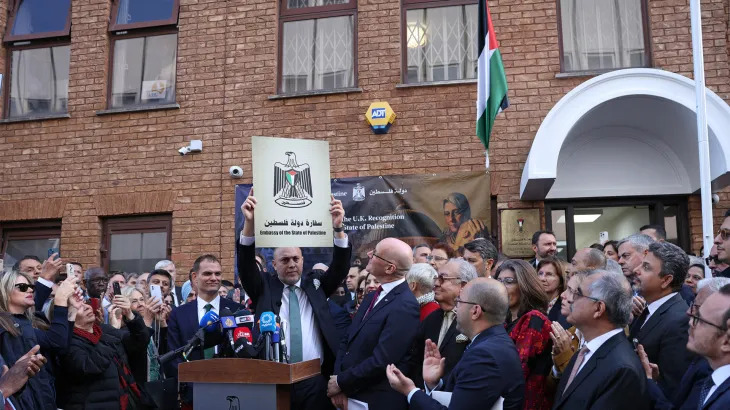
The Embassy of the State of Palestine was formally inaugurated in west London, marking a significant diplomatic milestone following the United Kingdom’s recognition of Palestine as a sovereign state.
The embassy, located in Hammersmith, replaces the former Palestinian Mission to the UK and now holds full diplomatic status and privileges.
Palestinian Ambassador to the UK Husam Zomlot described the opening as a historic turning point, not only for British-Palestinian relations but for Palestinians worldwide who have long sought international acknowledgment of their statehood.
“We gather today to mark a historic moment,” Zomlot said during the ceremony.
“The inauguration of the embassy of the State of Palestine to the United Kingdom — with full diplomatic status and privileges — is a symbol of our people’s inalienable right to sovereign statehood and equality among nations.”
The unveiling of the embassy plaque and the raising of the Palestinian flag underscored what Zomlot called the outcome of a struggle spanning more than a century.
“For generations of Palestinians in Gaza, the occupied West Bank, including east Jerusalem, and across the diaspora, this embassy represents proof that our identity cannot be denied, our presence cannot be erased and our lives cannot be devalued,” he said.
British officials attending the ceremony echoed the significance of the event, calling it an important step toward deepening bilateral relations and formal engagement between the UK and Palestine.
Recognition amid shifting global attitudes
The embassy’s opening follows the UK’s formal recognition of the State of Palestine in September, based on the 1967 borders to be finalized through future negotiations.
The recognition acknowledged Palestine’s legal rights and obligations under international law and came amid intensifying global debate over the future of Gaza and the viability of a two-state solution.
Britain’s move aligns with a growing number of countries that have taken firmer diplomatic stances on Palestinian statehood in recent years.
Several European nations — including Ireland, Spain, Norway and Slovenia — have formally recognized Palestine, arguing that recognition is necessary to preserve prospects for peace and accountability.
France has also moved toward recognition, framing it as part of a broader effort to stabilize the region and advance long-term political solutions.
Beyond Europe, many countries across Latin America, Africa and Asia have reaffirmed or strengthened diplomatic ties with Palestine, signaling widening international support for Palestinian self-determination.
Diplomats say the London embassy represents not only a bilateral shift but a reflection of changing global attitudes toward the Palestinian question.
A voice for Palestinians — and the next generation
The inauguration ceremony also highlighted the human dimension behind diplomatic progress. Obaidah, a 14-year-old Palestinian from Gaza, addressed attendees with a message that resonated beyond politics.
“I survived the genocide, but my body carries deep wounds,” he said, describing how parts of his family now live in the UK while his father remains in Gaza, where daily life is still shaped by fear and uncertainty.
Obaidah said the embassy represents more than recognition. “It is a place where our people are seen, where our voices are heard and where our hope for justice and dignity lives,” he said.
Looking ahead
Zomlot reaffirmed Palestine’s commitment to a just and lasting peace, calling for an end to Israeli occupation, respect for international law and the fulfillment of the rights of Palestinian refugees.
For Palestinians living in Britain, the embassy’s opening provides both symbolic affirmation and practical representation — a permanent diplomatic presence reflecting a growing international consensus that Palestinian statehood can no longer remain aspirational.