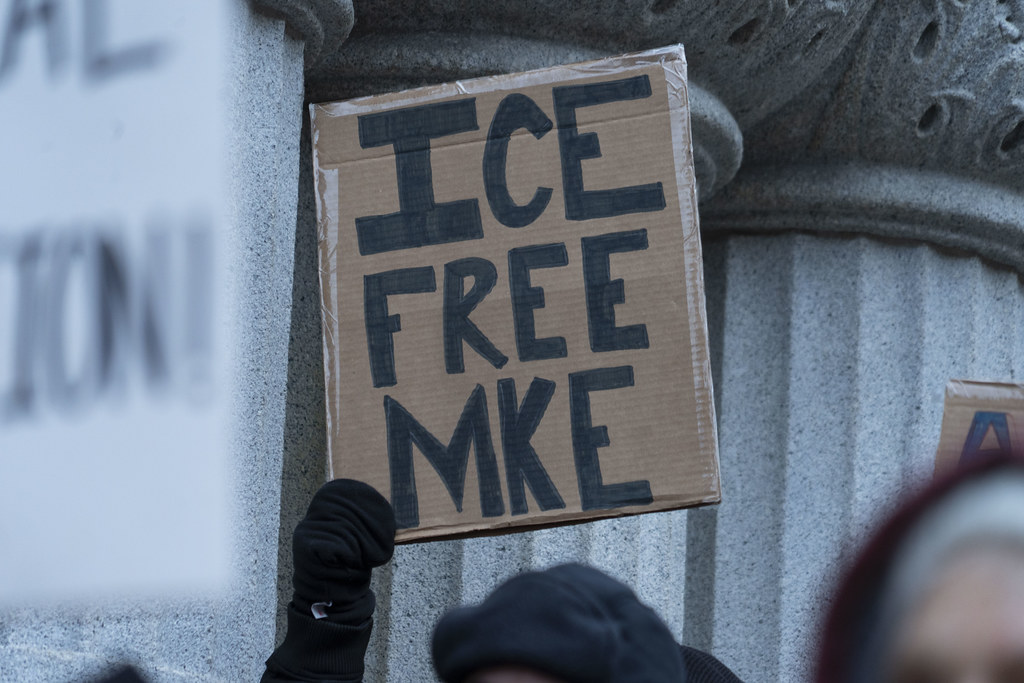
Photos by Joe Brusky
Muslim immigrants and allies are invited to a community forum Thursday to learn how to respond to ICE (federal Immigration and Customs Enforcement officers).
The Community Defense Network, a project with roots in Wisconsin’s Latino community that aims to keep immigrants safe during ICE raids, has invited Milwaukee’s Muslim community to join its team.
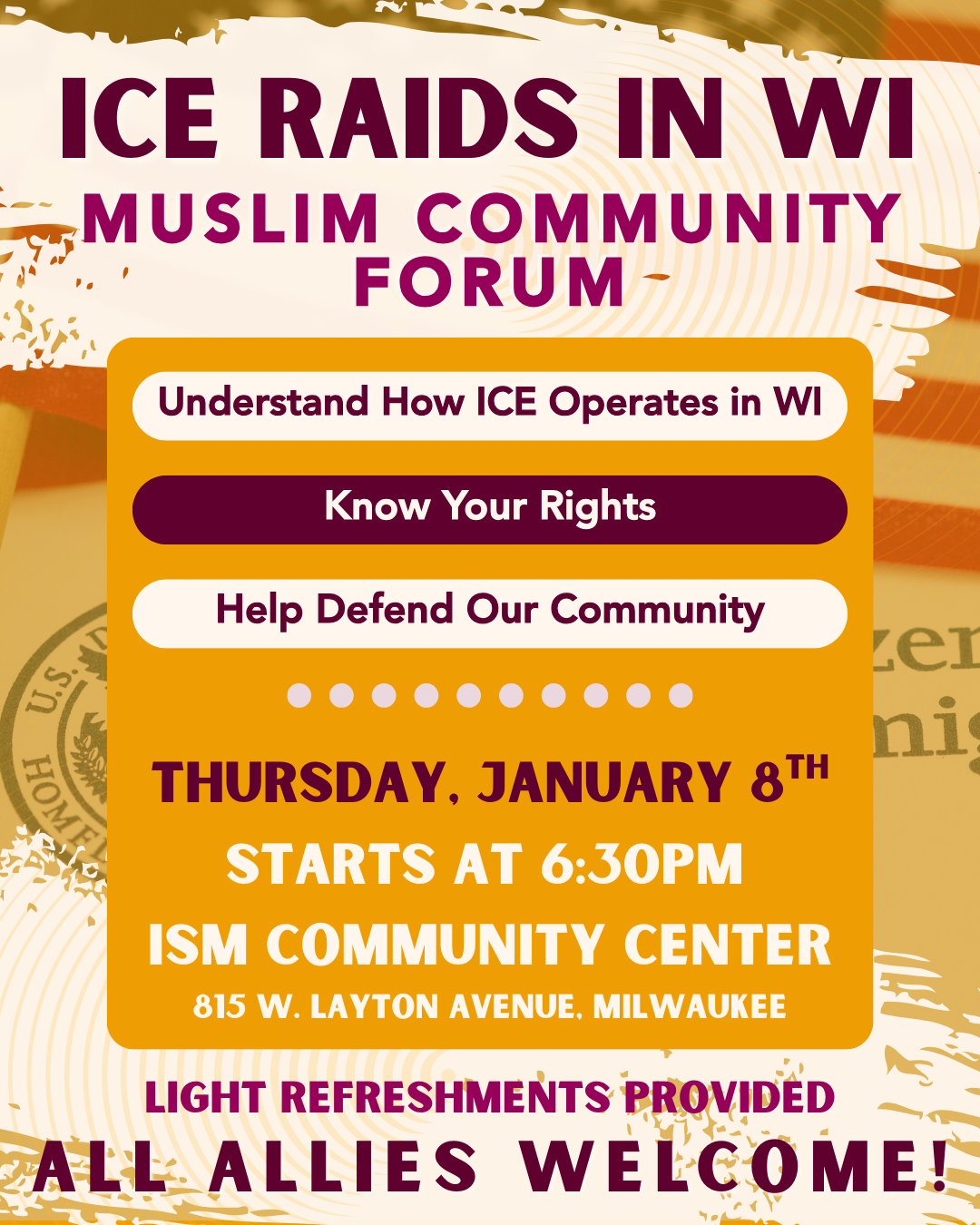
A Muslim Community Forum will be held at 6:30 p.m. at the Islamic Society of Milwaukee Community Center, 815 W. Layton Ave., Milwaukee, to introduce the CDN and explain how immigrants and allies can participate.
Connecting with the Community Defense Network
When President Donald Trump began his second term in January 2025, a young adult immigrant group, Comité Sín Fronteras, launched the Community Defense Network to prepare to keep immigrants safe, CSF founder Fernanda Jimenez explained in an interview Sunday with the Wisconsin Muslim Journal. CSF is part of Voces de la Frontera, Wisconsin’s leading immigrant rights organization.
“We are seeing not just undocumented immigrants but all immigrants are being targeted,” Jimenez said. “They started with people with deportation orders or some type of history. Now it is quite different. They take people from the workplace. They are impacting families. We need to be able to help these immigrants as soon as possible.”
The Voces de la Frontera hotline receives about 600 calls a month with reports of what observers expect is ICE activity in Wisconsin, Jimenez said.
“We started this statewide network, the Community Defense Network, to train people on how to watch for and identify ICE (U.S. Immigration and Customs Enforcement) and how to respond. The Network has really been strong in Milwaukee.”
ICE not only confronts members of the Latino community, she noted. “We want to introduce the Muslim community to what we have been doing to help immigrants be safe. We want to bring it to all of our immigrant communities, not just work in silos.”
A member of Jewish Voice for Peace introduced Jimenez to MWC founder Janan Najeeb. Najeeb arranged a meeting between Jimenez and leaders of the ISM, the Muslim’s Women’s Coalition and the Islamic Dawah Center of Milwaukee. Its purpose was to propose collaboration those Muslim organizations with the CSF, she said.
“Those hit hardest (by ICE raids) have been in the Latino community,” MWC founder Janan Najeeb told WMJ. “But the Muslim community has also been hit. We’ve heard of instances where individuals have been picked up, but their family members have not spoken publicly due to concerns about the safety of their loved ones.”
“With folks being terrorized and abductions happening, it is important there is a response, that these things don’t happen in isolation,” said CSF Wisconsin statewide organizer Elliott Magers. “Accompanying a family is important, even when we can’t prevent something from happening to them.”
“We’ve also heard of ICE agents floating around the neighborhoods near the Dawah Center because of their significant African community, including immigrants from Somalia, Nigeria and other African countries.
“We’ve heard of some Muslim individuals from a variety of countries being held, particularly in the past four months,” she continued. “Many are here without family and nobody even knows they’re being held. That’s why we want to be prepared.”
What’s special about the Community Defense Network’s trainings “is that they’re not your run-of-the-mill know-your-rights meetings, which are widely available now, online and everywhere,” Najeeb said. “The idea here is to create a number of rapid response groups that will monitor and inform others about any potential ICE activity at any center or near anyone’s home. These teams have been successfully implemented in the Latino community and are now expanding to also include the Muslim community.”
By October, about 2,000 people in Wisconsin had completed ICE verifier training, with about 700 of them in southeastern Wisconsin, Jimenez said. There are CDN volunteers around the state, in Racine, Milwaukee, Madison, Green Bay, Arcadia and other locations, she said.
Yet, “there haven’t been enough resources directed to our Muslim and Arab communities,” Jimenez said. “There have not been enough connections with us. We want all of us to feel confident in being able to defend all of our immigrant communities.”
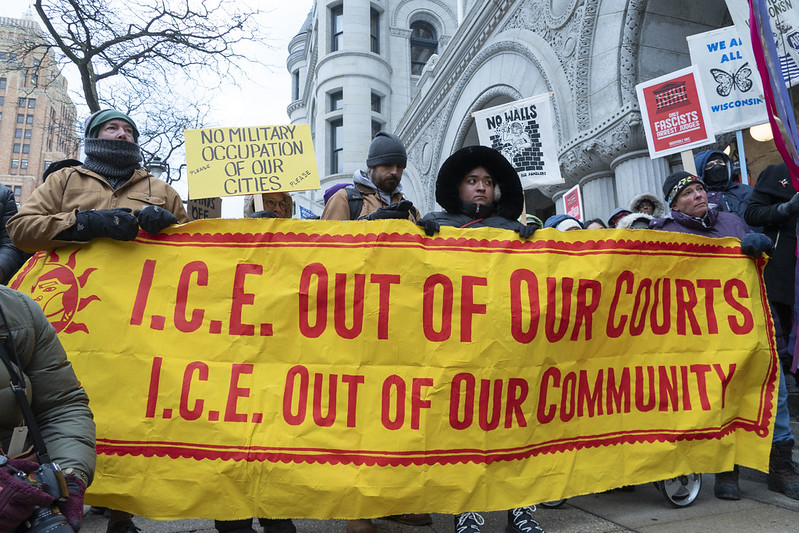
A coalition of labor, immigrant rights and faith organizations protested in December in front of the Milwaukee County Courthouse, where ICE agents have pursued undocumented immigrants.
What will happen at the forum
Thursday’s forum will provide an overview ICE activity seen in southeastern Wisconsin and explain how rapid response can prevent harm, Jimenez explained. It will include a discussion of legal rights, and the role of the rapid response teams and how they operate.
“This will be the first of multiple sessions. We encourage people who feel they are in a safe position, like citizens who were born here, to become part of this rapid response,” Jimenez added. “We also hope to find volunteers who can translate the information into the many languages in our immigrant communities.
“There will be an opportunity for folks to sign up to help us and participate in trainings in the next few months,” Jimenez said. Two ICE-verifier trainings will be held in January: Saturday, Jan. 17, 3 – 5 p.m., at the Milwaukee Islamic Dawah Center, 5135 N. Teutonia Ave., Milwaukee, and Sunday, Jan. 18, 2-4 p.m., at the Islamic Resource Center, 5233 S. 27th St., Milwaukee.
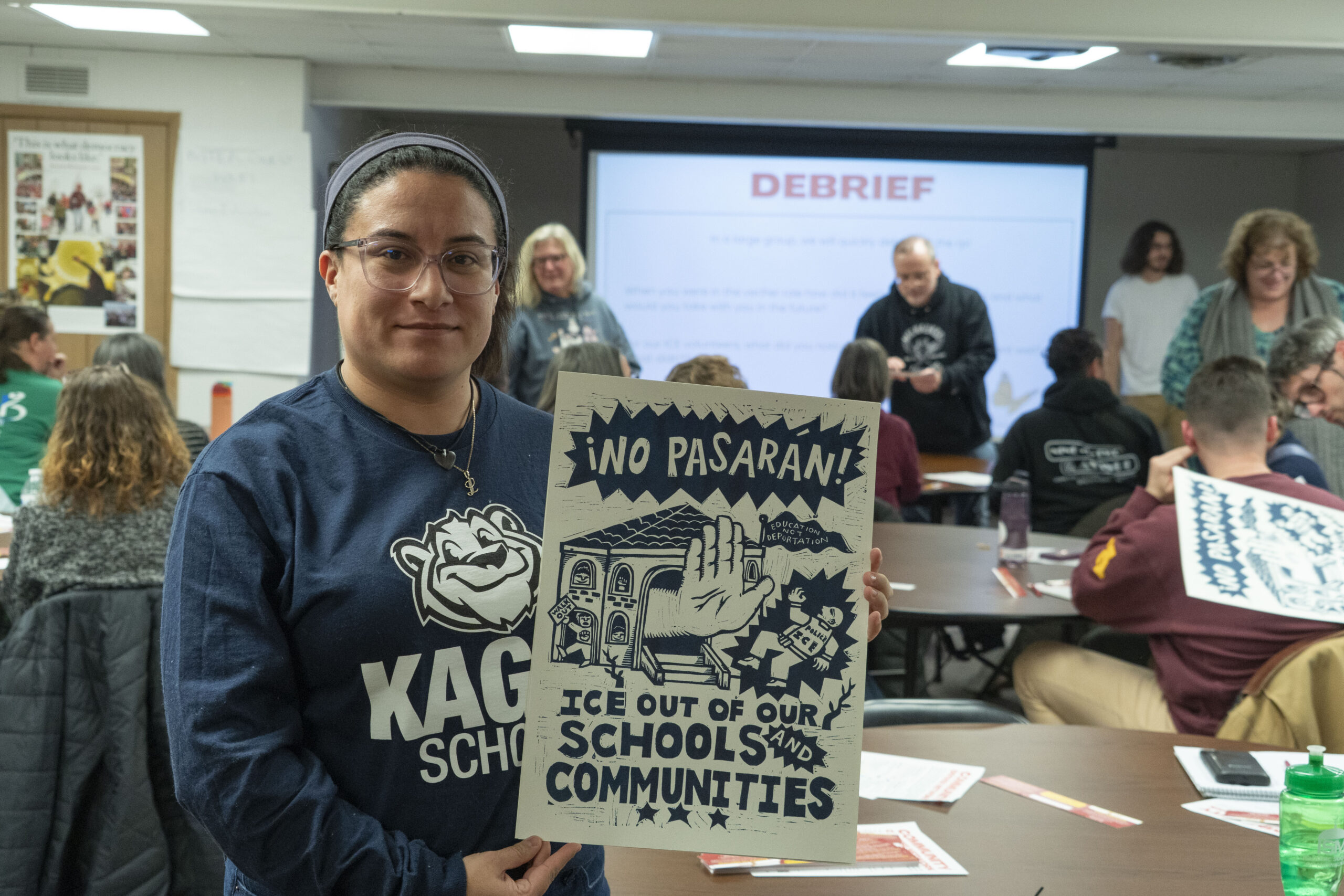
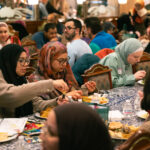
Milwaukee Teachers Education Association, along with Voces de la Frontera and the Comité Sin Fronteras, hosted an ICE Verifier Training.
The trainings are for both immigrants and allies, Jimenez explained. “We want to include people who are not as vulnerable, who can ask questions to federal agents. A lot of allies have taken the training.
“For immigrants, whether they are undocumented or have a protective status, they learn important information they need to know. It gives them a protocol of what to do if they are being detained or if agents are knocking at their door.”
Jimenez said future trainings will be announced as they are scheduled. There are usually one or two a month, she added.