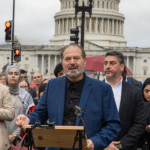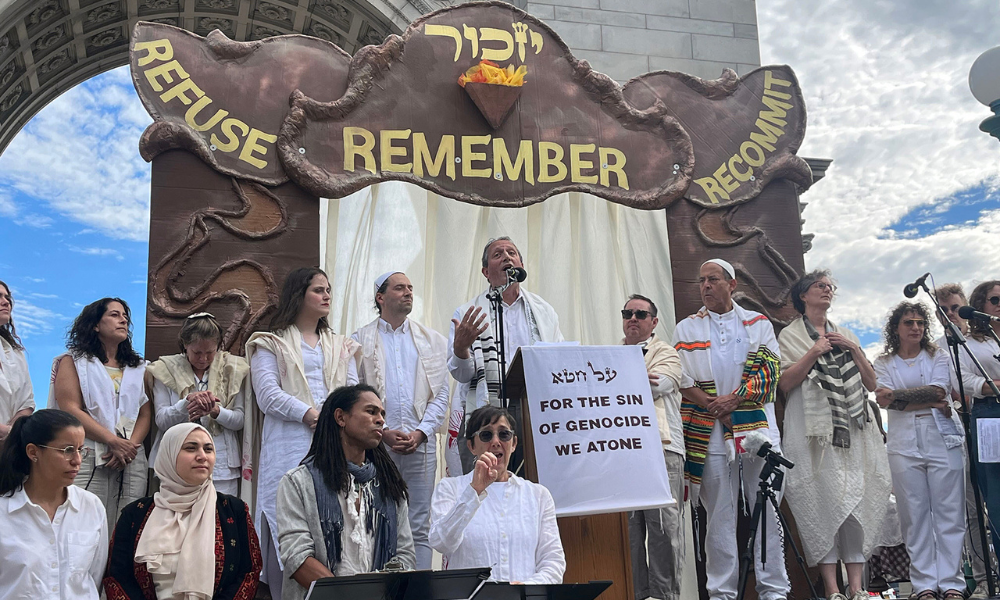
Brad Lander speaks during a Yom Kippur service at Grand Army Plaza, Monday, Sept. 21, 2026, in Brooklyn, N.Y. (RNS photo/Fiona André)
NEW YORK (RNS) — Hundreds of Jewish New Yorkers marked Yom Kippur, the Jewish Day of Atonement, on Monday (Sept. 21) with a mourning ritual memorializing Palestinians killed in the Israel-Hamas war. A few days before Israeli Prime Minister Benjamin Netanyahu’s highly anticipated visit for the U.N. General Assembly, the gathering also served to denounce how the Israeli government has handled the war.
Brad Lander, a New York Democratic nominee for Congress, who is Jewish, addressed the crowd gathered at Brooklyn’s Grand Army Plaza by denouncing Netanyahu’s visit and what he described as a “genocide” happening in Gaza.
He said he belonged to a group of Jews “who say no to ethnic cleansing, who say no to human-made famine, who say no to the use of U.S. tax dollars to bomb entire families, who say no to war criminals in our city this holy week or any week.”
In the city that’s home to the largest Jewish population in the U.S., Netanyahu’s visit has prompted divides — especially after Mayor Zohran Mamdani, a staunch Israel critic, in July reignited the debate over Netanyahu’s visit to the U.S. despite the International Criminal Court’s efforts to arrest him for what it deemed were war crimes committed in Gaza. The mayor called Netanyahu a “war criminal” but backtracked on his campaign promise of arresting him, citing the city’s lack of legal authority — which Netanyahu dismissed as comments “fomenting hate” and fueling antisemitism.
Netanyahu’s visit is expected to prompt a number of protests, which the mayor encouraged New Yorkers to participate in over the summer. However, according to The Forward, last week he said he “never encouraged them to protest,” but said they “have the right to do so in the city.” Last week, a group of Modern Orthodox Jewish teens protested the mayor’s stance on Israel in front of the mayor’s residence at Gracie Mansion. Showcasing their support for the Jewish state, the teens prayed with tefillin, the black leather threads attached to boxes containing Torah verses worn by observant Jewish men during prayers.
Now in its third year, the public remembrance service has become a space for Jewish New Yorkers opposed to the war in Gaza to voice their criticism and lament the devastation caused by the conflict. It was organized by Jews For Racial & Economic Justice, a left-wing Jewish organization of which Lander is a member, and Rabbis for Ceasefire, a collective of 450 Jewish faith leaders demanding an end to the war. The demonstration was co-sponsored by Jewish Voice for Peace, IfNotNow and the American Council for Judaism.
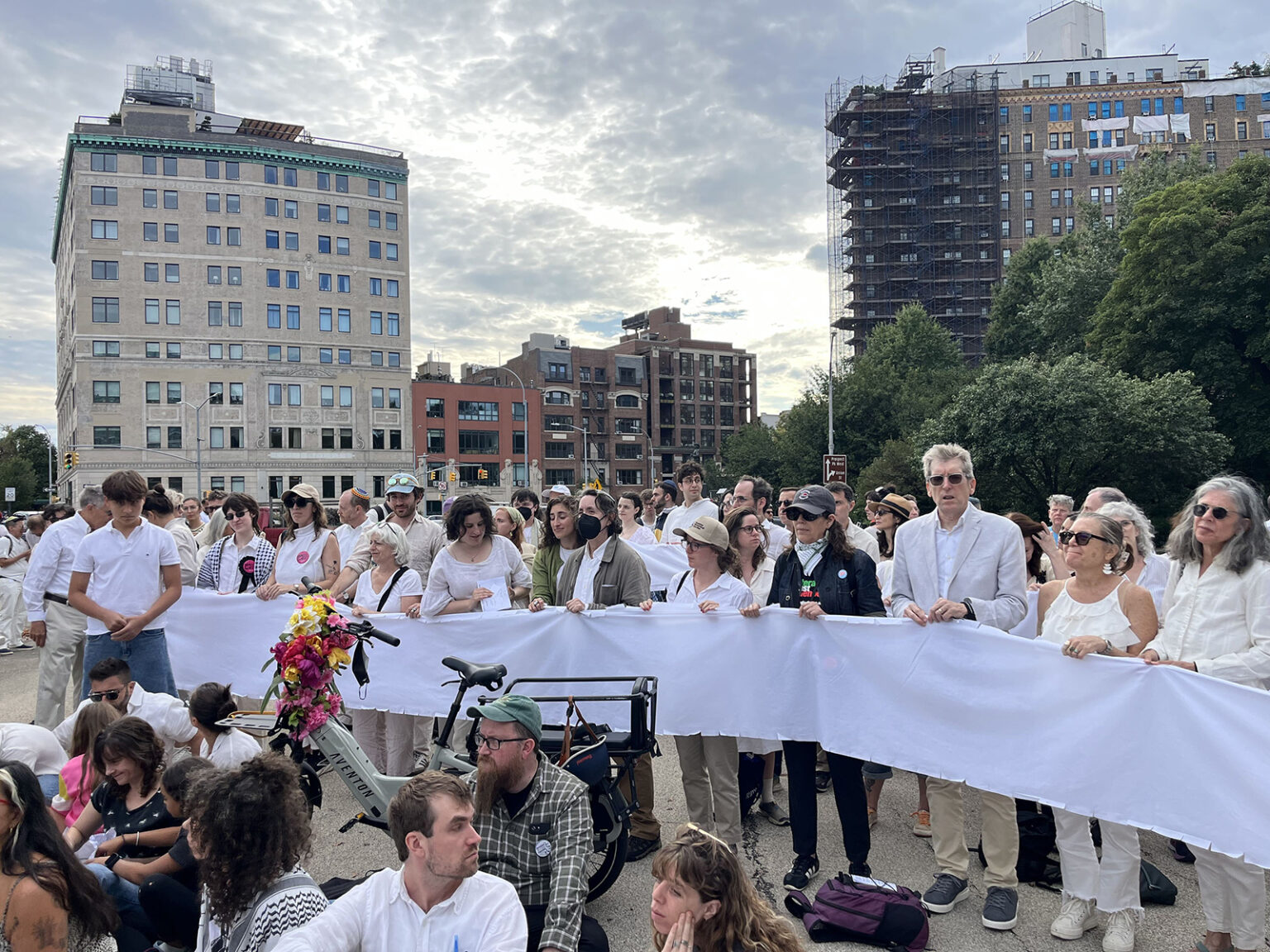
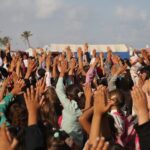
People attend a Yom Kippur service at Grand Army Plaza, Monday, Sept. 21, 2026, in Brooklyn, N.Y. (RNS photo/Fiona André)
Mahmoud Khalil, a Palestinian activist who was detained by U.S. Immigration and Customs Enforcement in 2025, told the crowd that repentance is challenging when “our tax dollars, our votes are being used to kill, to maim, to displace Palestinians, to displace Lebanese, to bomb Iranians and just really to forget that we are all humans.”
A Columbia University graduate, Khalil was detained after his green card was revoked over his role in the pro-Palestinian encampments that took over the New York campus in 2024. Now facing deportation, Khalil is suing the Trump administration and Columbia.
Monday’s gathering followed the steps of a traditional Yizkor ritual, or a Jewish memorial prayer service performed for the deceased. The memorial prayer service is usually recited during Yom Kippur, which started at sundown on Sunday and will end Monday evening. Led by Rabbi Ellen Lippmann and Rabbi Sam Kates-Goldman of Kolot Chayeinu, a progressive Jewish congregation in Brooklyn, the service featured prayers, chants and a calling of the names of Palestinians killed in Gaza.
In the crowd, attendees wore white T-shirts to signify their grief, and some also brought keffiyeh, a traditional Palestinian scarf seen by some as a symbol of Palestinian resistance. In front of the stage, where an arch reading “Refuse, Remember, Recommit” stood, organizers held an orange banner reading “Not another bomb.”
The group performed a Kriah ritual, a step of the Jewish burial process that consists of shredding a piece of garment or fabric to express grief and anger at the loss of a life. Attendees held a long banner of white shroud that they tore before tying the pieces to their chests.
Rabbi Abby Stein of Kolot Chayeinu led the crowd in prayers. “Let us make a new commitment. Let our grief not be in vain. … Let this reckoning change our actions for the sake of repair,” she said, before calling the crowd to commit to “boycott, protest, march, organize, lobby and vote in the name of life.” Stein, who is also an activist for trans rights, urged attendees to oppose U.S. military aid to Israel and advocate for a “permanent, real ceasefire.”
According to Pew Research Center, 42% of Jewish Americans under age 35 say they believe Israel’s way of carrying out the war has been unacceptable, yet 68% of Jews 50 and older think Israel’s conduct has been acceptable, pointing to a generational divide.
As they closed the ceremony, attendees walked in procession to Grand Army Plaza’s Bailey Fountain, where they affixed memorial cards with the names of Palestinians killed in the war to the limestones. More than 73,377 Palestinians have been killed in the war as of last month, according to the Gaza Health Ministry.
The event also drew Democratic nominees for New York state government, including pro-Palestinian activist Aber Kawas, who is running for state Senate. Other attendees included New York City Council members Shahana Hanif and Alexa Avilés, both who represent parts of Brooklyn; and Diana Moreno, who took over Mamdani’s former New York State Assembly seat with his endorsement.
This story was updated in paragraph 6 to correct that Rabbis for Ceasefire counts 450 members and not 80.