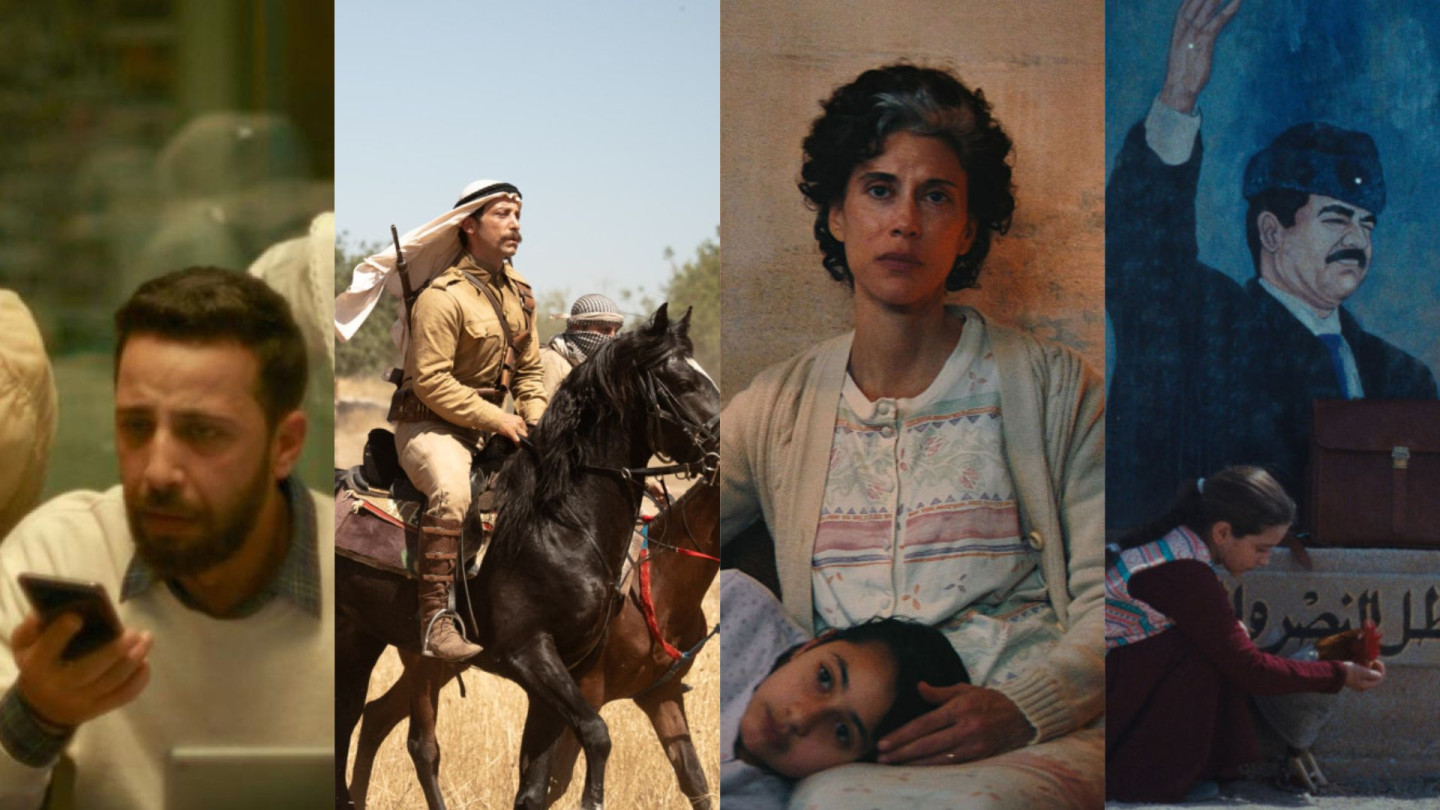
The 2026 Oscars are an unprecedented milestone for Arab cinema, with four films being shortlisted for the Best International Feature Film category. This is the highest number of Arab films to ever make this stage. Out of 86 submissions from countries around the world, only 15 were selected, four of which were from Arab directors.
The shortlist, announced in mid-December ahead of the official nominations on 22 January 2026, reflects a long history of artistic achievement that is only now coming to the Western forefront due to surging, and long overdue, support for Palestinian and Arab storytelling — as well as the rise of a new generation of film labels.
Of the four Arab films shortlisted, three focus on Palestine. There is The Voice of Hind Rajab, directed by Tunisian filmmaker Kaouther Ben Hania, which blends documentary with dramatisation to capture the killing of six-year-old Hind by the Israeli occupation forces.

Palestine 36, a historical epic by Palestinian director Annemarie Jacir, revisits the 1936–39 Arab revolt against British colonial rule, reclaiming a chapter of history often overlooked.
And thirdly, All That’s Left of You, directed and written by Palestinian-American director Cherien Dabis, follows a Palestinian family over decades of displacement and memory, exploring the long, ongoing violence of the Nakba on everyday life.
Meanwhile, the fourth Arab film to be shortlisted is The President’s Cake, by director Hasan Hadi, offering a glimpse of 1990s Iraq under crippling Western sanctions and Saddam Hussein’s regime.
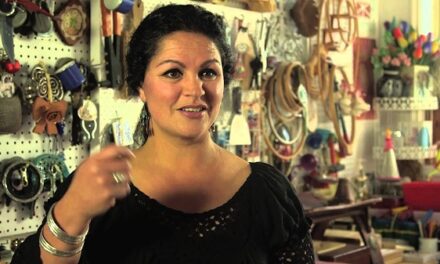
“Filmmakers like Annemarie Jacir, Kaouther Ben Hania and I have been doing this for a very long time, [so that’s nothing new],” Cherien Dabis tells The New Arab.
“[So what’s changed is that the] Academy has spoken. It’s clear that people want to support Palestinian voices and understand they’re being censored. This is a long time coming. It gives me hope knowing that waves of humanity are waking up and speaking up for Palestine, pressuring governments to end the violence and genocide.”
While the Oscars shortlisting is a remarkable achievement for Arab cinema, it remains to be seen how far these works will go in the official nominations on 22 January.
In a scenario where none of the four films make the five official nominations for the Best International Feature Film category, questions may be raised about the Academy’s positionality.
Support from Oscars, however, is just part of the story.
Cherien also praises the new players in the film industry who are playing an important role in supporting Arab films.
“It’s very exciting that companies like Watermelon Pictures and Willa are championing Arab cinema. Unlike the mainstream distributors, they don’t see supporting Palestinian films as ‘taking a risk’. Instead, they’re celebrating and honouring our stories, and allowing them to get out into the world,” Cherien adds.
“Watermelon Pictures saw that there was a major gap in the marketplace, and that major distributors and streamers were all-out rejecting Palestinian stories — which is the result of systemic racism that I’ve experienced in this industry for two decades.”
Of the four Arab films to be shortlisted, only the Iraqi entry found a major mainstream distributor in Sony Pictures Classics, a reflection of the film’s quality and, more importantly, the fact that its subject matter is more palatable to the US film industry, which remains too cowardly to endorse cinema about Palestine.
As such, new players such as Palestinian-owned film label Watermelon Pictures have stepped up to support all three Palestine-focused films that have been shortlisted, while the independent US-founded production company Willa is also involved in The Voice of Hind Rajab.
This is the second consecutive year that Watermelon Pictures has supported films shortlisted for the Oscars, despite being founded just two years ago.
Last year saw a series of successful releases, including The Encampments, The Teacher and From Ground Zero.
Munir Atalla, head of production and acquisitions at Watermelon Pictures, says he’s proud of the new distribution pathways for Arab films in the US and Canada, especially those that don’t conform to the usual narratives about the region.
“Historically, many of these films either went undistributed or were treated as marginal. In the wake of Israel’s genocide in Gaza, companies like Watermelon Pictures have stepped in to ensure that these works are not only seen, but supported with real infrastructure,” Munir tells The New Arab.
All the films that Watermelon works with receive robust theatrical releases, sustained awards campaigns and digital releases on multiple platforms, including the company’s own independent platform, Watermelon+, the proceeds of which fund the creation of future projects.
“The public response has been resounding, and audiences are showing up. And we’ll continue to fight for the production, distribution, and amplification of these voices,” he adds.
The presence of prominent executive producers, such as Javier Bardem and Mark Ruffalo who are supporting All That’s Left of You, is also amping up the momentum around Arab cinema, not to mention the open letters and other forms of campaign work undertaken by the likes of Tilda Swinton, Olivia Colman, Riz Ahmed, Ayo Edebiri, Emma Stone, Andrew Garfield and many others.
The 2026 Oscars shortlist has also renewed the spotlight on the women filmmakers at the heart of the Arab film scene.
“[These filmmakers] are nothing new. It just happens to be a moment where we made movies the same year. I think more than 50% of the filmmakers in Palestine are women,” says Cherien.
“It’s funny, because when people ask me if I’ve experienced sexism in the industry, I’m like: Yes, in the US, not in the Arab world.”
Cherien also says that she has not experienced sexism as a filmmaker in the Arab world.
“I feel celebrated and honoured and respected when I go to the Arab world as a filmmaker. I’ve experienced more sexism in Hollywood. And that’s because there’s tremendous respect for women as storytellers in our part of the world.”
By Sebastian Shehadi, a freelance journalist and a contributing writer at the New Statesman