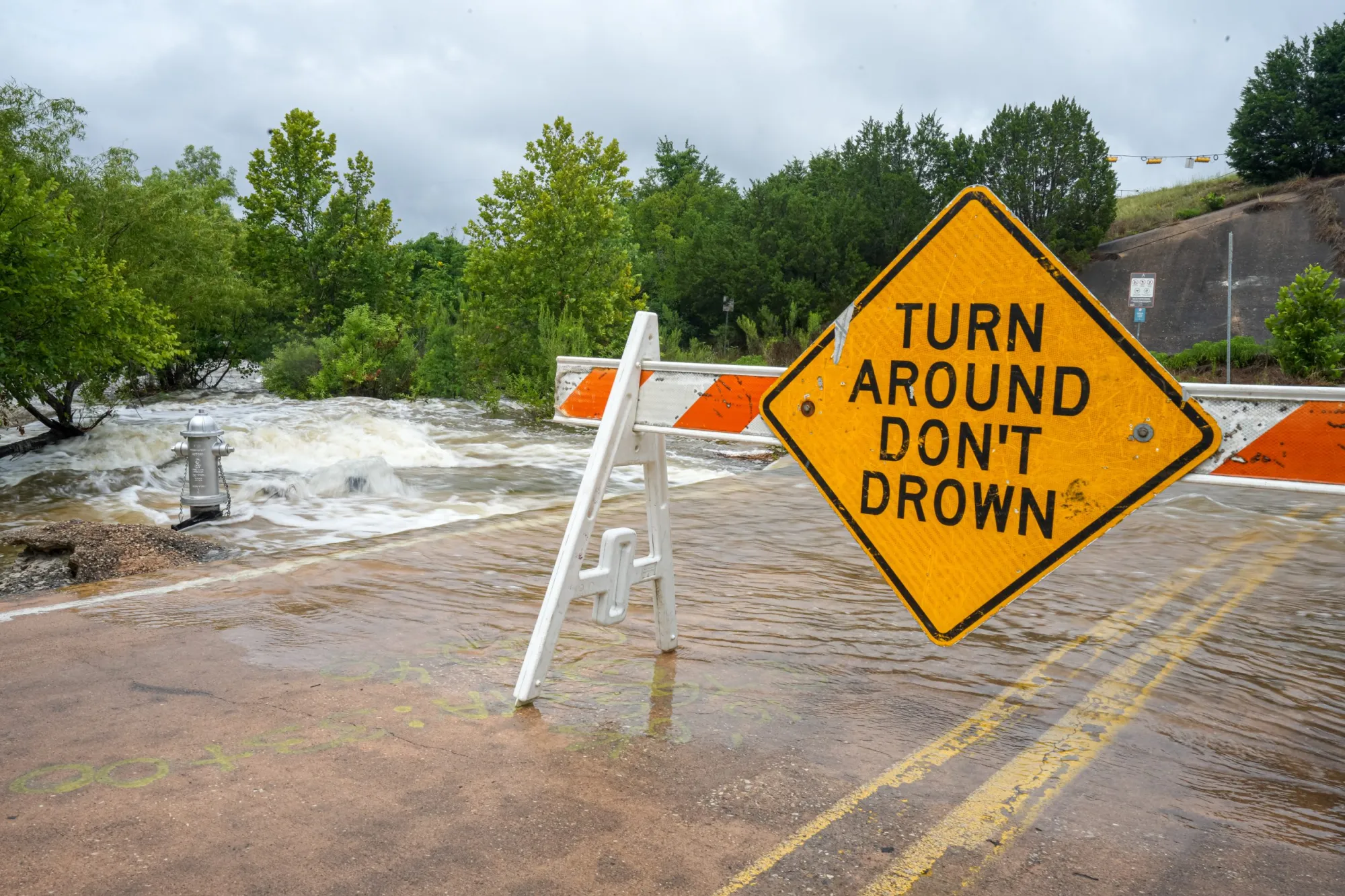
A sign blocks a water crossing on Old Spicewood Springs road after heavy rain on Monday, June 15, 2026, in Austin, Texas. Credit: Aaron E. Martinez/The Austin American-Statesman via Getty Images
Most people are not aware of the climate’s changing conditions until it arrives on their doorstep.
Longer summers, warmer winters, and more extreme changes between the seasons are what many might associate with the consequences of burning fossil fuels. While the first indicators of a rapidly shifting climate system might be too small for many people to see, meteorological changes are undeniable—and potentially the most life-threatening. This year won’t just be hot; it will likely be the hottest year on record.
The heat will have some help from what climate scientists say is an El Niño of historic proportions, which will more than likely affect severe weather conditions from June to August. Destructive weather events such as wildfire, hurricanes, and storms are likely to take on a new valence of harm, given that the governmental systems once relied upon to predict and mitigate these events are largely unrecognizable due to what groups such as the Union of Concerned Scientists refer to as the Trump administration’s “anti-science agenda.”
“We’re seeing these three crises—climate change, the authoritarian Trump administration, and affordability crisis—collide,” said Shana Udvardy, a senior climate resilience policy analyst at the Union of Concerned Scientists.
So what is El Niño, and what should we expect to see later this year? Prism talked to some experts to find out.
What is El Niño?
El Niño refers to the recurring oscillation of warm currents in the Pacific Ocean. According to the World Meteorological Organization, it typically occurs every two to seven years and lasts around nine to 12 months. Easterly trade winds circling the equator weaken, causing warmer waters to accumulate. This warm water is released into the atmosphere, which then raises the world’s temperature. Conditions build throughout the entire year and have historically peaked in December, which is also how the weather event got its name. Fishers in South America were the first to notice that warmer-than-average conditions appeared around Christmas, or the anniversary of the birth of Jesus, “el niño” in Spanish.
Because El Niño raises global temperatures and puts more heat into the atmosphere, other weather events are turbocharged, rendering already dire climatic conditions potentially catastrophic. The weather phenomena leads to milder winters in the U.S., meaning reduced snowpack. This does not bode well for the drought-stricken West, where states have yet to come to an agreement about allocation of water from the Colorado River.
“Climate change is affecting the impacts from El Niño, meaning a warmer atmosphere is likely to make areas that receive rainfall have more rainfall than normal. … And on the flip side, areas that receive less rainfall than normal are likely to receive even less rainfall,” explained Tom Di Liberto, the media director at Climate Central, a scientist-led research and communications organization that translates climate change information for policymakers and the public.
Even less rainfall is a danger because, as Di Liberto said, “It’s a very dry country.” Inside Climate News reported that while much of the country is experiencing some level of drought and faces risk of wildfire, the agencies tasked with conducting controlled burns and responding to wildfires are understaffed, underfunded, and underprepared.
“It’s not like we’re seeing a decrease in extremes. What we are seeing, potentially, is less of our ability to not only deal with the extremes as they occur, but especially deal with the long tail of the extremes after they occur,” said Di Liberto, who previously worked at the National Oceanic and Atmospheric Administration’s (NOAA) communications office and as the senior climate scientist for NOAA’s Climate.gov. “What good is a perfect forecast if it’s not tied to action?”
According to experts at World Weather Attribution, an organization that studies the impact of climate change on extreme weather, the “unprecedented” severity of El Niño is only possible due to climate change. El Niño years have always brought a pattern of heat, drought risk, and more powerful hurricanes. There are social consequences associated with these conditions, including increased conflict, disease risk, and hampered economies due to environmental stress. But World Weather Attribution, which draws connections between weather and climate change through the emerging field of attribution science that shows how much climate change is reshaping the world, said that even the cold-cycle weather events known as La Niña can be hotter than El Niño cycles of decades past.
How the federal government prepares for extreme conditions
As extreme weather risks grow, the amount of destruction caused can be determined by how prepared public agencies are to mitigate the fallout. Experts say it’s not looking good in the U.S. Since President Donald Trump’s second term, many of the agencies, systems, and research groups dedicated to weather monitoring and disaster preparation have been gutted.
That includes major budget and staff cuts to NOAA, the National Hurricane Center, and the National Weather Service, which forecasts and conducts early warning for communities. The administration also canceled the national climate assessment and has targeted the National Center for Atmospheric Research, a key arm of climate science research. Under Trump administration guidance, the Federal Emergency Management Agency’s (FEMA) funding has been drained to “emergency” levels, according to the Center for American Progress, and a 14% cut in staff has contributed to a backlog of 300,000 projects across 600 open disaster declarations.
“The Trump administration has really put the American people in harm’s way by having canceled many of these FEMA preparedness programs, pushing the burden of disaster response and recovery onto states and local tribal and territorial governments,” Udvardy told Prism. “It does lead to folks that are less prepared and ultimately, people will lose lives.”
Direct political retribution seems to be a part of this dynamic, with Trump refusing nearly 80% of disaster funding requests from Democratic states—the highest rate of denial since FEMA was created in 1979.
Udvardy explained that there are fewer resources available for people to prepare for extreme weather, coupled with higher costs for basic necessities such as air conditioning units, which abate periods of extreme, life-threatening heat. The anticipated outcomes are undoubtedly worse for some populations than others, Udvardy said, listing low-income people, disabled people, and elderly people as being especially boxed out by the federal government’s disinvestment. There are political concerns too. In the past, far-right groups have exploited disaster events to intimidate vulnerable residents and amass political power. In 2023, Grist reported that FEMA’s perpetual “game of catch up” left the agency susceptible to extremist intervention.
Impacts to civic infrastructure
The whole U.S. will be impacted by El Niño, though specific weather events differ by region. El Niño is expected to turn the volume up on the frequency and intensity of wildfires in the West, hurricanes in Gulf states, and drought conditions across the Midwest. Areas that have experienced flooding in the past will likely need to prepare for more.
U.S. infrastructure is now less equipped to handle the shocks of extreme weather, warned Geeta Persad, an assistant professor in the Jackson School of Geosciences at the University of Texas at Austin. Municipal storm drainage systems, water treatment plants, schools, roads, and other infrastructure were built to function under a certain set of conditions. Even with some variation brought about by El Niño and La Niña years, climate change is “moving the whole set of conditions that we’re experiencing out of the [range] that all of our human systems were built around,” Persad explained.
Research shows that due to industry-caused climate change, more than 1,600 critical buildings across the U.S. are susceptible to inundation and flooding. Our systems can no longer bend to fluctuations in weather; they’re more likely to break.
For instance, as the atmosphere warms overall, it’s primed to hold more water. And as rain events such as storms and hurricanes grow more fierce, storm drainage systems built decades ago can’t handle the inundations of water common today. Not to mention that natural storm mitigation and flood protections such as healthy coastal ecosystems, wetlands, and grasslands have struggled under the weight of industrial development, corporate farming, and coastal land loss.
Persad said that after years of neglect, community members are the experts in how a weather event is likely to affect their region. In many cases, communities have developed mutual aid groups, networks, and other methods of grassroots support to absorb the shock of flooding, a loss of power, or an evacuation notice. While it’s great to see people take care of each other when disaster strikes, it shouldn’t be the norm, Persad cautioned.
“Not every community has the resources to take action based on that understanding of what’s needed,” Persad said. “I don’t view these adaptations that I see different communities taking as a model that should be replicated elsewhere, but as a call to action for greater support at a systemic level to make sure that everyone is protected in these situations.”
 B
B