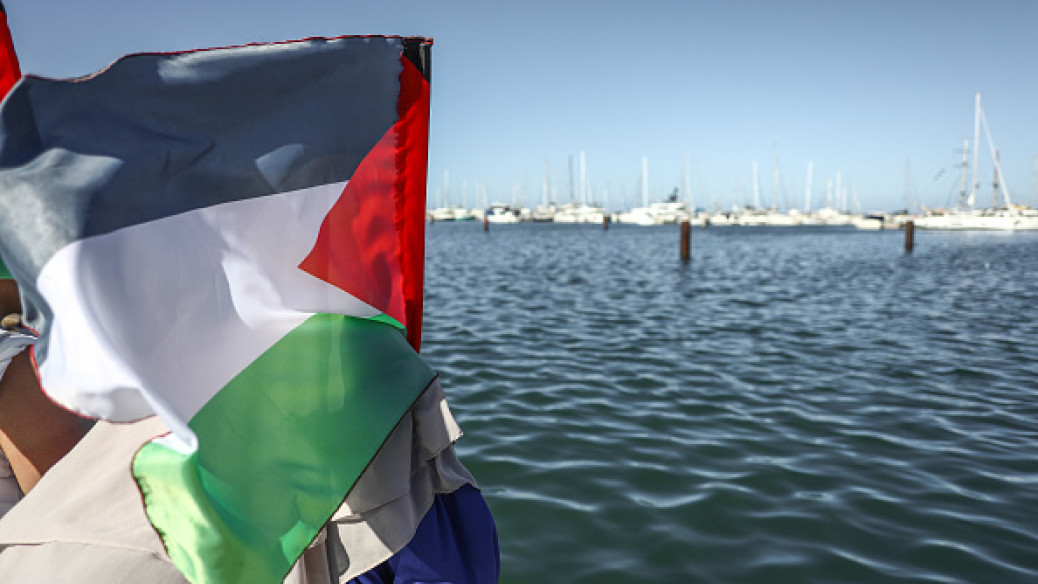
Unions across 22 countries mobilise against weapons shipments and military supply chains supporting Israel, as Palestinians in Gaza show solidarity. [Getty]
A global dockworkers’ strike involving 113 ports began on Friday in protest against military supply chains supporting Israel’s genocidal war on Gaza– as Palestinians in the besieged territory have also rallied in support of the movement.
Organised by the dockworkers’ union coalition Dockworkers Don’t Work for War, the action has been described by activists as the largest coordinated port mobilisation of its kind.
Organisers said more than 25 unions across five continents would refuse to handle weapons shipments to Israel, staging 24-hour strikes and other actions, including work stoppages and demonstrations of varying durations.
Their demands include an end to the transportation of weapons and military equipment through civilian ports to conflict zones.
Local unions in France, Italy, Greece, Spain, Turkey and Morocco issued a joint call for an end to wars in the Middle East, including the war on Gaza, and “an end to the militarization of ports”.
No Harbour for Genocide (NHG), a pro-Palestine organisation campaigning to halt maritime transfers supporting Israel’s war, told The New Arab that its research had identified 315 consignments of components for Israel’s Elbit Systems passing through 56 commercial ports in 29 countries between August 2025 and September 2026.
NHG said many of the ports detected in its research were among those whose workers were taking part in Friday’s strike.
“The same military, shipping and oil interests driving war and genocide in Palestine, Lebanon, Yemen, Sudan, Congo, and beyond are driving fuel poverty, cost-of-living crises and unsafe conditions in our own ports and communities,” a spokesperson for NHG told The New Arab.
“It helped provide examples materially backing the workers who were already moving toward action and found the information useful. The credit for today belongs to the workers themselves.”
Organisers said that participation would range from full-day strikes to shorter walkouts and demonstrations, however the extent of the disruption remained unclear as industrial action and protests having been taking place across several countries.
In Greece, the ENEDEP dockworkers’ union called a strike at Piraeus, the country’s largest port, as part of the international day of action.
Additionally, protesters in Turkey’s Istanbul gathered outside Haydarpaşa port beneath a banner reading: “No to war, no to armament!”
Italy’s Unione Sindacale di Base (USB) said demonstrations were planned at major ports, including Genoa, Trieste and Gioia Tauro.
In France, the CGT ports and docks federation called a one-day strike at major ports, including Le Havre, Marseille, Dunkirk and Rouen, in opposition to “the militarization of port facilities” under European policies.
“International coordination is the only way forward, and the evidence is in what workers have already won,” the NHG spokesperson told The New Arab.
“We’ve seen arms vessels call at different ports once workers turn against the ship, and we’ve seen Maersk quietly cut ports like Fos from their weapons supply routes when the opposition there stood alone.”
They continued: “Earlier this year, 26 containers of military steel were seized, and that would not have happened without coordinated action to reject three different MSC vessels from ports in Greece, Spain, Türkiye and Italy.”
“The supply chain of imperialism is global, and workers have learned the lesson it teaches: it can only be materially disrupted if action is taken globally too.”
The pro-Palestine maritime campaign Global Sumud Flotilla (GSF) also announced its participation, saying it would join land-based mobilisations across four continents as part of the global shutdown for Palestine.
The group said a flotilla of five vessels would operate in international waters between Sicily and Malta.
GSF added that around 20 of its activists had launched a 24-hour campaign of non-violent direct action to obstruct and challenge three major commercial vessels bound for, or servicing, Israeli infrastructure.
Prominent Spanish-Palestinian flotilla activist Saif Abukeshek told The New Arab that, as strikes take place around the world, GSF is communicating with local unions, including Italy’s USB, to offer support and amplify voices of solidarity with Palestine.
He said the group hopes to expand the movement to countries such as South Africa, India and Australia.
“I believe the message is that we are tired of continually waiting for governments to take the dignified action of ending their complicity and preventing our ports and seas from being used for war purposes and for transporting materials used in the genocide against the Palestinian people,” Abukeshek said.
“People, civil society, unions, organisations and students are taking a step forward to prevent this situation from continuing.”
He continued: “The message is clear. We are taking a step forward in our mobilisation and we will be adding this as part of our strategy, in addition to the sea missions and flotillas that try to break the Gaza siege.”
“We will also continue mobilising through our flotillas to block ships carrying such materials and complicit in the war, as well as organising actions at sea that expose the roots of the genocide and the companies that continue to benefit from and invest in the genocide and the war.”
Palestinians in Gaza back global strike
The international mobilisation has drawn support from Palestinians, particularly in Gaza, where residents and the Palestinian General Federation of Trade Unions have voiced solidarity with the movement.
On Thursday, Palestinians gathered at the fishermen’s port near Gaza City ahead of Friday’s strike, hoping to draw attention to the plight of fishermen who have faced killings, injuries and arrests during Israel’s assault on the territory.
Shaher Saad, secretary-general of the Palestinian General Federation of Trade Unions, told The New Arab that Friday’s international action reflected growing opposition to Israel’s brutal war on Gaza, which has killed more than 74,000 Palestinians and injured over 175,000 since 2023, most of them women and children.
Saad also highlighted the situation facing Palestinian fishermen, who have endured destruction and been prevented from accessing the sea since Israel launched its assault.
He said his organisation firmly supported the international mobilisation, describing it as “one form of solidarity with the Palestinian people”.
“We knew that many unions affiliated with the Palestinian General Federation of Trade Unions wanted to express solidarity with the Palestinian people and oppose the transfer of lethal weapons to the Israeli government, which is killing Palestinians in Gaza, the West Bank and Jerusalem.”
Saad said the federation had formally backed the initiative after learning of plans for workplace strikes and protests.
“When we learned about this trade union initiative, which involved calling for strikes and protests at workplaces, we formally supported it.”
The union leader stressed the importance of the action in calling for governments to intervene and impose a full arms embargo on Israel.
“This is an important form of solidarity because these weapons are being used to kill Palestinian children, women, elderly people, medical staff and journalists,” Saad told The New Arab.
“All of this is happening while weapons are being transported through ports around the world to Israel, where they are used to kill the Palestinian people.”
Saad confirmed that the federation was coordinating with Palestinian workers and fishermen in Gaza, while expressing hope that Friday’s mobilisation would lead to sustained international cooperation rather than remain a one-day show of solidarity.
“The workers who took part in today’s strike have performed a heroic act of solidarity. They have raised their voices in support of the Palestinian people and stood alongside them,” he told The New Arab.
“The Palestinian people have been deprived of their freedom. They seek to establish an independent and democratic Palestinian state, with East Jerusalem as its capital.”
He added: “The Palestinian people want peace, but peace must be based on their rights and dignity, and above all on the establishment of an independent Palestinian state. It cannot simply mean concessions granted by the Israeli occupation to those it chooses.”
“We do not want this occupation on our land, and there can be no lasting solution while it continues to remain on our homeland.”