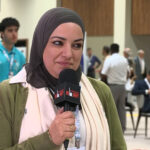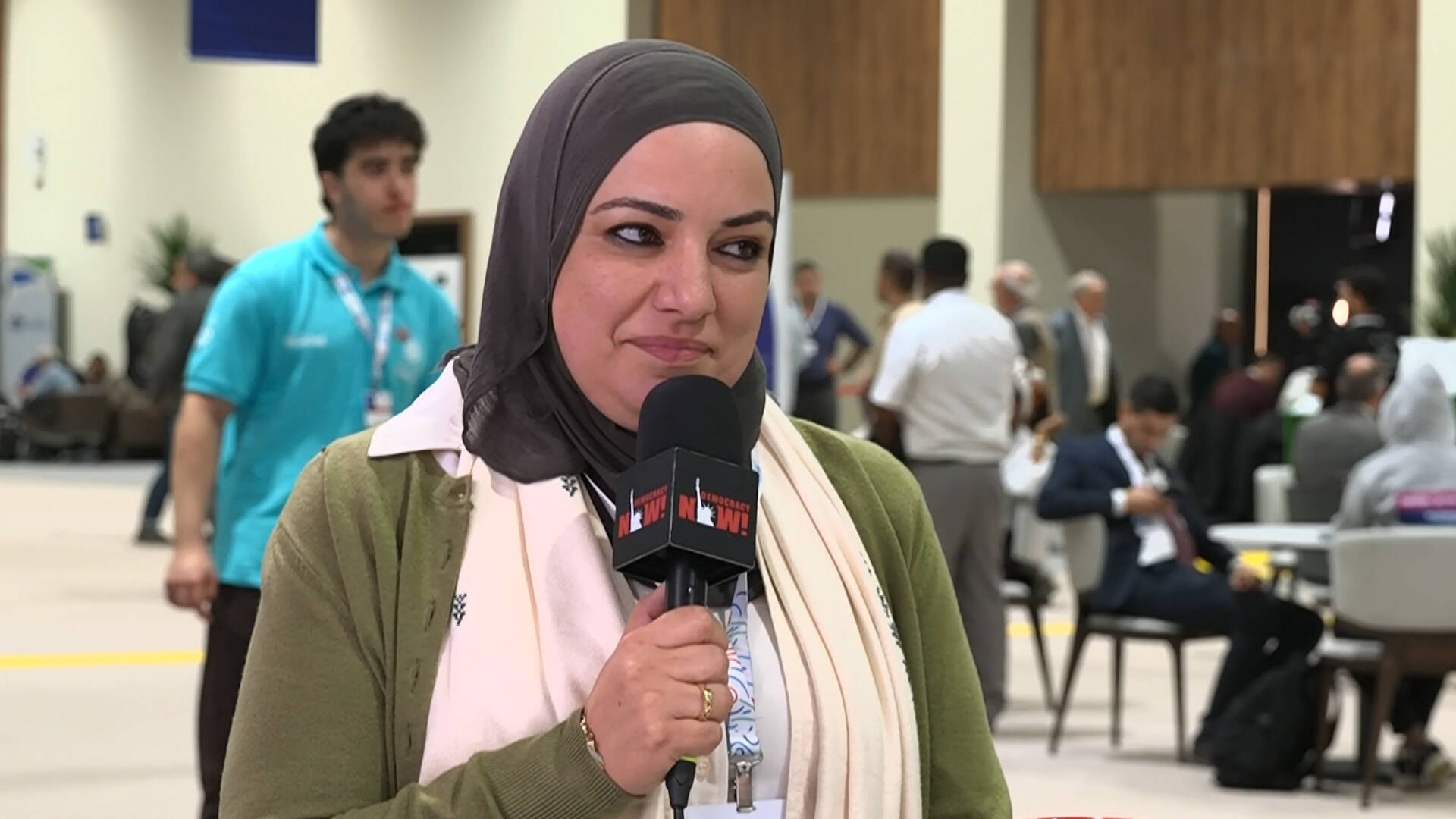
Activist Abeer Al-Butmeh from Friends of the Earth Palestine speaks at COP31 about the environmental devastation in Gaza and the West Bank caused by Israel’s attacks and ongoing occupation.
Transcript
AMY GOODMAN: This is Democracy Now!, democracynow.org, The War and Peace Report. I’m Amy Goodman, with Anjali Kamat. We’re in Antalya, Turkey, at U.N. climate summit, COP31.
Our guest, Abeer Al-Butmeh, coordinator of PENGON, the Palestinian Environmental NGO Network, a member of Friends of the Earth International.
Welcome to Democracy Now!, Abeer.
ABEER AL-BUTMEH: Thank you so much.
ANJALI KAMAT: Abeer, can you talk about how the climate crisis that’s being talked about here at COP31 is connected to what’s going on on the ground in Palestine?
ABEER AL-BUTMEH: Yeah. Climate crisis in Palestine is not natural phenomena. It’s a climate justice issue. It’s a human right issue. When we talk about justice for Palestinians, it means the sovereignty on our land, sovereignty on water resources, sovereignty on natural resources. We cannot talk about climate justice without the right for Palestinians to reach their agricultural land and to move freely between cities. We cannot talk about climate justice without the right to cope with climate changes. We need sovereignty to deal with our Palestinian water resources, that Israel has denied the access and sovereignty on all natural resources in Palestine.
When we talk about climate crisis, we focus more on water resources, which is under the Israeli control. More than 85% of Palestinian water resources are under Israeli control and pumped and supplied to the Israeli illegal settlements in the West Bank. And the situation in the Gaza Strip, water was used as a weapon against the Palestinians since the beginning of the war against Gaza Strip.
And other sector, which is agricultural areas, also there is no Palestinian sovereignty on the land. Currently, the Israeli settlers’ violence against the Palestinian farmers and the Palestinian organizations also are accelerated, with the protection of the Israeli forces. This is the situation in the West Bank, and while the situation in Gaza Strip is much catastrophic. Based on the statistics, only 3% of the agricultural land under accessibility for Palestinians, and you can imagine how only 3%, while before 7th of October, the agriculture sector was the main sector for people in Gaza, even it was many restrictions and restrictions on access also on the agricultural land before 7th of October. But the situation now has become unbelievable.
ANJALI KAMAT: And, Abeer, you’re based in the West Bank.
ABEER AL-BUTMEH: Yeah.
ANJALI KAMAT: But when you’ve been here speaking, you’ve talked about what’s happening in Gaza as an ecocide.
ABEER AL-BUTMEH: Yeah.
ANJALI KAMAT: Can you talk about what that means?
ABEER AL-BUTMEH: Yes, it is ecocide. Since the beginning of the war, they targeted all the elements of life inside Gaza. They cut off water, cut off energy, cut off food. That means killing of all people inside Gaza. When we talk about how it is ecocide, they damaged all the environmental sectors inside Gaza. They deliberately targeted all the environmental sectors. They targeted the agricultural areas.
They targeted the wastewater treatment plants. Currently, six of the treatment plants out of service, so the raw wastewater flow without treatments to the agricultural areas and penetrate to the water reservoirs inside Gaza, which is already polluted before the war, but that mean that situation is much catastrophic. So, also they targeted the desalination plants. They targeted all the infrastructure inside Gaza.
Another silent threat, which is the accumulation of solid waste beside the displaced areas, which is also the — leached for the solid waste penetrate to the soil and also reach the water wells inside Gaza Strip. In addition to that, the huge amount of debris that is mixed with heavy metals and poisonous materials.
AMY GOODMAN: The debris all over the ground from the rubble?
ABEER AL-BUTMEH: Yeah, yeah. So, the debris also, which is a critical concern for people inside Gaza. So, when we talk about how it is ecocide, yes, it is ecocide, killing all the components of environmental sector inside Gaza, in addition to the fishering sector. More than 95% of this sector was targeted and damaged as a result of this war, and which is the main sector for people who depend on inside Gaza.
AMY GOODMAN: There is a lot of solidarity expressed here at many different actions that do not involve Palestine, but people talk about Palestine.
ABEER AL-BUTMEH: Yeah.
AMY GOODMAN: If you can talk about the importance of that?
ABEER AL-BUTMEH: Yeah, solidarity for Palestine is very important. And it is not only a word. For people who suffer from killing, from targeting from Israel, feeling that the world support this population, that means a lot. And it is not a little, because when we feel that we are alone, that make us cannot continue our struggle.
AMY GOODMAN: And, Abeer, if you can talk about your own background in the West Bank, where you grew up?
ABEER AL-BUTMEH: Yeah.
AMY GOODMAN: Talk about the olive trees.
ABEER AL-BUTMEH: Yeah, I grew up in a village called Battir village, and I’m strongly connected with the land. Since I am a child, I was going to the agricultural areas, and I used to go to irrigate our crops. And I grew up between the mountains, between the plants. So I studied water and environmental engineer. And I’m really happy and feel myself on the ground between the agricultural areas.
That’s why I see that it is very important for any Palestinian to defend the land. It is our identity, our life. So, this is — yeah, my aim is to protect my land and to raise the Palestinians’ voices among people, among international communities, to raise their demands at international spaces.
ANJALI KAMAT: You know, we’re seeing so many Palestinians being cut off from their lands in the West Bank —
ABEER AL-BUTMEH: Yeah.
ANJALI KAMAT: — because of increased settler and soldiers, military activity, and, of course, the ecocide, as you talked about, in Gaza. A lot of the developing countries here at the COP31 are talking about loss and damages, right?
ABEER AL-BUTMEH: Yeah.
ANJALI KAMAT: And what rich countries owe the Global South. What kind of accountability are you calling for here at COP31?
ABEER AL-BUTMEH: Yeah. When we talk about climate, and we are at COP31, and we will talk about loss and damage and climate finance, the main question should be raised is how the governments can supply this ecocide happening without accountability, can finance the military for Israel. Without supporting governments, Israel cannot continue this ecocide, without supporting and the cooperation with the corporations that’s fueling this ecocide. How these governments does find finance and support for Israel to continue this ecocide, while cannot find money to support the Palestinian farmers and protecting the Palestinian farmers?
This year, most of the Palestinian farmers cannot reach their agricultural land. Currently, we have the olive harvesting season. We cannot reach our groves in order to harvest. The Israeli — unfortunately, it is really painful when we see the Israeli settlers on our land harvest our trees, steal our olive oil.
So, we cannot imagine how the governments, how the international community stay silent while the Israeli occupation and the Israeli settlers, with the Israeli — with the protection of the Israeli forces, continue their violations and their environmental crimes.
AMY GOODMAN: Abeer Al-Butmeh, we want to thank you so much for being with us, coordinator of PENGON, the Palestinian Environmental NGO Network, a member of Friends of the Earth International, here at COP31, the U.N. climate summit in Antalya, Turkey. I’m Amy Goodman, with Anjali Kamat.
By Democracy Now!