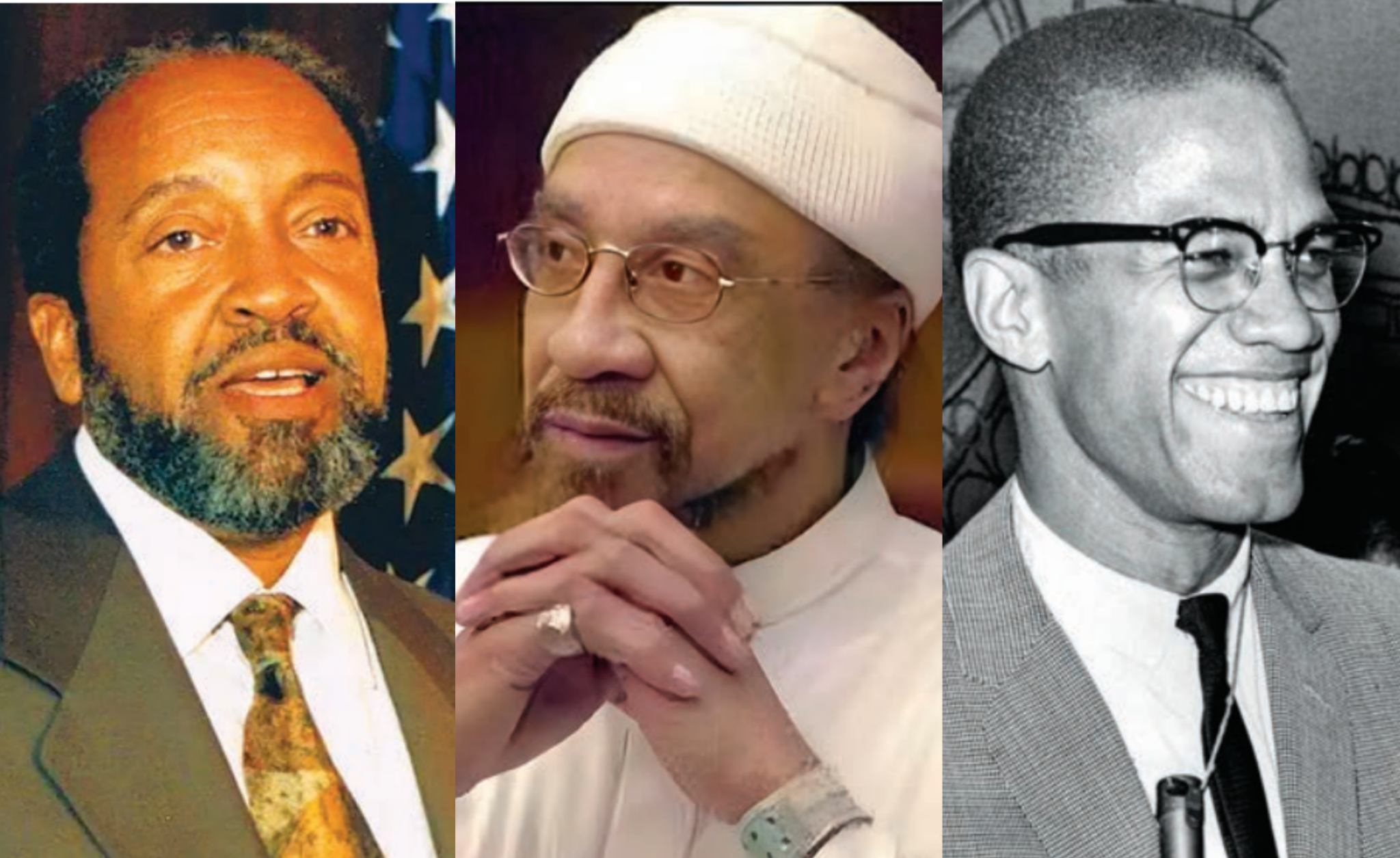
(Left to right) Imam Warith Deen Mohammed, Imam Jamil Al-Amin, and Malcolm X
The story of Islam in America is often told in fragments – moments of protest and prayer, of awakening and struggle, of communities finding themselves while trying to be fully seen by a nation that rarely understands them. Within this vast narrative, specific figures stand as defining peaks. Among them, three stand together like milestones marking different terrains of the same journey: Imam Warith Deen (WD) Mohammed, the quiet architect of traditional Sunni Islam in America; Imam Jamil al-Amin, the uncompromising defender of justice for Black America; and Malcolm X, the luminous bridge between the Black struggle and global Islam whose shadow shaped the moral and intellectual contours of the country.
Comparing their spiritual paths is not to flatten them into simple categories — moderate and militant, reformer and revolutionary, political and spiritual. Instead, it is to understand how Islam in America matured through parallel visions, how contrasting experiences created space for a rich plurality, and how each man’s shared commitments fostered the diverse expressions of Muslim life in America today.
The Architect of Transformation
When WD Mohammed inherited the theologically unorthodox Nation of Islam (NOI) after his father Elijah Muhammad’s death, he also inherited one of the most complex religious and sociopolitical institutions in American history. He stepped into that role not as a firebrand but as a quiet reformer whose vision of Islam was both expansive and deeply rooted in orthodoxy. Unlike Malcolm, whose departure from the Nation created a significant rupture, WD Mohammed chose to transform the movement from within — methodically, gradually, and with a determined grace.
He guided countless African American Muslims into the global Sunni tradition, steering the community away from theological isolation and racial essentialism. Under his leadership, temples became mosques, ministers became imams, and the Quran replaced spurious racial mythology as the primary source of guidance. His tone — calm, studious, reflective — stood in contrast to the confrontational cadence that had defined earlier decades of Black Muslim activism.
Yet his contribution was no less revolutionary. He reimagined Muslim American identity not exclusively as an outpost of resistance, but also as a constructive pathway for national and moral life. WD Mohammed forged interfaith alliances, built educational institutions, and established organizations that legitimized American Islam in the eyes of both policymakers and spiritual religious leaders. Through patience and vision, he turned a community inward toward spiritual growth while guiding it outward toward civic engagement. He believed that Islam could heal America’s fractures not through confrontation, but through moral clarity and community building. His leadership was two steady hands shaping clay into form.
The Firebrand of Moral Resistance
If WD Mohammed was the architect, Imam Jamil al-Amin was the sentinel. Before his conversion to Islam, he was H. Rap Brown, one of the most electrifying voices in America’s Black Power movement. His speeches carried the weight of the cultural revolution; his words had been sharpened by the institutional violence and injustice of the 1960s. The state watched him closely, prosecuted him relentlessly, and pursued him long after his activism matured into disciplined Islamic faith.
Imam Jamil shed the compromised rhetoric of the past but not its moral clarity. His transformation was not an abandonment of struggle, but rather its purification. He built a new community in Atlanta’s West End brick by brick, establishing a model of Muslim communal life rooted in service, safety, and moral discipline. There, drugs disappeared from street corners, families found stability, and young men found purpose.
Where WD Mohammed emphasized institutional legitimacy, Imam Jamil who passed away in November, emphasized moral sovereignty — communities free of addiction, state dependency, and moral decay. He believed that Islam offered liberation not only from sin but from the structures of oppression that produced it. It was a grassroots revolution, intensely local and yet grounded in global Islamic ethics.
But his fearlessness came with a price. His lifelong surveillance under the Counterintelligence Program (COUNTERPRO) followed him into his Islamic leadership. His controversial conviction in 2002 for the murder of a sheriff’s deputy — despite contradictory evidence and a confession from another man — created an open wound in America’s Muslim community. Many saw him as a political prisoner, a casualty of a justice system still acting out the prejudices of the past. And yet Imam Jamil’s leadership was the leadership of a man who refused to bend. His example taught us that faith requires courage, that justice demands sacrifice, and that spiritual conviction must never be divorced from earthly struggle.
The Bridge Between
Between WD Mohammed and Jamil al-Amin stood Malcolm X — neither their mirror nor their opposite, but the archetypal leader from which both drew different lessons. Malcolm taught WD Mohammed the necessity of theological reform; he taught Jamil al-Amin the necessity of moral resistance.
Malcolm’s pilgrimage to Mecca shattered the boundaries of race by deepening his understanding of Islam, opening the door for WD Mohammed’s sweeping reforms. His denunciation of American injustice, sharpened by his unique courage and poetic rage, became the template for Imam Jamil’s moral activism. Where Malcolm searched for a unifying vision, WD Mohammed sought permanence. Where Malcolm confronted the state, Imam Jamil confronted the street.
Malcolm’s charisma lay in transformation through rhetoric; WD Mohammed’s, in transformation through institution; Imam Jamil’s, in transformation through action. All three believed deeply in Islam’s redemptive power. All three saw Islam as the path to human dignity for African Americans. But their methods reflected different interpretations of the same Quranic command: “Stand firmly for justice, even if it is against yourselves” (Quran 4:135).
The Strength of American Islam
The differences between these leaders were not signs of fracture but of maturity. Islam in America did not grow through a single voice or unified strategy. It grew through multiplicity — through the soft-spoken reformer, the community builder, the revolutionary, the negotiator, the intellectual, the imam on the corner, and the imam in the hall of Congress. WD Mohammed taught Muslims how to enter American institutions with moral confidence. Imam Jamil taught them how to resist the injustices of those same institutions. Malcolm X taught them how to reclaim identity, dignity, and agency in a country that sought to deny them all three. Together, they created a moral ecosystem, one that nurtured the mind, protected the community, and confronted oppression.
Their Shared Commitment
Despite contrasting styles and divergent paths, one commitment bound these men together: the dignity of Black life. Each refused to accept the racial hierarchy imposed by American society and believed Islam provided a vocabulary of spiritual and racial equality. For these three foundational Muslim American leaders, leadership was not about visibility but accountability to God, to community, and to the truth.
WD Mohammed left behind institutions, schools, mosques, interfaith councils, and a stable Sunni American Muslim identity. Imam Jamil left behind a generation of street leaders transformed into community protectors, a blueprint for urban Muslim communal life, and an unresolved legal battle that continues to stir the conscience of the faithful even after his death. Malcolm left behind a universal language of dignity that transcended race and faith, animating movements across the globe. Taken together, they offer Muslim Americans — and all Americans — three necessary tools: vision, courage, and truth. Vision without courage becomes abstraction. Courage without vision becomes chaos. Truth without both becomes silence. WD Mohammed provided the vision. Imam Jamil provided the courage. Malcolm provided the voice.
To study these men is to encounter the complexity of Black Muslim leadership — its theological evolution, its political entanglements, its spiritual depths, and its unyielding love for justice. They were not perfect, but they were principled. They were not identical, but each was indispensable. And though their roads diverged, their destination was the same: the creation of a community rooted in God, dignity, truth, and liberation. American Islam stands today on the shoulders of many, but few carried its weight as they did. WD Mohammed, the builder; Jamil al-Amin, the defender; Malcolm X, the awakener. Three men — three legacies — one horizon.
By Aslam Abdullah, Ph.D., a Resident Scholar at Islamicity.com.