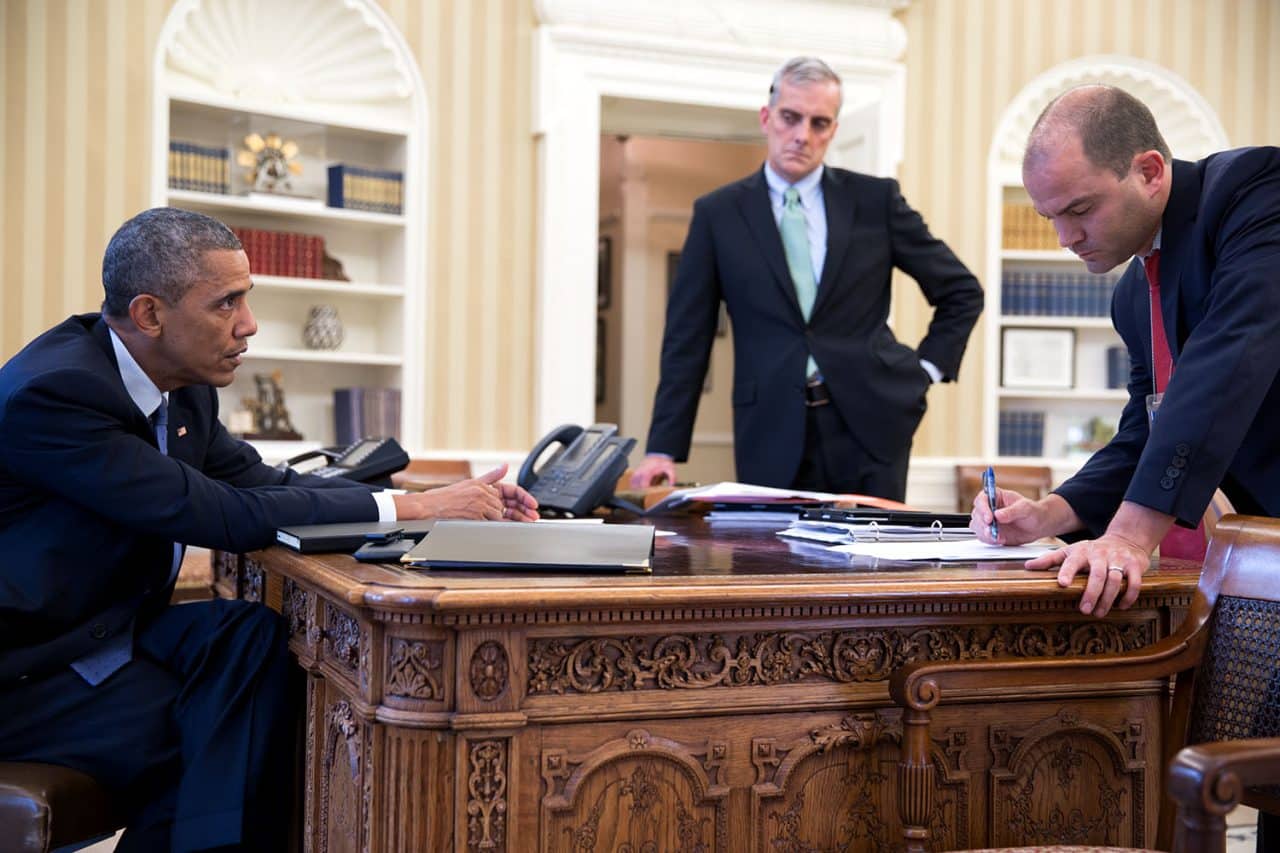
President Barack Obama meets with Chief of Staff Denis McDonough and Ben Rhodes, Deputy National Security Advisor for Strategic Communications, right, in the Oval Office, Aug. 7, 2014. (Official White House Photo by Pete Souza)
In yet another sign of the shifting consensus on Israel among Democrats, Ben Rhodes, the former Deputy National Security Advisor and speechwriter for Barack Obama, published a groundbreaking Op-Ed in The New York Times this week.
From the point of view of Palestine solidarity activists, Rhodes still has a way to go, and it’s a good bet that he is not actively seeking to be identified with this movement. However, he has been among the more critical voices among mainstream Democrats regarding Israeli policies and actions since leaving government, and this op-ed was a significant step in the right direction.
In the past, Rhodes has supported the contention so many progressives made—not just Palestine solidarity activists—that Joe Biden’s policy toward Palestine and Kamala Harris’ refusal to move away from it cost the Democrats dearly in the 2024 election.
But now Rhodes is saying something of supreme importance: that changing our policy away from blanket support for Israel is good politics and good policy not only on a pragmatic basis, but also because it is the right thing to do. That’s an argument we don’t hear enough from political insiders.
Rhodes does own up to some of the mistakes Obama made while Rhodes was working for him. But he really unloads on Biden. He writes that Biden’s “approach made Democrats hypocrites when defending a ‘rules-based order,’ racial equality and democracy. It alienated elements of their base and placed them out of step with younger voters. And in an age of authoritarianism, fealty to an Israeli strongman who routinely humiliated them made Democrats appear weak: Mr. Netanyahu was hugged all the way into the arms of Donald Trump.”
Rhodes lays out the case for genocide in Gaza; through he stops just short of affirming it. But he does grapple at least to some extent with the ethical question that anyone who supports Israel in any way should be wrestling with: “If you believe a Palestinian child is equal in dignity and worth to an Israeli or American child, it is no longer possible to support this Israeli government while hiding behind platitudes about peace.”
A shot in the Democratic Party’s battle over Israel
Rhodes’ overall message is a strong one. He correctly and admirably centers Israel-Palestine policy as a moral issue, but he is not so naïve as to think that a “mere” ethical argument will sway his fellow Democrats. Instead, he does what, in my view, is the key to changing so many immoral American policies, foreign and domestic, using Gaza as the icon.
Rhodes writes: “… one reason New Yorkers believed [Zohran Mamdani] would fight to lower costs is that they knew he had core convictions. His willingness to be pilloried by powerful people about his views on Israel…showed that he was not afraid to stand up for his beliefs. By contrast, the familiar pandering to pro-Israel voters by Mr. Mamdani’s main opponent in the mayoral race, Andrew Cuomo — including volunteering for Mr. Netanyahu’s legal defense team — did not come across as particularly courageous or authentic.”
This point is not made in political discourse enough. Gaza and Palestine serve as proxies for bigger issues regarding a candidate’s character these days.
A September poll by the New York Times of New York residents showed that 57% of Democrats were more sympathetic to the Palestinians and only 18% more sympathetic toward Israel.
While it’s true that “sympathizing more” with Palestinians is not the same as being anti-Zionist, New York also boasts the largest Jewish population in the world other than Tel Aviv, and the clear majority of them are Democrats. So that poll cannot be waved away.
Still, while New Yorkers were certainly not voting for their mayor based on Palestine, Rhodes is correct about what Mamdani’s stance showed about his integrity. It was precisely what Kamala Harris had lacked in 2024.
This remains a breaking point among Democrats, but both Mamdani’s victory and Rhodes’s Op-Ed show that the tide of support among Democrats is turning. That’s becoming even clearer in the attitude of so-called “mainstream” Democratic operatives.
First, we had the execrable Sarah Hurwitz, Barack and Michelle Obama’s former speechwriter, telling the world that we should abandon Holocaust education because it teaches young people to oppose the strong killing the weak. She then added how horrible it is that she can’t communicate with young Jews because they have been made too aware of the “wall of Palestinian bodies” through which she must now talk.
That was followed by Hillary Clinton, someone whose hands are thoroughly soaked in blood, speaking at a conference held by Yisrael Hayom, the Miriam Adelson-owned newspaper that was created and serves as a mouthpiece for the Israeli right wing.
Clinton ranted about her frustration because her false and distorted version of history regarding Palestine and Israel was being rejected by young Americans, including Jewish Americans. She essentially called them stupid, gullible, and ignorant of history, when in fact, they have demonstrated that they had a far better grasp of history and current reality than the sheep Clinton is obviously more accustomed to preaching to.
Underlying both Clinton’s and Hurwitz’s words is not just contempt for Palestinian lives and rights but an active hostility to them. And that is what Rhodes is standing against.
Rhodes’s shortcomings
While the overall thrust of Rhodes’s article is laudable, it also reinforces several myths that we must move past if we ever hope to change our governments’ policies from the current, bloody ones.
One is demonstrated in the sentence quoted above, singling out the “this Israeli government.” This is an echo of the notion that the current, right-wing government of Israel is an anomaly, a unique formation that has led Israel to become the worst version of itself.
It is true, of course, that the current Netanyahu government is the most radically fascistic of any in Israel’s history. But it has merely magnified what already existed; it did not invent it. When Yoav Gallant called everyone in Gaza “human animals” and cut off all food, water, medicine, electricity, and everything else from Gaza, he was not inventing a new scheme. To one degree or another, Gaza had experienced that many times over the years. True, those closures had not been quite as full or lasted as long as the current genocide, but water, food, electricity, and healthcare supplies had all been restricted and often unavailable for Gazans for many periods since Israel captured Gaza from Egypt in 1967.
The oppression and dispossession of Palestinians have taken many forms over the years, but only the most naïve can look back at the three decades of the Oslo Accords and believe Israel was ever serious about achieving peace.
Indeed, Rhodes unintentionally illustrates the problem his words raise.
He writes: “Few Democrats embraced Israel’s conduct, but many chose to emphasize a story of Palestinian terrorism and rejection of peace. That instinct is part of the problem. Yes, Yasir Arafat was a difficult interlocutor at the 2000 Camp David Summit. Does that justify the relentless displacement of Palestinians in the West Bank ever since? Yes, Hamas has engaged in abhorrent acts of terrorism. Does that warrant dropping 2,000-pound U.S.-made bombs on refugee camps full of children?”
The context of this is to imply that Israel reacts to Palestinian “misbehavior” and that it overreacts in an intolerable way. While that’s better than defending Israel’s actions, it still distorts the reality.
Arafat was considered “difficult” at the Camp David summit because he refused Ehud Barak’s “generous offer” that was far short of minimal Palestinian demands and offered practically nothing on the sensitive issues of refugees and Jerusalem. Rhodes’s example ignores this.
He similarly echoes the idea that Israel “overreacted” to Hamas’ crimes. He fails to connect his own criticism of Joe Biden’s laser focus on a normalization deal between Israel and Saudi Arabia that would have crippled Palestinian diplomatic leverage to the October 7 attack, which was almost certainly prompted, in part, by those very efforts.
Nor does Rhodes grapple with the very real question of what prompts Palestinian resistance in the first place. It occurs precisely because Israel has, since 1948, dispossessed and conducted massive violence against Palestinians that dwarfs anything Palestinians can even imagine, while blocking every legal and diplomatic avenue Palestinians might have to address these issues. To remove that context mischaracterizes the entire issue of Palestine and Israel.
These examples reflect Rhodes’ limitations in his Op-Ed. It’s important to note them. However, they don’t accurately reflect the quality of Rhodes’ piece overall, and we should be cautious not to sacrifice the good in pursuit of the perfect.
The Democratic Party’s future — Mamdani or Hurwitz?
Rhodes’s article arrives as the Democratic Party is faced with a decision on which path forward for its policy toward Israel and the Palestinians.
As Rhodes notes, even beyond policy changes, voters want to see leaders who stand by principles and fight for them. That is where the Democrats, with their cynical strategies and open contempt for their own voters, have failed so badly, and it’s why any victories they win are short-lived despite the obvious threats Republicans pose.
Although Rhodes closes his Op-Ed by saying “Sometimes, to win, you must show that there are principles for which you are prepared to lose,” he also makes the important point that the risk posed by abandoning support for Israeli aggression and genocide is exaggerated.
“Large majorities of Jewish Americans continued to vote for Democrats in recent elections despite the fact that Republicans relentlessly sought to use Israel as a wedge issue. By taking the moral high ground, the Democratic Party could bring new voters into its coalition and show that it understands the times we are living through.”
Just so. By distancing itself from the blatant and bloody racism of Hillary Clinton and Sarah Hurwitz, the Democrats may lose a few dollars, but they will gain a lot of votes and popular support. Indeed, Mamdani’s decision to run as a Democrat—it was Andrew Cuomo who ran as an Independent, the so-called “outsider”—shows that there is potential for remaking the Democratic Party along more ethical lines.
Rhodes’s Op-Ed breaks open that ground and attempts to pull the party away from the racism and cynicism of Clinton and Hurwitz. He still has a way to go to truly support justice in Palestine, and to thereby support a practical, sustainable, and better future for everyone living between the river and the sea. But it’s a hell of a good start, and something well worth rallying around and supporting.







![15 Things You Didn’t Know About Makkah and the Ka’bah [Part 1]](https://wisconsinmuslimjournal.org/wp-content/uploads/2026/03/AdobeStock_87517185-scaled-e1774211732813-150x150.jpeg)