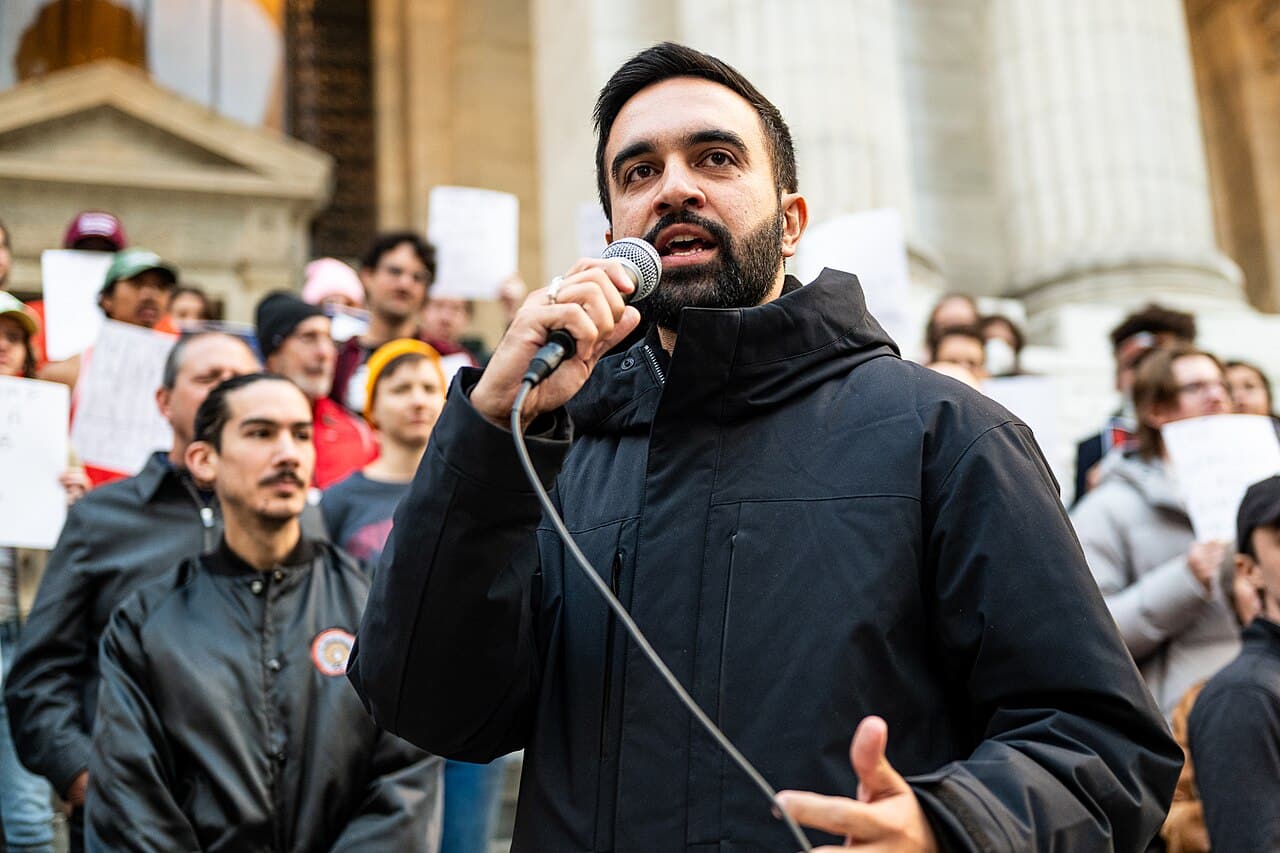
Zohran Mamdani at the Resist Fascism Rally in New York City’s Bryant Park on October 27, 2024. (Photo: Bingjiefu He, licensed under CC BY-SA 4.0)
In his first hours in office, New York City Mayor Zohran Mamdani rescinded nine executive orders that his predecessor, Eric Adams, had issued following his corruption indictment.
Some of the revoked orders were pro-Israel measures.
One barred city officials from boycotting or divesting from Israel, subjecting them to potential “disciplinary action” if they backed such a campaign.
“You are being targeted,” Adams told attendees of the North American Mayors Summit Against Antisemitism, while announcing the action last month. “And we have to be as intelligent and as focused, as strategic as possible…That’s why I am signing an executive order today to deal with BDS, so we can stop the madness that we should not invest in Israel.”
“BDS has no place in our city,” he later tweeted. “The movement is antisemitic in nature and discriminatory in practice. NYC contracts and pensions must serve the public good. Discrimination is illegal. Antisemitism is abhorrent.”
Mamdani also revoked a June order that adopted the controversial International Holocaust Remembrance Alliance’s (IHRA) working definition of antisemitism.
The definition equates some criticisms of Israel with antisemitism. These include describing “the existence of a State of Israel is a racist endeavor” and denying the “Jewish people their right to self-determination.”
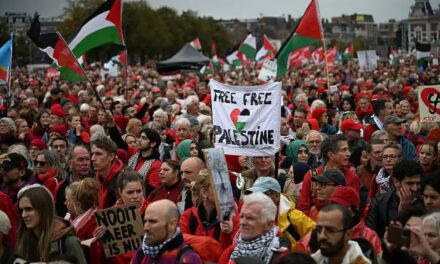
Mamdani also canceled an Adams order that directed the NYPD to take steps towards a ban on protests outside houses of worship.
In addition to the cancellation, Mamdani issued his own executive order instructing Police Commissioner Jessica Tisch to review the issue. It calls on Tisch to establish “appropriate limitations on protest activities outside of houses of worship during non-religious activities to protect the speech and assembly rights of community members who make use of houses of worship.”
That Adams’ order was a direct response to a November protest outside the Park East Synagogue, organized by the Palestinian Assembly for Liberation. The activists were targeting an event hosted by Nefesh B’Nefesh, an organization that assists Jewish individuals in relocating to Israel and participating in the dispossession of Palestinians from their land.
Two days after the protest, Mamdani met with pro-Israel Rabbi Marc Schneier, who said he urged Mamdani to support legislation banning such protests.
Mamdani’s moves on Thursday, January 1, were immediately condemned by pro-Israel organizations.
Israel’s Diaspora Affairs Minister Amichai Chikli called them a “series of antisemitic steps” and dubbed Mamdani an “overt antisemite and a supporter of terrorism.”
“It is no coincidence that one of Mayor Mamdani’s first actions was an attempt to cancel the IHRA definition of antisemitism,” he added. “He knows very well that according to that definition, he himself falls under the category of antisemitic.”
National Jewish Advocacy Center Director Mark Goldfeder said it was “hard to overstate how disturbing” the revocations were.
In a statement, the World Jewish Congress said it was “concerned by calls to abandon the internationally recognized IHRA definition of antisemitism at a time of rising antisemitism in New York, the United States, and globally.”
William Daroff, CEO of the Conference of Presidents of Major American Jewish Organizations, told the Jewish News Syndicate (JNS) that repealing the IHRA definition “diminishes New York City’s ability to recognize and respond to antisemitism at a time when incidents continue to rise.”
“New York City should lead with moral clarity and resolve in confronting antisemitism. This decision points in the opposite direction,” he added.
Inna Vernikov, a GOP councilwoman from Brooklyn, warned that “pro-Hamas antisemites emboldened by” Mamdani’s actions would soon be coming to NYC.
New York Civil Liberties Union executive director Donna Lieberman praised Mamdani’s moves.
“Both [Adams] orders appeared to be last-ditch attempts to suppress viewpoints that the mayor and his benefactors disagreed with, especially since one of them was issued just in the last few weeks,” she told the New York Times. “It is no surprise and it is good news that our new mayor has revoked them.”
“The right to free speech does not depend on your viewpoint, and that is true for speech about Israel or Gaza, it is true about political activism about that conflict, and it is true about any other political issue that we face,” she added.
In his inaugural address, Mamdani referenced the diversity of New York City and the struggles of local Palestinians.
“New York belongs to all who live in it together. We will tell a new story of our city,” he told the crowd. “The authors of this story will speak Pashto and Mandarin, Yiddish and Creole. They will pray in mosques, at shul, at church, at gurdwaras, Mandirs and temples, and many will not pray at all. They will be Russian-Jewish immigrants in Brighton Beach, Italians in Rossville, and Irish families in Woodhaven, many of whom came here with nothing but a dream of a better life, a dream which has withered away.”
“They will be Palestinian New Yorkers in Bay Ridge, who will no longer have to contend with a politics that speaks of universalism and then makes them the exception,” Mamdani added.
Mamdani had been facing pressure in the weeks leading up to his inauguration from leftist and Palestinian activists in the city, who were angered by his decision to keep the pro-Israel NYPD Commissioner Jessica Tisch in her current role, which was viewed as a betrayal of the base that helped elect him.