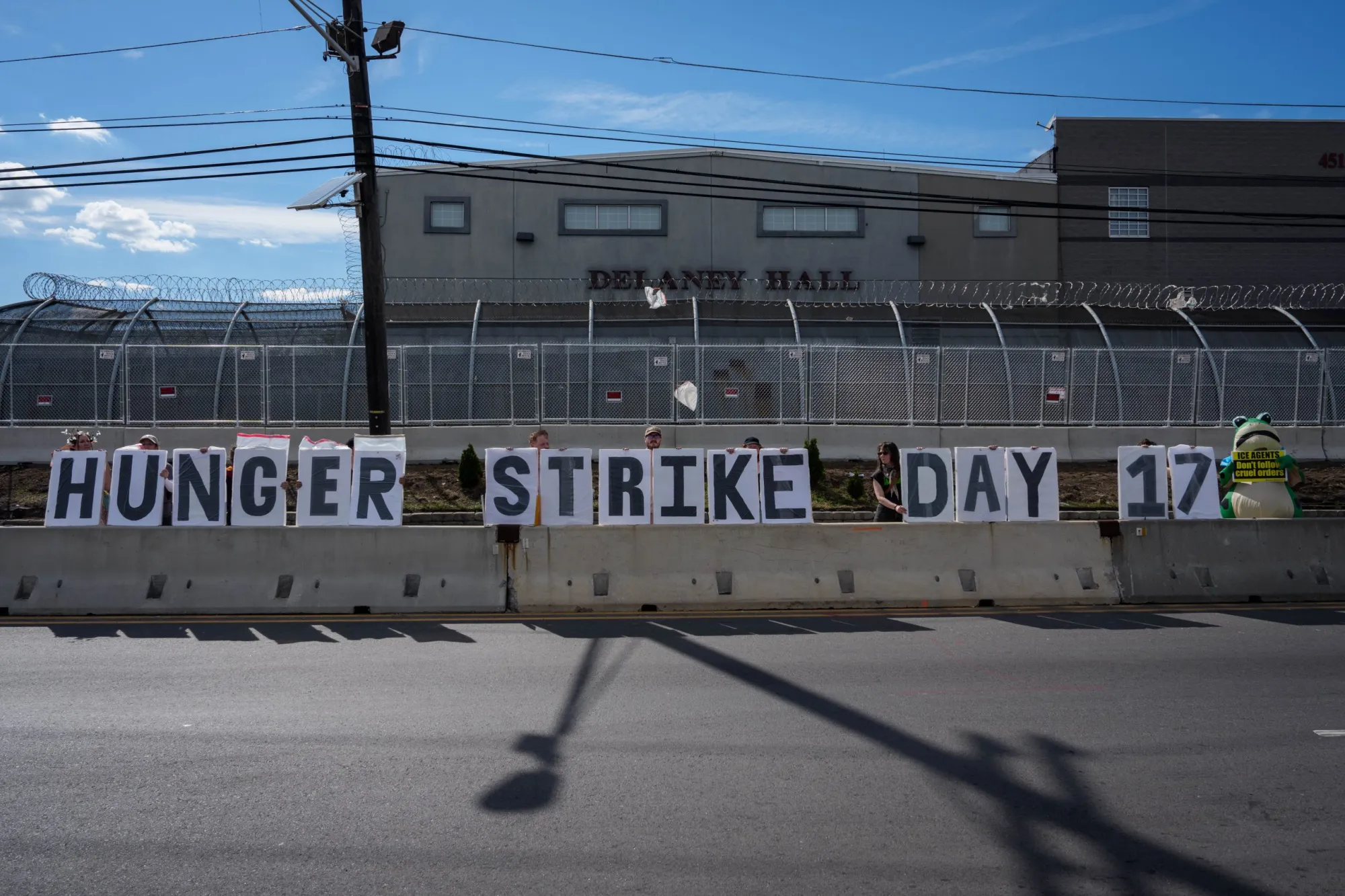
Protesters hold signs in support of the detainee hunger strike outside Delaney Hall, where ICE is housing detained immigrants on June 7, 2026 in Newark, N.J. Credit: Adam Gray/Getty Images
Hundreds of noncitizens detained by Immigration and Customs Enforcement (ICE) have gone on hunger strikes across the country to protest the widespread denial of due process and deteriorating conditions in detention centers during the Trump administration, according to advocates and detainees.
Conditions in ICE detention facilities have never been good, typically prompting around a dozen hunger strikes a year, said Josefina Mora-Cheung, director of organizing at La Resistencia, a grassroots organization that supports detainees at the Northwest ICE Processing Center (NWPIC) in Tacoma, Washington. Last year, La Resistencia documented 16 such protests, mostly carried out by single detainees. But this year, the group has already documented 18 hunger strikes involving about 25 individuals at NWPIC, the most recent of which ended July 20.
“This year we’ve seen such a skyrocketing of numbers that indicates how much people are willing to put their lives at risk in order to call attention to these conditions that are ultimately life-threatening for people,” Mora-Cheung said. “People are not willing to give up so easily or to have their spirits broken.”
Hunger strikes in ICE jails have also been reported at Adelanto ICE Processing Center in California; North Lake Processing Center in Michigan; Moshannon Valley Processing Center in Pennsylvania; Prairieland Detention Center and Camp East Montana in Texas; Torrance County Detention Facility in New Mexico; the ICE unit at the Louisiana State Penitentiary or “Angola”; and Delaney Hall in New Jersey. About 500 noncitizens have reportedly joined the strikes.
Advocates say there have likely been more hunger strikes across the 425 jails administered by ICE and its network of private contractors, but the agency denies they are taking place and, according to the advocates, quickly tries to break them up through threats or coercion.
ICE did not respond to a request for comment.
Detainees complain about inhumane conditions—including unsanitary food and water, lack of medical care, widespread physical abuse, and retaliation for filing complaints—along with racist abuse and a complete absence of justice and due process.
Take the case of Rogelio Bolufé Izquierdo, a Cuban national who has gone on multiple hunger strikes, including one that lasted nine days in Torrance. Initially sent to the notorious “Alligator Alcatraz” in Florida, Bolufé was transferred nine times in retaliation for his organizing, according to La Resistencia.
Bolufé spoke with Prism over the phone from Guayaquil, Ecuador, where he was deported in June despite having an open asylum case and a pending appeal before an immigration court.
He claimed that detainees are denied access to legal counsel at the Torrance ICE jail and very likely at the other jails where he’d been detained. He also claimed that his legal court documents were taken from him and that facilities do not provide mail service, which is the only way detainees can follow their deportation proceedings or request asylum.
“That was one of the main reasons we went on hunger strike,” Bolufé said.
“The legal proceedings do not follow due process. They are a farce,” he added. “The Fifth Amendment does not exist in U.S. immigration proceedings.”
Torturous conditions in ICE jails have been well-documented by advocacy groups over the past two decades. These conditions have not only persisted during the current Trump administration but have worsened, according to advocates.
At least 52 people have died in ICE custody since President Donald Trump’s inauguration last year. According to Human Rights Watch, this mortality rate is nearly four times that of the Biden administration and more than two and a half times that of the first Trump administration.
In the largest documented hunger strike of the year, at Delaney Hall in New Jersey, more than 300 men and women participated in a weekslong labor and hunger strike that ended in June. They denounced degrading conditions and a lack of due process, including arbitrary denials of bond and coercion to sign legal documents that would result in deportation.
“We see with profound helplessness and frustration that the right to due process & legal counsel were violated, and benefits granted in the 4th, 5th, and 6th Amendments of the U.S. Constitution were unacknowledged,” wrote 25 of the Delaney Hall hunger strikers in a public letter. The author, identified as Leonardo Villalba, was summarily transferred to another ICE jail, according to the letter’s postscript.
ICE could not simply deny that the massive hunger strike at Delaney Hall was happening, so agents resorted to violence, said Jenny García, a campaign coordinator at the nonprofit American Friends Service Committee’s New Jersey Immigrant Rights Program. ICE officers cut off the detainees’ external communication, repeatedly threatened to sabotage their cases, and brutally assaulted and pepper-sprayed them, García said.
Hunger strikers at Torrance were stripped naked and sent to cold cells, where they were exposed to 24-hour lighting, according to Bolufé, who spent seven months in that prison. Innovation Law Lab, an immigrant and refugee justice organization, has documented these cold chambers at Torrance, calling them torture.
At some point during his strike, Bolufé said he asked himself, “Why should I go on if it makes no sense? No one will find out. It’s a lawless situation; the law isn’t respected here, no one will know.”
Despite the odds, strikes have brought individual victories: answers about cases from ICE officials, release from solitary confinement, and release from detention altogether at NWPIC and Delaney Hall, which also secured $12 million in pro bono legal services, said Mora-Cheung.
“This is strong,” García said about the ability of detainees to organize and encourage one another amid the horrific and inhumane conditions in which they are confined. “What’s happening inside is the best of humanity.”