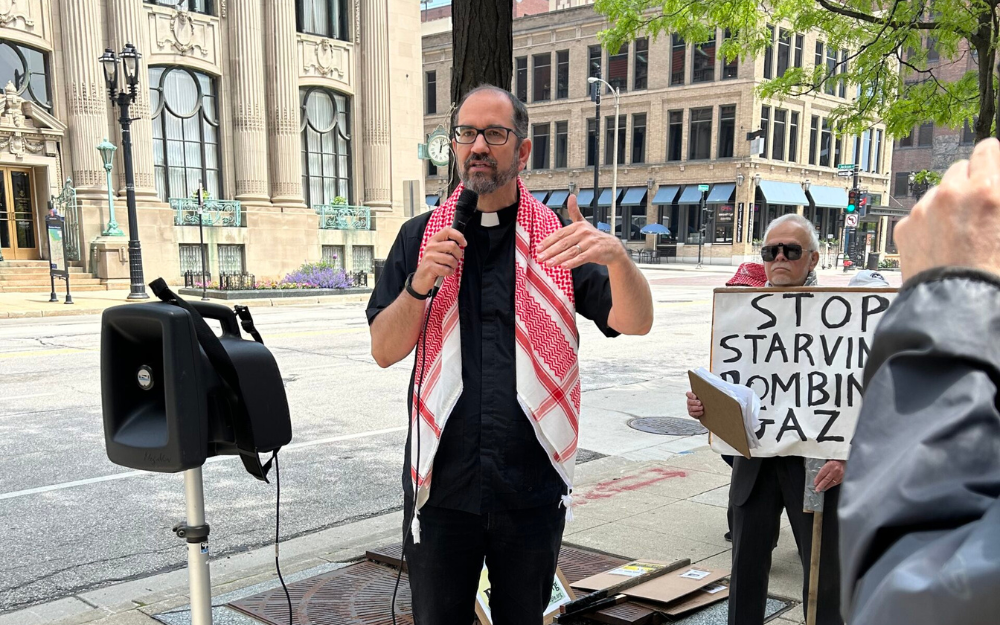
Pastor Darren Utley of First Presbyterian Church of Racine speaks at the Solidarity Fast for Gaza MKE in June on the Federal Courthouse steps in Milwaukee with members of Veterans for Peace, Peace Action Wisconsin, Jewish Voice for Peace, Wisconsin Coalition for Justice in Palestine, Milwaukee for Palestine, Wisconsin Christians for Justice in Palestine, Catholics for Peace and Justice, and others.
Milwaukee Muslims often spot a lanky man in a clerical collar protesting against Israel’s genocide in Gaza that began in October 2023. And long before, at rallies for Palestinian rights over the years, the minister universally called “Pastor Darren” stood with protestors, spoke at rallies and offered prayers.
A reverend with the Presbyterian Church U.S.A. and pastor of First Presbyterian Church in Racine, Pastor Darren has no apparent ties to Palestine—he has no Arab heritage. He is not part of the Muslim ummah (the worldwide Muslim community). Yet he has long been aware of the plight of the Palestinian people and has taken up the fight for their rights.
And, although Pastor Darren cannot personally take credit, no one was more pleased than he when on June 30 the Presbyterian Church U.S.A.’s General Assembly, which was meeting in Milwaukee, voted overwhelmingly (454 to 15) to declare Israel’s military actions in Gaza a genocide. It supported a U.S. arms embargo against Israel and divestment from specific corporations tied to the Israeli military. The Council on American-Islamic Relations (CAIR), the nation’s largest Muslim civil rights and advocacy organization, welcomed the decision, calling it “historic.” (In 2022, PCUSA also declared Israeli policies met the legal definition of apartheid and divested from select companies profiting from the occupation.)
Who is Pastor Darren and why does he always show up to defend Palestinian rights? The Wisconsin Muslim Journal conducted three interviews with Pastor Darren last week and also interviewed people who know him well to answer those questions.
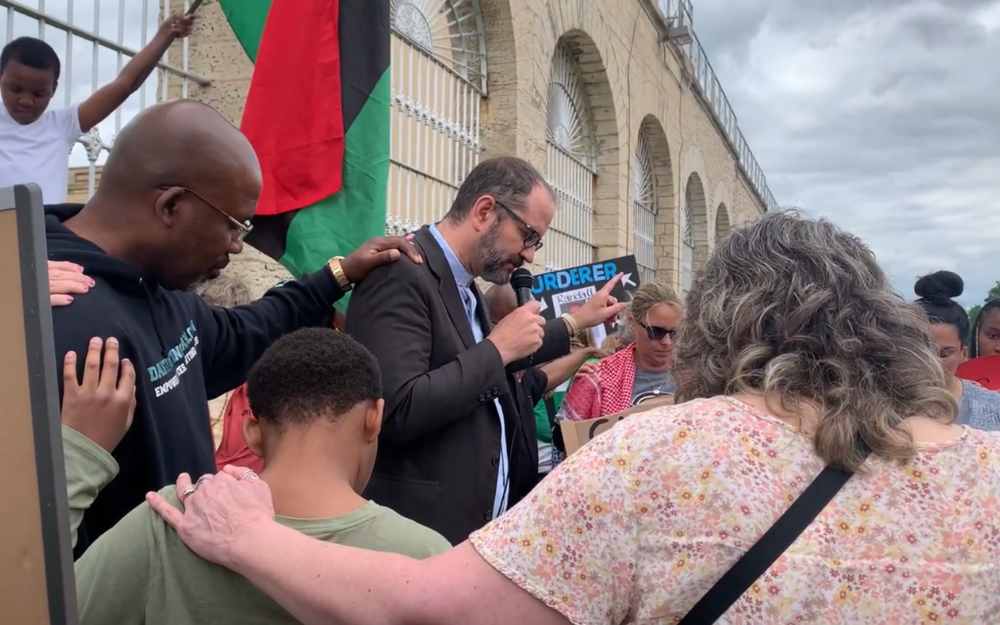
Reverend Darren Utley leads prayer outside the Waupun Correctional Institution. He is an avid defender of the rights of incarcerated people.
Following his interest
Utley, 55, didn’t set out to be a clergyman. As he described it, he went to seminary and joined the clergy by default. With none of what he called, “Normal career ambitions,” he floundered. He taught high school “because I was offered a job,” he said. “I wasn’t necessarily bad at it; it just wasn’t doing it for me.”
It was the Bible’s Gospel stories that hooked him and reeled him in.
Throughout his childhood, Utley’s family bounced between different conservative Protestant Christian denominations, he said. His parents divorced when he was kindergarten age, and when his mother remarried, the family moved about every three years because of his stepfather’s work.
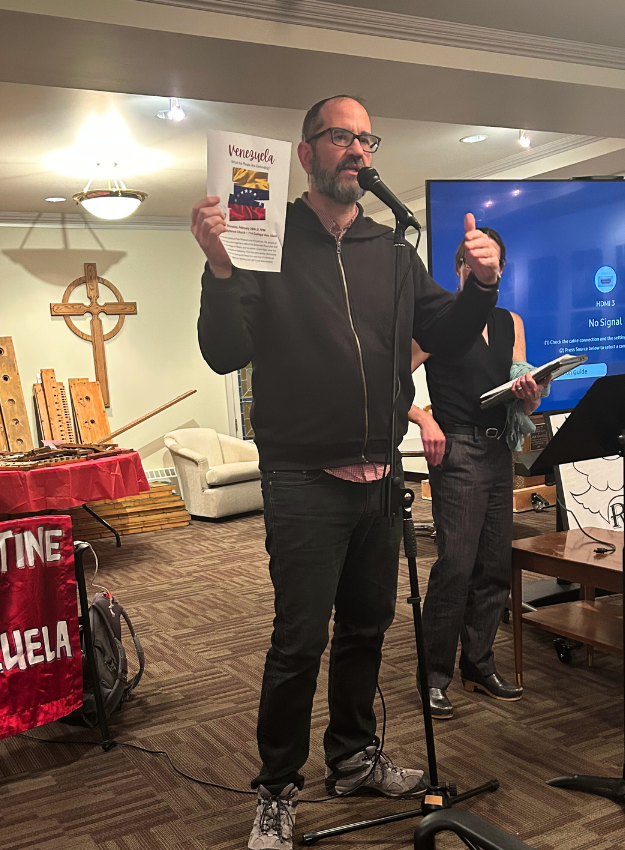
Rev. Darren Utley holds a flier about an upcoming program on Venezuela at the conclusion of an educational program on Gaza. He and the First Presbyterian Church of Racine host the Racine Coalition for Peace and Justice’s programs.
“I don’t really know what it was but, when I was in high school, the main stories of the Gospel (which focus on the life, death and resurrection of Jesus) stuck out to me,” Utley said. “I would read and reread the Gospels (the first four books of the New Testament—Matthew, Mark, Luke and John). I wasn’t a ‘holier-than-thou’ type of kid; it was just something I did.
“I felt that those stories described a way of being in the world and it was something I wanted to figure out how to do.”
His interest in the Gospel stories didn’t match up with many professions, he noted. So rather than aspiring to a certain career, Utley focused on “studying that thing I’m interested in.”
Going to Bible College in Ohio right after high school seemed like a logical choice, he said. “But that’s not what Bible college is. It’s really an indoctrination into a particular branch of understanding. I don’t remember the denomination now, but it was something like ‘the Christian Church,’ he said with a laugh. “Something fairly conservative.
“I didn’t find what I was doing there matched with what I thought I would be doing,” he said. “I ended up skipping classes and doing a lot of urban ministry work. I joined a group and we went out early in the morning, picked up donuts and went down to a homeless shelter, had a little church service and just talked with people. We’d look through the want-ads with them.”
Utley decided that Bible College wasn’t the right place for him. He moved back to Illinois to live with his parents for a while. Then he moved up to Grand Rapids, Michigan to stay with one of his high school friends. He stayed 12 years, met Debora, who became his wife and graduated from a Bible college of the Christian Reform Church. “It was fairly conservative, too,” Utley said. “But what I was interested in was finding people who were in need. That’s what the Gospels showed. I was wrestling with this idea of how to actually live like I should. Being a pastor doesn’t necessarily lead to being the kind of person you want to be.
“What keeps kind of coming back to me, and I don’t think this is unique to Christianity, it comes across multiple faiths and to people without faith, is this sense that we are created to live in a world in a certain way,” he explained. “This world that we live in has enough for everyone. If we place people in our hearts and desire peace, we know what to do. People know what justice is. It rings true.”
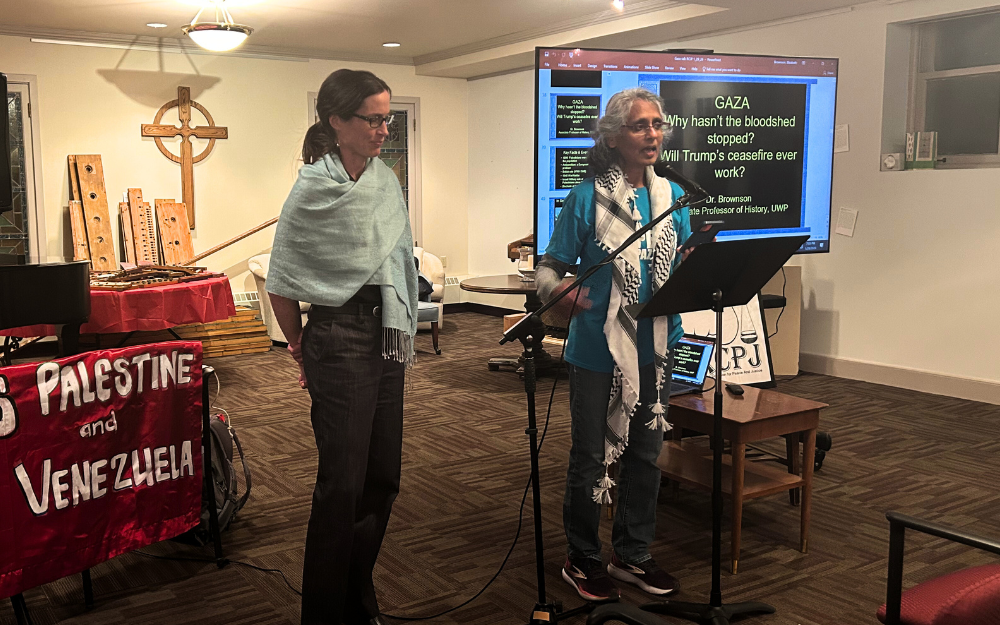
Elizabeth Brownson, Ph.D., (left) stood by as Racine Coalition for Peace and Justice president Sonali Knotek (right) introduced the University of Wisconsin-Parkside associate professor of history before her public talk on the often untold history behind the Israeli military’s assault on civilians in Gaza.
Fighting the good fight
Utley’s understanding of the Gospels and God’s message led him into activism, he said. “The Gospels is a story about that world God is calling into existence. There are people and powers who want to stamp that out for their own greed, their own profit and their own power. The people who want (to fulfill God’s will) have to fight them and do whatever you can to get to that world you want,” he said.
On a daily basis, it means “trying to attune myself to the voice that’s calling for the other possible world,” he said. And it’s not a fight for only Palestinian rights. “It goes across multiple causes. It’s the simple reality that everywhere there are people trying to live on their own land, sustain themselves and take care of their own people. If left alone, most people do that well.
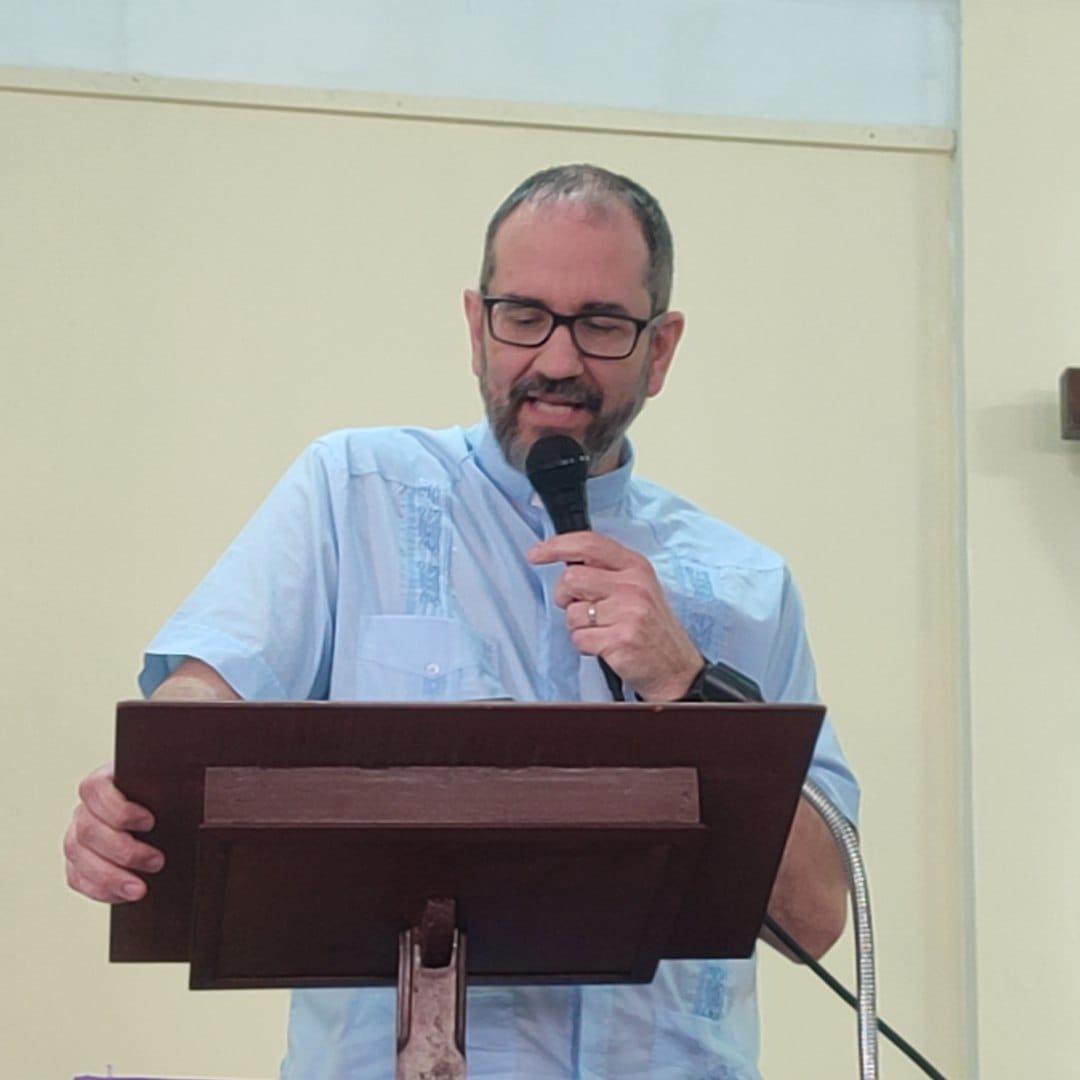
Pastor Darren Utley of Racine preaches in Matanzas, Cuba, in March during a visit with First Presbyterian Church of Racine’s sister church.
“Take the example of Cuba,” he said. “When you’re with the everyday people there, there’s a natural tendency to try to help each other out to make it through the worst circumstances.”
In March, Utley went to Cuba to visit the First Presbyterian Church of Racine’s sister church. On that visit, “most of the time, I just followed people around, listening to their stories.”
Although it’s difficult for Americans to travel to Cuba due to U.S.-Cuba relations, Utley can get a religious visa that is requested by a religious organization in Cuba. “It’s a long process and you have to be prepared to apply 60 to 90 days in advance.”
Now he is preparing to go again soon. “After what happened in Venezuela in January with the kidnapping of their president and the first lady, then (the Trump administration’s) attention turned toward Cuba,” Utley said. “My family and I thought, “Well, we need to try to get down there and bring whatever we can to the church and the community down there.
“The people at the church there are serving the community, too, so taking it to the church is taking it to everyone. We just want to make sure to get things they need down there because we are worried it will really shut down again.”
The Racine Coalition for Peace and Justice, a longstanding group that Utley joined after moving to Racine, is helping gather supplies and donations to go to Cuba with Utley.
Utley said the First Presbyterian Church in Racine and the Unitarian Church, that uses the church space and where Utley preaches once a month, have both been receptive to his call to stand with the oppressed. “In the Presbyterian Church, we are not decreeing on high what the people of the church should do. We are suggesting, making recommendations. People are open to changing their ideas. It is not as easy to change our actions.”
Utley’s underlying philosophy
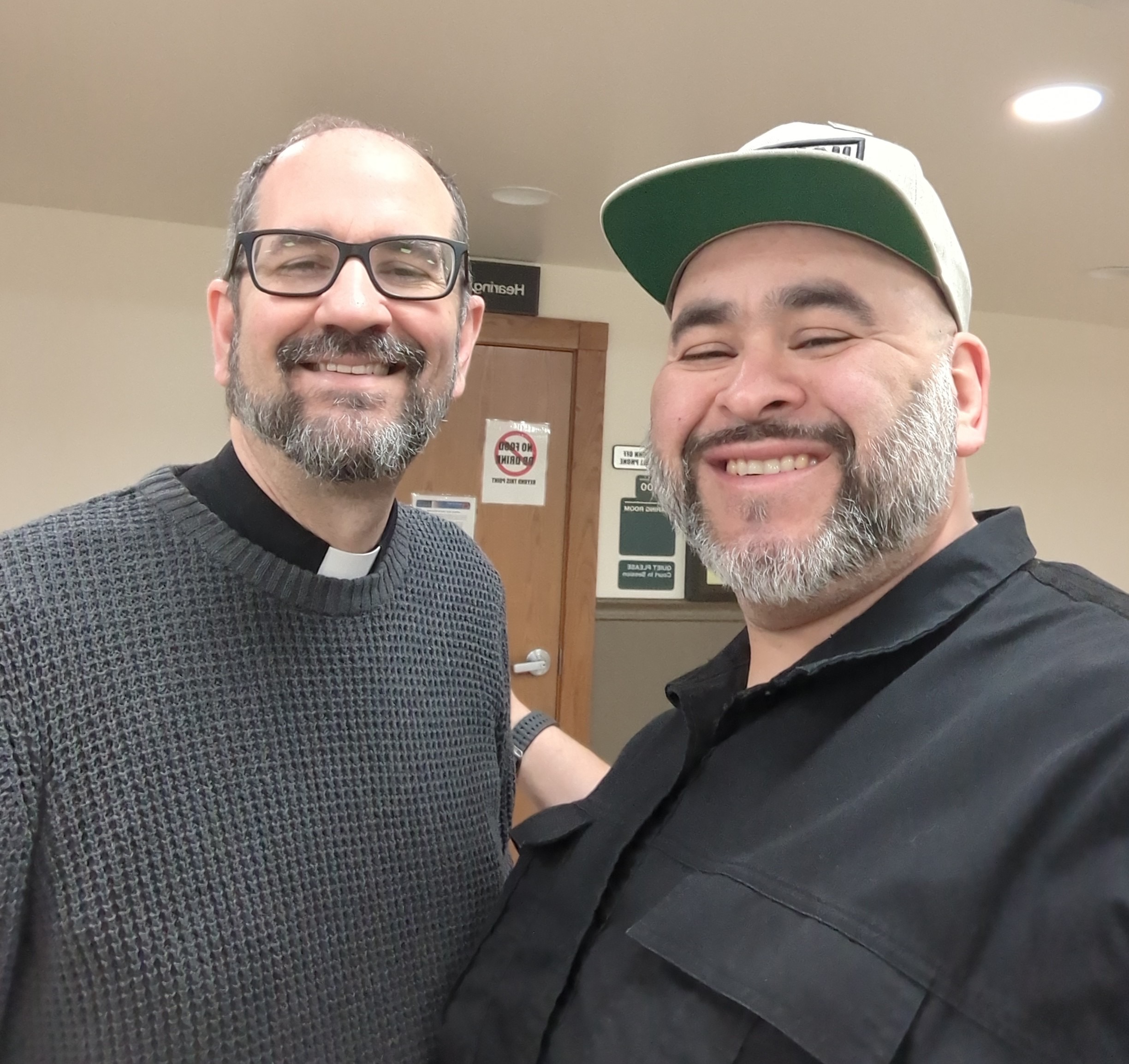
Pastor Darren Utley poses with his friend Bobby Ayala. Ayala, who was incarcerated for 27 years, and was befriended by Utley when adjusting to “life on the outside,” joins Utley in activism on prison reform and justice.
“Especially since 9/11 and afterwards, what has shaped my advocacy is my reading of the Gospels,” Utley reiterated. “The Gospels and the Hebrew scriptures are anti-imperial scriptures for people subjected to imperial powers, whatever they may be. They ring out with the message not to accommodate or play along with the empires, that you have to be a separate people. You have to counter what they are doing.
“What I’ve learned over the past 25 years is that we live in the empire,” he continued. “We are today’s empire. We are Rome; we are Babylon. If we are trying to be a people who read these scriptures and follow them, what does it mean to combat empires for us?
“In part, it means to stand on the side of those who are being oppressed by the empire, to be true to general human dignity.
“To do that, we need to turn our attention to ourselves,” he said. “It’s not just people over there. It’s a problem we all have. We are still buying into American exceptionalism. We’re still not seeing ourselves as the main people causing all the problems. Until we get to that place, we are only picking around the edges.
“Especially since the George Floyd protests and all the ICE abductions going on now, people are organizing to provide mutual aid to each other. It is not just advocacy around issues we need to be doing. We need to make sure people have food, rides, what they need to survive the situation we’re in now and where we need to get to. We need to put the steps in place to actually do it.
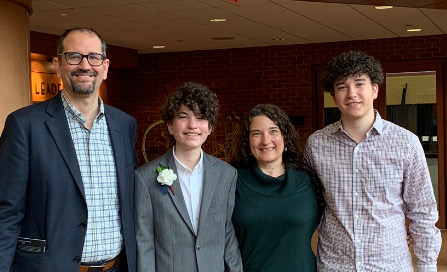
Pastor Darren Utley, his son Joshua, wife Debora and son David often protest injustice as a family.
“Beyond just having the right ideas about things, we need to be an actual presence. What does it mean to be people who are concerned about people’s liberation, people willing to bring unjust laws, to hide people, to provide sanctuary?”