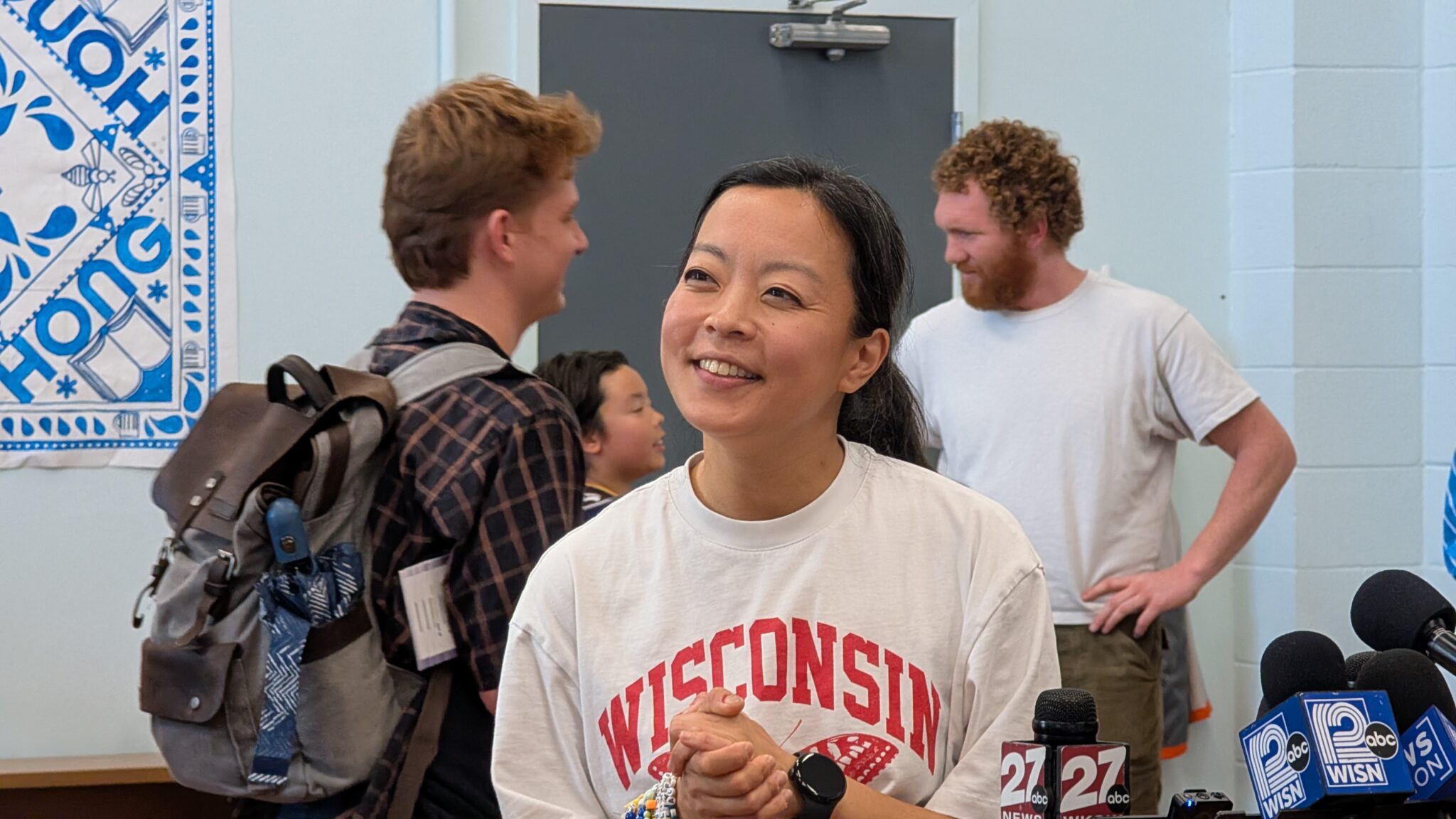
“It’s not just about winning tomorrow, but it’s about uniting our coalition. It’s about bringing in new builders. It’s about making sure everyone in Wisconsin sees themselves in our vision for a better Wisconsin for everyone,” Hong said. (Photo by Baylor Spears/Wisconsin Examiner)
Wisconsin’s crazy rollercoaster of a Democratic primary is finally over. After staying up all night waiting to see David Crowley declared the winner by one-half of one percentage point at 2:30 Wednesday morning, a lot of voters are feeling dizzy and seasick.
Many Francesca Hong supporters are angry. Their grassroots campaign, the best organized, most energized, with the boldest vision throughout the race, was big-footed by Gov. Tony Evers’ last-minute endorsement of Milwaukee County Executive David Crowley. Adding insult to injury, Crowley had already dropped out when Evers urged him to jump back in with a big boost from late campaign cash, apparently for the sole purpose of thwarting Hong.
Crowley supporters are relieved. They saw Hong as an inexperienced candidate who would lose a winnable general election to Republican Tom Tiffany, a Donald Trump enabler and election denier who has plans to sell off public lands and bring back a total abortion ban.
National media viewed the Wisconsin primary as a test of the left which, according to the New York Times, the left clearly failed with Hong’s “stunning” loss.
But feverish punditry about the significance of Wisconsin’s primary has distorted the real meaning of the results. Polls showing Hong was on track to win by double digits were less accurate than the anecdotal experience of voters who knew their friends and neighbors were fretting about how to vote and hadn’t made up their minds right up until Election Day. Those voters moved to Crowley in big numbers at the very end of the race, as he came to seem like the safe alternative. But Hong’s near-miss is hardly a stunning defeat. On the contrary, it showed real strength for a candidate who, when she started, was counted out.
If your main exposure to Hong was the video of her appearance on Fox News, where she talked in circles about an old tweet in which she recommended canceling Thanksgiving, refusing to either disavow or endorse the idea, the worry made sense.
It wasn’t just old, establishment types who felt it. “A lot of our members had to be talked down off the fence, they were so worried about electability,” says Robert Kraig, executive director of Citizen Action of Wisconsin, which endorsed Hong.
For those voters, the big struggle in the primary was a contest between hope and fear. Kraig sees this as a natural phenomenon. “People are hard-wired to be risk-averse,” he says. Especially when the stakes are high, people’s fears, and the sense that they have to protect what they have, overcome their aspirations for something better. Kraig spent time trying to persuade people that they needed to be more imaginative, to consider that many candidates who once seemed improbable, including President Barack Obama and Sen. Tammy Baldwin, changed people’s views of “electability.”
Hong’s priorities — free childcare, a massive expansion of healthcare, a big minimum wage hike, fully funded schools paid for with a tax increase on the rich — and her assertive, take-it-to-the-hoop attacks on Tiffany, whom she called a “traitor,” resonated with a lot of Wisconsin Democrats. It was the fear that she was not ready for prime time, that she would lose regular voters by speaking the lingo of the academic left, more than her socialist policy positions, that caused them to jump ship. That doesn’t mean the Hong movement failed, or that Democrats can afford to ignore it now that Crowley pulled off his narrow win.
As Kraig points out, voters are not particularly attached to “moderate” policy positions. Progressive ideas can generate big support among a cross-section of voters. Hong’s campaign demonstrated that.
It makes sense that people who were the most fed up, who felt they had the least to lose, supported Hong. Some were young DSA members. But also, Kraig says, some of his group’s organizers who are “standard liberals” — doctors who are deeply concerned about the systemic failures of healthcare — pushed hard for the group to endorse Hong because of her recognition of the need for radical change in the healthcare system.
The night before the election, I watched Hong fire up canvassers at her campaign office on the east side of Madison. A young, excited group of volunteers clearly felt like they were part of something historic. That movement energy has not been lost. It’s up to Crowley to tap it and to Democrats to recognize its significance. It would be a huge mistake for the Crowley campaign, having pulled off its narrow victory, not to try to connect seriously with the grassroots energy that animated Hong’s supporters.
Kraig and Christine Neumann-Ortiz, the executive director of the immigrant rights group Voces de la Frontera, which also endorsed Hong, both hold out hope that Crowley, a former community organizer, will not just talk about “unity” with Hong voters, but will listen seriously to them and adopt some of their positions.
Kraig suggests that Crowley take a page from President Joe Biden, who invited the Bernie Sanders/Elizabeth Warren wing of the Democratic party to help him shape policy after he won in 2020. “It would be good to be credible. To take some positions. Not just call for unity. He could do events with Fran on some issues he wants to lean in on,” Kraig says.
Crowley could make inroads with an energized voting base by taking a stronger position against rapacious AI data centers — one of the issues that animated the Hong campaign. That could be complicated for him with his trade union endorsers. But Hong was the first to recognize what others now see: Voters are demanding a stronger stance.
“It’s going to be really important to connect to those organizer roots and to be bold, not to be timid and move to the center or the right,” says Neumann-Ortiz.
Voces embraced Hong because she was deeply engaged in defending immigrant rights, including through the Statewide Community Defense Network. “People are coming together to support immigrant families being persecuted by ICE,” Neumann-Ortiz says. Crowley could do more to connect to that, taking a clear stand in support of measures that protect immigrant families.
“We are in a period of growing authoritarianism — people see that, and growing economic inequality — people feel that,” says Neumann-Ortiz. “We need a movement that brings working people together and challenges the divisions of the right and Tom Tiffany. That’s what’s needed; not to lose that fighting spirit.”
People are fed up with the lesser-evil argument that “you have no choice,” she adds. And they aren’t putting up with it. “We have seen the emergence of candidates that are much more progressive,” she says. “They come out of a community organizing culture and are willing to demand more.”
More progressives are going to continue to run for office, Neumann-Ortiz predicts. Real political power, she says, “comes from that organized community. They are doing the real democracy work, not just in elections, but the ongoing work of people coming together.”
Crowley won with a boost from Evers, although he dismisses the idea that he is a creature of the “establishment.” Kraig thinks that’s silly – of course he got a big establishment hand up. But that doesn’t have to be how he governs.
“Progressive Era champions put into office by the political machines turned against them and became reformers,” Kraig points out. He holds out hope that Crowley, connecting with his organizer roots, might follow in that great Wisconsin tradition.