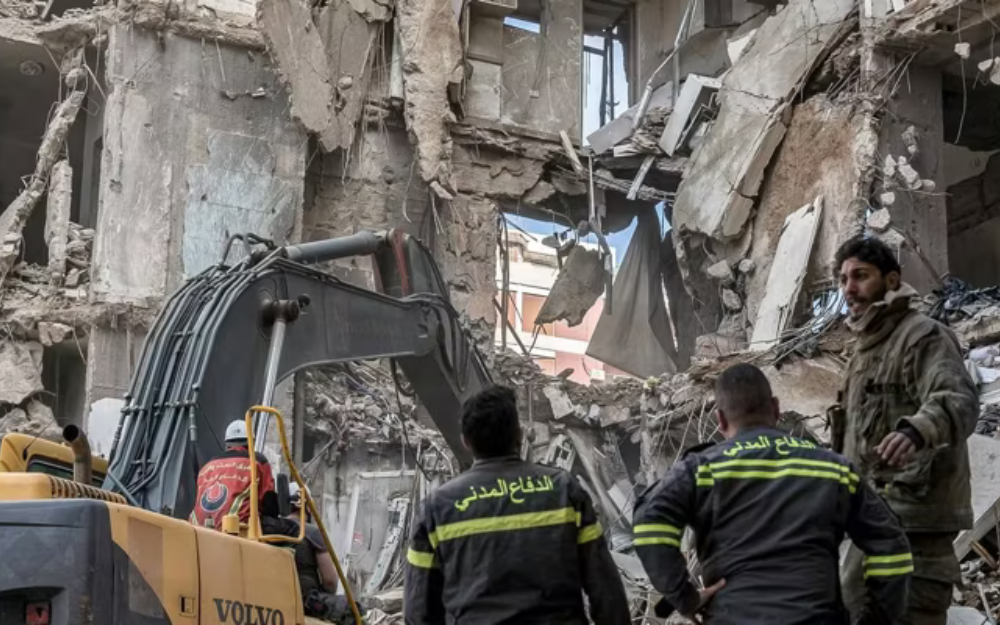
Rescue workers continued to search for missing people in the Beirut neighborhood of Tallet al-Khayat on April 8, 2026. (Photo by Sally Hayden/SOPA Images/LightRocket via Getty Images)
A United Nations agency said late Thursday that Israel’s massive bombardment of Lebanon earlier this week killed or wounded more than 180 children, a statement issued as the Israeli military vowed to continue assailing the war-ravaged country—potentially derailing ceasefire efforts in Iran and across the region.
The UN Children’s Fund, widely known as UNICEF, said the toll from Israel’s assault on Wednesday brought the total number of children killed or wounded in Lebanon since March 2 to at least 600. The agency said it is “receiving reports of children being pulled from under the rubble, while others remain missing and separated from their families.”
“Many are experiencing trauma, having lost loved ones, their homes, and any sense of safety,” UNICEF said. “Across the country, more than one million people have been uprooted, including an estimated 390,000 children, many for the second, third, or even fourth time.”
UNICEF went on to echo growing concerns in the region, and around the world, that Israel’s continued bombing and invasion of Lebanon “poses a grave risk to the ceasefire and the efforts toward a lasting and comprehensive peace.”
“The children in Lebanon cannot be left behind,” the UN agency said.
UNICEF’s statement came as the chief of staff of the Israel Defense Forces said Lebanon is the Israeli military’s “primary combat” zone and that the IDF is “in a state of war, we are not in a ceasefire.”
US President Donald Trump and Israeli Prime Minister Benjamin Netanyahu have both insisted that Lebanon was not included in the Iran ceasefire agreement announced late Tuesday—a claim that Iranian leaders and Pakistan’s prime minister, who is mediating peace talks, have said is false.
On Thursday, Trump said Netanyahu agreed during a phone call to “low-key it” in Lebanon. But in a recorded statement addressed to residents of northern Israel on Thursday, Netanyahu declared: “There is no ceasefire in Lebanon. We continue to strike Hezbollah with force, and we will not stop until we restore your security.”
Netanyahu’s decision to escalate Israel’s attacks on Lebanon—killing hundreds of people and leveling entire neighborhoods—just hours after Trump announced the ceasefire deal with Iran fit with a longstanding pattern of the Israeli government undercutting diplomacy.
Jamal Abdi, president of the National Iranian American Council, wrote for The Intercept on Thursday that Israel “has worked ceaselessly to prevent any off-ramp from confrontation between the US and Iran,” noting that “in 1995, when Iran and the US flirted with economic rapprochement by opening the Iran oil industry to American investment and development, Israel and AIPAC lobbied Congress and President Bill Clinton to block it.”
“Netanyahu is widely thought to benefit from wars—from Gaza to Iran and now, most critically, in Lebanon—to shore up his political fortunes. He faces an election in October, and losing could lead to the revival of corruption charges that might land him in prison,” Abdi noted. “The question now may unfortunately not be whether Iran and the US can find a compromise. Instead, the fate of the global economy and, not least, Iranians themselves, could rest between Netanyahu and Trump, who faces his own political challenges in midterm elections this year.”
US Sen. Chris Van Hollen (D-Md.) wrote Thursday that “Netanyahu urged Trump to start this war, now Trump must demand he help end it.”
“Who’s calling the shots here?” Van Hollen asked.