Photos by Cherrie Hanson
Janan Najeeb’s idea for an Islamic public lending library grew into a unique community resource with a full time librarian and more than 5,000 cataloged items.
A large book order just arrived at the Islamic Resource Center’s lending library with books you’re unlikely to find in your local library or bookstore. And while you may be able to purchase some of them online, many books in IRC’s lending library are nowhere else in Wisconsin or the United States, patrons report.
“You won’t find a library of titles like ours where the public can just walk in off the street, get a library card and check out books,” said IRC founder Janan Najeeb.
“Like other libraries, we have book clubs for adults and youth that anyone can join, activities for children and we have an experienced, professional full-time librarian.”
“This library is a hidden gem right in our own backyard waiting to be discovered,” said long-time patron Srishti Sardana, Ph.D., an assistant professor of psychological and brain sciences at the University of Wisconsin-Milwaukee. “I hope more people from the faith, but most importantly, who are not learn about it.”
Wisconsin Muslim Journal interviewed Najeeb, Sardana and IRC librarian Jenny Wegener yesterday to provide an overview of this unique resource, available to all at no cost.
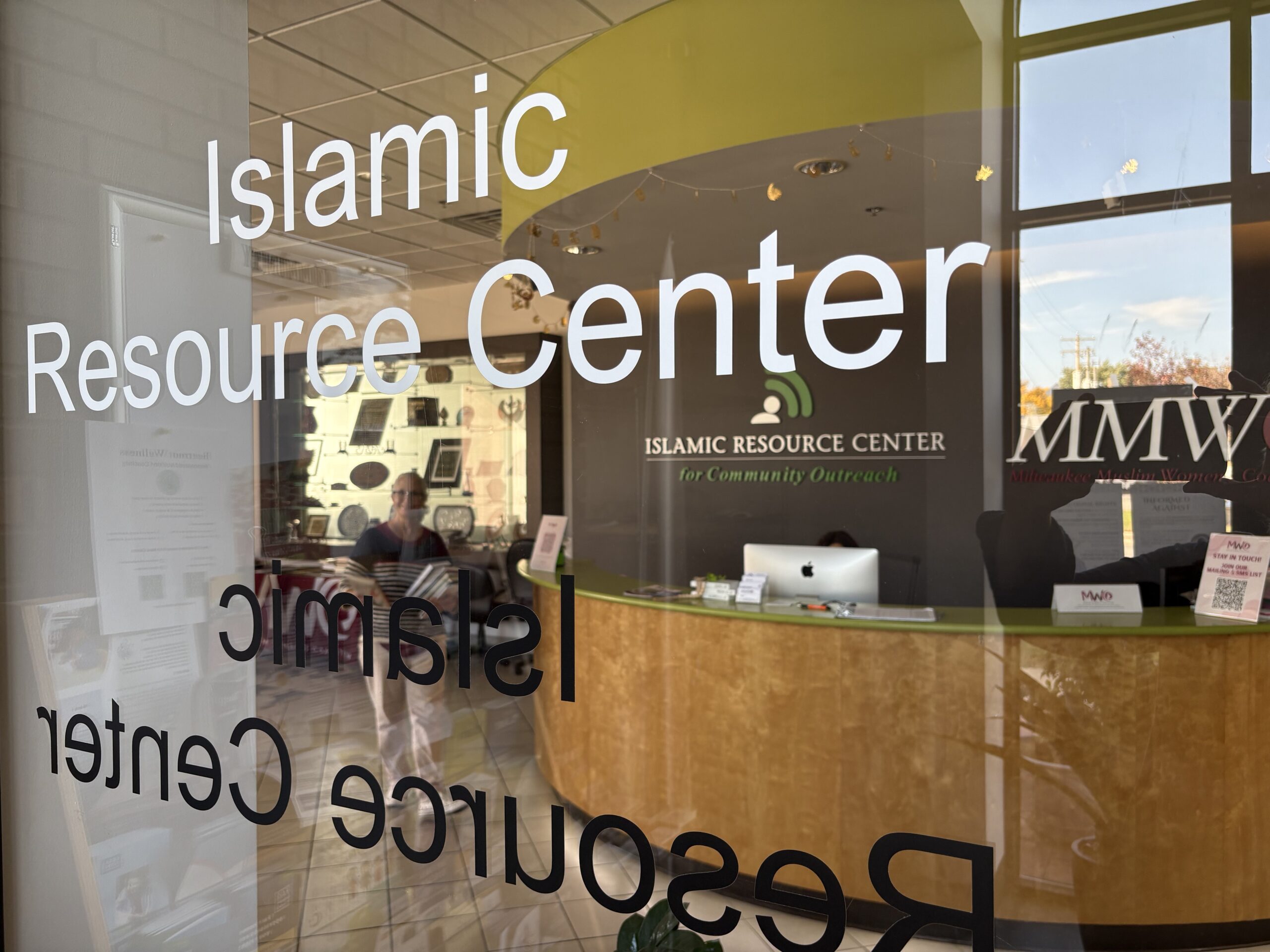
The Islamic Resource Center opened in 2011 at 5235 S. 27th St. in Greenfield. Hours are 10 a.m. to 6 p.m. Monday through Friday. A current driver’s license is required to register for a library card.
A useful resource for academics
Dr. Sardana, an IRC library patron since arriving to Milwaukee two years ago to teach at UWM, frequently checks out books for herself and to share with her students. They are useful in her research, clinical practice and teaching, she said. Dr. Sardana’s work focuses on how to build systems of mental health care to close the gap for treatment in low- and middle-income countries, as well as in high-income countries with low mental health resources. Her work takes her around the world to places of greatest need.
“As a scientist, what I struggle with most, which the library offsets for me, is the struggle to find resources written by Muslim authors,” she said. “When you look up resources in academic publishing, whether it’s journals or books, very few are by Muslim authors. Those written by people in our community don’t make it to the mainstream bookshelves or databases that are available online. I have to come to the library to find books I am able to cite in grant applications.
“I’m able to say, hey, here’s a book in my bibliography that you’ve not seen before. It’s an authentic source. In that way, it’s meeting a very important learning gap.”
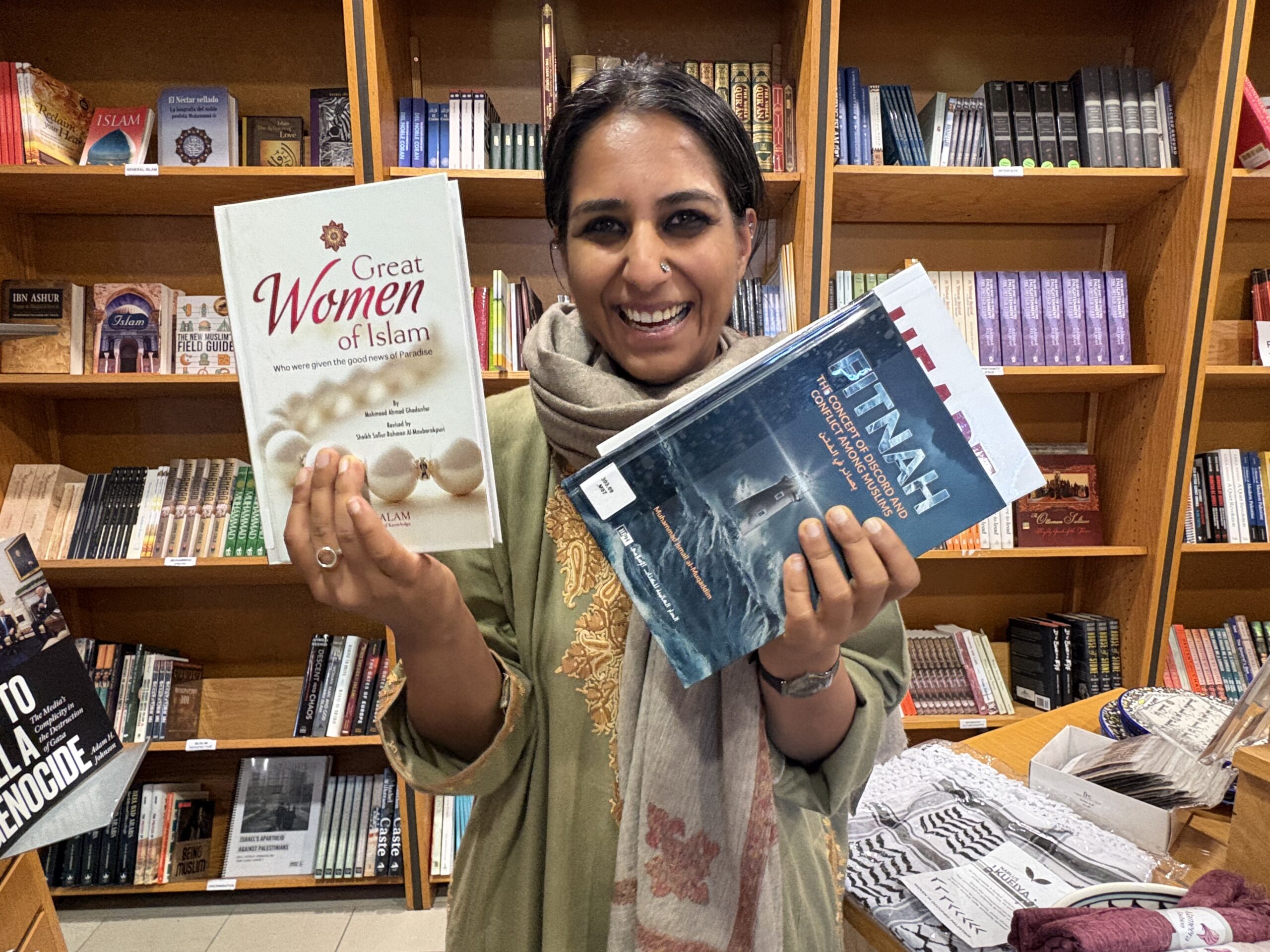
Srishti Meera Sardana, Ph.D., UWM assistant professor, Psychological and Brain Sciences seeks research material at the Islamic Resource Center library.
She also finds resources at the IRC library for her students. “One of the books I had checked out was Islam for Dummies. I’m using it to train my research assistants at UWM, who come from all faiths, religions, races and ethnicities. Most know nothing about Islam.
“I want students of other faiths and beliefs to truly understand Islam and see that it is different from what’s perpetuated,” she said. “The library is a source of both scholarship and knowledge, and also demystifies our culture, religion and community.”
Dr. Sardana needs her students to understand the Muslim community’s perspectives and unique challenges, she said. In one project, psychology students are learning to strengthen Muslim families that experience domestic discord and conflict.
“I want my students to learn how to properly, appropriately, respectfully talk with Muslim families without imposing external knowledge that doesn’t align with both the culture and the language of the folks in our community. I want them to learn to be more truly culturally responsive. They’re not going to get that from academic articles not written by a community or published by a community at all.
“I hope they all become library members,” she added.
Fulfilling the need for Islamic materials
When Najeeb began planning the IRC in 2010 (it opened in 2011), she knew she wanted to include a library. The Muslim Women’s Coalition Speakers bureau visited churches, schools and other groups to speak with audiences curious about Muslims and Islam.
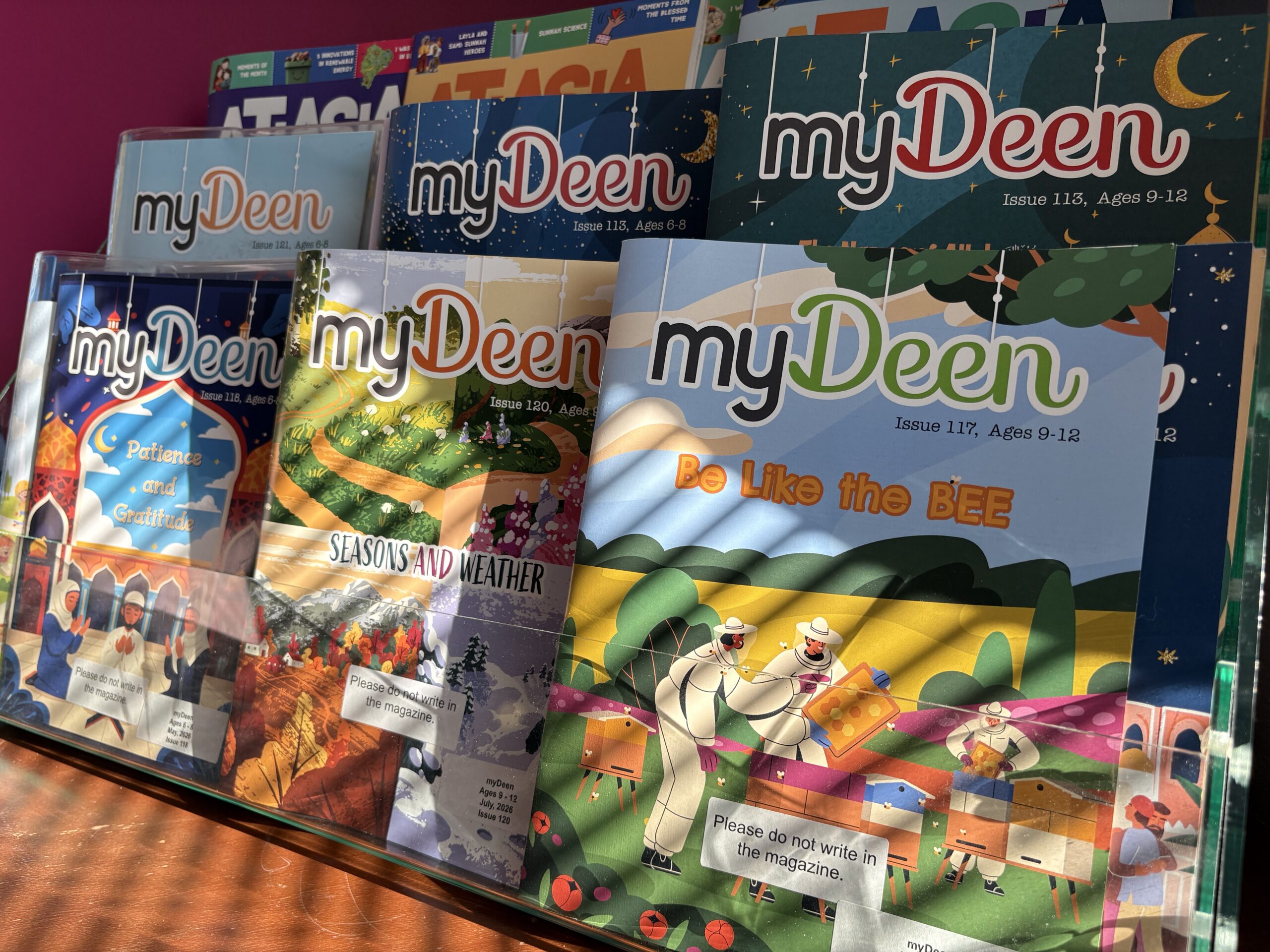
Children’s educational magazines, including Atlasia and My Deen, are available to read at the library or check out.
“They always asked for recommendations of books they could read for further information,” Najeeb said. She searched for herself and didn’t find much. “There was a lot out there that was inaccurate and perpetuated misconceptions.”
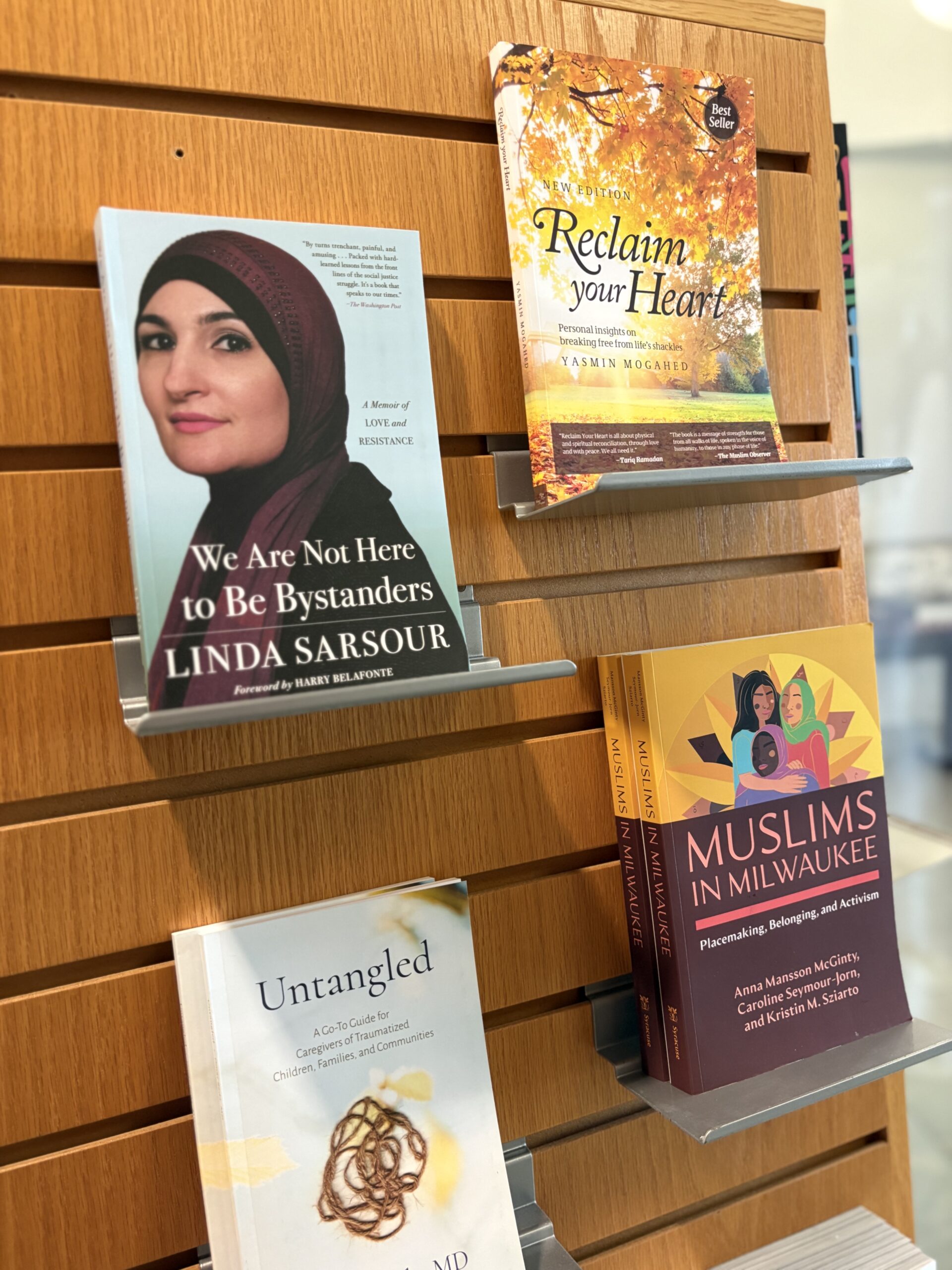
The adult book club selections are found in the library and the bookstore.
Najeeb’s first step was to search out Islamic libraries to see what they offered. “I went to New York, New Jersey, Chicago, Michigan, Ohio—I even went to Los Angeles, California. All the libraries were attached to other institutions. If there was an independent Islamic public lending library in the country, I could not find it.
“It’s different when you have a library in a mosque,” she added. “Muslims at the mosque can use it but the general public won’t find it.”
“We have a solid core of regular visitors, and they are not all Muslims,” Najeeb said. Frequent patrons include school teachers, pastors, members of the interfaith community and others of all cultures and faith looking for curated, vetted material.
Like many libraries, the IRC offers story times for children and book clubs, including a book club for middle school girls and an interfaith book club for adults.
The library is funded through the IRC’s operational budget and donations made to the library from community members, Najeeb said.
Then Najeeb “spent a good year” visiting book stories in Greater Milwaukee and public libraries, looking for Islamic titles. “I would go to six or seven bookstores every month to see their religion sections. I never found more than five or six titles. Usually, they would have one or two translations of the Quran, but often ones I had never heard of so couldn’t have confidence in. Other books I saw, sometimes bestsellers, would be books that were incredibly negative about Islam. I realized this kind of library with good resources was something really missing.
“How can we expect people to understand who we are as Muslims or to understand our faith when all the information they’re getting is from anti-Muslim sources. And back when we were starting, it was before people could just jump on the internet to get information.
“We needed children’s books where Muslim kids could see names and characters that they could identify with,” she continued. “We needed accurate information for Muslims and non-Muslims alike. I realized one of the most important things we could do in this facility (the IRC) would be to open up a lending library and bookstore. We started with a couple of hundred books and now we are upwards of 5,000, and of really high quality on a broad range of topics.”
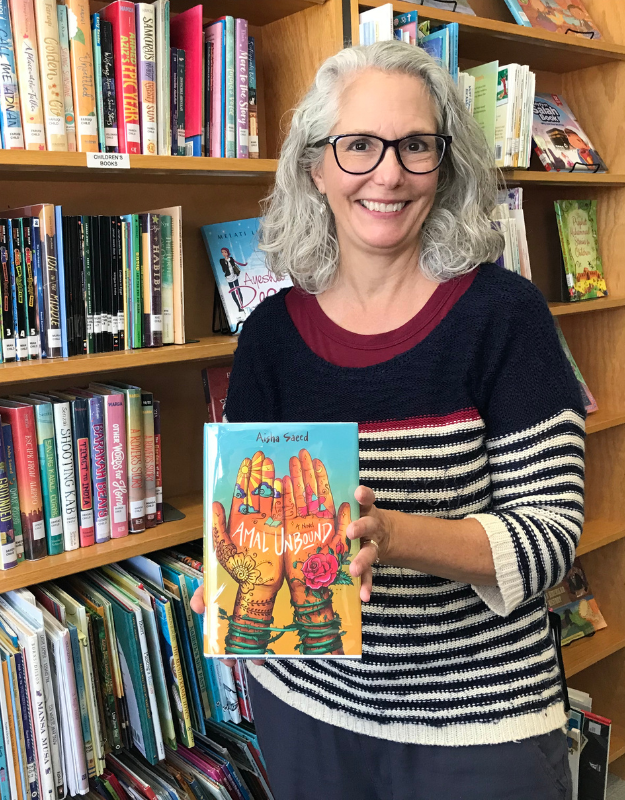
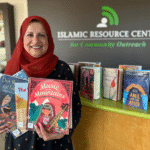
Islamic Resource Center librarian Jenny Wegener
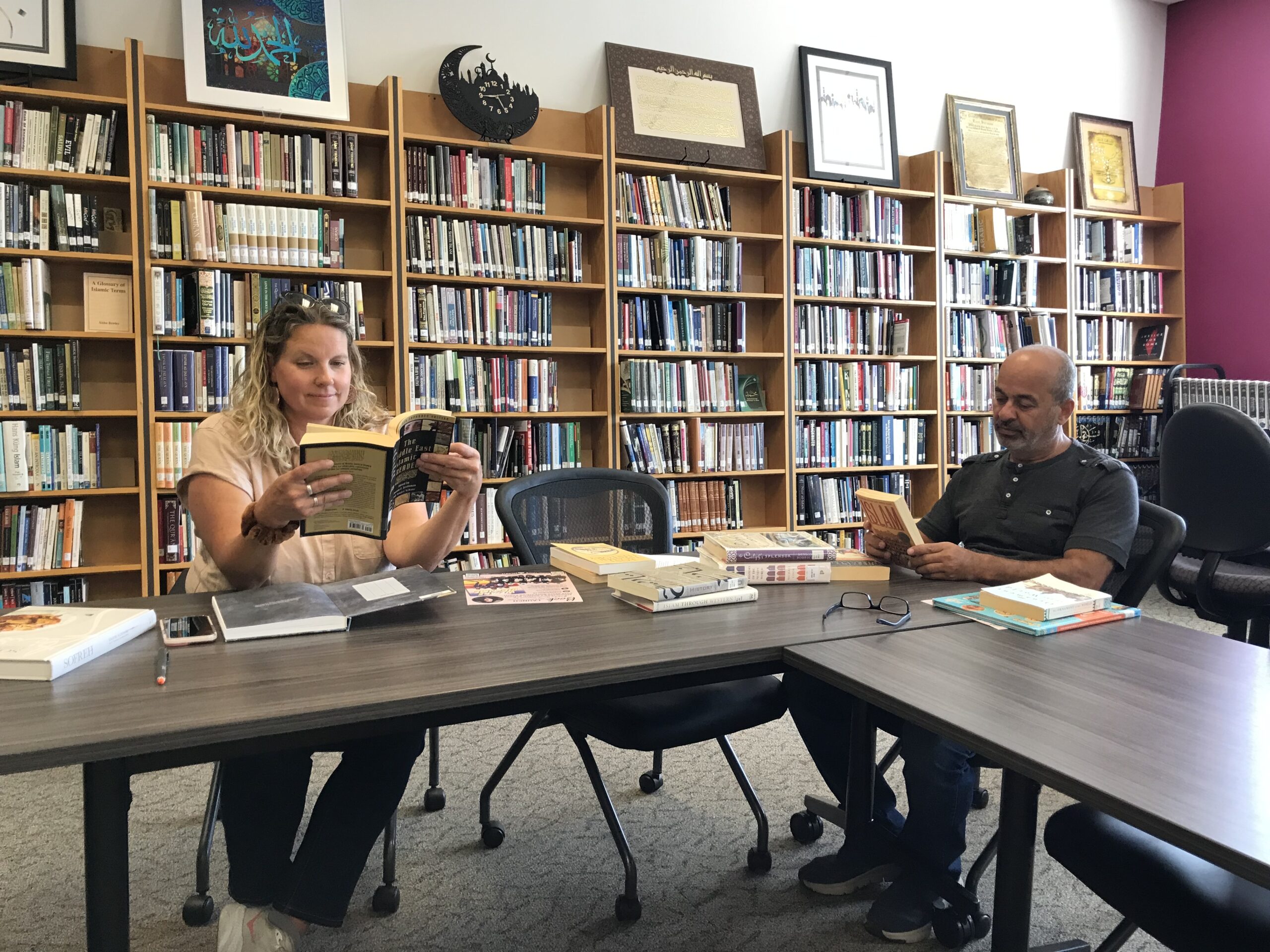
Khaled Abukamireh and his wife, Karen Squire enjoy spending time at the Islamic Resource Center library.
What’s on the shelves?
The IRC lending library can’t find all it needs from the usual sources, Wegener says. The librarian learns of many titles from community members and patrons, then seeks them out from Islamic publishing houses and, in one case, even from the author. (Wegener is communicating with an author in Jordan to get a requested title not available anywhere else.)
“If you say to a librarian, ‘I don’t know if you’ll be able to find this,’ you’ve just slapped down a challenge,” she laughed. “We’ll go to the end of the earth to find things for readers. That’s our favorite thing to do.”
“We have a unique collection because we bring in things from all over the world,” Najeeb said. “It’s not anything you’ll find in all the bookstores.”
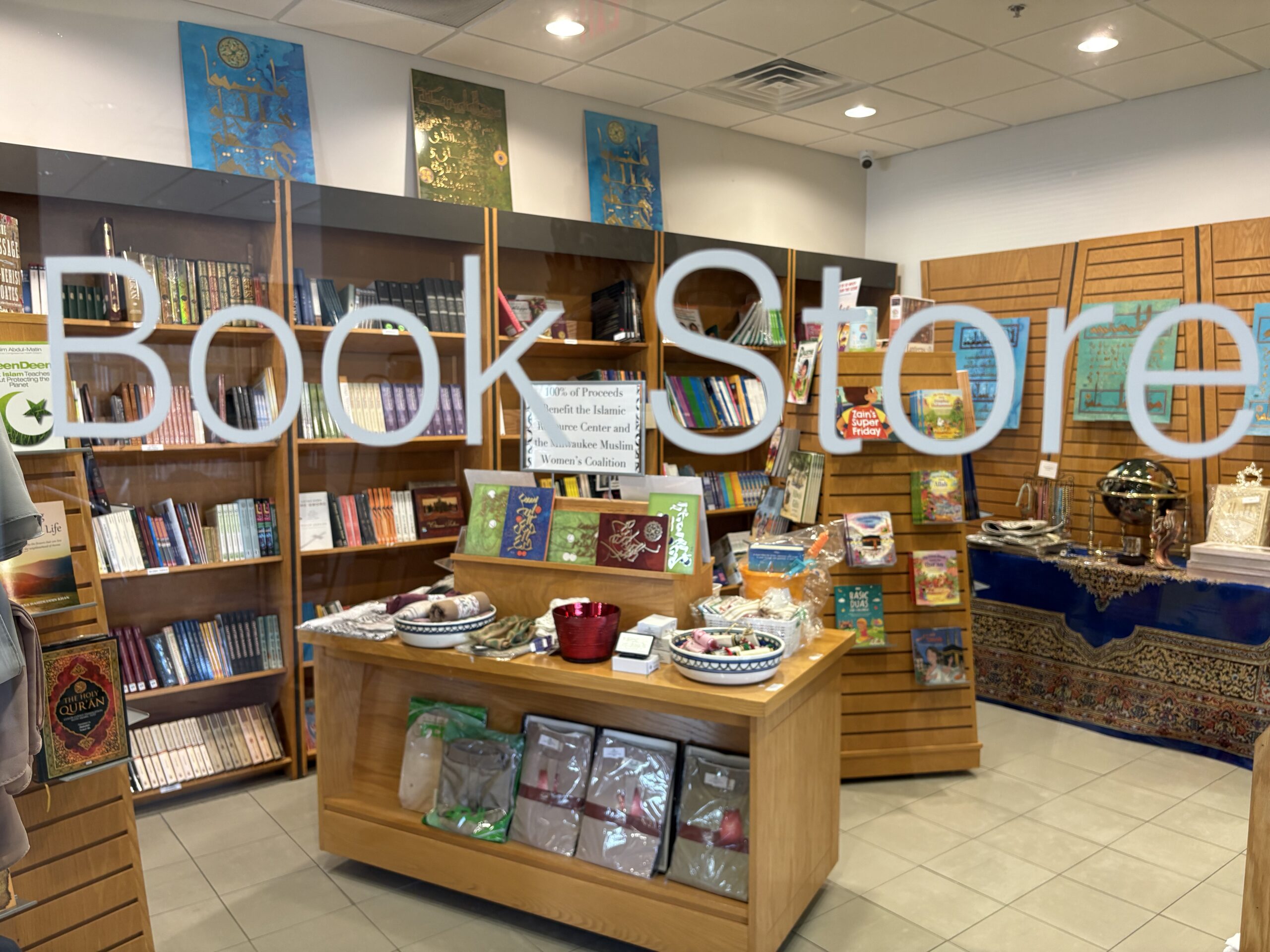
The Islamic Resource Center features a bookstore with clothing, gifts and artwork.
Three orders, about 60 books in all, arrived in August and September, Wegener said. Half were from Islamic publishing houses. They include new translations of classic tafseer (scholarly explanation of the Quran), other adult nonfiction and fiction, and titles (fiction and nonfiction) for children and young adults, including picture books.
Wegener sorted through the list of new titles to highlight some for Wisconsin Muslim Journal.
“For teens, the graphic nonfiction novel Our Stories Carried Us Here arrived,” she said. “It is an anthology of stories of young immigrants, including the story of a young Rohingya man who lives in Milwaukee.
“Also for teens, Gathering Words: A Quest for the Prophet’s Legacy came in. This book is the story of the journey of a seeker of knowledge and is a blend of fiction and reality. It combines academic exploration and adventure.
“For school age readers, we received Part 4 of the The Simple Seerah: The Story of Prophet Muhammad and a fun novel about a Pakistani girl who enjoys playing cricket while navigating being a good sister and daughter.
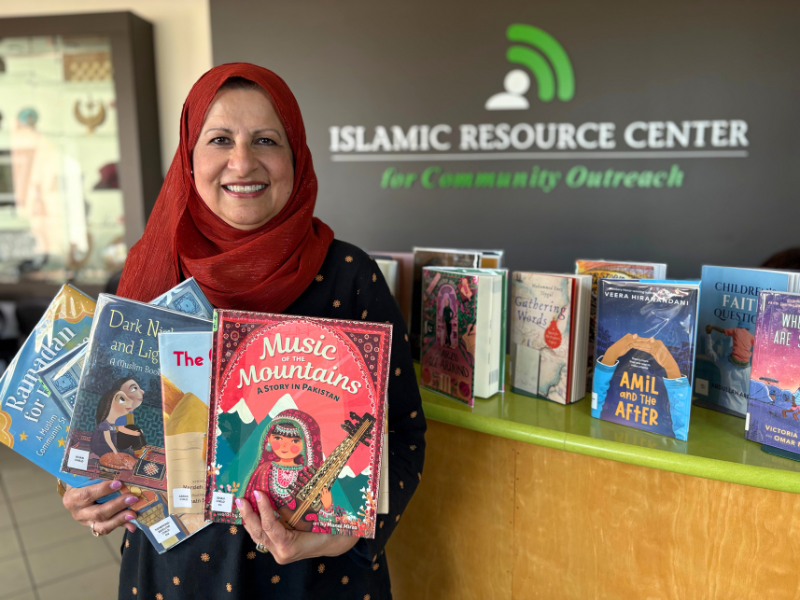
“Some beautiful new picture books that just came in include Ramadan Rain; Music of the Mountains: A Story in Pakistan; Home Away From Home, a story about a girl spending time with her grandmother overseas; and the nonfiction Mama in Congress: Rashida Tlaib’s Journey to Washington by Rashida and Adam Tlaib.
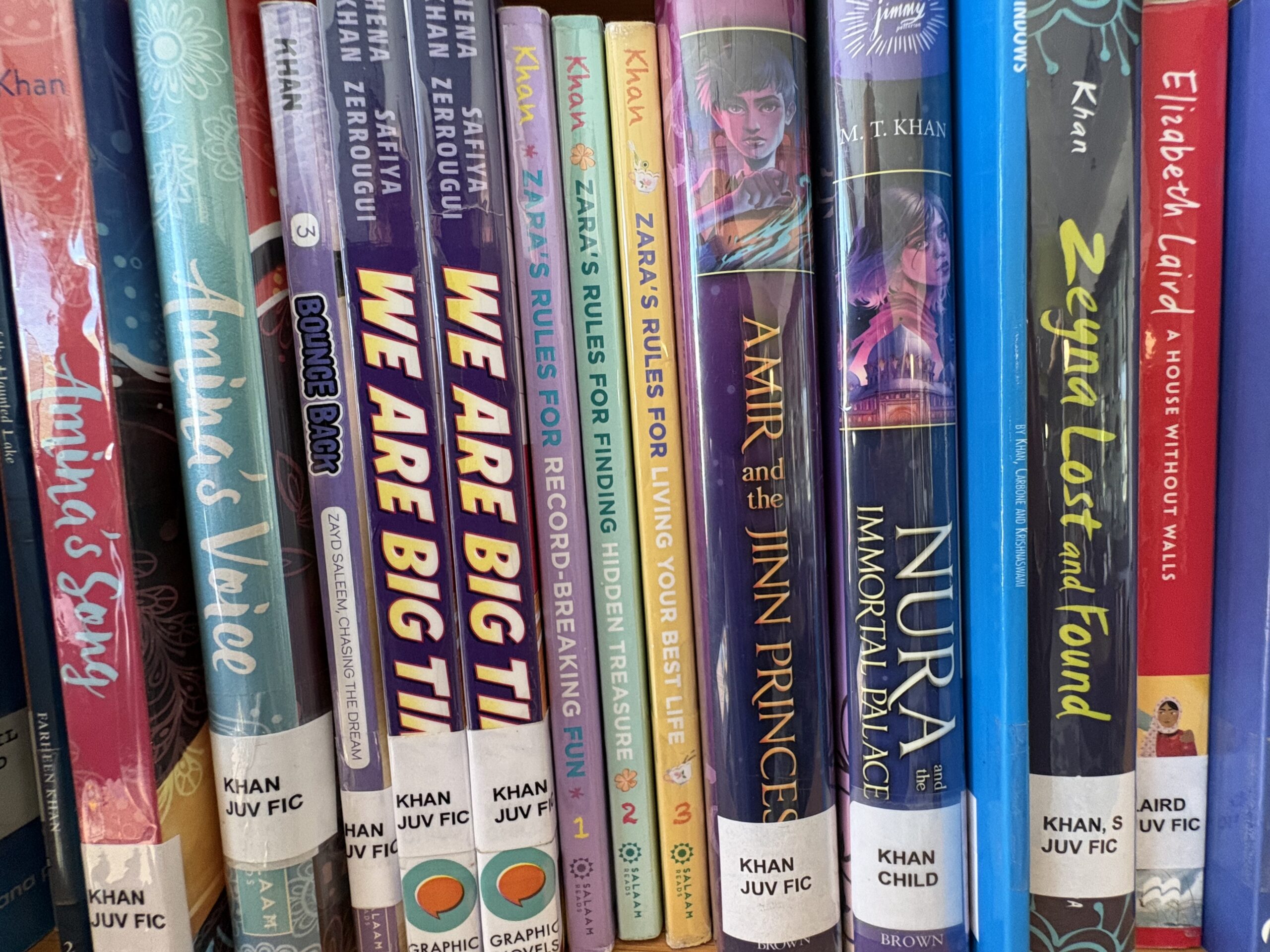
The library offers a youth book club and carries a selection of books for teen readers.
“For adults, this shipment included: Dear Moon: Inspiration from the Beautiful Wisconsin of the Quran, Children’s Faith Questions and an incredibly beautiful copy of Mukhtasar Sahih Al-Bukhari that is in Arabic and English. This is an abridgement of the Hadith compiled by Imam Muhammad al-Bukhari – one of the most famous collections of the Sunnah of the Prophet.
“We have a special place here because we can provide Muslim parents and non-Muslims with books centered around faith and Islamic identity,” Wegener said. “They are not just good reads but books that reflect a cultural identity. Parents can share lovely picture books with children that reflect their identities. Independent readers can find books that address issues they might be dealing with, like fasting in Ramadan. Muslim kids can find characters just like them. Adults can read about the faith and increase their knowledge or learn more about parenting or cooking or history, you name it. Non-Muslims find accurate information.
“And all within a very welcoming, safe space where they know they are always welcome.”
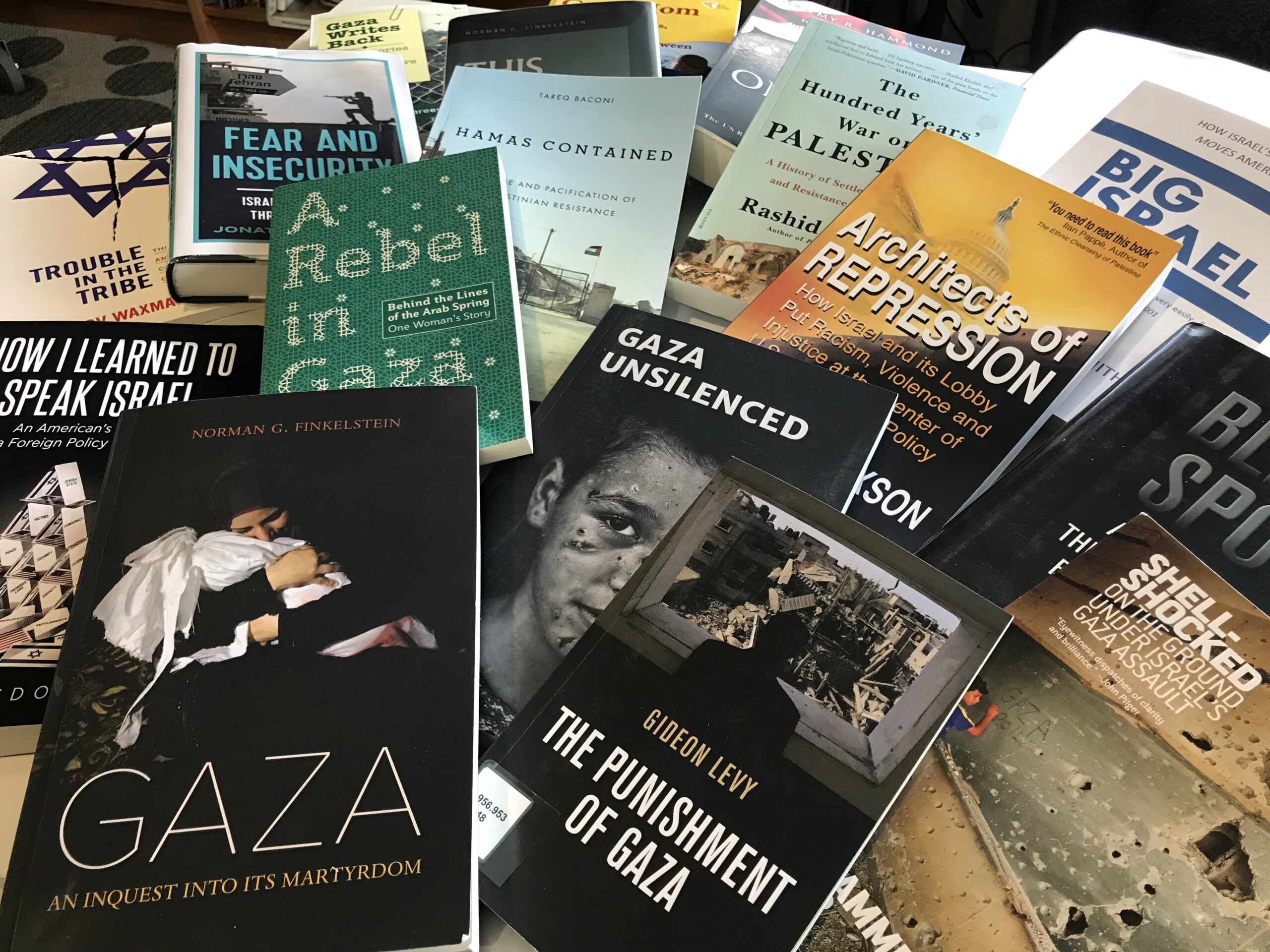
The Islamic Resource Center library at 5235 S. 27th St., Greenfield offers a growing collection of books on Gaza, Palestine, U.S. foreign policy and international law. Additional titles can be ordered upon request.
Because our stories matter
Wisconsin Muslim Journal reports on people, stories and experiences of Muslims across our state. As a nonprofit publication, we are committed to making this work available to everyone without a subscription or paywall.
Every story we publish is produced by professional journalists, photographers and editors committed to reporting on Wisconsin’s Muslim communities. Keeping this work going requires time, talent and resources.
If you value dedicated, fact-based coverage that documents Wisconsin Muslim history, please consider supporting us with a donation. Gifts of any size make a difference and help us continue to report on narratives that might otherwise go untold.
We are grateful for your readership.