Photos by Yaseen Najeeb
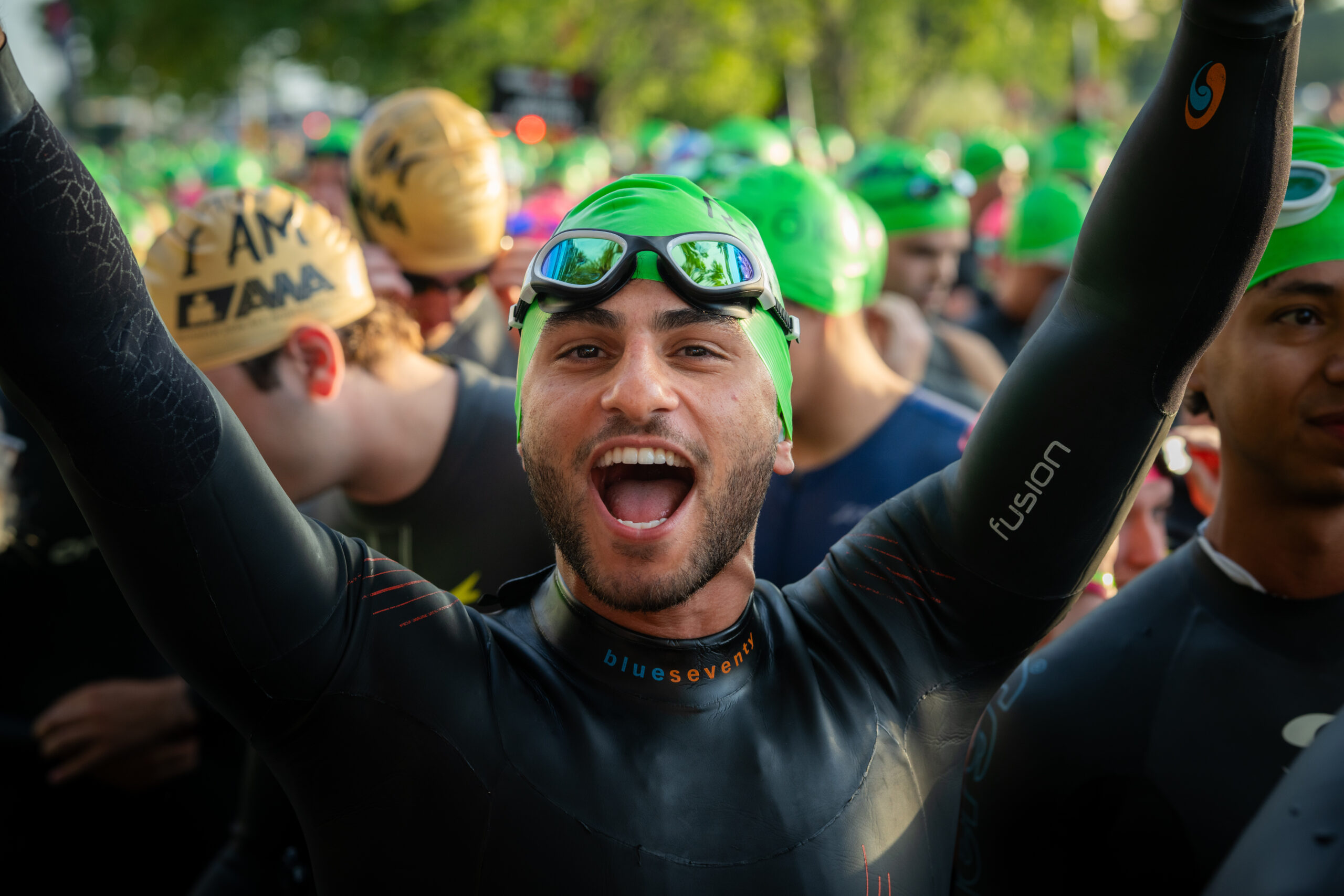
An adrenaline-charged Hadi Najeeb, 24, of Madison, lined up for the first event of the IRONMAN 70.3 Wisconsin on Saturday. He taught himself to swim competitively in just over eight months. “I knew I put in the work,” he said. “I just had to go out there and show it.”
Baby steps, that’s the key to tackling big challenges, says Hadi Najeeb of Madison, who completed the IRONMAN 70.3 Wisconsin. Eight and a half months ago, the 24-year-old started training practically from scratch, he said in an interview last week.
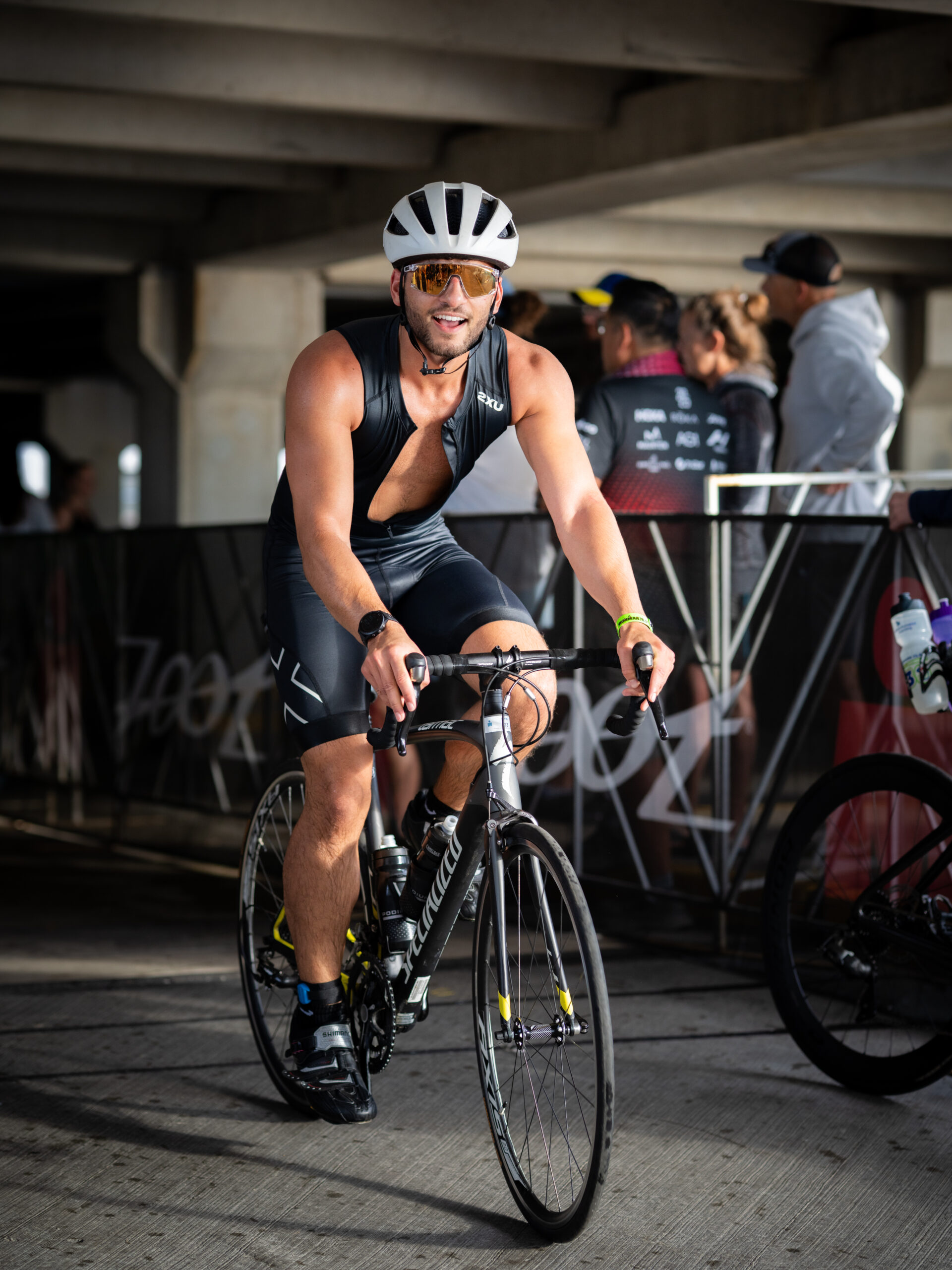
Hadi Najeeb had not owned a bike for a decade when he bought one this year to train for a triathlon.
“I was not a swimmer and I hadn’t ridden a bike since early middle school,” he said. “But everything went super well. I smashed my goals for time.”
Najeeb was among about 2,500 participants in the long-distance triathlon race held Saturday in Madison. It included a 1.2-mile swim in Lake Monona, a 56-mile challenging bike ride through Dane County’s rural countryside, known for its rolling hills, and a 13.1-mile hilly run that wound through the University of Wisconsin campus, inside Camp Randall Stadium and finished on the steps of the Wisconsin State Capitol.
Known as a “Half IRONMAN,” it is exactly half the distance of the full IRONMAN triathlon, which was held in Madison Sunday.
“He did 40 minutes better than he anticipated, which is amazing,” said Yaseen Najeeb of Milwaukee, Hadi’s older brother by four years. “He’s a very hard worker, very determined. And he’s very headstrong. When he sets his mind on something, for sure, he will complete it.”
The decision
Hadi Najeeb, a Milwaukee native, moved to Madison to study kinesiology at the University of Wisconsin. He graduated in 2024; an internship became a job, so he decided to stay.
Now a clinical specialist on the cardiac rhythm management program for Medtronic, a global healthcare technology company, Najeeb often has long, unpredictable work hours. “We’re experts in our devices, which are basically pacemakers, defibrillators and some other things,” he explained. “We support doctors during the implant process of these devices, and also support any sort of troubleshooting.”
Why add triathlon training to his already full schedule?
“Now, that’s a loaded question,” Najeeb said. “People do a triathlon for a lot of different reasons, but rarely just for fitness. People who like to build muscle actually lose their fitness look when training.
“When people do endurance sports like this, they are putting themselves in a situation where discipline becomes a non-negotiable. I’ve always had a very competitive nature. I’m someone addicted to fitness and just enjoy moving my body. I was an athlete in high school. Some injuries slowed me down. I wanted to see if I could get back to where I was.
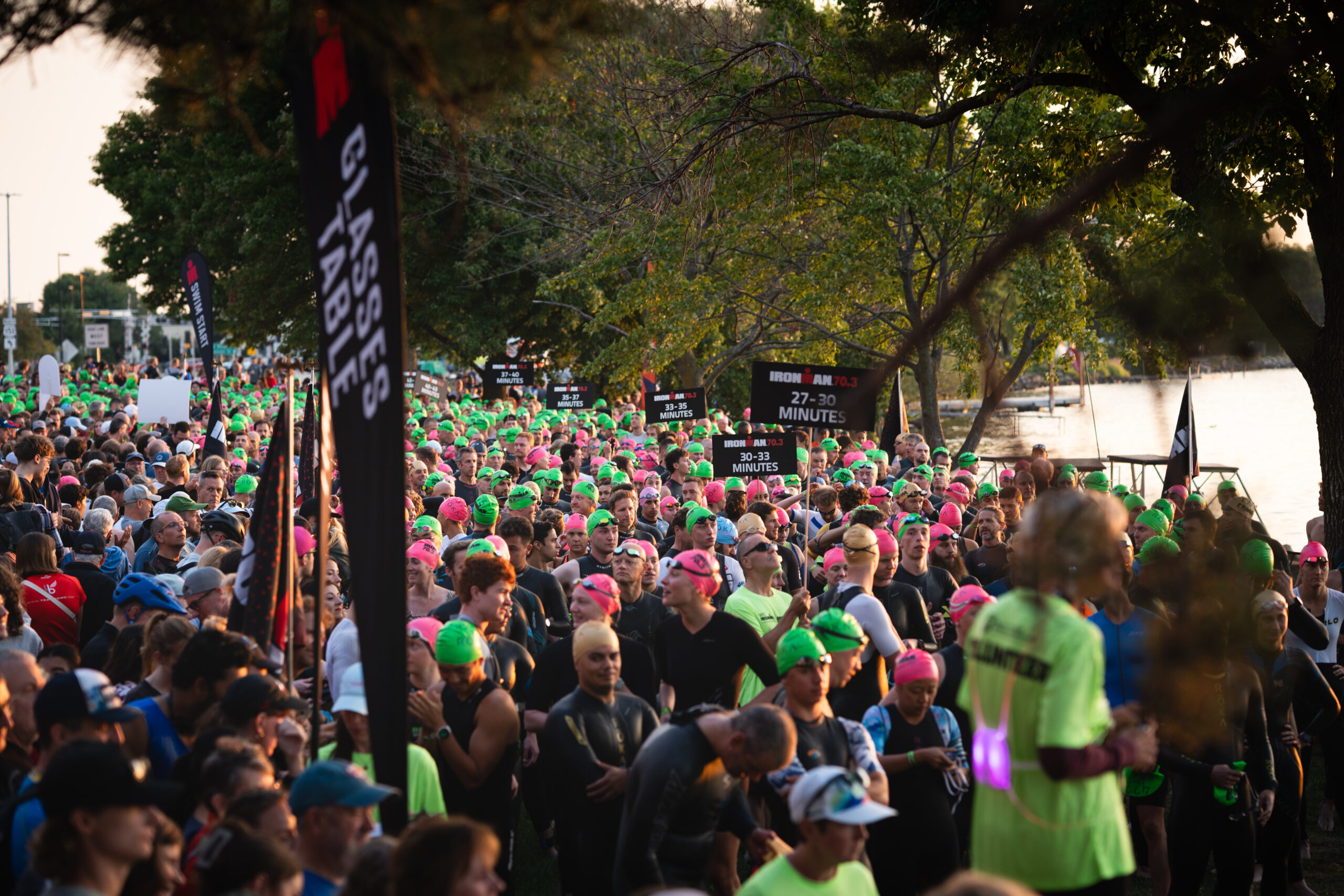
At the starting line, “it’s very jam-packed,” said Hadi Najeeb of Madison. “You can’t even extend your hands. They whistle for people to start. You go in five at a time, and you have about five seconds between waves.”
“I had to work through a lot of baby steps,” Najeeb recalled. “Every single day, you get a little bit better and you just keep progressing. A year goes by and you’re in a completely different space than you were before.
“For me, competing in a triathlon was not about training my body; it was about training my mind to get through difficult situations. Just like other situations—losing your job, a family crisis, whatever it is—realizing that time keeps moving and you really can keep progressing and moving forward is what matters to me. It’s really a battle of the mind.”
In November 2025, Najeeb challenged himself to a half-marathon and it went well. In December, he started thinking about the IRONMAN 70.3 triathlon.
“It seemed like an impossible task, but it’s been a dream of mine. I said to myself, ‘Let’s see what I’m capable of.’ Once you sign up, it becomes real,” he said.
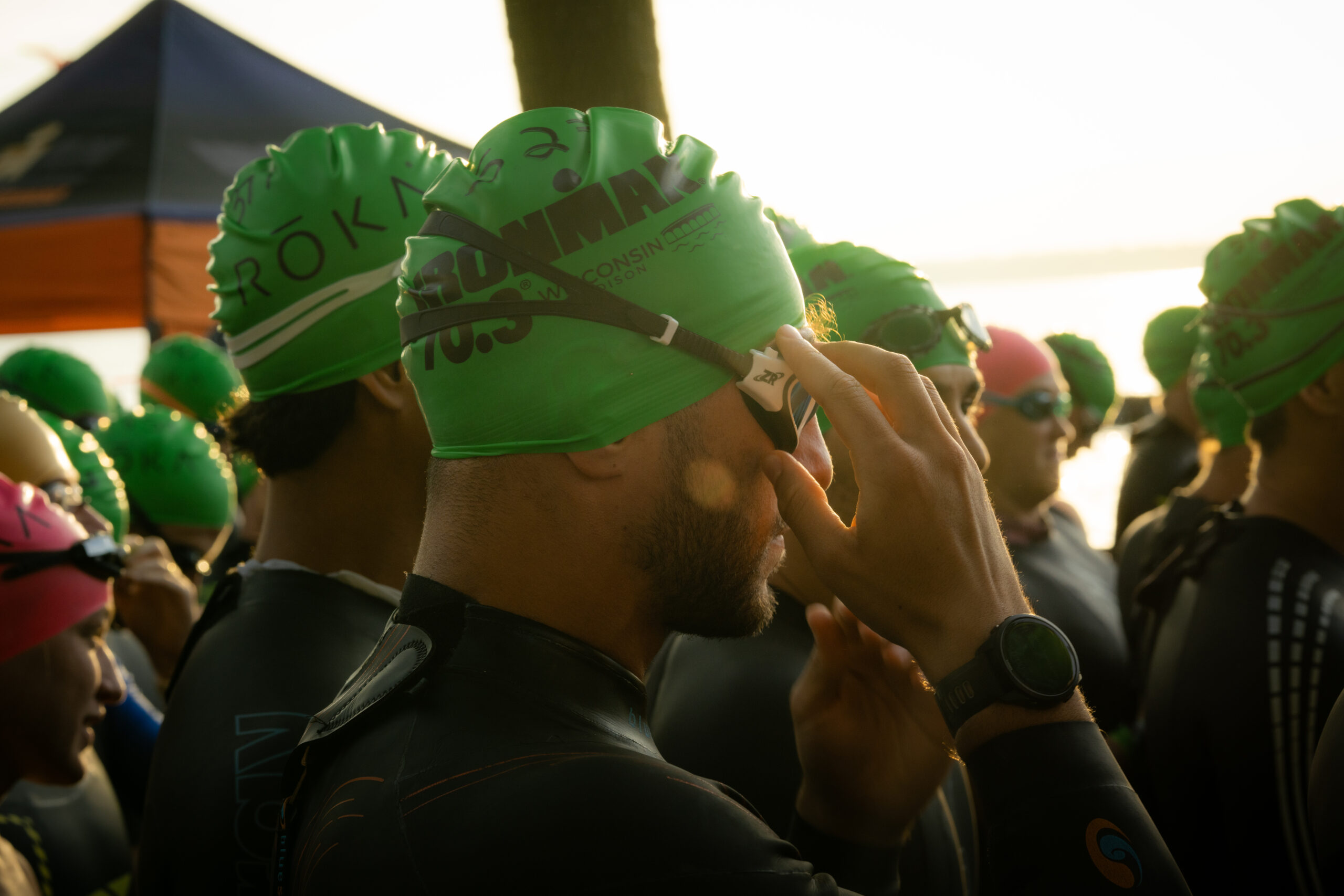
“I saw my family when I was going out and said hi to them,” triathlon competitor Hadi Najeeb said. “Then, I put on my goggles, put my earplugs in and got in the zone.”
Learning to swim, bike and take care of his body
Najeeb started training with a focus on swimming. “I took one step at a time. Swimming was its own battle,” he said.
“If you’re not a swimmer, you’re fighting to learn technique, fighting to not drown, fighting to figure it out. It’s a very difficult thing. I knew I couldn’t swim 50 yards without having to stop. I didn’t know form and technique. I taught myself.
“I’m a very social guy, so in the pool, I’d be asking people on my left and right for tips. I’d watch YouTube videos. I have a little notes app where I recorded things I learned in every single swim session. Before I’d hop into the pool each time, I’d check my notes for things to keep in mind while swimming.”
Sometimes, Najeeb asked himself, “Did I get too far ahead of myself by committing to this?” he said. “But if you keep showing up, you have a little win, like realizing you just swam 200 yards without a break. Now I’m easily swimming a mile on a regular day. Even if it’s raining and the waves are coming at me, I can fight my way through all that stuff.
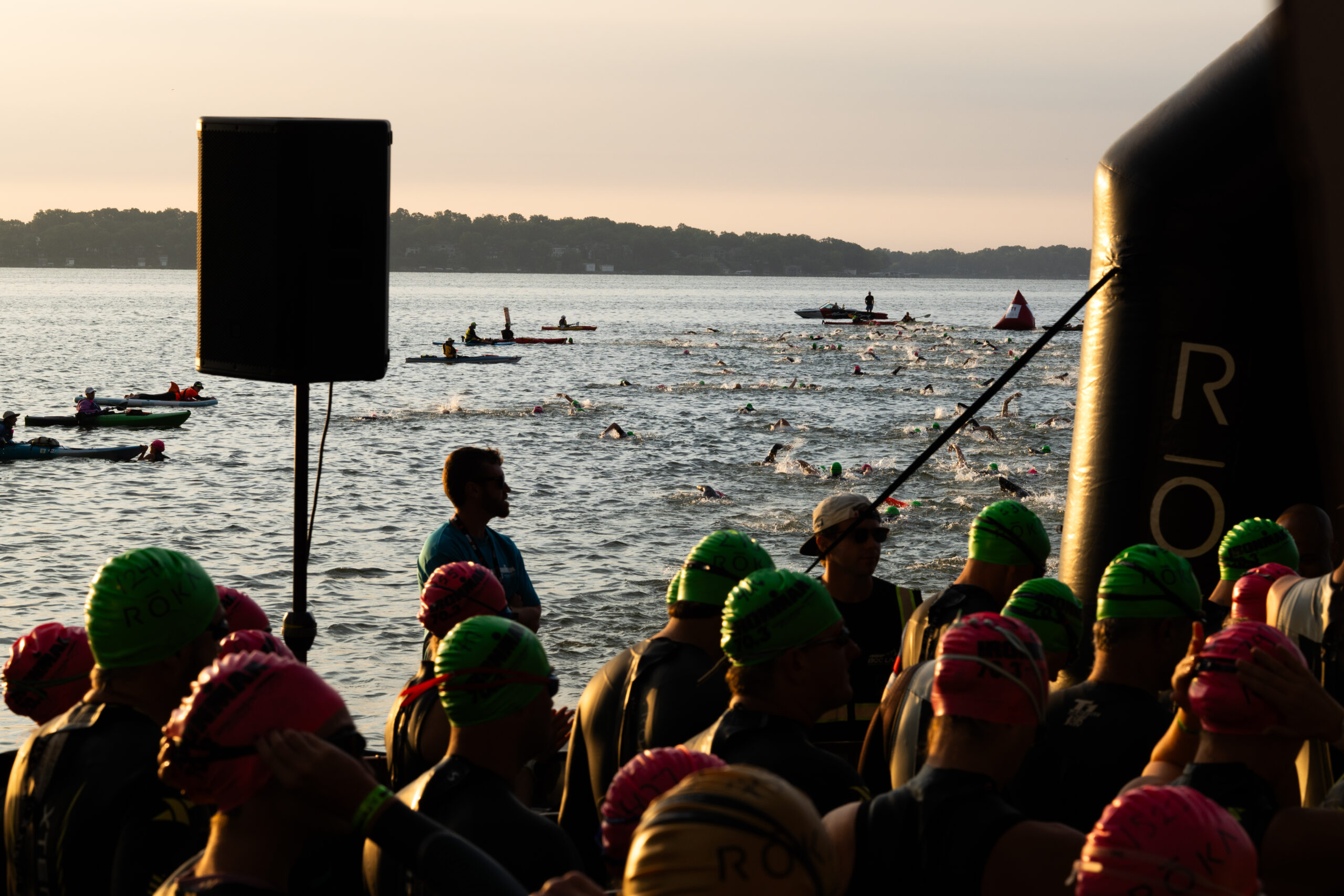
Hadi Najeeb’s older brother Yaseen took him to the starting line. “It was dark when we got up. We watched the sunrise. The sky was a nice pink, and there was no wind.”
“I got a bike a couple of months later and went through the same battles. The ride through the hills in Madison is known as one of the more difficult in an IRONMAN. It seemed impossible. So, you question yourself. ‘Is this doable?’ But you just keep showing up and finding the little wins.”
Although Najeeb had just competed in a half-marathon before training for the triathlon, the run still had challenges. A stress fracture in his foot taught him to take breaks and give his body time to heal, he said. He added yoga and stretching sessions to his routine.
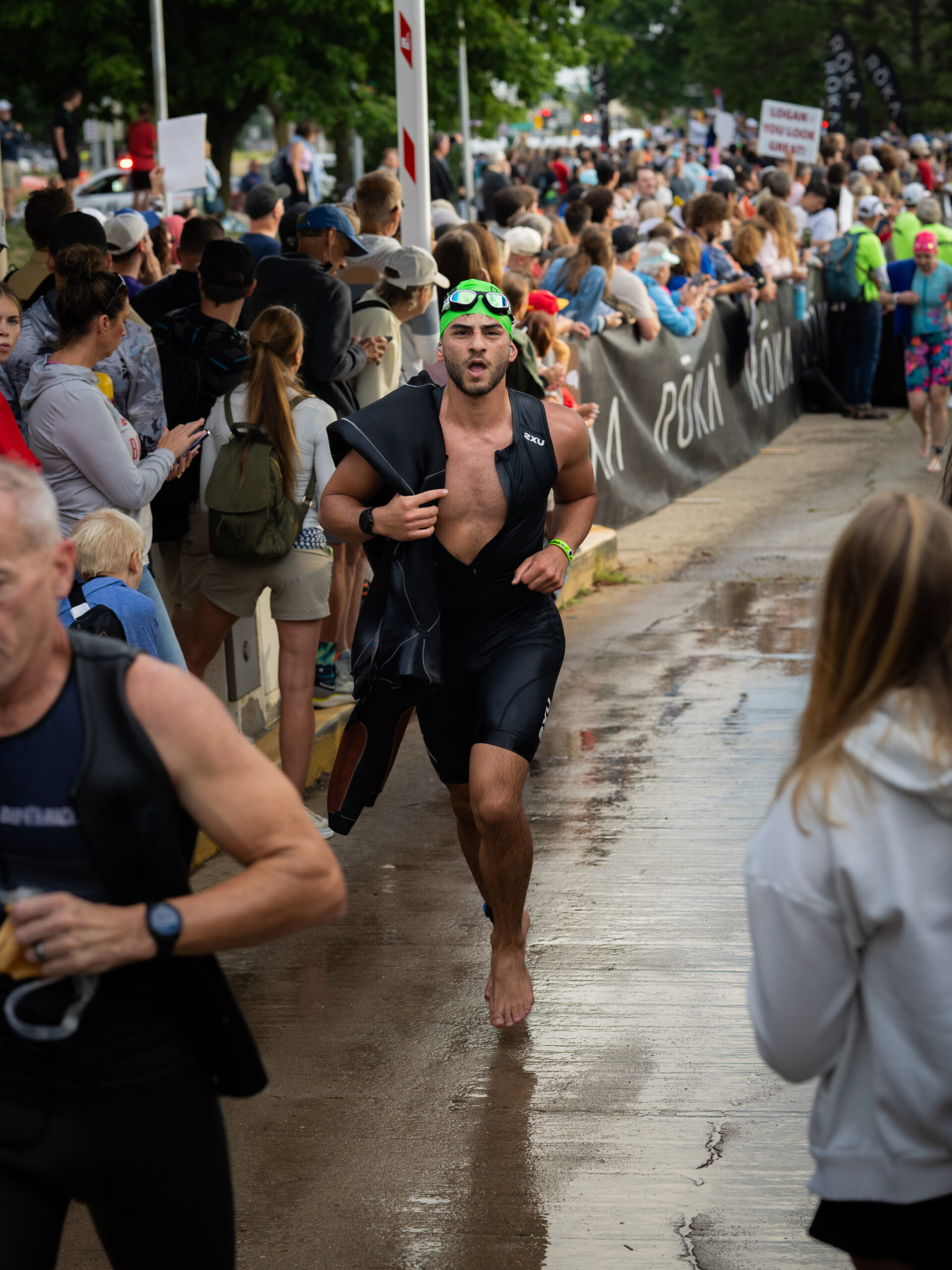
Najeeb had also lifted weights before he began training for the triathlon. At 5-foot-11, Najeeb was “around the 190-pound range,” he said. “Now I’m sitting around 181. I’ve definitely just leaned out, lost some of that bulked muscle.”
During training, “you’re burning a lot of calories, and so you have to focus on eating a lot, too,” Najeeb said. “There’s a lot to learn about how to fuel your body, eat clean and drink more water. There will be times when you fail, but you keep learning and improving.
“I remember situations when I completely cramped up and couldn’t move in the middle of a bike ride and had to Uber home, or a neighbor would give me some bananas or electrolytes before I knew how to fuel properly. I was burning 2,500 to 3,000 calories a training session. If you’re underfueled, your body will shut down.”
He also learned to focus on getting good sleep, he said. “No caffeine after 4 p.m. No wasting time at night. Sleep recovery is super important.
“It’s a transformation of life,” Najeeb said about the training experience. “It’s the only way you can do it, change everything.”
Rain or shine
Najeeb trained every day for more than eight months, doing two training sessions a day, four days a week. On the other three days, he did one session. Each session was about an hour and a half, except for weekends, he said.
The weekend sessions were longer, three to four hours. “I’d go for a 50-mile bike ride and then maybe a little run right after,” he said. “They’re called brick sessions. You’re doing one sport followed by another sport. The pair is called ‘a brick.’
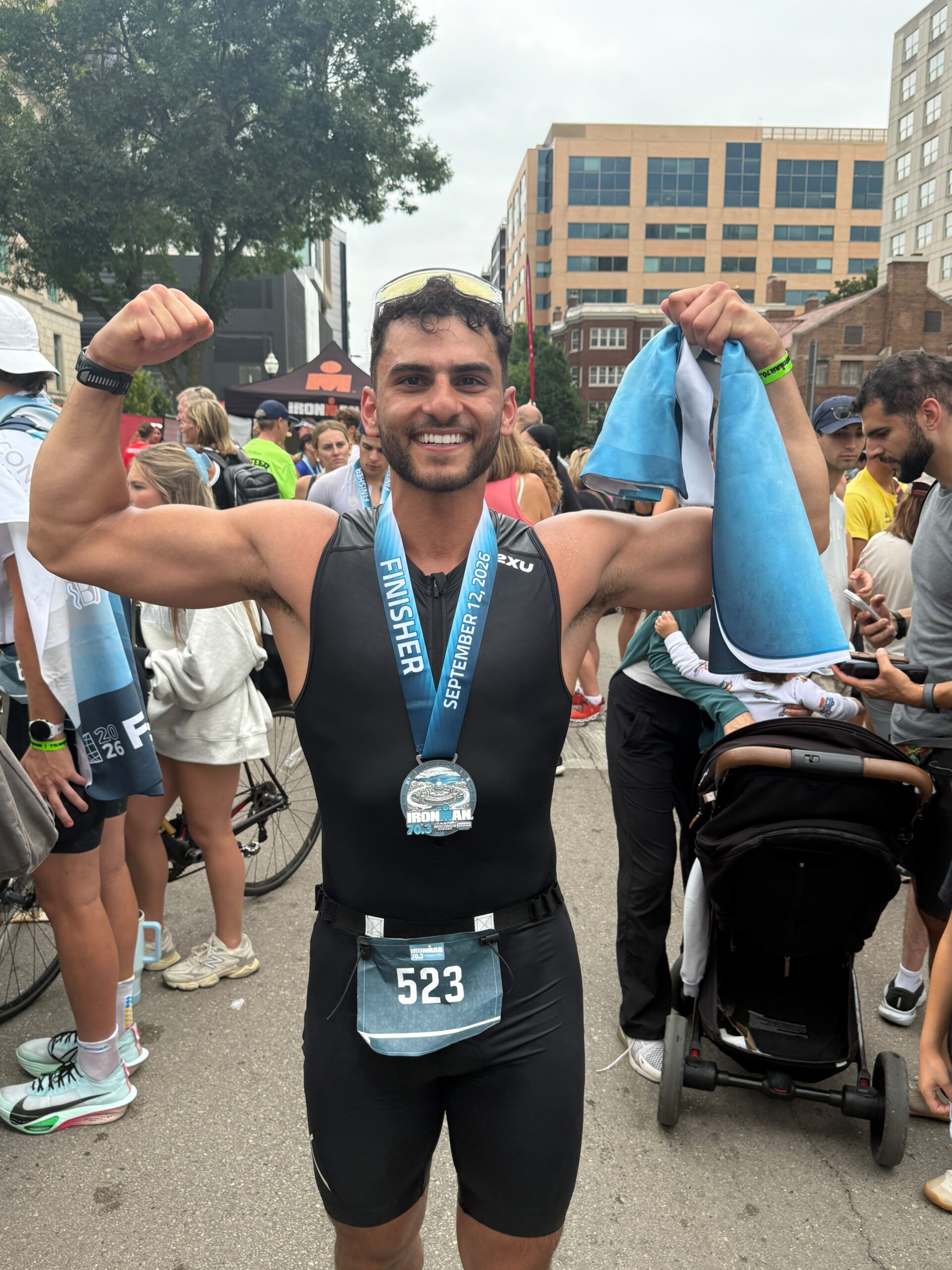
A family member took a photo of Hadi Najeeb Saturday, just after he crossed the finish line of the half IRONMAN. “I can’t describe the feeling,” he said. “Raw emotion. I felt everything all at once.”
“Committing to the race really enforces discipline,” Najeeb said. “I don’t work 9 to 5. I can be at work at 6 a.m. and come back at 10 p.m. I’d barely eaten and been on my feet all day, but I’d still head to the swimming pool for a training session, and wake up at 4 a.m. the next day to go for a run, then I’d take a bike ride midday. You start planning it out and go through all these little battles to train your mind to do what you have to do.
“If you freeze, you just break it down and tell yourself, ‘Let’s take a baby step.’ You end up taking that step and you keep going. It builds until you get to a point where you have accomplished what you once thought was impossible.”
“You also have to face the challenges alone,” Najeeb said. “You meet people along the way but, for a race like this, you have to be able to do the sessions alone and focus on your craft.
“It’s actually very peaceful,” he added. “At work, I’m very social and surrounded by people. During the race, you aren’t allowed to listen to music, so I didn’t when I was training either. “It’s time to think on your own. It’s very peaceful.”
Race day
Lots of people may be motivated to try a triathlon but not everyone finishes it. “There’s only so much motivation can do,” Najeeb said. “Once you actually start training, discipline takes over. It’s a matter of showing up for yourself day after day.
“I’m someone who tends to keep moving the bar,” he said. “When I started in December, my goal was just to finish the race. With how impossible it originally felt, I would have been happy to complete it.
“But doing training sessions I had originally thought were impossible, I told myself I’d try to do a sub-seven-hour finish time,” Najeeb told WMJ a week before the race.
Adrenaline woke Najeeb up at 2 a.m. He forced himself to eat, loading up on carbs. “No one wants to eat that early,” he said in an interview after the race.
Yaseen had spent the night Friday and drove Hadi to the start line the morning of the competition. They watched the sunrise, then went to the start line at 7 a.m. “You could feel the energy in everyone,” Yaseen said.
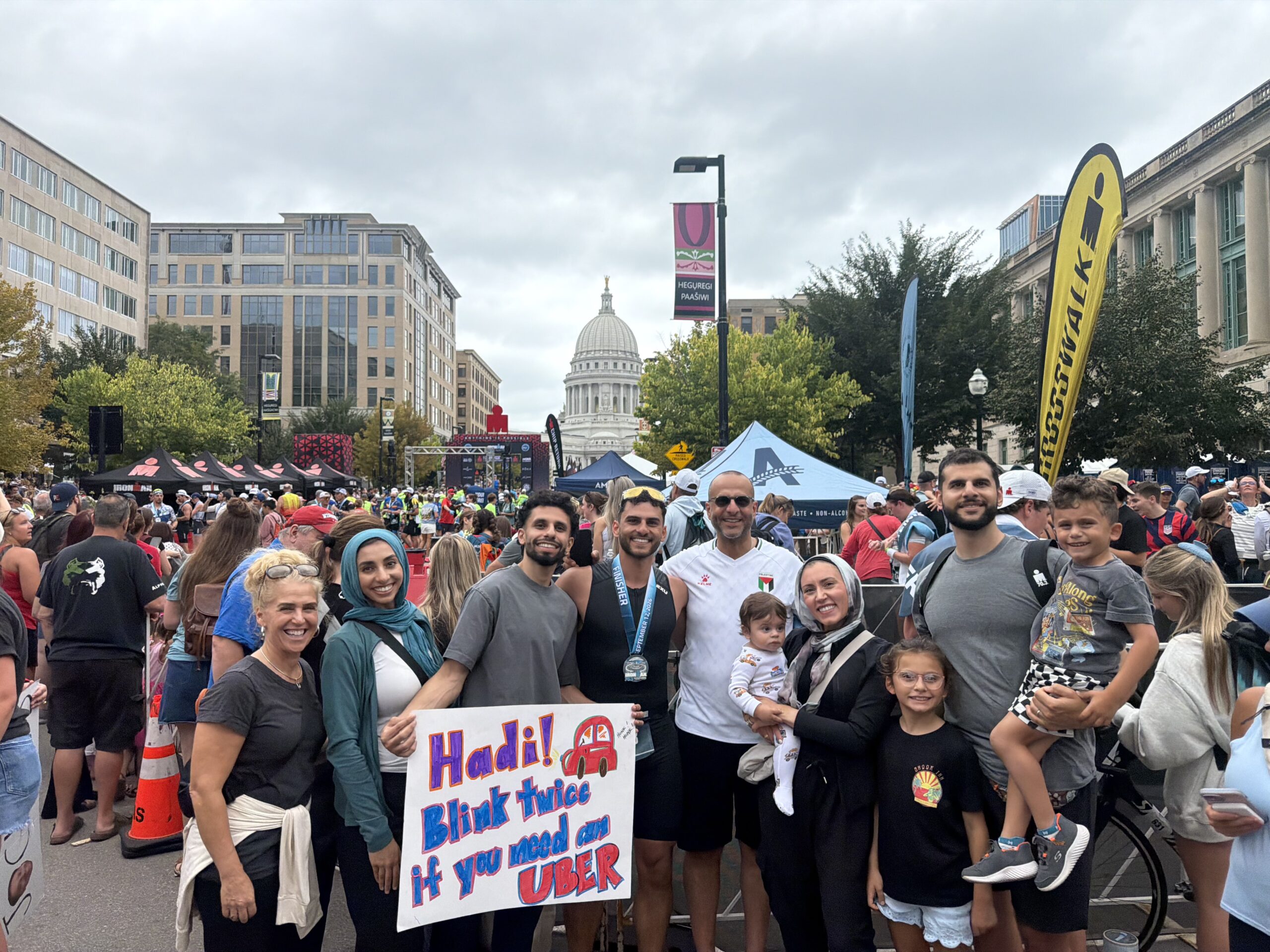
Hadi Najeeb (center) is surrounded by family who cheered for him throughout the IRONMAN 70.3 competition. They include (left to right) his aunt Heather Nelson, cousins Jehan and Salam Salous, uncle Issan Atta, sister-in-law Dr. Reem Mahjoub and brother Rayyan Najeeb, and their children. “When he finished one event, we’d run to the next,” brother Yaseen Najeeb said. “I think he was surprised to see us at every turn.”
“I checked my heart rate,” Hadi said. “It was around 120. In training, it’s around 50 or 60 to start. So, I told myself to start out slow and make sure I didn’t go out too fast and burn out.”
Najeeb finished the race Saturday in 6 hours and 21 minutes, with his personal bests in both swimming (40 minutes) and biking (3 hours and 10 minutes).
He finished the final event, the run, in 2 hours and 19 minutes, about 20 minutes more than his time in a half-marathon last year. “I had to do some running and some walking,” he said.
The average overall finish time for an IRONMAN 70.3 is between 5 hours and 30 minutes and 6 hours and 30 minutes, the IRONMAN organization says on its website. The average swim time is 35-45 minutes, and the average bike time is 2 hours and 45 minutes to 3 hours and 30 minutes. The average run time is 2 hours to 2 hours and 30 minutes.
Najeeb saw family and friends along the way, but “everyone cheers for you, whether they know you or not,” he said. “It was an incredible experience. Just seeing that red carpet—I can’t explain how it felt. A sense of accomplishment, of relief – I felt every emotion all at once. It was great!”
Because our stories matter
Wisconsin Muslim Journal reports on people, stories and experiences of Muslims across our state. As a nonprofit publication, we are committed to making this work available to everyone without a subscription or paywall.
Every story we publish is produced by professional journalists, photographers and editors committed to reporting on Wisconsin’s Muslim communities. Keeping this work going requires time, talent and resources.
If you value dedicated, fact-based coverage that documents Wisconsin Muslim history, please consider supporting us with a donation. Gifts of any size make a difference and help us continue to report on narratives that might otherwise go untold.
We are grateful for your readership.