Thoughts after a humiliating night for anti-Muslim bigots, on holding our own to account, and what to make of electoral politics.
Like so many Muslims, I spent last night watching the election results come in. I stayed up long after, and at some point I started writing, mostly because I couldn’t sleep with this many thoughts running through my head. Some of what I felt was happiness, some of it was discomfort, and the two kept clashing.
I write this as a Palestinian American who spent my undergraduate years watching, day after day, the genocide in Gaza. It was the era of the encampments, when campuses across this country became the front line of the movement for Palestine and students were suspended, arrested, and smeared for refusing to look away. In my own small way, I was among them, and that time has shaped how I see everything since, including last night.
What follows isn’t an academic paper or a polished political analysis. It’s simply my thoughts from a long night, in the order they came to me.
In this piece:
-
Why I’m happy this morning
-
But I know this blue
-
Blue or red, it doesn’t matter
-
They wouldn’t spend this much if it didn’t matter
-
But this isn’t the end-all be-all
-
Hold them accountable, even Mamdani
-
Today, we continue
Why I’m happy this morning
I imagine most Muslims woke up happy this morning, and I did too. Last night was a humiliating night for anti-Muslim bigots and for many politicians whose loyalties clearly lie with Israel. While I’m usually happy whenever I see Muslims win and whenever I see pro-Palestine candidates win, I’m far happier when I see a pro-Israel or anti-Muslim politician removed from office, because that is really what I’m looking for. Any time someone who puts Israel ahead of the people who elected them, or who builds a career on hatred of Muslims, loses their seat, every American should be celebrating, because politicians like that are a problem for this entire country, not just for Muslims.
And we have every reason to be happy. Dr. Adam Hamawy, a surgeon who stood in Gaza’s hospitals treating the wounded while the bombs fell, and who came home calling what he witnessed a genocide, is headed to Congress as New Jersey’s first Muslim congressman. Abdul El-Sayed, after outlasting one of the most vicious smear campaigns this country has seen in a Senate race, will become the first Muslim ever to serve in the United States Senate. In Queens, Aber Kawas, a Palestinian American organizer who ran unapologetically for Palestine, will become the first Palestinian Muslim woman in the New York State Legislature.
The losses were just as sweet. Here in Texas, where I’m writing from, Greg Abbott, a governor who declared CAIR a terrorist organization, called a Muslim community development a “Shariah compound,” and spent his term making Muslims the target of his politics, has been sent home. And back home in Wisconsin’s 1st District, where I’m from, Bryan Steil, a congressman who answered my family’s letters about the genocide by calling our people terrorists, lost his seat to Mitchell Berman, an emergency room nurse, ending more than thirty years of Republican control. Good riddance. Up and down the ballot, one anti-Muslim bigot after another was shown the door.
Part of that happiness is simply watching people beat AIPAC. I grew up in this country believing that AIPAC was untouchable, that Israel was untouchable, and that their power was simply a fixed feature of American politics that the rest of us had to work around. As a Muslim, I always knew that no power endures except the power of Allah (SWT), and it has been humbling to watch that truth play out so clearly in my own lifetime.
For me, the clearest sign came on October 7th, which shattered the image Israel had spent decades building, of an all-seeing intelligence service and an untouchable military that no one would dare to test, and that image has never been restored. With the most advanced weapons in the world and the unconditional backing of the United States, Israel has still not broken Gaza, and the world can now see what was always true: its power rests on others holding it up.
Over the last few years we have seen it again and again: AIPAC can be beaten, and Israel can be beaten. Last night was more proof of it. Honestly, it’s less about any specific candidate than about the sight of the entire establishment, the entire media apparatus, the whole Zionist billionaire class, AIPAC, and a sitting president all piling onto one person and still failing to stop him. That, to me, is worth being happy about.
But I know this blue
And yet, as happy as I am, I can’t fully settle into it. Democrats rode what people are already calling a blue wave last night, and as the map filled in with blue, I couldn’t help but recognize the color.
I know this blue. It is the same blue that carried out the genocide in Gaza. What happened under Biden and Harris was a Democratic genocide, one the Republicans have simply inherited and continued, so it should surprise no one that so many in our community have lost whatever faith they once had in electoral politics. We have watched Democrats win big before, and we know what came next. It isn’t that Biden and Harris did nothing for us; they armed, funded, and defended the worst atrocity I have ever witnessed in my life. All of the support, the votes, and the organizing our communities poured into them was repaid with bombs on Gaza.
At the same time, the alternative is a Republican Party and a broader right wing whose hatred of Muslims grows louder and more open with every election, to the point that anti-Muslim bigotry is no longer a fringe tactic but a central part of how they campaign. Their support for Israel is sometimes more extreme than the Democrats’, but more often it’s simply louder and more visible. That doesn’t make it any worse; the Democrats’ support is just as deadly, even if they’re quieter about it. Either way, there is no good option waiting for us on the other side of the aisle.
Caught between those two parties, our community has split over how to respond, and I see two camps forming. The first has had enough. To them, voting for a party that armed a genocide is a moral line they will not cross. They argue that a vote only has power if you’re willing to withhold it, and that “lesser of two evils” logic is exactly how both parties have kept us captive for decades. They see these Democrats as liberal Zionists, they point out that Abdul has already conceded on core principles and that Mamdani used Palestine to win and then walked it back once he had power, and they don’t want our community’s energy anywhere near these politicians.
Many times, I find myself agreeing with them and seeing things the way they do, though not completely. The people in this camp are some of the most important voices in our community, and we wouldn’t be where we are without them. They are the ones who refused to let our community be taken for granted, who said no when it would have been easier to fall in line, and who kept raising the bar while others were ready to settle, and much of the shift we’re seeing now exists because they never stopped pushing.
The second camp sees that position as backwards, a no-progress mentality, and their answer remains that we still need to show up and vote. In their view, walking away from the ballot box doesn’t punish anyone; it only hands power to people who hate us even more openly and would gladly finish what the Democrats started. They remind us that the stakes aren’t only in Gaza but here at home, where the other side offers a Muslim ban, community members snatched off the street by masked ICE agents, and governors branding our institutions as terrorist organizations. They point out that the shift we’ve seen, from Democratic senators voting to block arms sales to candidates refusing AIPAC money, happened because people stayed in the fight and forced the party to move, and that every seat we abandon is a seat AIPAC is happy to fill. I don’t share their level of faith in electoral politics, but I share their refusal to walk away from what is still an important part of the fight.
So no, I’m not celebrating because I’ve suddenly regained my faith in the Democratic Party, or because I have full confidence that these candidates will change everything, or because I think they are the heroes who will free Palestine. None of this means I agree with Abdul, Mamdani, or any of these candidates on everything either; as a Muslim first, and as a Palestinian, there are places where I part ways with each of them, which I think should be obvious. But I keep returning to the same point: I simply don’t see a good argument against rooting out the people who are clearly loyal to Israel. Anyone working within an oppressive system is going to be limited by it, and I don’t expect any of them to fully dismantle it from the inside. That’s exactly why my bar is where it is: given the choice, I would rather work with people who are not loyal to Israel than with people who are.
Blue or red, it doesn’t matter
A few days before the election, I posted something on social media that captures how I see all of this: there is no real Democratic or Republican party, only the question of whether you are pro-Israel or anti-Israel. Any politician who is pro-Israel, Democrat or Republican, needs to be rooted out, and I mean that equally for both parties.
I consider one of my primary responsibilities as an American to be cutting this country off from Israel, because I believe that once America is completely cut off, it is only a matter of time; Israel, quite literally, cannot survive without us. I know there’s a bigger conversation to be had about whether America is the real power here and Israel is simply one of its tools, and I think there’s a lot of truth to that. But either way, the relationship is the lifeline, and cutting it is where our responsibility as Americans begins. I know that’s a simplified way of putting it, but as I mentioned earlier, this isn’t a policy paper, and it’s honestly how I see it.
The pro-Israel lobby knows that lifeline is slipping, and it has clearly realized that sympathy no longer works as a strategy. The old argument, that Jews need a homeland because they are not safe anywhere else, collapsed under the weight of the genocide; Gaza killed it. In its place, they’ve turned to fear, and specifically to anti-Muslim fear, and Muslims in this country are the ones paying the price for it.
I believe we have matured as a Muslim American community, and I don’t want to see us regress. What some Muslim politicians have achieved is impressive and historic, and I don’t take that lightly. But we are no longer the “we just want a seat at the table” Muslims; that was the politics of the last generation, and respectfully, its time has passed. Today, being Muslim isn’t enough to earn our support: either you do something, or you’re out.
And this kind of accountability works. Kamala Harris was punished in 2024, and I consider that a great step forward. In Dearborn, a city Biden won easily four years earlier, Harris finished behind Trump, while Jill Stein took nearly one in five votes on the strength of her opposition to the genocide. Our community showed that its votes could no longer be taken for granted, and that complicity came with a price.
Look at what came after. In April 2025, only 15 senators voted to block arms sales to Israel; this past April, 40 of 47 Senate Democrats did. Refusing AIPAC money has become a litmus test, and politicians who once eagerly courted the group now go out of their way to distance themselves from it.
AIPAC itself has noticed. Less than two weeks before the election, it announced that it would stop endorsing candidates and stop giving to campaigns under its own name, while its super PAC carries on. The most powerful lobby in Washington has become so toxic that it no longer wants its name on the finance reports of the candidates it supports. A lobby at the height of its power doesn’t hide its name; one that knows the public has turned against it does. But AIPAC isn’t going anywhere. It’s retreating into the shadows, and we’ll need to be sharper than ever about following the money it no longer wants us to see.
Yesterday, it was red’s turn to be punished. Step by step, the United States Congress is being rooted out of Israel’s grip, and the hope is that it will continue until Israel is eventually cut off entirely. That’s where this is headed, and the work our community has put in is part of why.
They wouldn’t spend this much if it didn’t matter
That’s also why I struggle with purity tests that rule out every candidate currently on the ballot, and with the argument that we should stay out of electoral politics altogether. I understand where both come from, but when no one on the ballot is good enough, the result is the same as not showing up at all, and that leaves the field wide open to the people who want us gone. Would AIPAC be spending more than $100 million this cycle, smearing pro-Palestine candidates and fabricating lies about them, if these elections didn’t matter? To me, that says Israel is extremely desperate, that it is on the verge of collapse, and that its defenders know exactly where the pressure points are.
Just look at what it took to try to stop Abdul El-Sayed. In the primary, AIPAC’s super PAC spent more than $30 million backing Haley Stevens, the most it had ever spent on a single race, and he won anyway. When Mike Rogers said he would take help from anyone, AIPAC was back within a day. Then the President of the United States flew to Port Huron to call Abdul a “jihadist Muslim Brotherhood member,” and Rogers asked him on a debate stage, “Are you for America, or are you for these terrorist groups overseas?”
The establishment media was hardly better. On CNN, Jake Tapper, Dana Bash, and Kaitlan Collins turned interview after interview into an interrogation over Israel, Iran, and old social media posts, while the same network gave Stevens a national stage in the final days to air her grievances against her own party’s nominee. I can’t remember a progressive who lost a primary ever getting that kind of platform.
Then, two days before the election, Stevens sat beside Rogers in a Detroit church and endorsed him, after promising to back her party’s nominee. For years, Muslims were lectured to “vote blue no matter who.” The moment the nominee was a Muslim who refused to bow to AIPAC, the same people who preached it dropped the slogan without a second thought. “Vote blue no matter who,” it turns out, was only ever meant for us.
Billionaires, a sitting president, the Republican nominee, the media, the Democratic establishment, and the most powerful lobby in Washington all converged on one man. And some people want to tell me not to pay attention to this? Nobody spends that much money and burns that much credibility on something that doesn’t matter. They know exactly what’s at stake, and so should we.
But this isn’t the end-all be-all
I understand the anger of those who are so strongly against us wanting these candidates to win, and I think I know where it comes from. At its root, it is frustration at how quickly people forget, and fear that a handful of victories will convince our community that voting is the only thing we can do. They worry that people will pour all of their effort and all of their hope into it, that they will swear by these politicians and live and die by them, and that they will treat this as the end-all be-all while regarding anyone who disagrees as an enemy. Worst of all, they fear that people will forget Gaza, forget the genocide, forget that it was the Democratic Party that betrayed us, and conclude that there is no more work left to do.
If that is what last night means to someone, then I honestly agree with them: there is no reason to be happy and no reason to celebrate. Anyone who spent the last two years saying never again to the Democrats, and is now ready to hand their whole heart back to a party that hasn’t fundamentally changed, isn’t feeling hope; that’s amnesia. Those who were in the streets in 2024 and are now making excuses for politicians in 2026 should ask themselves what changed, because it certainly wasn’t the bombs. And for anyone who only shows up for Palestine when there’s a ballot involved, Palestine was never really the point.
Anyone who treats this as the end-all be-all is part of the problem. That includes those who look down on grassroots organizing now that we supposedly have “real” power, those who criticize people protesting in the streets for being too loud or too aggressive, those who get defensive when we hold our politicians accountable, and those who mock people whose standards are higher than their own. Nobody gets to put all of their faith in this, and it would be silly to.
Electoral politics is a very real part of this country, and to say it has no impact would be wrong, but to say it is the only thing that matters would be just as wrong. It is one piece of the puzzle. So fine: we root out the pro-Israel bigots, we root out the anti-Muslim bigots, and we keep moving the needle, one seat at a time, further and further. We focused on it, we put in our work, and we should be proud of that, but we owe the same work, and more, in every other arena as well.
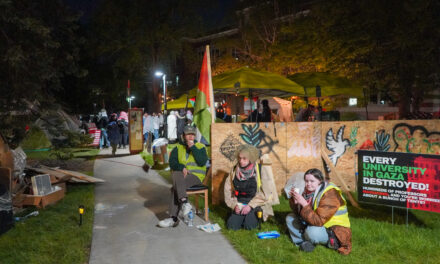
This morning, we turn back to the more important work, the grassroots work that caused this entire surge in the first place. This shift didn’t come from consultants or campaign ads, but from the student encampments for Palestine, which no one can deny produced a complete shift in America; from people in the streets, many of whom lost jobs, scholarships, and friendships for speaking up; and, before any of that, from the heroic people of Gaza and the rest of Palestine, whose steadfastness forced the entire world to look.
That is the work. We continue organizing and fighting in the streets, and those of us who aren’t on the front lines continue supporting, defending, and standing with those who are, recognizing them as the key piece that brought us to this moment rather than as an embarrassment to be managed. We continue putting pressure on our politicians as well. We do not worship them, we do not make excuses for them, and once they hold power they are not our heroes, so we owe them no special politeness. If I lived in Michigan and Abdul El-Sayed were my senator, I would hold him to every word he campaigned on and make sure he never forgot whose votes put him there. The same goes for Mamdani, and for anyone else who wins on our votes.
Hold them accountable, even Mamdani
A few weeks ago, on the anniversary of October 7th, Mamdani was protested by pro-Palestine activists, many of them students, for attending a vigil in Union Square. They called him a traitor and chanted, “Mayor Mamdani, pick a side, justice or genocide.” What struck me just as much as the protest itself was the reaction from so many Muslims and pro-Palestine voices online, who were quick to dismiss those protesters as stupid, as kids who don’t understand anything, as people who were going to ruin it for everyone else.
Honestly, I think that’s crazy talk. Have we not learned anything? It was students sitting at lunch counters who pushed the civil rights movement forward, students who helped turn this country against the war in Vietnam, and students who forced universities to divest from apartheid South Africa. Just two years ago, it was students in the encampments who cracked open the conversation on Palestine in America. Young people have been on the right side of history again and again, usually while the “reasonable” adults around them urged them to calm down.
So I’ll say it: I was happy to see that protest, and I find it offensive to watch Muslims who have bought fully into electoral politics now turn on the people holding Mamdani to account. Have we already forgotten that they’re the ones who got him elected in the first place?
Think about the pressure Mamdani faces every single day from the Zionist lobby, the media, the donors, and half of the political establishment. That pressure is relentless, and it works; it’s a large part of why so many people feel he has already conceded on things he ran on. If all of the pressure comes from one direction, which way should anyone expect him to move?
That’s why pushing back from our side is necessary. I mean public pressure, and at times that means calling out, and even shaming, the pro-Palestine officials we helped elect. It matters for two reasons. The first is for the officials themselves, so they know they’re not off the hook. I have no idea what it’s like to be in Mamdani’s position, and I’m sure it’s incredibly difficult, but that’s exactly why he needs to feel us pulling just as hard in the other direction. The second is for the public, so that everyone watching can see that the needle keeps moving toward Palestine and that even our “allies” are held to a standard.
We didn’t elect Mamdani so that we could stop paying attention. If Abdul reaches the Senate and someone criticizes him, and someone else’s first instinct is to ask why they’re attacking him when he’s one of the good ones, then they’ve lost the plot. Winning the seat isn’t the finish line; it’s where the pressure starts.
Today, we continue
So yes, I’m happy with many of the results. But that happiness has its limits. I will never forget the Gaza genocide, and I will never forget that it was the Democratic Party that funded it, defended it, and asked for our votes while it was happening. A few good nights at the ballot box don’t change that, and I don’t consider them the end-all be-all.
If Democrats are going to hold power in Congress, then we should be clear about what we expect from them, and loud when they fall short. That means a full arms embargo on Israel. It means using their majority to block the very weapons sales most Senate Democrats already voted against when they had no power to stop them. And it means protecting the students, organizers, and community members who have been detained, deported, or silenced for speaking up, and tearing down the anti-Muslim machinery the right has spent years building. That’s the least we should demand, even knowing that Congress alone will never give us everything we’re fighting for.
And still, I am hopeful, more hopeful than I have ever been. I believe I will see Palestine free in my lifetime, and I believe I will live to see the day America is cut off from Israel. But I don’t think electoral politics will be the main factor in getting us there, and I think it’s a little naive to believe it will be. As long as the American empire exists in its current form, Israel is not a policy mistake that the right election can correct; it is a load-bearing part of how that empire projects its power in our region. A system that depends on something does not vote itself out of depending on it, and you cannot simply reform your way out of a structure that is working exactly as it was designed to work.
Elections can weaken that structure’s grip, expose its defenders, and punish them, and that matters. But the real change will come the way it always has: from the heroic people of Gaza and the rest of Palestine, whose steadfastness no army and no amount of American money has been able to break; from movements here and around the world that refuse to be quiet; and above all from Allah (SWT), who has promised that His help is near.
Last night we celebrated beating some of them. This morning we wake up and remember how many people have been slaughtered with our own tax dollars. And so, today and every day after, we continue.
In closing, these are just my own thoughts, written through a long night. I’m sure there are things I got wrong or could have said better, and I welcome disagreement and correction. Whatever is right in this is from Allah (SWT), and whatever is mistaken is from me.
Sources
Because Our Stories Matter
Wisconsin Muslim Journal reports on people, stories and experiences of Muslims across our state. As a nonprofit publication, we are committed to making this work available to everyone without a subscription or paywall.
Every story we publish is produced by professional journalists, photographers and editors committed to reporting on Wisconsin’s Muslim communities. Keeping this work going requires time, talent and resources.
If you value dedicated, fact-based coverage that documents Wisconsin Muslim history, please consider supporting us with a donation. Gifts of any size make a difference and help us continue to report on narratives that might otherwise go untold.
We are grateful for your readership.