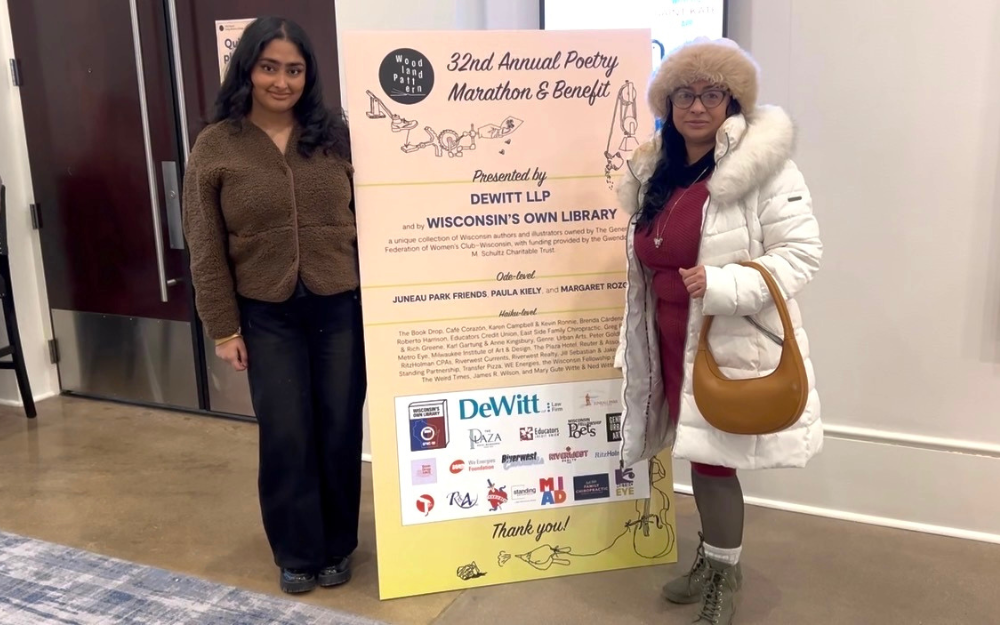
Aleena Ahmad (left), Milwaukee’s second Youth Poet Laureate, and her mother, Sayema Khatun (right) attended Woodland Pattern’s 32 Annual Poetry Marathon & Benefit in January at Saint Kate – the Arts Hotel in Milwaukee. The two-day, 24-hour marathon features hundreds of poets, live musical performances and screenings of moving-image works.
“It was life changing!” Nicolet High School senior Aleena Ahmed of Bayside said about her experience as the Milwaukee Youth Poet Laureate. Selected her sophomore year, Ahmed found herself in new roles that made her junior and senior years that much richer, she said.
Wisconsin Poet Laureate Dasha Kelly and Woodland Pattern Book Center, 720 E. Locust St., Milwaukee, a nonprofit arts organization, established the Milwaukee Youth Poet Laureate Program in 2022—in partnership with the Milwaukee Public Library, Milwaukee Public Schools, University of Wisconsin-Milwaukee’s Writing Project and UWM’s Graduate Program in Creative Writing. It is part of the national affiliation of Youth Poet Laureate programs.
Milwaukee’s program offers a dedicated year-long mentorship for the laureate and continued support after the laureate’s tenure. It holds workshops and open mics for Milwaukee teens, and provides curriculum support for public school teachers who wish to incorporate poetry in their classrooms.
As the Milwaukee Youth Poet Laureate, Ahmed shared her poetry before a variety of audiences, facilitated workshops, received mentoring and also offered mentorship to other youth who aspire to write. She won a paid summer internship with Woodland Pattern Book Center and a $500 book allowance. Woodland Pattern is the only Milwaukee arts organization presenting contemporary literature to the general public on a continuous basis, its blog explains.
Representing Milwaukee at a regional poetry competition in 2024, Ahmed placed second in the Midwest.
A source of inspiration
Masjid Al-Quran Imam Hafiz Shafique is one of her fans.
“Aleena is my student, and I have known her since she was very young,” he said. “She has always been an intelligent and brilliant student, though quite shy in her early years.”
At the invitation of the Ahmed family, Imam Shafique attended an event last year that was organized by UWM students in Aleena’s honor. “It was truly a wonderful surprise for me,” he told the Wisconsin Muslim Journal. “Seeing her invited to present her poetry was something I could hardly have imagined when she was younger. It was a deeply proud moment for me as her teacher.
“Her recognition as Milwaukee Youth Poet Laureate is not only a personal achievement but a source of pride and inspiration for our Masjid Al-Quran community. It reflects the potential of our youth and highlights the importance of nurturing both faith and creative expression.
“Aleena’s journey is a beautiful example of how confidence and leadership can grow over time,” Imam Shafique said. “She continues to inspire younger members of our community.”
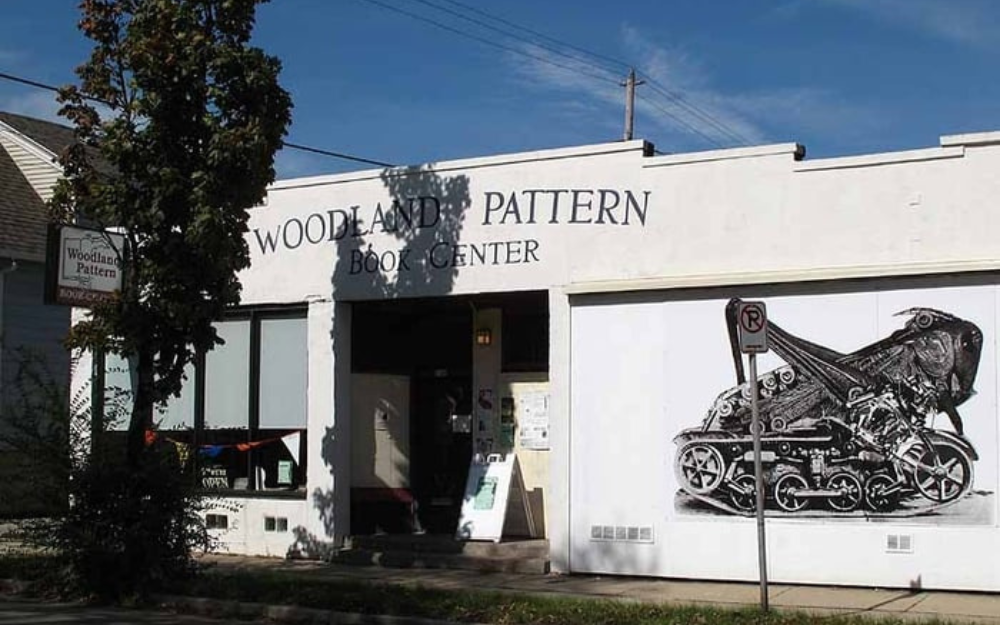
Woodland Pattern Book Center, 720 E. Locust St., Milwaukee, hosts many events for the Milwaukee Youth Poet Laureate Program, including summer poetry camps and multiple workshops led by the Youth Poet Laureate.
Becoming the voice of Milwaukee’s youth
The Milwaukee Youth Poet Laureate competition is open to all high school freshmen, sophomores and juniors in Milwaukee County, but only one student is selected to be the voice of Milwaukee’s youth.
Ahmed didn’t expect it would be her.
She first learned of the Milwaukee Youth Poet Laureate competition two days before the deadline to submit entries. She would need five poems and only had two she felt were ready. In addition, she needed to put together a CV of her extracurricular activities, volunteer work and academic honors.
Ahmed rallied to get it all done. “I am somebody who, like my parents, is an immigrant. I’ve lived in Bangladesh and America,” Ahmed said in an interview. “Having the two experiences, I know there are a lot of opportunities here, so I try not to waste them.”
She faced another hurdle. If Ahmed made it to the finals, she would need to perform her poetry before an audience, something she had never done before. Selected as one of the top three finalists, she received an invitation to Milwaukee City Hall to present her poetry.
“I was so nervous,” she recalled. “For days leading up to it, I was shaking.”
One poem she presented, Paralysis, is “very emotionally vulnerable,” she said. “It’s about my mother. I meant for it to be a testament to her strength, and the strength of all immigrants, to take a risk to come to America, to a land they’re completely unfamiliar with.”
To Ahmed’s surprise, she won.
A year of opportunity
Reflecting on her year as Milwaukee Youth Poet Laureate and the impact it had on the years that followed, Ahmed said, “That was one of the best programs I’ve ever been part of. I love to connect with people. Being Milwaukee’s Youth Poet Laureate gave me the platform to be able to connect with even more people and share my work with them.
“It was very fulfilling. It pushed me to be the best writer and pushed me to have the best artist side of me possible.”
As Milwaukee Youth Poet Laureate, she led multiple workshops. “I got to come up with a few ideas of my own and create them,” Ahmed recalled. One of her favorites was about “yapping.”
“I always say I’m a yapper and my friends agree,” she said. One of her mentors in the program suggested she teach others how to “yap.”
Ahmed made a yapper workshop to help participants face the insecurities and fears that restrict them. “When you allow yourself to be free, when you liberate yourself to write whatever you want, free of judgment and care, that’s when you get pieces that are the most raw and truthful and connective,” she said. She did another workshop on how to channel anger into a productive force.
One of her best experiences was taking on a leadership role at Woodland Pattern’s poetry camp, she said. Ahmed worked with students much younger than herself to others of the same age, helping them express themselves.
“It’s so inspiring to work alongside so many talented students. I’m always learning from their work.”
Ahmed advises youth “not to let your fears or anxieties inhibit your drive or passion. I used to fall into the habit of critiquing my work before I’ve even finished writing the draft instead of simply letting the thoughts flow, but I realized the kind of poetry people really connect with comes from a place that is raw and authentic. The things we may perceive as ‘imperfections’ in our work simply reflect the human experience.”
From an early age
Amid a barrage of new opportunities and responsibilities, one thing didn’t change—Ahmed’s desire to write.
“I’ve always been connected to storytelling from a very young age,” she said. “My mother always tells about how, before I could read or write, I would make up stories and she would write them down for me. As I’ve grown up, I’ve come to love writing, literature and poetry.”
Ahmed credits her parents. “I took piano and painting lessons, and played soccer. The promise was that I was allowed to explore everything and poetry was, for whatever reason, the one that stuck.”
Her mother, Sayema Khatun, was a big influence on her, Ahmed said. A professor of anthropology at Jahangirnagar University when she lived in Bangladesh, Khatun still stays engaged intellectually, attending lectures, reading and researching topics, Ahmed said.
“My mom loves literature, so I’ve always been encouraged to read and write. She’s a big reader, mostly in Bengali since that’s her native language, but she appreciates American literature as well.”
What Ahmed likes about writing is the way it helps you “connect with your emotions and with other people’s experiences.”
Although she describes herself as “a very optimistic person,” in recent years, her writing “embodies more of the anger I have,” Ahmed said. “I believe anger is very, very healthy. It’s your body’s way of knowing you deserve better. It’s your body’s way of having self-respect. People get angry because they know something should be different. Anger creates good change. When it’s used productively, it can do a lot of good.
“Poetry, in many ways, has served as a tool for moral reflection, where I’ve confronted inner conflict and sublimated these feelings into a tool to advocate for change in our communities and foster connection.”
Faith like Noah
During a Zoom interview with WMJ, Ahmed wore a sweatshirt with “Faith like Noah” printed across the front. She saw it at a rummage sale and picked it up. It resonated with the memory of a conversation with her mother.
“There was this one time I was really stressed and anxious,” Ahmed recalled. “Mom was talking about how Noah was given this insurmountable task by God. He had no idea how he was going to do it—build a ship and get two of every kind of animal on it before a humongous flood. ‘Sometimes, you just have to have faith,’ she said. That idea stuck with me. No matter how things look right now, they will work out the way they are supposed to.”
Ahmed’s Islamic values translate over into her poetry, she said. “Islam is less about what I write and more about how I write. My view on Islam is also my view on life. In Islam, I’ve been taught to look through a lens of love and to love everything God has created, to see the beauty in everything.
“I connect with my faith through love, and believe that love is the strongest motivator behind maintaining spiritual discipline. In poetry, I push myself to explore these feelings, which in turn makes my connection to Islam that much stronger.
“Also, Islam values long-term fulfillment over short-term gratification,” she added. “Poetry has taught me to confront difficulty in my life. It’s easy to avoid things—whether it is putting off assignments, having hard conversations or ignoring problems—but it doesn’t benefit us in the long run. The page forces me to see things I may not see otherwise, and I learn to live a healthier life because of it.”
What’s next
As she faces graduation, Ahmed is ready for new adventures. She hasn’t decided on her major—”maybe business or economics or psychology, or maybe a mix of the three,” she said. In the long run, she plans to go to law school. “I’m very passionate about being a lawyer,” she said.
One thing is sure—she plans to keep writing. “That’s something I never want to let go of,” Ahmed said. “I plan to keep writing throughout college, throughout my career, throughout my life. That’s for sure!”

A sample of Aleena Ahmed’s poetry
At WMJ’s request, Ahmed shared a poem she wrote recently. Here it is:
Turmeric Stains
You used to stand still,
Pinned to the earth like rock amongst waves
Spindled with salt that burn against wound
And yet you left yours open, colliding with mineral centuries old
Under the bleeding sun, rays dispersed into shards of crystal
Turned infinitesimally small between my feet and spill into a melange of saffron and paprika Across air as I breathe in the years between us that inched us separate,
Inched me further,
Allow the turmeric beneath my nails to dissipate under warmth, lift under light and question its existence in your presence
This bay turns balm, thick and solid amidst movement
But not yours,
You melt an eternity of motion
Into this frozen space
I wish could stay still forever