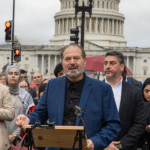
Salah Sarsour, the Islamic Society of Milwaukee board president who was arrested by ICE and is now waiting for the verdict in his deportation hearing, will speak at a community meal to introduce an upcoming new helpline for families impacted by ICE arrests.
As more and more families of all backgrounds are impacted by the Trump administration’s “supersized” immigration crackdown, a collaboration of Wisconsinites has come together to help families cope with its aftermath.
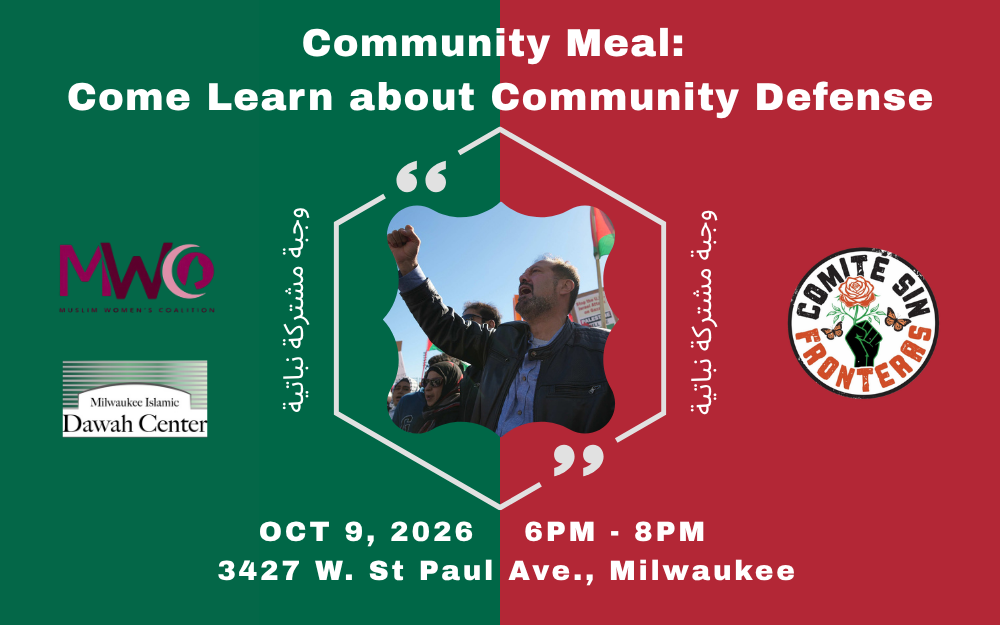
The Community Defense Helpline will be introduced to Milwaukee’s Muslim community at a community meal Friday, Oct. 9, from 6 – 8 p.m., at the AFSCME (American Federation of State, County and Municipal Employees) Hall at 3427 W. St. Paul Ave., Milwaukee. Salah Sarsour, the president of the Islamic Society of Milwaukee and a longtime permanent resident who was taken in a surprise arrest March 30 by ICE agents and is now awaiting the verdict of his deportation hearing, will be the keynote speaker.
Other speakers include Muslim Women’s Coalition executive director Janan Najeeb, immigrants’ rights historian and co-founder of Jewish Voice for Peace Rachel Ida Buff, Ph.D., Iuscely (pronounced “you-SELLY”) Flores of Comité Sin Fronteras and Burhan Clark, president of the Milwaukee Islamic Dawah Center.
All are welcomed to this free event to learn more about the services the helpline offers, volunteer opportunities and more. Comité Sin Fronteras, the Muslim Women’s Coalition and the Islamic Dawah Center of Milwaukee are sponsoring the community meal and information session. The helpline number will be announced and launched by early November, organizers said.
The Community Defense Helpline is being developed by a collaboration between Comité Sin Fronteras, an undocumented-immigrant-led community defense organization in Milwaukee, and various individuals, said Rachel Ida Buff, Ph.D., a University of Wisconsin-Milwaukee professor, a historian of migration and immigration rights movements, co-founder of Jewish Voice for Peace—Milwaukee and a member of the Community Defense Helpline collaboration.
A “supersized” immigration crackdown
MS NOW reporter Jacob Soboroff told an audience in Madison Thursday that the Trump administration did not start the immigration crackdown, but it did “supersize” it, The Cap Times reported today. Soboroff spoke Thursday at The Cap Times Idea Fest about his experience as an NBC News reporter, going inside detention centers. He was invited to go in because President Donald Trump wanted the American public to see the cruelty of the centers for themselves as a deterrent to future migrants, he said.
The number of U.S. Immigration and Customs Enforcement detentions and arrests has increased significantly over the past year. According to data compiled by TRAC Immigration, detention numbers had scaled up by roughly 70% from 39,000 in January 2025 to 67,000 by mid-July.
While the majority of ICE arrests are of Latino individuals, those beyond the Latino community have escalated dramatically. That’s why the Community Defense Helpline organizers are reaching out to a variety of immigrant communities from Asia, Africa and the Middle East, said Flores, co-chair for the Comité Sin Fronteras Mutual Aid Working Group. “We are doing our best to connect with more communities outside those people usually think of when hearing ‘undocumented immigrant.’ We know there are undocumented people from more countries than Mexico. We want to connect with those folks so they don’t feel so isolated and so alone.”
The Community Defense Helpline organizers use data to determine what languages are most spoken by those affected by ICE arrests, Flores said. “We are looking for and finding people who want to help answer calls in those languages. Right now, we are looking for Arabic, Farsi, Hmong and Spanish speakers.”
“We can see these ICE arrests have not abated,” said Janan Najeeb, executive director of the Muslim Women’s Coalition. “It is real and we are hearing of more and more Muslim individuals being picked up. Some of them don’t have family here or anyone else. They don’t know who they can contact. We want them to know there is a number they can call to get assistance.”
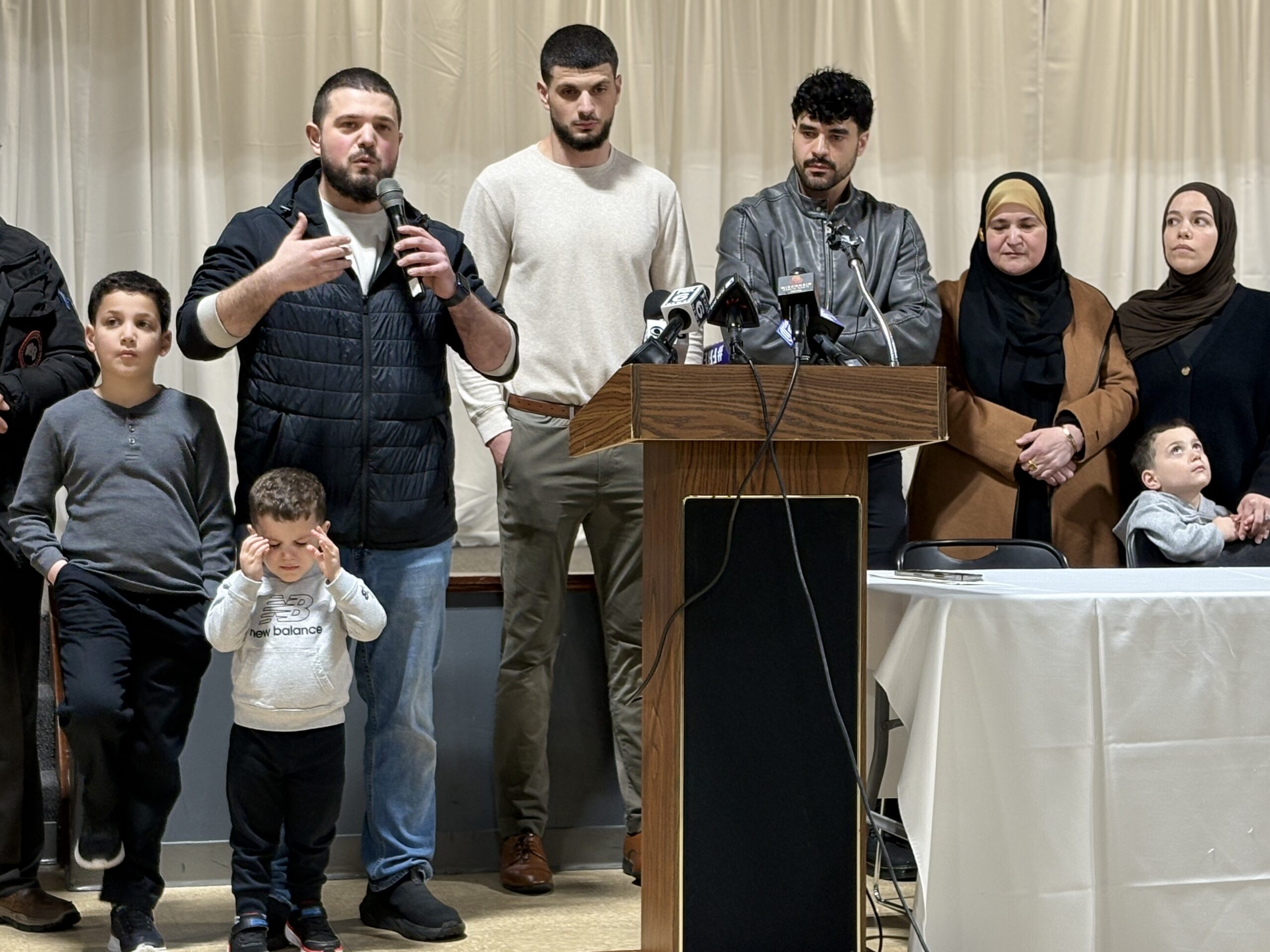
Photo by Yaseen Najeeb
Kareem Sarsour spoke to a huge crowd that gathered at the Islamic Society of Milwaukee Community Center upon learning his father, Salah Sarsour, had been arrested by ICE March 30. Other members of Mr. Sarsour’s family joined him on stage.
What’s the Community Defense Helpline?
The Community Defense Helpline is a number to call for whatever help you may need after ICE has arrested a family member, explained Buff. “Say ICE took your relative and you don’t know how to find them, we will help you do that. Or, your spouse was taken, and there is no one to pick up your kids from school. Or you need money for groceries, or you need a lawyer; this is a number you can call for help. It’s a resource to connect people living in the wake of the terrible tragedy of having someone taken to someone who can help them get through it.”
The helpline is different from the Voces de la Frontera’s emergency hotline (1-800-427-0213) that is for reporting ICE activity. That emergency line verifies rumors of ICE sightings to prevent misinformation and provide guidance during an immigration arrest or detention. The VOCES emergency hotline is available in English and Spanish 24/7. “That’s the number you call to say, ‘I think I see ICE’,” Buff said. “The helpline is to help people dealing with the aftermath.
“VOCES does wonderful work but really focuses on the Latinx community,” Buff said. “A bunch of us have been feeling there are lots of folks in the Arab and Muslim communities that are vulnerable but may not be tuned in to VOCES.”
Also, “our goal is to see what assistance families need and help them get it,” said Janan Najeeb, executive director of the Muslim Women’s Coalition. “Maybe there’s only one car in the family, and the driver gets picked up; or the family is new here and still learning English; or mom is with a baby at home, and dad was picked up and no longer able to pick up the kids from school. They have an urgent issue.
Or suddenly the breadwinner is gone, and they don’t have groceries. The idea is to immediately connect people with someone who can help. The idea is to alleviate the suffering of family members of someone picked up in an ICE raid.”
The collaboration benefits from input from the Latino community because “they have been at this for a while and have developed protocols, knowledge and expertise,” Najeeb said. The involvement of the Muslim community brings language ability, she said. Volunteers from the Muslim community can add Arabic, Burmese, Rohingya, Somali and some African languages.
The Oct. 9 event aims to educate the Muslim community about the helpline, Najeeb said. “The idea of having Br. Salah speak is to bring attention to the fact that (his arrest) happened. Here’s the ISM president, and he is going through this. He will be someone the people will relate to.”
Although the Oct. 9 event targets the Muslim community, “we want to assist everyone who needs it, regardless of their background,” Najeeb added.
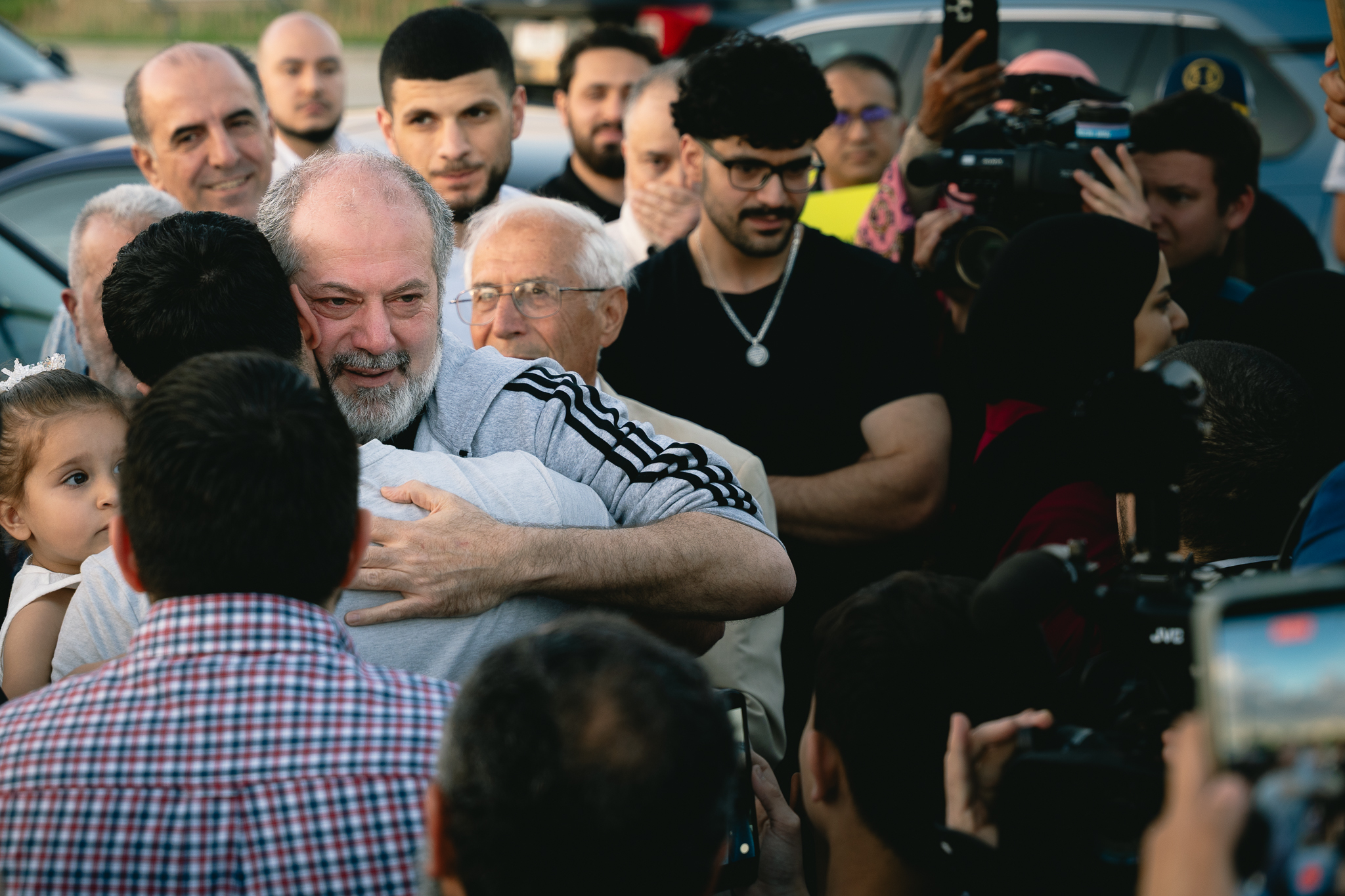
Photo by Yaseen Najeeb
Salah Sarsour, 53, hugs relatives and friends in the Islamic Society of Milwaukee parking lot June 18, the day of his release after 81 days in ICE custody.
A year of planning
The idea for the helpline grew out of Flores’ experience with the VOCES emergency hotline. As a member of the Milwaukee County ICE OUT coalition, Flores volunteered to be a hotline operator for the VOCES emergency hotline. She already had a dozen years behind her as a community organizer in the undocumented community.
“The VOCES hotline was really efficient for finding out about ICE activity and having ICE verifiers show up to a scene or in case someone was being detained, to help with a list of attorneys or providing money to put an attorney on retainer. But there were some gaps I noticed after three months, which included just that direct human connection for help with things like a ride because they were afraid to drive to an appointment,” she said.
VOCES’ mission with the hotline was to be a “See something; say something” hotline, and it did that well, she said. “You can’t expect for the one singular immigrant rights organization in the state to handle hundreds of thousands of undocumented people’s cases in the state,” Flores said. So a year ago, Flores asked others she knew if anyone was interested in creating a helpline. Several Milwaukee community leaders responded, she said. “I found a team of good folks, and we started meeting.”
“We’ve been meeting for about a year, gathering community resources and handing out forms to potential volunteers,” Buff said. “We started talking about what we can offer that is not being offered. Now we have drivers, dog walkers and feeders, grocery runners, you name it,” said Buff. “We’ve been handing out volunteer forms at No Kings demonstrations and trainings for knowing your rights and verifying ICE sightings. “We’ve amassed a pretty good bank of volunteers. We also have family-to-family mutual aid forms, where families with a little extra money can help families who don’t have enough.
“If you don’t have the money and you just have the goodwill, you could do errands or walk with people who want to pick up their children from school but are terrified.”
It’s a complex undertaking to help a wide variety of people with whatever they need, Buff admitted. Over the past year, a detailed plan with dispatchers and response teams has come together. They have also collected data about local resources, she said. “There are so many moving parts,” she said.
Because our stories matter
Wisconsin Muslim Journal reports on people, stories and experiences of Muslims across our state. As a nonprofit publication, we are committed to making this work available to everyone without a subscription or paywall.
Every story we publish is produced by professional journalists, photographers and editors committed to reporting on Wisconsin’s Muslim communities. Keeping this work going requires time, talent and resources.
If you value dedicated, fact-based coverage that documents Wisconsin Muslim history, please consider supporting us with a donation. Gifts of any size make a difference and help us continue to report on narratives that might otherwise go untold.
We are grateful for your readership.