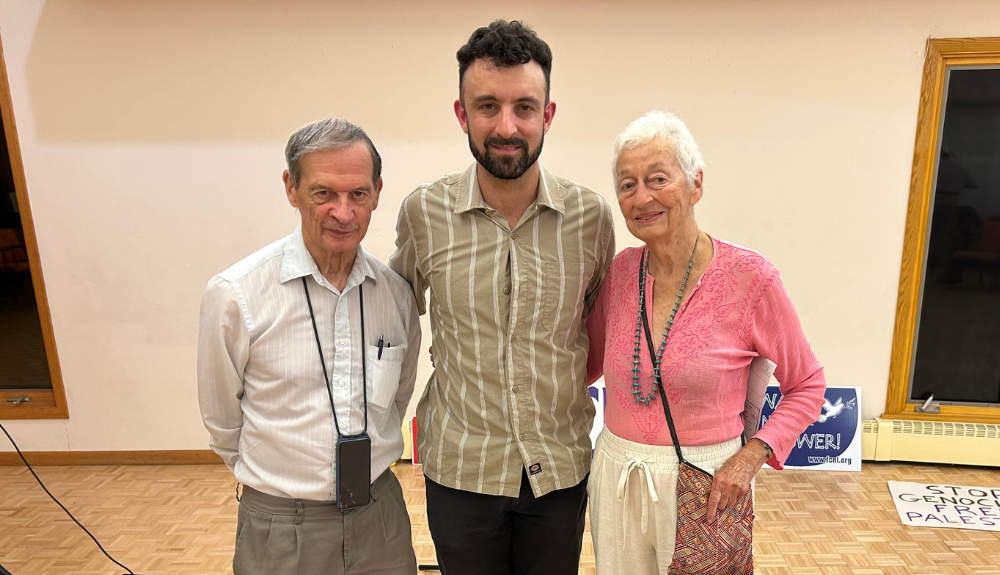
Art Heitzer, (left) a long-time civil rights attorney and former long-serving president of Milwaukee Turners, Milwaukee’s oldest civic and social justice organization, and Peace Action Wisconsin co-founder Julie Enslow (right) were both mentors of Erik Sperling (center) in his teenage and college years.
U.S. foreign policy expert Erik Sperling, a native of Mequon, cut his teeth on international affairs as a youth activist in Milwaukee. He worked closely with Peace Action Wisconsin when he was in high school and college. His early mentors included long-time Milwaukee civil rights and employment law attorney Art Heitzer, Peace Action Wisconsin co-founder Julie Enslow and her partner, the late George Martin, a prominent Milwaukee activist. Sperling joined them in protests against the 2003 Iraq War.
Today Sperling is the executive director of Just Foreign Policy, a nonpartisan nonprofit organization that works to unite people across the political spectrum, including elected officials and other policymakers, “to reduce the harm caused—whether knowingly or inadvertently—by U.S. foreign policy worldwide” and make “meaningful and lasting change,” its website says. The graduate from the University of Wisconsin-Milwaukee has a J.D. from Georgetown University Law Center. He has worked as senior advisor and counsel in the Congressional offices of Ro Khanna and John Conyers.
Peace Action Wisconsin hosted Sperling Thursday night at the Friends Meeting House in Milwaukee for a talk titled U.S. Foreign Policy in a Troubled World; Where Do We Find Signs of Hope? In a lively, fast-paced, wide-ranging conversation with a clearly knowledgeable audience, Sperling spoke for an hour and a half on foreign policy issues from Gaza to China, Russia, Cuba, Yemen and more.
“I thought it would be a small conversation,” Sperling said to about 50 people who came to hear him. “But, of course, this community that so many of you here have built is just phenomenal. I want to support this community and make sure we can get the most out of our elected officials, ensure they are accountable and that we make a very solid contribution to the global scene.”
Here are a few of the highlights.
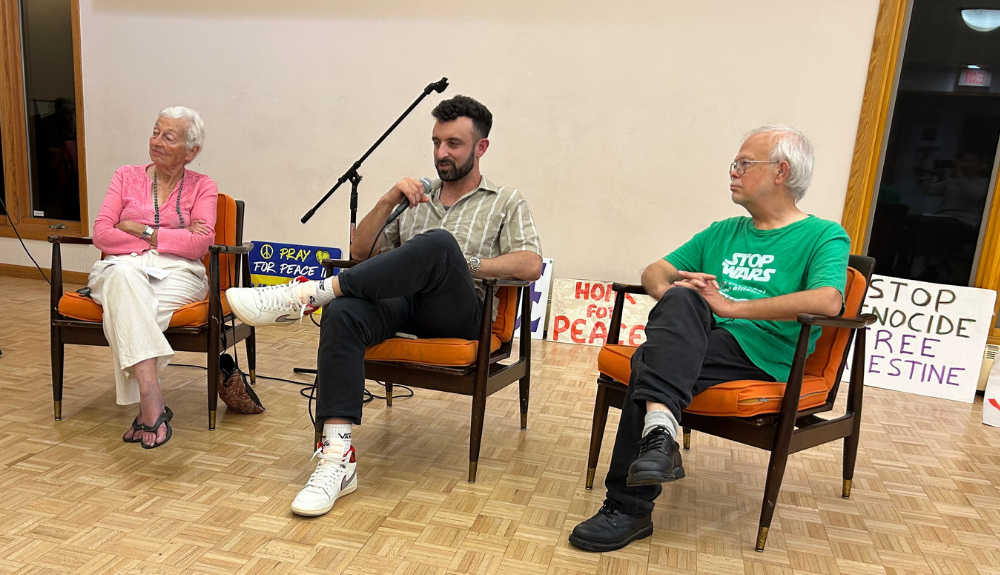
Peace Action Wisconsin co-founder Jule Enslow (left) and PAC Steering Committee co-chair Jim Carpenter led a discussion Thursday with guest speaker Erik Sperling (center), executive director of Washington D.C.-based Just Foreign Policy.
More about Sperling
“I was shocked by the Sept. 11 attacks,” Sperling recalled. “I didn’t understand why we would go to war in response to a terrorist attack. Why shouldn’t we charge and prosecute them? I got involved with Milwaukee’s peace activists. Over time, I started to see what’s going on in U.S. foreign policy around the world. It wasn’t just the Iraq War. As it turns out, there is a long history of U.S. interventionism doing harm to advance U.S. goals in the world.”
Sperling grew up in a family of lawyers. His father, Michael Sperling, is the lead attorney at Sperling Law Offices, LLC, a personal injury law firm in Milwaukee, founded in 1982. He did what his family does, he said, “I went to law school.”
“When I got my degree, I asked, ‘What am I supposed to do with this?’ People I had met said, ‘Go to Capitol Hill.’ I said, ‘What does that mean?’ I had never heard about going to Capitol Hill to become a staffer. I did and I decided I was going to do the type of solidarity work I had become familiar with right here in Milwaukee.
“I had the great honor of working with John Conyers (a U.S. representative from Michigan from 1965-2017), who was Dr. King’s friend. It was an incredible experience.
U.S.-Saudi War on Yemen
“We started working on the U.S.-Saudi war in Yemen, which I’ve been tracking since our Iraq War days. The U.S. and Saudi launched this war in 2015 and I was right there, ready to work on it. We started building awareness. Our first letter had Rep. Keith Ellison, D-Minnesota, (a Catholic who converted to Islam as a young man and became the first Muslim elected to Congress) and 10 other members of Congress on it, saying we should consider using diplomacy instead of war.
“I went to Rep. Conyers, who was about 86 or 87 years old at the time, and said, ‘Sir, we’re getting deeper into the Yemen Policy. I just want to make sure you are on board with this.’
“He said, ‘Erik, you know my slogan—Jobs, Justice and Peace. Does this support peace?’
“And I said, ‘Yes, sir, it does.’
“‘Then let’s do it.’ That was his mentality. It came out of the activist movement of the Sixties, when people really understood the connection between economic justice, civil rights, peace and anti-imperialism.”
Between Cold Wars
“At the time I started working with Rep. Ro Khanna (D-California), the U.S. was between Cold Wars. The U.S. was able to do things without a big pushback internationally. Then D.C. became aware that China was not going to simply submit to the Western order. So, we returned to a Cold War mentality that’s zero sum. It both contributes to pushing Russia and China into an alliance and seeing that alliance as an existential threat to U.S. hegemony around the world.
“One way or another, so many of the conflicts we’re working on link back to the China, Russia, Iran group of countries.”
“And North Korea,” a member of the audience called out.
“Yes, they’ve been pushing further into that alignment as well,” Sperling agreed.
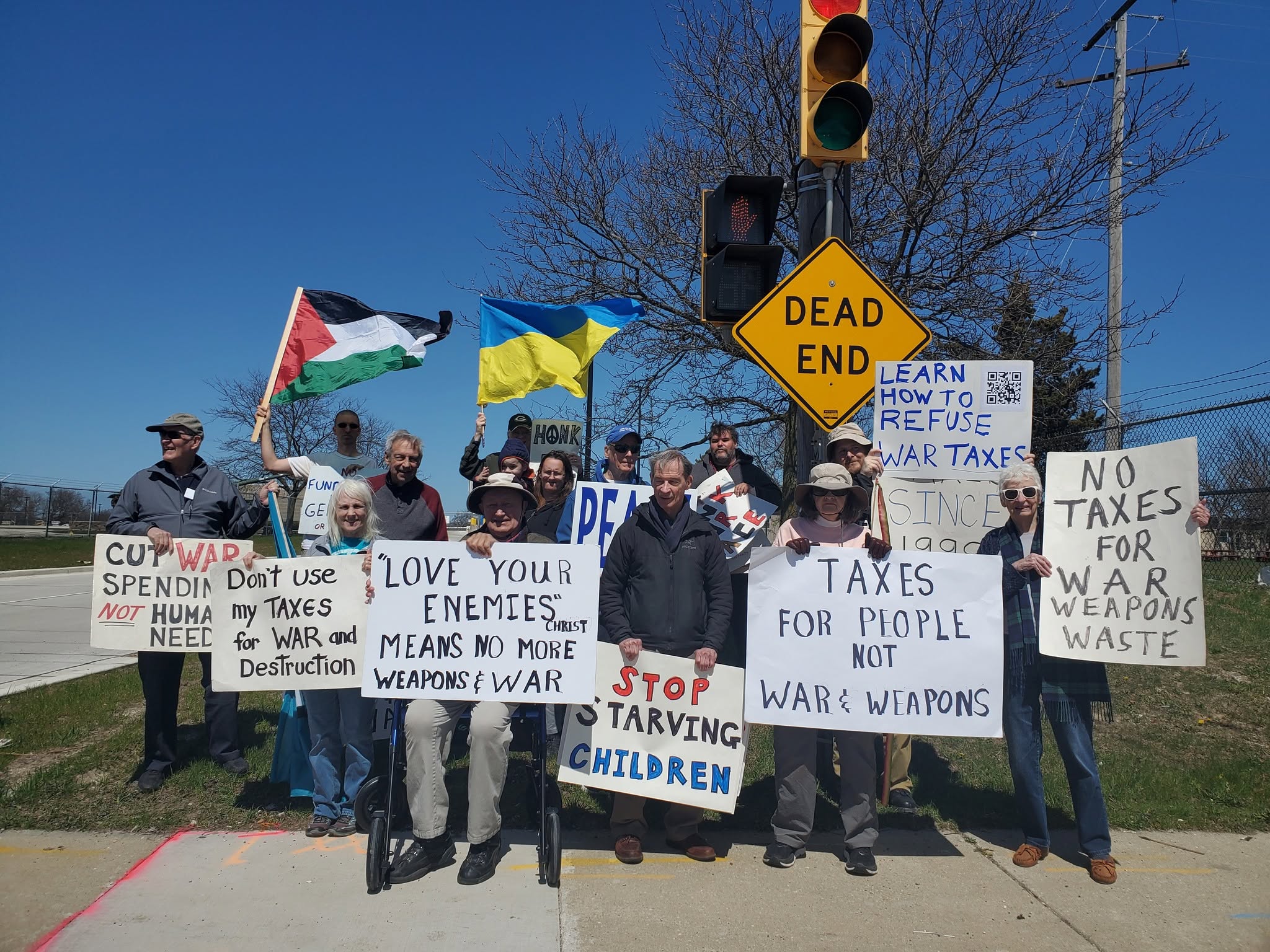
Members of Peace Action Wisconsin frequently organize demonstrations against harmful consequences of U.S. foreign policy.
Israel’s genocide in Gaza
“Just five years ago, I don’t think any of us envisioned how much opposition there would be to the U.S.-Israel relationship. That’s been a really exciting development, of course, coming from the horrific genocide in Gaza,” Sperling said.
“It was clear from the first moments what Israel was going to do. In just a couple days, they surpassed the death toll from Oct. 7. The question the U.S. faced was how quickly to call for a ceasefire. A huge group of us, about 100 organizations, called for a ceasefire right away. There was another set of groups saying, ‘We need to give Israel some time to react. This is their 9/11.’
“About a dozen members of Congress called for a ceasefire within that first week. Momentum grew from there and we built a movement, putting a lot of pressure on the Biden administration. We weren’t able to stop the genocide but we are putting a lot of pressure on them. There’s still a lot more work to do,” Sperling said.
Jim Carpenter, co-moderator of Peace Action Wisconsin, interjected, “Let’s talk about what is happening in Gaza right now. Basically, it’s a parking lot, turned into rubble. People say by the time we get something positive accomplished there, there will be no more Gaza left to save.
“There has been a movement to say to the United Nations, ‘Do your job. Stop this genocide. If you can’t stop a genocide, you’re going to be an irrelevant organization.’ There’s been some movement to use a uniting for peace mechanism to get the U.N. General Assembly to act if the Security Council doesn’t act. Do you know anything about this movement? Is there any talking inside the beltway about this? Is there any hope for the United Nations taking a more positive role in stopping this genocide?”
(Carpenter announced there will be a “Stand for Peace; Respect International Law” event Saturday, Sept. 19, from noon – 1 p.m. at the intersection of Martin Luther King, Jr. Drive and North Avenue, to support respect for international law.)
“Yes, the U.N. has this challenging structure with the veto of the permanent members,” Sperling responded. “This is a huge challenge. If you can get two thirds of the General Assembly, it can take a position, but it is still an advisory type thing.
“What we see is that our role here is to impact U.S. policy. In the case of Gaza and Israel, our view is that the U.S. is essentially enabling Israel’s entire ability to do anything there. We’re not just arming it. We’re also providing intelligence and diplomatic support,” he said.
“For those of us who are in the pro-Palestine movement, our goal is Palestinian dignity, sovereignty and freedom. I think there is going to be a debate in the coming years about what kind of a two-state formulation is acceptable. And I think there’ll be an effort to impose a two-state on the Palestinians.
“How do we engage in a way that really preserves Palestinian sovereignty at a time when there’s going to be a lot of pressure from people to say, ‘Just be happy they have a state it all?’”
Elections
“One important factor is elections. There are exciting electoral developments. We’re seeing AIPAC candidates losing at unprecedented rates. It’s an opportunity for us. “We’re looking to build pressure so that if the Democrats retake the house, they have to actually go follow through on binding legislation to limit U.S. weapons to Israel. Sen. Chris Van Holland (D-Maryland) announced he is going to force a vote in the Senate on human rights violations in the West Bank.
“Our focus has been to force voting in both chambers, getting our issues on the floor. Many (in Congress) would prefer for the executive branch to make the decisions and then they can critique it from the sidelines, but don’t have to have accountability. Establishment forces hate votes for a couple of reasons: the American public is more progressive than the body itself and, second, it raises issues the progressives and anti-war candidates can primary them on. When the Democrats get into power we want to hold them accountable so they can force the Trump administration’s hand. We want them to put in binding restrictions.”
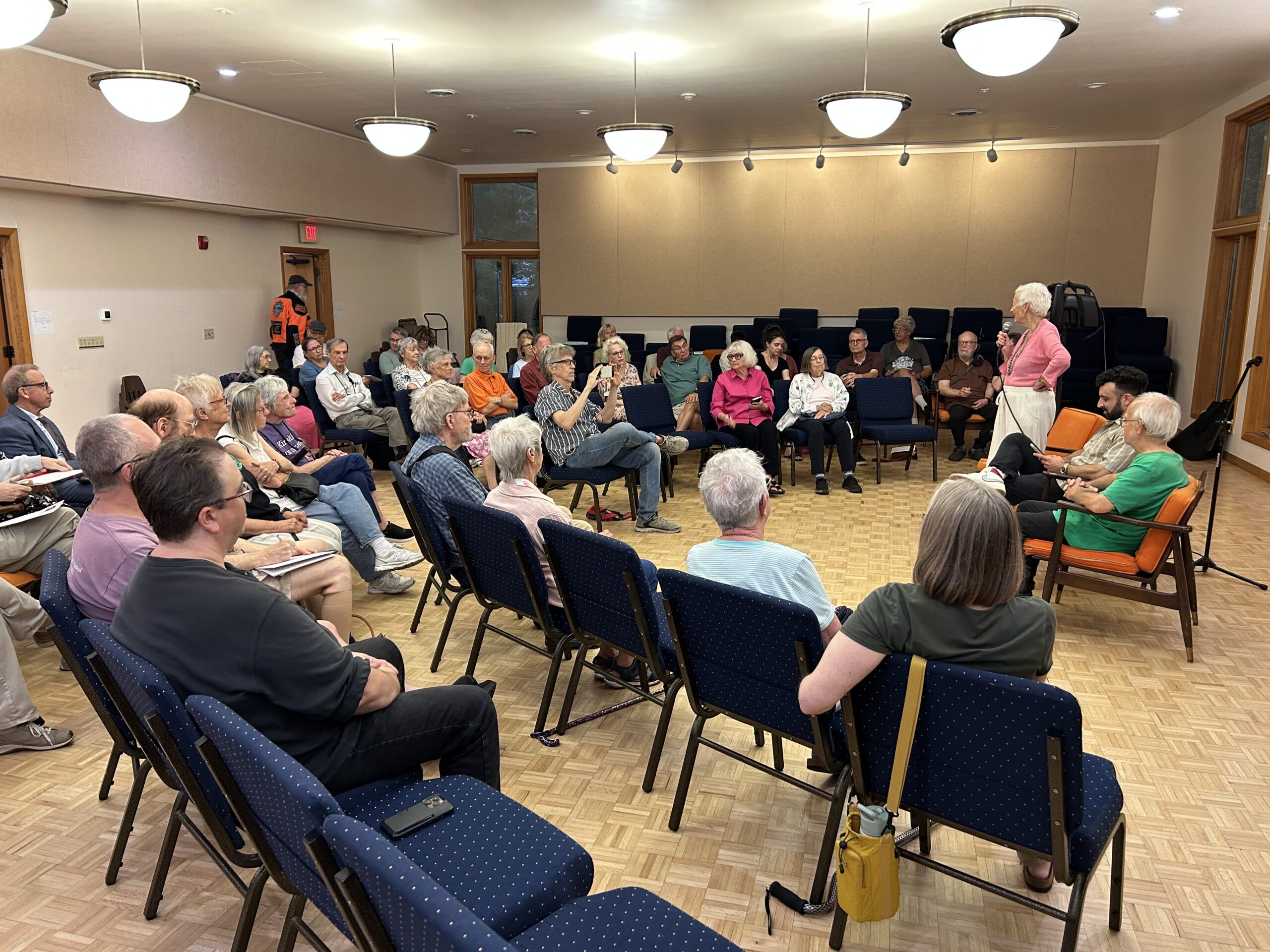
About 50 people attended Peace Action Wisconsin’s discussion with U.S. foreign policy expert Erik Sperling Thursday at the Milwaukee Friends Meeting House in Milwaukee’s Riverwest neighborhood.
Israel’s assault on Lebanon
“Trump announced a ceasefire with Iran and we felt we were so close. We had a lot of hope that he was going to do the right thing and the smart political thing, which is get out of the war. But when we knew Netanyahu and Marco Rubio had announced that Lebanon was not part of it, we knew the ceasefire would fall apart. Iran had said 100% that Lebanon must be included in the ceasefire.
“Marco Rubio knows that Trump doesn’t really understand this Lebanon component. So, he tells Trump, ‘Lebanon is its own thing.’ We noticed a good percentage of the Democrats who are very pro-Israel were also silent on Lebanon. Yet, everyone who’s following the issue knew that if the Lebanon war was not stopped, the ceasefire was going to fall apart.
“We worked with Congresswoman Rashida (Tlaib) to force votes on Lebanon. It did a lot of good in terms of drawing positive attention to Lebanon … but, in the end, Rubio and Waltz managed to tank the ceasefire.”
The blockade of Cuba
“The Biden administration waited until its last day to take action on Cuba, which was immediately reversed by the Trump administration. Now we have Marco Rubio, the number one enemy of Cuba, and he is openly starving them. It’s truly a horrific situation.
“We held a War Power Resolution vote in the Senate (against the blockade) and 47 senators voted with us. Our goal is to have the Dems retake the House and demand that Democrats take a very hard line against these sanctions … We need to talk about the idea of intentionally starving a population as something that should be prosecuted.”
Wisconsin’s legislators on foreign policy
“I love Gwen,” Sperling said about Rep. Gwen Moore. “We’ve known her for decades. But there is so much more she and her staff could be doing. With this turnout tonight for just a random event, I see there is so much power here to get things done.
“And Sen. Tammy Baldwin, I would love for her to take part on these issues. There’s no reason Tammy can’t be a peace champion on a couple of major issues. And (Rep.) Mark (Pocan), he just joined the House Foreign Affairs Committee. One thing we can do is form a high-level group that can keep these folks accountable.”
Is there a principle or value that underlies our foreign policy?
“When I was a kid, I was really impressed by a World War II veteran named John Gilman. He was a Jewish leftist who volunteered to fight in World War II because as a Jew and a leftist, he wanted to fight fascism. That was a beautiful vision.
“Today there is a lot of fear mongering. Many think we’ve got to stay on top. Those people’s vision is to get the AI technology so our killer drone swarm will beat their killer drone swarm. The reality is your enemy is not as evil as you think they are. In fact, your enemy is killing way fewer people than you are.
“China’s making overtures, saying, ‘Let’s do this diplomatically.’ But then they’re also signaling, ‘We will contest you in this space if you keep down this path.’ AI imposes huge risks. We’ve been working with Bernie’s office to say we need U.S.-China AI diplomacy because now it’s a nuclear level issue. We should work diplomatically with China to slow the development of AI. China’s not going to slow down if the U.S. doesn’t signal that we’re going to live with them in peace.
“One of the things I’ve learned in Washington is that they don’t really know what they’re doing either. They’re in an ecosystem where they play their role. They’re in the defense industry-funded think tank, working on Iran policy and they talk to other people who have their same worldview, but they never ask the big questions.
“That’s where groups like this amazing community and others can raise questions like, “Why don’t we use diplomacy to kind of solve world problems together, just kind of have the major countries negotiate and discuss these things in a fair way?
“That’s our vision. Let’s see if we can accomplish it.”
Because our stories matter
Wisconsin Muslim Journal reports on people, stories and experiences of Muslims across our state. As a nonprofit publication, we are committed to making this work available to everyone without a subscription or paywall.
Every story we publish is produced by professional journalists, photographers and editors committed to reporting on Wisconsin’s Muslim communities. Keeping this work going requires time, talent and resources.
If you value dedicated, fact-based coverage that documents Wisconsin Muslim history, please consider supporting us with a donation. Gifts of any size make a difference and help us continue reporting narratives that might otherwise go untold.
We are grateful for your readership.