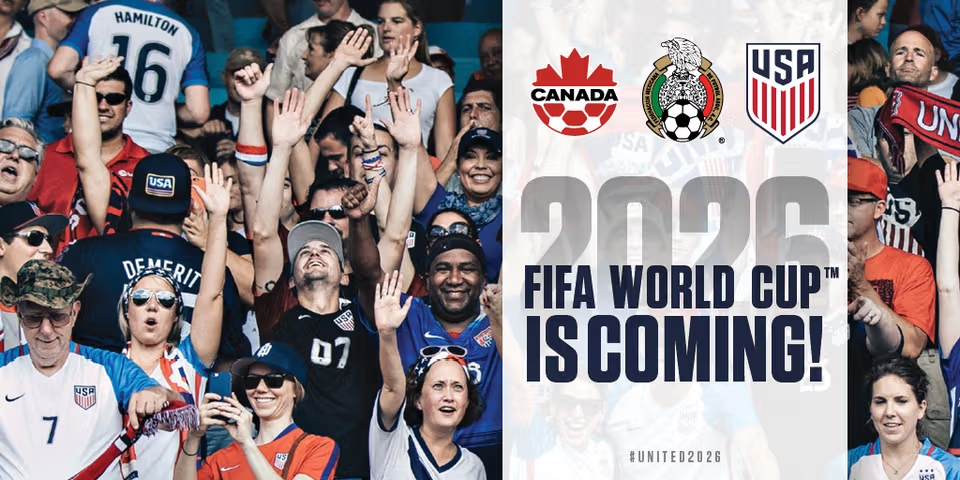
The countdown to the 2026 FIFA World Cup was supposed to be about venues, visas and match schedules.
Instead, it is being overshadowed by politics — and a growing chorus of voices urging fans to stay away from America.
Across social media, calls to boycott matches hosted on U.S. soil are gaining traction, driven by fears over immigration enforcement, political instability and President Trump’s increasingly aggressive posture toward foreign governments.
The tournament, which will be co-hosted by the U.S., Canada and Mexico beginning in June 2026, is now facing scrutiny long before the first ball is kicked.
For critics, the concern is not abstract.
They argue that U.S., under the current administration, no longer offers the sense of safety or neutrality that global sporting events depend on.
Rhetoric that ripples beyond borders
The latest surge in boycott calls followed Trump’s remarks this week that America was “going to start now hitting land” and would target drug cartels “running Mexico.”
The comments landed heavily, not least because Mexico is a co-host of the World Cup and will stage several marquee fixtures.
They also fit into a broader pattern.
On Jan. 3, U.S. forces launched a military operation in Venezuela aimed at capturing President Nicolás Maduro and his wife, Cilia Flores.
U.S. prosecutors allege the couple and close associates were involved in a cocaine trafficking network linked to cartels Washington has designated as terrorist organizations.
Maduro has denied the allegations, accusing the U.S. of attempting to control Venezuela’s oil reserves.
At home, tensions have been inflamed by the killing of Renee Good in Minneapolis by an Immigration and Customs Enforcement officer — an incident that critics say crystallizes fears about aggressive enforcement and unchecked authority.
Fans walk away, hashtags fill the void
What distinguishes this moment from past online outrage is the action behind the words.
“I canceled my World Cup tickets,” said Mohamad Safa, executive director of the non-government organization Patriotic Vision, who has nearly 500,000 followers on X.
Safa said he feared arbitrary detention under U.S. immigration policies. “The ICE may decide that I am a gang member, and I’ll be locked in prison for a year with no charges, no hearing, no trial,” he wrote. “The U.S. is not safe to visit.”
British politician George Galloway posted that traveling to the United States for the tournament would be reckless, while former British prosecutor Nazir Afzal highlighted what he called the irony of Trump receiving FIFA’s inaugural Peace Prize in 2025 despite recent military threats involving Venezuela, Mexico, Greenland, Iran and Colombia.
FIFA’s dilemma: Open doors, closed minds
The World Cup is the most-watched sporting event on the planet.
More than 3.4 million spectators attended matches at the 2022 tournament in Doha, Qatar, underscoring the scale of the challenge FIFA now faces.
Boycotts are not unfamiliar territory.
The 2022 World Cup was dogged by protests over Qatar’s treatment of migrant workers and restrictions on LGBTQ+ rights, with activists urging fans and sponsors to stay away.
Meanwhile, the Trump administration last month unveiled a “FIFA Pass” initiative designed to fast-track visa interviews for ticket holders traveling to America.
The FIFA Prioritized Appointments Scheduling System aims to reduce wait times while maintaining strict immigration controls.
However, critics remain skeptical. They argue that expedited visas do little to address deeper fears about profiling, detention and the unpredictability of U.S. policy.
By Mehr Jan