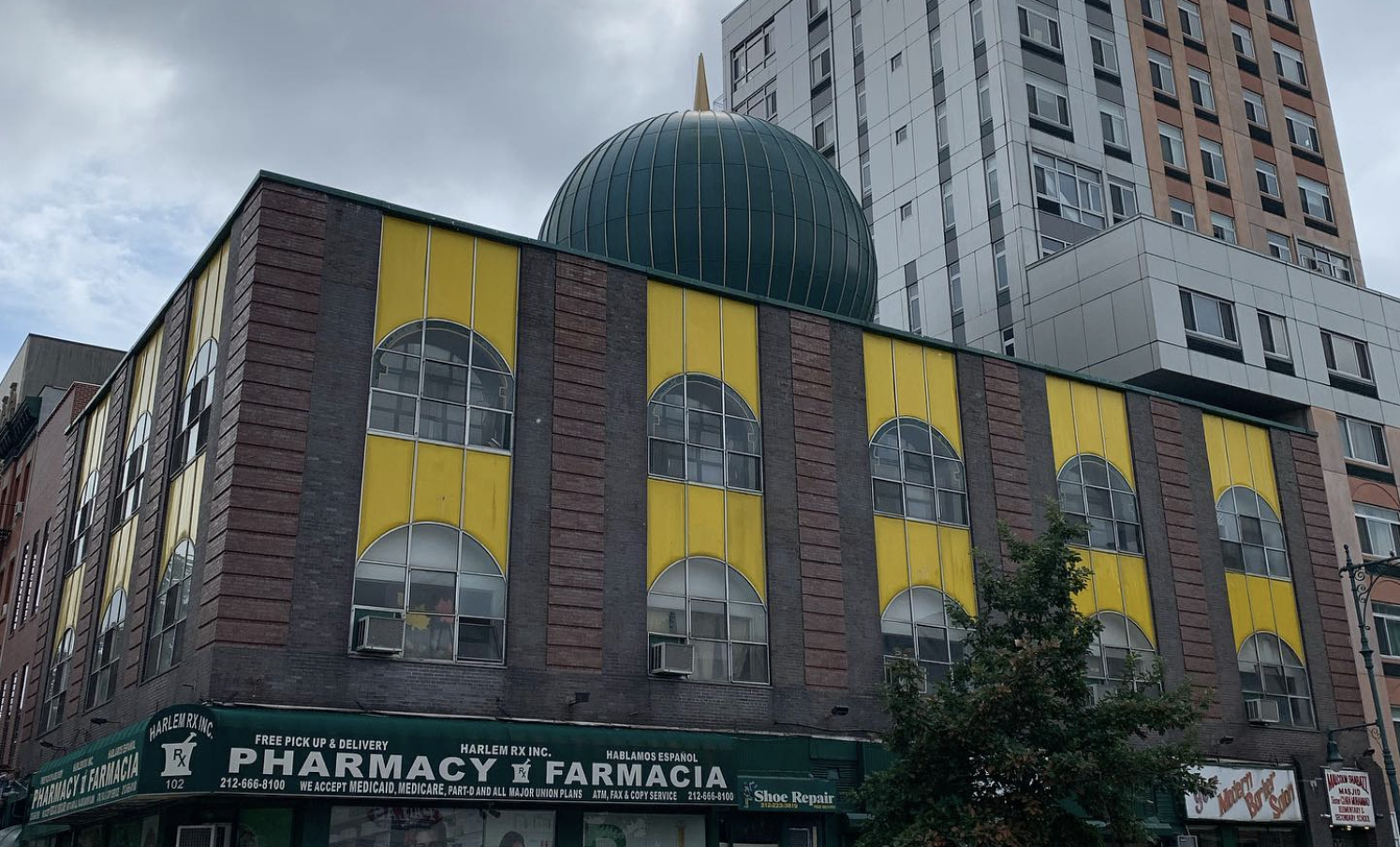
Masjid Malcolm Shabazz in Harlem, New York. Photo cred: @americanarchitecture on Instagram
The story of Islam in the United States is intricately tied to Black history. What started from enslaved West Africans eventually led to Islamic institutions that shaped Muslims in America and American society as a whole. Their mosques served as more than houses of worship; they filled the role of sanctuaries for the Black community, incubators of civil rights activism, and centers for local politics. The stories of these institutions and the people who built them reveal a profound truth: Islam has always been an American religion.
Islam’s Early American Presence
It is essential to understand that Islam arrived in America not with 20th-century immigrants but with enslaved Africans. Historians estimate that approximately 15% of enslaved Africans during the period of the American Revolution were Muslim (Edward E. Curtis IV, Muslims in America: A Short History, 2009, Oxford University Press). These early Muslims practiced Islam in secret, creating the foundation for future Black Muslim movements. One early American Muslim was Job ben Solomon, an enslaved African American who is reported to have prayed in the forests of Kent Island, Maryland in the 1730s. This quiet devotion resurfaced again during the Great Migration as African Americans in northern cities reconnected with Islam.
Masjid Muhammad: The Nation’s Mosque
In the nation’s capital, a historic institution took root and would become representative of African American Islamic identity throughout the country. Dating back to the mid-1930s, Masjid Muhammad was the first mosque built in the nation’s capital by one of the oldest Muslim communities in the country composed of members who are descendants of enslaved African Americans.
The congregation was founded by the theologically unorthodox Elijah Muhammad around 1937 as Nation of Islam Temple No. 4. The modernist building that stands today, designed by architect David R. Byrd, was completed in 1960 with the help of civil rights leader Malcolm X. “He donated $1,400 of his own money towards its construction, and this is the only mosque in all of America that he helped to build from the ground up,” Imam Talib Shareef told The Washington Informer.
The mosque’s opening ceremony on Dec. 10, 1960 remains powerful in the collective memory of the community. Elijah Muhammad came to Washington, D.C. for the inauguration. Following his death in 1975, the mosque transitioned to Sunni Islam under the leadership of his son, Warith Deen Mohammed – who distanced himself from his father by changing the spelling of his last name. This transformation was part of a broader movement that would bring hundreds of thousands of African Americans into mainstream Sunni Islam.
The mosque’s importance was officially acknowledged in 2024 by the African American Cultural Heritage Action Fund, becoming the first Islamic institution to receive such recognition. Albert Sabir, the mosque’s administrative director, reflected on this milestone. “It is a tremendous recognition, and I think it speaks to those who have gone forward before us in terms of setting the groundwork,” he told Religion News Service.
The mosque remains a pillar of Washington, D.C.’s religious and civic life, hosting interfaith conferences, operating the nation’s first Muslim American Veterans Association, and offering Muslim Boy Scouts and Girl Scouts programs.
Mosque No. 7 and Masjid Malcolm Shabazz: Malcolm X’s Harlem
No discussion of Black-led mosques would be complete without examining the institution most associated with Malcolm X’s transformation into a national figure. In 1946, Temple No. 7 of the Nation of Islam opened at the Harlem YMCA in New York City. When Malcolm X was appointed minister in June 1954, it was described as “just a storefront,” but under his leadership, it would become one of the country’s most influential religious and political spaces.
Malcolm X transformed the small congregation into a bold social and political movement. Between 1954 and 1960, the Nation of Islam grew from 400 members to 40,000 members. The mosque became far more than a religious institution. It was an educational center, a hub for community organizing, and a platform from which Malcolm delivered his critiques of American racism and imperialism.
After Malcolm X’s split from the Nation of Islam in 1964 and his subsequent assassination in 1965, Temple No. 7 was firebombed and destroyed. In 1976, the mosque was redesigned by architect Sabbath Brown and reopened with a new name, Masjid Malcolm Shabazz. The redesigned building featured traditional Middle Eastern architectural elements, including arches and an aluminum dome once topped by a golden crescent.
Today, this mosque stands as a place of worship and a memorial to Malcolm X’s complex journey within Islam.
Masjid Bilal: Cleveland’s Groundbreaking Achievement
In Cleveland, Ohio, another historic achievement in African American Muslim history took shape: Masjid Bilal. It was the first mosque where the predominantly African American congregation did the construction work themselves (Natalie Neale, “Masjid Bilal – Cleveland’s First Purpose-Built Mosque,” Cleveland Historical, March 17, 2018). The community’s origins dated back to the early 1950s when it was established as Elijah Muhammad’s Temple of Islam No. 18. The congregation later relocated to a former Roman Catholic Church on East 92nd Street and Holton Avenue where the repurposed building became known as Masjid Willie Muhammad.
The vision for a purpose-built mosque began in 1980 when Imam Clyde Rahman attended a meeting with Imam Warith Deen (WD) Mohammed. A location for the mosque was identified and was purchased by WD Mohammed’s brother, Jabir, who also was the manager of boxing champion and Muslim activist, Muhammad Ali. This connection to Ali, one of the most famous Muslim converts in American history, added another layer of significance to the project.
Masjid Bilal opened mortgage-free on Friday June 3, 1983. The first service was Jumuah prayer, followed by an open house for the public.
Under Imam Clyde Rahman’s leadership, Masjid Bilal became a pioneer in interfaith dialogue and cooperation. In 1993, Rahman said prayers of peace at Temple Ner Tamid on Yom Kippur, the Jewish Day of Atonement. Then in 1994, the spiritual leader of Temple Ner Tamid, Rabbi Bruce Abrams, visited Masjid Bilal to pray during the end of Ramadan (“Islamic Religion,” Encyclopedia of Cleveland History, 2020). This commitment to interfaith cooperation and peaceful coexistence became a hallmark of Masjid Bilal’s identity.
Wallace D. Mohammed II, president of The Mosque Cares, Inc., later reflected on the mosque’s significance. “We all knew what was happening here in Cleveland,” he said during a visit to the mosque. “There was a pride and a great feeling that many of us experienced due to what was happening here. This physical building should be preserved as a monument to our history.”
When Clyde Rahman passed away in 2009 at the age of 79, he left behind a legacy of bridge building and community service (Ann Brown, “Remembering Clyde X: The Black Business Pioneer Who Helped Set Up ‘Little Egypt’ In St. Louis,” Sept. 8, 2022. The Moguldom Nation).The mosque continues under Imam Shafeeq Sabir’s leadership while maintaining Rahman’s vision of interfaith cooperation. Today, Masjid Bilal operates a free health clinic and welcomes Christians, Jews, and Muslims to pray together and learn about Islam.
The American Society of Muslims: Warith Deen Mohammed’s Revolution
Elijah Muhammad’s death in 1975 marked what would become the most significant transformation in Black American Islamic history. His son, Warith Deen Mohammed inherited Nation of Islam’s leadership and immediately began implementing sweeping changes that would bring hundreds of thousands of African Americans into mainstream Sunni Islam (“Warith Deen Mohammed,” Britannica, 2004).
WD Mohammed had begun questioning his father’s teachings years earlier during a prison sentence from 1961 to 1963 for refusing military service. Upon assuming leadership of the Nation of Islam, he moved to reform the movement. WD Mohammed rejected core Nation of Islam doctrines, including the divinity of Wallace Fard Muhammad and the demonization of white people.
He renamed the organization multiple times, first the World Community of al-Islam in the West in 1976, then the American Muslim Mission in 1978, and finally the American Society of Muslims. He changed his own title from “Supreme Minister” to “Imam,” and replaced the chairs inside the mosque with traditional prayer rugs while also introducing the five pillars of Islam to the community.
This transformation, known as the “Second Resurrection,” affected an estimated 200,000 followers. As one scholar explained, WD Mohammed was not merely assuming leadership but taking on the responsibility to guide a community from a doctrine shaped by racial separatism to the true principles of Islam while maintaining an African American identity (“Imam Warith Deen Mohammed: The Journey and Evolution of a Man and the Community He Led,” Oxford Academic, 2014).
Importantly, WD Mohammed insisted that his reforms did not mean abandoning concern for Black issues. As he led his followers toward Sunni Islam and away from his father’s Black religious separatism, he also insisted that African American Muslims continue to take pride in their ethnic heritage, work for improvement in the quality of Black life, and interpret Sunni Islam in light of African American historical circumstances.
This transition created a network of mosques across the U.S. affiliated with what became known as The Mosque Cares or the Ministry of W. Deen Mohammed. These institutions maintained a distinctly African American character. They were known for practicing orthodox Islam while operating full-time Clara Muhammad Schools (schools started by Elijah Muhammad’s wife), publishing the Muslim Journal, and creating a national community that remains active today.
In 1992, WD Mohammed became the first Muslim to offer the opening prayer before a session of the U.S. Senate, symbolizing the acceptance and integration of African American Muslims into mainstream American religious and civic life.
A Living Heritage
The history of Black-led mosques in America tells a story of resilience, creativity, and faith maintained against tremendous odds. From Shaykh Daoud Faisal’s pioneering work in Brooklyn to Imam Wali Akram’s establishment of the First Cleveland Mosque; from Malcolm X’s transformation of Mosque No. 7 into a powerhouse of Black consciousness to Warith Deen Mohammed’s historic transition to orthodox Islam; from Imam Clyde Rahman’s interfaith bridge building at Masjid Bilal to the continuing work of Masjid Muhammad as “The Nation’s Mosque,” these institutions have been essential to both Black American and American Muslim identity.
These mosques did not just preserve Islam in America. They transformed it, infusing it with the prophetic tradition of speaking truth to power that has characterized African American religious expression from the spirituals of enslaved people to the sermons of civil rights leaders. They created spaces where being Black and Muslim was not a contradiction but synonymous.
They remind us that the story of American Islam cannot be told without centering the experiences, struggles, and triumphs of African American Muslims. These mosques did not just make history but continue to make it, serving as beacons of faith, justice, and community in an ever-changing America.
Subscribe to the Islamic Horizons magazine and support authentic journalism by Muslims for Muslims.
Nawal Ali is a public health graduate from Chicago with a background in development. She is currently researching Islamic culture in Central Asia.





![15 Things You Didn’t Know About Makkah and the Ka’bah [Part 1]](https://wisconsinmuslimjournal.org/wp-content/uploads/2026/03/AdobeStock_87517185-scaled-e1774211732813-150x150.jpeg)