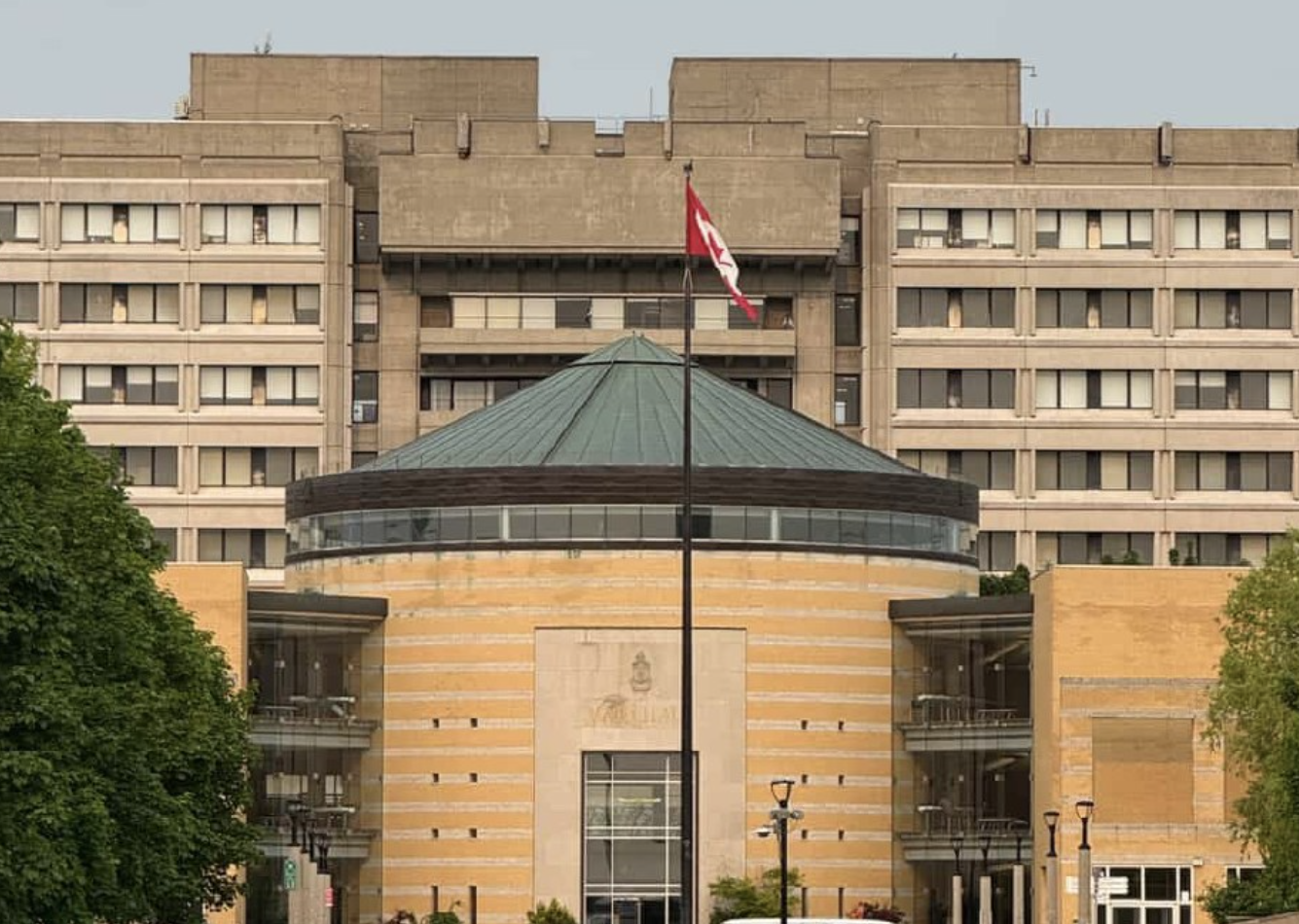
Photo Cred: @yorkuniversity on Instagram
York University’s Islamophobia Research Hub (IRH; or the Hub) was formally launched last August at a moment of urgent need for rigorous, community-engaged scholarship on Islamophobia.
Based at the York Centre for Asian Research in Toronto, Ont., the Hub provides an institutional home for building, mobilizing, and disseminating research that deepens public understanding of Islamophobia. It develops real-world solutions to this social blight rooted in academic expertise and community knowledge. The Hub’s foundational mandate is outlined on its website: Canada now records the highest number of Islamophobia-related fatalities in the G7, and the country continues to see a “disturbing upward trend in hate crimes against Muslims,” marked by everything from fatal attacks to bomb threats and daily harassment.
The inaugural event for the IRH gathered scholars, journalists, and community organizers with keynote speaker Shree Paradkar – an investigative reporter at the Toronto Star – offering a strikingly honest and incisive reflection on Islamophobia’s colonial roots. She drew from her personal journey moving from a newsroom in Singapore — a diverse, multicultural setting where Muslims were not socially or journalistically othered — to a Western newsroom where she found Muslims repeatedly framed through suspicion, distance, or erasure.
This contrast laid bare for her the extent to which Western journalistic norms continue to be shaped by colonial hierarchies, determining who is seen as fully human and who is cast as a perpetual outsider. She described how Islamophobia is sustained not only through explicit bigotry but also through “propaganda by omission,” the systematic non-coverage of Muslim perspectives within the authoritative news media. True decolonial work, she argued, requires rejecting simplistic binaries of innocence and guilt and recognizing that any community can be an oppressor or oppressed, depending on circumstance and power.
The Post-9/11 World
This assessment resonated deeply with attendees, particularly given the broader social context in which the IRH has emerged. Islamophobia in Canada does not occur in a vacuum. As the Hub noted, its contemporary manifestations cannot be separated from “the normalization of racism and Islamophobia in the post-9/11 fabric” of political and cultural life and the transnational circulation of Islamophobic discourses.
Islamophobia has become, as many scholars now observe, the last socially acceptable form of public prejudice. Paradkar, however, cautioned against viewing this in isolation, noting that antisemitism is also resurfacing in some communities. Both forms of hatred, she argued, feed off the same failures of empathy, the same refusal to recognize the full humanity of others.
While the Hub is new, its work is already shaping national discourse. Last summer, the Hub released its first major publication, “Documenting the ‘Palestine Exception’,” a comprehensive report analyzing how Islamophobia, anti-Arab racism, and anti-Palestinian racism intensified in Canada after the events of Oct. 7, 2023. The report compiles interviews, organizational data, and media coverage from Oct. 2023 through Nov. 2024, providing a detailed picture of how individuals and organizations have experienced rising hostility, surveillance, professional repercussions, and erasure.
Its findings reveal a troubling institutional pattern in which long-standing commitments to free expression, anti-racism, and human rights appear to falter when applied to Palestine. The “Palestine exception” outlined in the report illuminates how certain political topics become insulated from accountability, while the communities connected to them — especially Muslims and Arabs — become disproportionately targeted.
The IRH Team
A central part of the Hub’s strength lies in its leadership. The IRH is directed by Nadia Z. Hasan, PhD, an assistant professor in the School of Gender, Sexuality, and Women’s Studies at York University. Her scholarship and advocacy focuses on systemic racism, Islamophobia, and the legal and administrative structures of Muslim life in Canada. Her work is rooted in community organizing, and she has led multiple national advocacy campaigns challenging racism, hate, and discrimination. Under her leadership, the Hub positioned itself not just as a research center, but as a space where scholarship and community realities inform and structure one another.
Supporting Hasan is an interdisciplinary team whose expertise reflects the complexity of Islamophobia. York University’s postdoctoral researchers Dr. Salmaan Khan, PhD, Maira Hassan, PhD, and Khalidah Ali, PhD, each bring distinct but interconnected areas of specialization ranging from labor inequity and political economy, to gendered racialization in Canadian courts, to the impact of Islamophobia on humanitarian aid and governance.
Their work is complemented by a cohort of research assistants whose professional and academic backgrounds encompass data science, policy advocacy, refugee support, women’s studies, legal research, and anti-racist organizing. Together, this team works to ensure that the Hub’s work is both analytically rigorous and grounded in the lived realities of affected communities across the Canadian landscape.
The Hub is further guided by a robust steering committee composed of scholars, authors, human rights advocates, and community leaders. This group provides the Hub with a wealth of expertise in politics, socio-legal studies, secularism, anti-Black Islamophobia, literature, and community organizing. Their presence signals the Hub’s commitment to multidisciplinary scholarship and its recognition that the fight against Islamophobia must operate across academic, cultural, legal, and civic spheres.
Impactful, Real-World Scholarship
The Islamophobia Research Hub is not merely responding to a particular political moment – it is helping define a new intellectual and community landscape. By integrating decolonial analysis, community-engaged research methods, and policy relevance, the Hub is offering a model of scholarship that refuses to remain siloed. Its work illuminates Islamophobia as a global and transnational phenomenon, while grounding solutions in local realities and community needs.
As Paradkar reminded attendees, the narratives a society chooses – or chooses to ignore – shape the boundaries of its moral universe. Through its launch, its summer report, and the collective expertise of its assembled academic team, York University’s Islamophobia Research Hub has positioned itself to redraw those boundaries with clarity, compassion, and a deep commitment to justice.