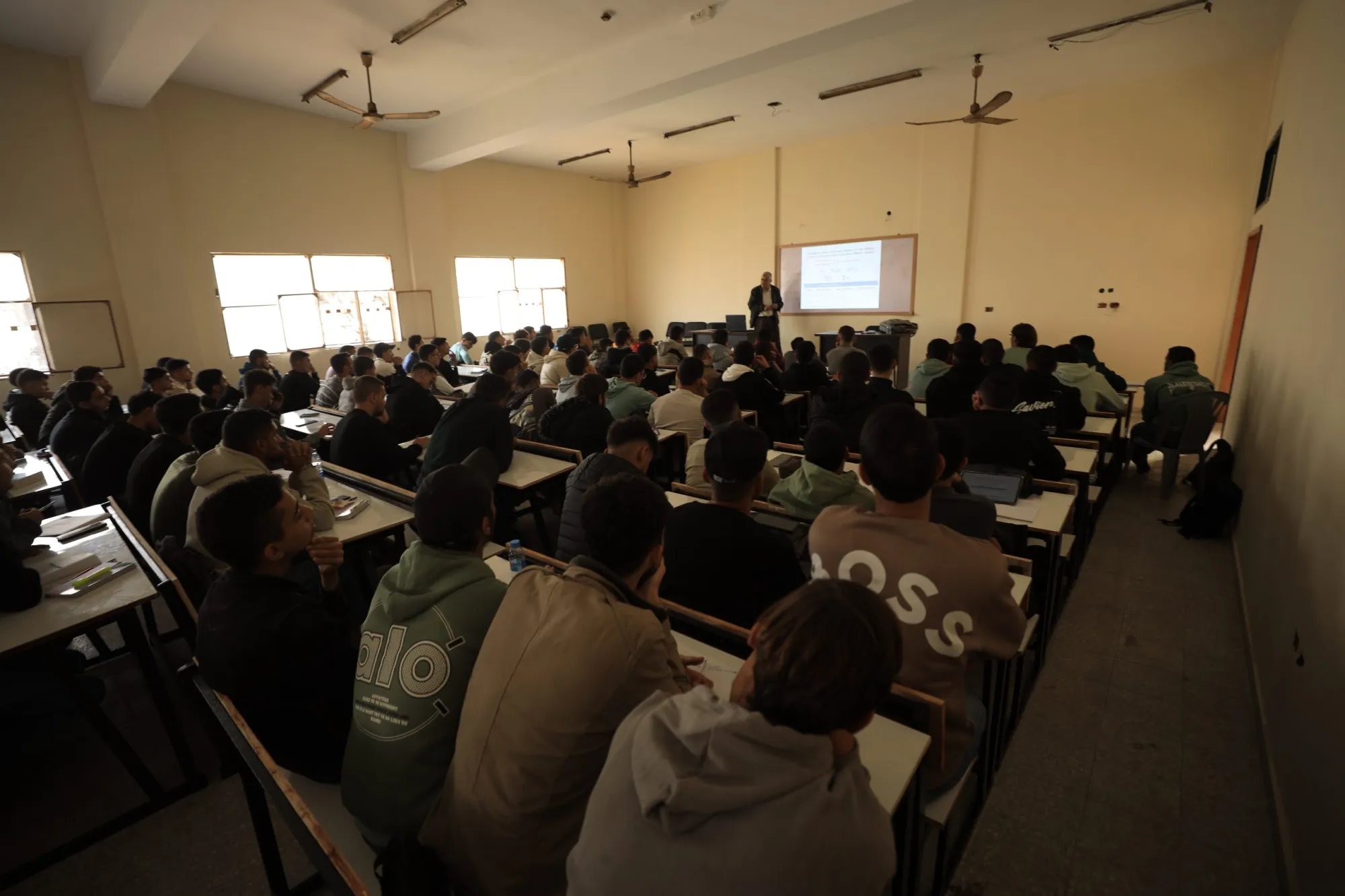
Medical, nursing, and engineering students attend their first in-person classes on Nov. 29, 2025, at the Islamic University of Gaza in Gaza City following the ceasefire after Israel’s two-year-long attacks on Gaza. Credit: Khames Alrefi/Anadolu via Getty Images
Aya Shamlakh finished secondary school, or tawjihi, in the Gaza Strip last year with a 91.6 GPA, out of 100, despite the most difficult circumstances.
“During the genocide, I had been displaced multiple times along with my family, sometimes to areas without internet access, which made my journey even harder,” the 18-year-old said.
Immediately upon graduating, she joined the Islamic University of Gaza (IUG), where her siblings also study and which reopened for in-person classes only for first-year students last fall after shutting down during the genocide. Shamlakh chose to study nursing, a field she was drawn to after witnessing her brother being injured in an airstrike and being unable to help him.
“I want to help as many people as I can and provide them with free medical care,” Shamlakh said.
IUG, founded in 1978, was the first higher education institution to be established in the Gaza Strip, and one of Gaza’s largest universities. It served tens of thousands of students before the war. But like other educational institutions in Gaza, IUG was forced to close its doors when the genocide began, and was targeted multiple times by Israeli airstrikes. Despite the dire circumstances, nearly 4,000 students graduated from the university during the war through remote learning. Then, on Nov. 29, the school reopened its doors to welcome first-year students enrolled in certain health and science programs within what remained of its buildings, though attending in person is optional.
“I couldn’t believe that after such a long time, I would be able to study inside real buildings,” said Shamlakh, describing the moment she entered the university as transformative. “Now I feel free. Now I feel like I’m truly studying.”
Surviving destruction
Israeli strikes destroyed 12 of the 16 buildings on IUG’s central campus in Gaza City, and severely damaged the remaining four. The second campus, which housed the Faculty of Medicine and the Turkish Hospital University Hospital, has been completely destroyed. The two buildings comprising the Khan Younis campus in the south have been badly damaged.
UNESCO estimates that more than 95% of higher education campuses across Gaza have been severely damaged or destroyed since the war began.
Israel didn’t stop at destroying the education infrastructure. It also launched a series of assassinations targeting some of IUG’s reputed professors, most notably the university president, Sufyan Tayeh, who was killed by an airstrike on his house in Jabalia.
Still, the staff exerted huge efforts to make some buildings usable in order to accommodate as many students as possible.
“Today is a historic day. It is a new birth of the Palestinian higher education,” said IUG President Asaad Yousef Asaad, in a video the university posted to YouTube on the first day of in-person learning. “Palestinian people love life and education. They challenged the war and the very hard reality.”
Asaad said the university plans to allow the gradual return of in-person learning for other students as well.
Perseverance amid genocide
During two years of genocide, students in Gaza proved to the world that learning is possible under any conditions.
After shutting down when the war began, IUG announced the resumption of classes via the online learning system in July 2024. For many, that decision was a glimpse of hope after a nine-month suspension in their education.
However, online learning was full of challenges. The electricity was cut, and relying on solar panels was limited and insufficient. The internet was unstable, pushing students to walk long distances to certain spaces where they could download lectures and complete their exams.
Despite their accomplishments, students dreamed of attending university the way others outside of Gaza do. They wished to make friends, enjoy the campus, and address professors face-to-face. Unfortunately, that dream became even more unattainable under bombings and endless journeys of displacement.
On Oct. 10, 2025, when the ceasefire was announced by President Donald Trump, hope returned to those who wished to sit at real desks, not behind screens.
The new online semester at IUG was scheduled to begin on Nov. 8. The university announced that the semester would be face-to-face for only first-year students from the faculties of medicine, health sciences, sciences, nursing, law, information technology, and engineering. On Nov. 29, doors opened for in-person learning for those students.
Attending in-person lectures is optional. Despite the ceasefire, Gazans still face multiple challenges, particularly transportation. The high cost of fuel has made fares unaffordable for the majority of people, and the ongoing cash crisis adds to the burden. Drivers refuse digital payments and insist on cash, which is scarce, worn out, or torn.
“We truly know the difficulties that students face in reaching the university,” Basam Al-Saqa, assistant to the IUG vice president for academic affairs, said in a separate video posted to YouTube by the university on Nov. 29.
Dreams realized
Like many others, Walid Abed’s education was interrupted during the war, and he was unable to take his tawjihi exams under normal conditions.
When he was finally able to take the exams last year, Abed, 19, was displaced to the south during the exams. But his perseverance proved stronger than any challenge: He passed all his exams with a score of 89.77. He is now enrolled in the engineering department at IUG.
“My dream has always been to be an engineer, and now, my dream has come true,” Abed said.
Abed now lives in the eastern part of Gaza City. He faces daily challenges in reaching the university.
“I know the in-person lectures are optional, but I won’t miss this valuable opportunity, even if I have to walk to the university,” he said.
Meanwhile, non-first-year students are looking forward to the day when they can also set up their desks again inside the university buildings. They long to reunite with their friends, eat breakfast on campus, and visit the library that was once filled with many valuable books.
As a junior student who joined the university in 2023 after graduating from secondary school, I only spent one month on campus before the genocide began. That month was the most beautiful in my academic life, but the war disrupted all my plans for a productive university year. Since July 2024, I have been studying online, and a mix of emotions has overwhelmed me.
I feel proud that I managed to overcome many challenges along the way, but I also feel sad that I never got the chance to experience university life like other students around the world. At one point, returning to the university felt impossible due to the massive destruction and long interruption. But the impossible has become possible, and our hope for a full return remains strong.
The partial reopening of the Islamic University is more than an academic step; it is a declaration that education in Gaza refuses to die and a reminder that knowledge remains one of Gaza’s most enduring forms of resistance.
By Editorial Team:
Sahar Fatima, Lead Editor
Carolyn Copeland, Top Editor
Stephanie Harris, Copy Editor