Photo courtesy of Marquette University
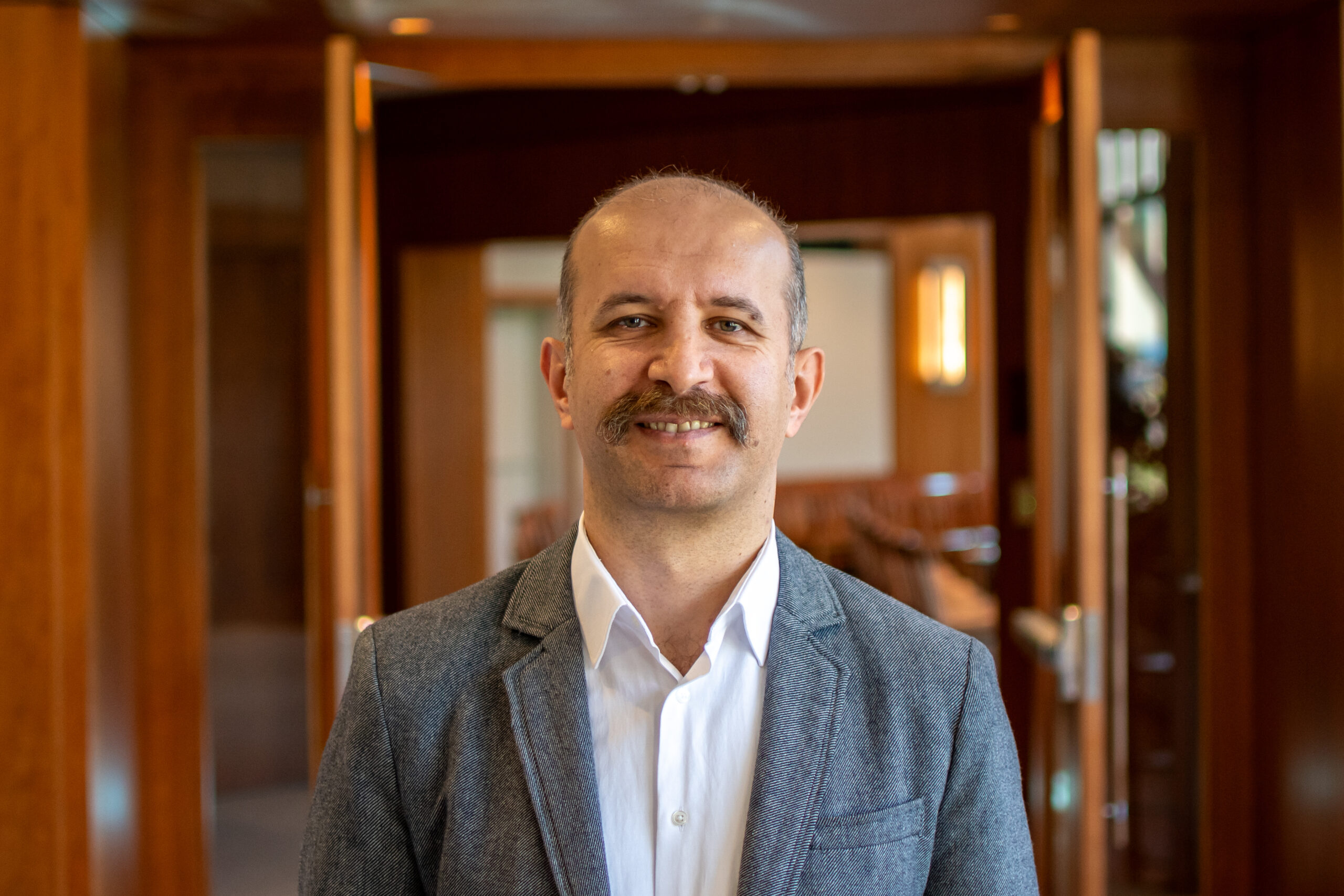
Fatih Harpci, Ph.D., joined Marquette University’s Campus Ministry last summer as MU’s Muslim chaplain.
As students in Marquette University’s Arabic Language and Culture Club set up calligraphy and henna stations, an Arabic clothing display and a Middle Eastern buffet Feb. 13 to celebrate Arabic culture, MU’s new Muslim chaplain Fatih Harpci milled about. Instead of heading home on a dark, cold Friday evening after a full workweek, Dr. Harpci attended the students’ event.
Tall and slim with a wide smile, he quietly walked up to groups of students or faculty members and quickly engaged in conversations. Why the smile? “It’s sunnah (the traditions and practices of Prophet Muhammad that serve as a model),” he told the Wisconsin Muslim Journal.
“I am here to listen to the needs, struggles and stories of Muslim students,” Dr. Harpci said in an interview in Marquette Today, a publication for the Marquette Community, about his role as the Muslim chaplain at Wisconsin’s largest private university and one of the largest Jesuit universities in the country. He also views “fostering healthy interfaith relationships on campus and beyond” as an important part of his duties, he said.
“We are thrilled to have Dr. Harpci here supporting our Muslim students and encouraging students of other faiths to connect with them and get to know their Muslim classmates,” Steve Blaha, director of MU’s Campus Ministry, told the Wisconsin Muslim Journal. “We’ve had Dr. Harpci serve on a number of panels. He is a terrific speaker who always fosters an environment dedicated to lifting up people of faith and encouraging dialogue.”
Serving Muslim students and developing interfaith understanding—these are hallmarks of Dr. Fatih Harpci’s work in southeastern Wisconsin for more than a dozen years.
Teaching about Islam
Dr. Harpci is a full-time associate professor of religion at Carthage College in Kenosha, a college affiliated with the Evangelical Lutheran Church in America. He is there except for five hours on Mondays and Fridays, when he is fulfilling his part-time job as the Muslim chaplain at Marquette.
With only about a dozen Muslim students at Carthage, the vast majority of its student body knows little about Islam, he said. When he joined Carthage in 2014, the Religion Department had one course on Islam. It was named “Islam,” Dr. Harpci told WMJ. He has since developed four solo-taught and three team-taught classes in Islamic studies that are popular course offerings at the private liberal arts college.
Dr. Harpci is uniquely prepared to explain Islam to people of other faiths. Although he aspired to study medicine after high school and had the required grades, the politics in Turkey (where he was born and raised) prevented a practicing Muslim from entering elite professions at the time, he told a Marquette University Wire reporter.
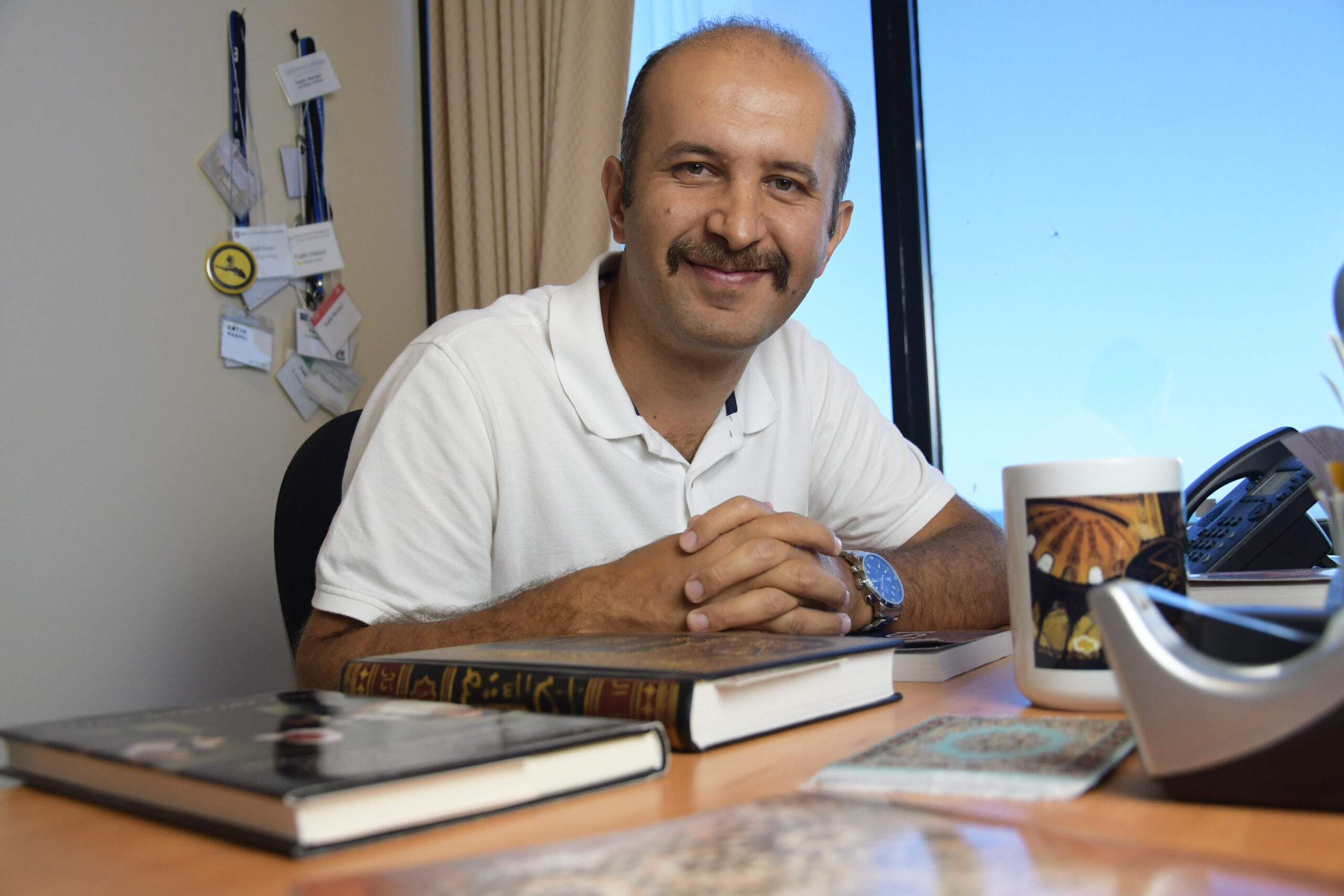
Dr. Fatih Harpci is a full-time associate professor of religion at Carthage College in Kenosha.
Accepting his fate, he earned a Bachelor of Arts degree in Islamic theology from Marmara University, a leading university in Turkey with an internationally esteemed religious studies program. His concentration was on fiqh (Islamic jurisprudence) and hadith (teachings and examples of the Prophet Muhammad).
His next stop was Moravian Theological Seminary in Bethlehem, Pennsylvania, a university dating back to 1742 with roots in the Moravian Church, a Protestant Christian denomination. Harpci was the first Muslim seminarian in the school’s history. There, he completed a Master of Arts in Theological Studies with a thesis on the necessity of interfaith dialogue.
At Temple University in Philadelphia, Harpci earned a doctorate in Islamic studies. His dissertation examined hadith about Jesus, particularly about his second coming and messianic roles, Dr. Harpci said.
He knows several languages. Turkish is his native language. He is fluent in English, and he reads and writes Arabic at a high level. “I did not have experience traveling in or living in Arabic-speaking countries,” he added. “But when it comes to reading and understanding traditional texts, whether the Quran or hadith, I have no issue.”
He also knows Ottoman Turkish. “It’s not really a separate language,” he explained. “But it is written in Arabic script. It was used before 1923, when Atatürk came to power. It doesn’t come in handy often, but might if I’m doing some archival research.”
Dr. Harpci’s published research and academic presentations frequently address common topics in the Abrahamic traditions (Judaism, Christianity and Islam). Who is My Neighbor? Philanthropy in Light of the Prophetic Model, published in 2020 by Indiana University Press’ Journal of Muslim Philanthropy & Civil Society, examines the duties of Muslims towards their neighbors and concludes Muslims are “to do good (ihsan) to their neighbor who is near and distant, regardless of their ethnic, racial or religious background, and that charity is an excellent way to do good to both Muslim and non-Muslim neighbors.
His dissertation on the numerous references to Jesus in hadith is in the publication pipeline. It is expected to be a chapter in a book titled Jesus, Son of Mary, to be published “very soon, inshallah” by the Society of Biblical Literature, Dr. Harpci said. “My chapter is titled Jesus in Hadith Literature.”
In his 2014 co-authored book, Sultan of Hearts, Prophet Muhammad, Dr. Harpci details the exemplary life of Prophet Muhammad.
Serving Muslim students
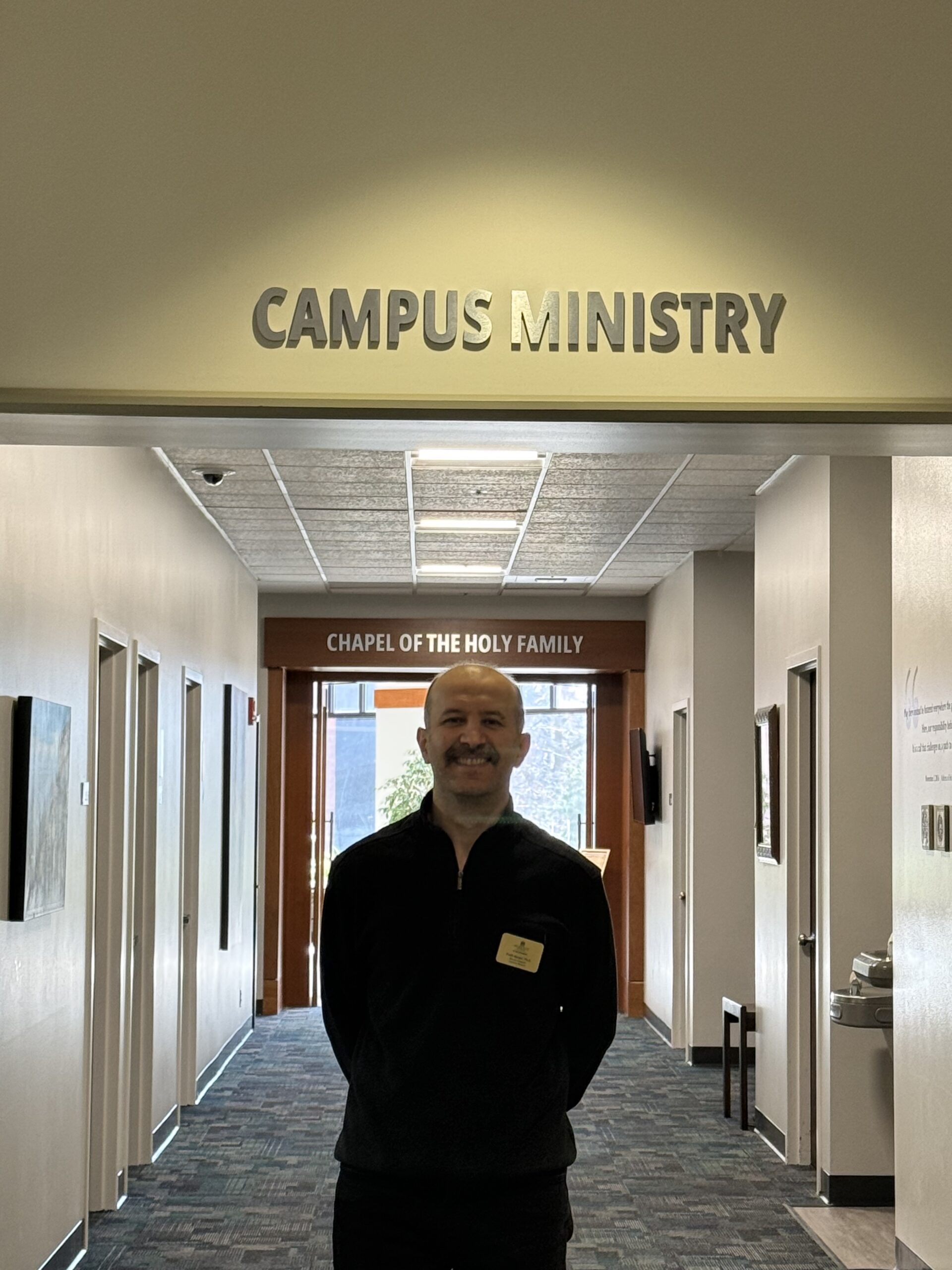
Dr. Fatih Harpci, Marquette University Muslim chaplain
Dr. Harpci has passed the halfway mark of his first academic year as MU’s Muslim chaplain with the new year. He works in MU’s Campus Ministry, a department whose mission is “to meet the diverse spiritual needs and interests of Marquette University’s student community.”
He is at MU Mondays and Fridays, 9 a.m. – 2 p.m., usually in his office in MU’s Alumni Memorial Union (AMU 236F), “right behind the information desk on the main floor, near the Muslim prayer space,” he told WMJ in an interview Monday. An article on the Marquette Wire, MU’s student media, reports, “He can be reached anytime at fatih.harpci@marquette.edu.”
“I will be primarily responsible for providing spiritual support, programming, leadership, community engagement and outreach to students in the Marquette University Muslim community, including non-practicing individuals,” Dr. Harpci told Marquette Today in November.
Muslim students stop by his office to talk about whatever is on their minds, Dr. Harpci said. Like all students, they have family struggles or deal with grief. “I just tell them I am here,” he said. “I want to give them spiritual support. I’m mainly here to listen. I don’t promise I can solve anything.”
Strengthening interfaith ties
Since joining Marquette at the beginning of the academic year, Dr. Harpci has worked to increase understanding in the rest of the community about issues Muslim students face, he said. “The first thing I did was check into halal meals. We have halal offerings on campus, but are they of good quality? Do the students know where to find them? I talked with the company that provides meals on campus to learn more about it. Where do they get their meat? What choices do they offer?
“Another thing I did was to communicate to Muslim students where we have prayer spaces. There are three locations right now that are available for Muslims to pray.”
One challenge is finding MU’s Muslim students to share information with them. Dr. Harpci knows of about 200 Muslim students on campus, but those are only the ones who checked a box on their registration form indicating their religion. “Of course, there are others who didn’t check the box,” he noted.
A strategy he is using to find Muslim students is to network with different offices and organizations that may intersect with them. For example, he is in touch with someone working with African American students, another in the International Student Office, and with some student organizations. He is working with the International Student Office to plan a meet-and-greet session with international Muslim students when they come to campus.
Dr. Harpci wrote a letter to the Marquette University community about Ramadan to help raise awareness across campus about this holy month for Muslim students. He also spoke about Ramadan in mid-February at a Soup and Substance lunch gathering for all students, faculty and staff interested in attending.
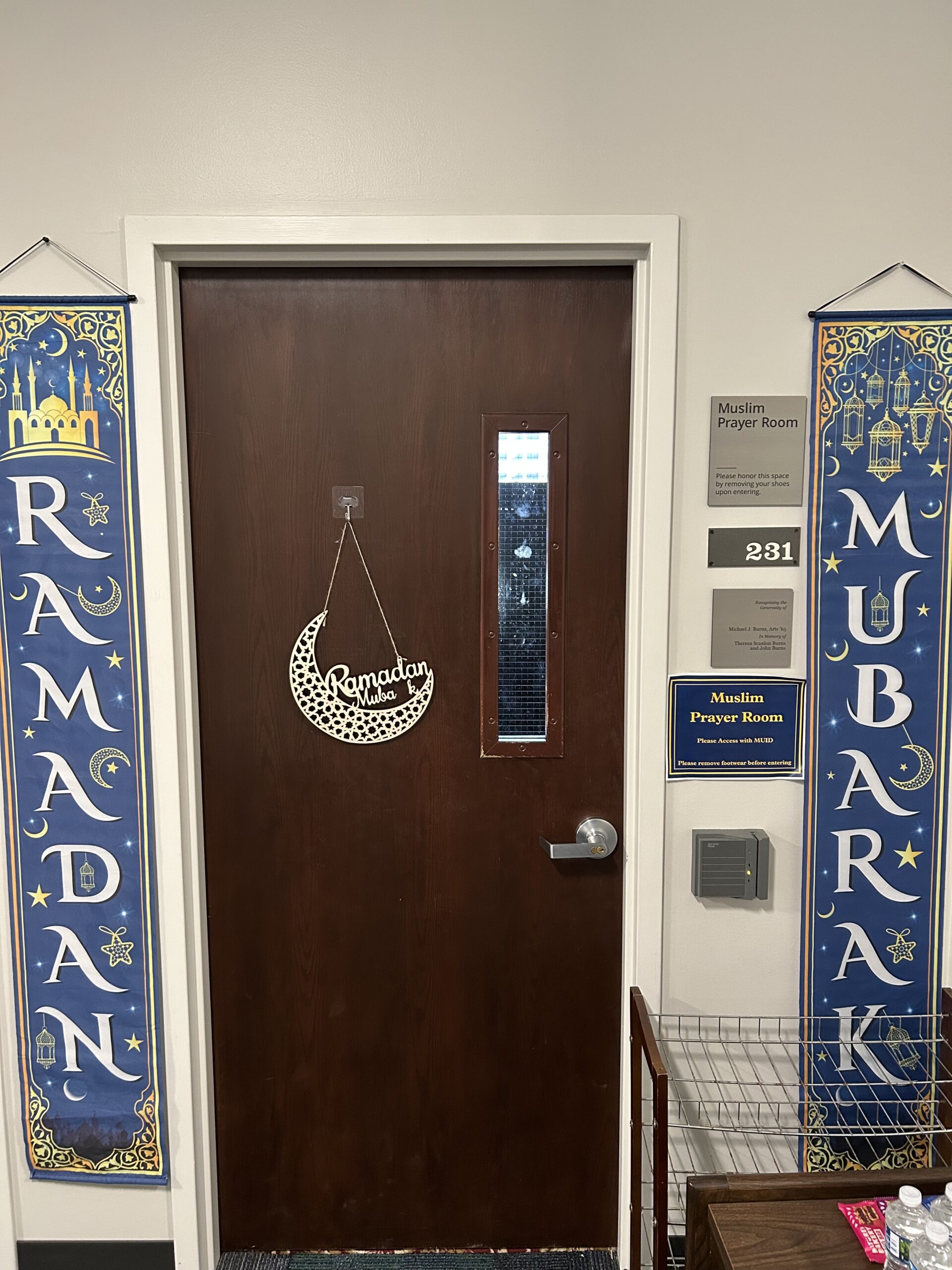
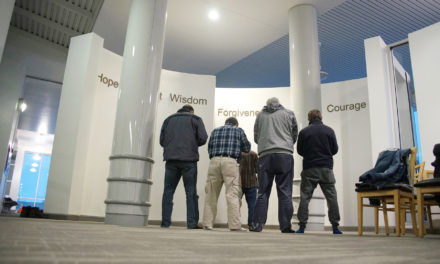
One of MU’s Muslim prayer rooms is located in Campus Ministry.
He also delivers khutbahs (sermons) at Friday prayer services. “And sometimes I give chances to students who want to give a khutbab. We rotate,” he said.
One of the next issues he hopes to tackle is finding a permanent home for Friday prayers. “The location changes from one week to the next. I want to say we have about 40 to 50 students attending, both men and women.” Establishing a permanent prayer space “is a discussion we have on the table,” he said.
Dr. Harpci started a Quran circle that meets right after Friday prayer. The short study sessions focus on a verse or two. “We have about 20-25 minutes before students have to rush to class,” he said. “We don’t have time to get in too deep, but this is not simply a translation either.”
During Ramadan, “we’ve had two iftar dinners (for breaking the daily fast). And I organized another one off campus at the Turkish American Society of Wisconsin.” The iftars are open to all, and Dr. Harpci said he would be pleased if non-Muslims join in.
Beyond campus
Dr. Harpci’s role in southeastern Wisconsin’s Muslim and interfaith communities extend beyond campus. He is featured in the 2020 book Interfaith Engagement in Milwaukee: A Brief History of Christian—Muslim Dialogue, edited by Irfan A. Omar, Ph.D., an MU associate professor of theology, and Kaitlyn C. Daly, a Marquette University graduate. It identifies Dr. Harpci as a leader in interfaith programs in Milwaukee, saying, “A key member of TASWI (Turkish-American Society of Wisconsin) and a professor of religion at Carthage College, Prof. Fatih Harpci has led the dialogue and discussion from the Muslim side for several years. Harpci is a noted scholar and committed practitioner of interfaith dialogue, academically as well as in praxis.”
He is an active participant in worship at the American Albanian Islamic Center of Wisconsin and serves as a speaker at many Muslim and interfaith events and programs, including those of the Muslim Women’s Coalition, the Milwaukee Interfaith Conference and others.
When he does get home to his wife Selma and two sons, 6 and 9 years old, his life does not slow down. His sons have been waiting for him to play, he said.
“Just let me get this coat off,” he tells them.



![15 Things You Didn’t Know About Makkah and the Ka’bah [Part 1]](https://wisconsinmuslimjournal.org/wp-content/uploads/2026/03/AdobeStock_87517185-scaled-e1774211732813-150x150.jpeg)