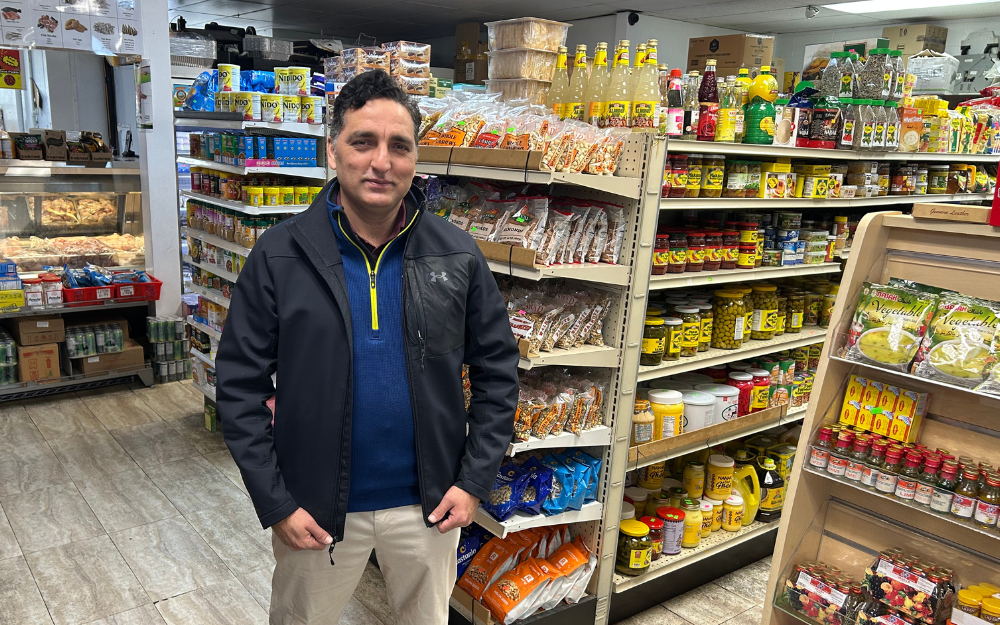
Photos courtesy of Haq Nawaz
Haq Nawaz, 45, opened his Brookfield grocery store Raja Bazaar in 2018. After building this successful business, he is now negotiating to buy a store and a restaurant in Milwaukee.
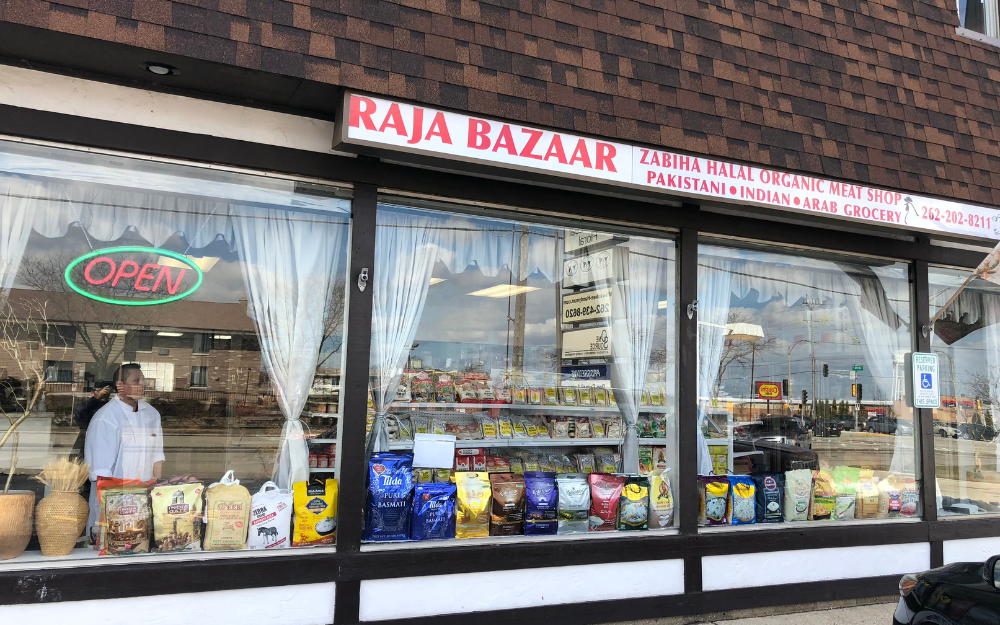
Raja Bazaar, with its zabiha, halal meat shop, at 3065 N. 124th St., sits inconspicuously in a small, red-brick building on the eastern edge of Brookfield, facing Wauwatosa.
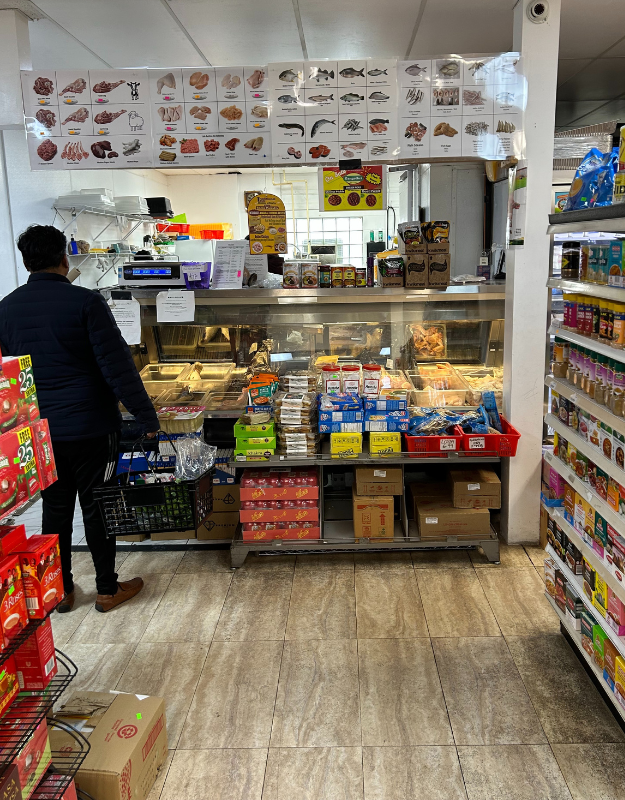
Don’t let its unassuming storefront fool you. The 1,975-square-foot store is packed to the brim with Pakistani, Indian and Arab groceries and a steady flow of regular customers of many ethnicities. Whether they drove two hours to get there or popped in from just around the corner, they often stay to chat with each other and the staff.
If they have the opportunity, as one Wisconsin Muslim Journal reporter did this week, to ask owner Haq Nawaz, 45, of Brookfield, to show them around, he’ll take them through aisles of hundreds of colorful bags of rice of multiple varieties, famous and rare, flours of all types, lentils, spices, teas, dried fruits and sauces. “There are tangy sauces, mint sauces and mango sauces,” he pointed to his left, as we walked. He paused and picked up a jar of garlic paste. “This is very popular. I think a lot of women and men don’t have time to grind their own at home. They just buy it. It saves time.
“And pickles—we can’t keep up with the demand for pickles,” he noted. On the right, we passed jars of tahini, the sesame paste used in many Arabic dishes, cans of hummus and other Middle Eastern basics.
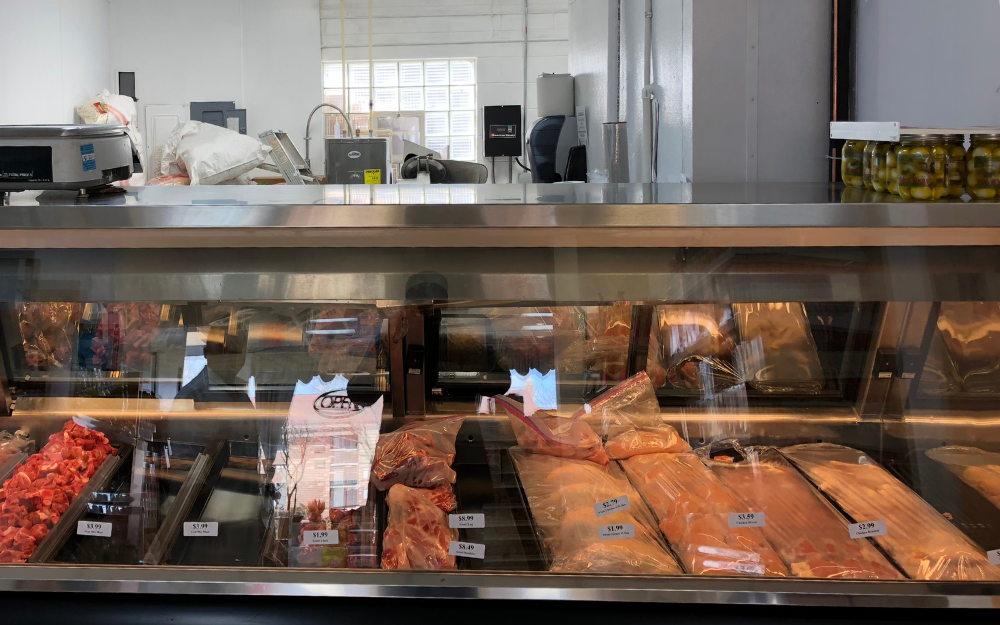
Freezers line the north wall from the front windows to the surprisingly spacious and shiny clean butcher’s station in the back. Frozen falafels and sambousa, okra and other vegetables, and stacks of frozen fish filled the shelves.
As we walked, Nawaz stopped occasionally to share a story. Each tale concluded with a life lesson his eight years as a business owner taught him.
“This store is not about money-making,” he explained. “It is a relationship store. I’m in the relationship business.”
Lesson 1: Business is a service.
In 2017, Nawaz’s wife, Shamim Haq Nawaz, pregnant with her second child, went to buy groceries. After she checked out, she was carrying their one-year-old Momin and a load of groceries. It was snowing outside.
“When she got back home, she told me how hard it was for her,” Nawaz recalled. “She couldn’t carry our son and a 20-pound bag of rice. So, I asked her, ‘How come you didn’t reach out to the store and ask them to help you out?’
“‘I looked at the guy at the counter and he turned away,’ she said. She realized he didn’t want to do anything for her.
“‘This is not how it should be,’ I said. We wondered how many other people go through something similar.”
That’s when the couple decided to create a grocery that really serves its customers, Nawaz said. They opened Raja Bazaar in 2018.
“To this day, our employees ask customers if they need help carrying their groceries. If they do, they go out and put the groceries in their cars,” he said. “In three years, we became known for our good service and products. By 2021, our business really picked up.”
Lesson 2: Listen to your customers.
“When we first opened the store, we didn’t have any idea what to order,” Nawaz admitted. “A storeowner in West Allis closed his store. I happened to hear about him, so I called him. He came over and helped us order some products.
“After that, we started asking customers what they’re looking for. Now, you see almost any famous Indian brand of rice, flour, lentils and spices. The same goes for Pakistani and Middle Eastern products, whatever people tell us they are looking for. I learned about a lot of brands I never knew existed.”
He lifted a white bag of long-grain rice. “This banni rice we have here is very special. Someone who comes here requested it. You don’t find it in many stores.” He put it down and picked up another.
“This one is called Aahu Barah. In Farsi, aahu means ‘deer.’ See the deer on the bag,” he said, pointing to a picture. With the recent immigration of refugees from Afghanistan, it flies off the shelf.
“See these bags of organic rice. I was never a big fan of the organic thing. I thought maybe it was just a way to charge people more. Then a customer came in, asking where our organic products were. I asked him, ‘What’s the difference?’
“‘I’d rather spend my money on good food now than buy medicine later,’ he told me. I never thought about it like that. So, I told my wife we need to get some organic products. Now, we have organic flour, rice and other items. They sell slower, but we are giving people the opportunity to buy it if they want it.”
Lesson 3: Finish what you start
At 20, Nawaz moved to Milwaukee in 2000 to study chemical engineering at the University of Wisconsin-Milwaukee.
Soon, his mother aimed to find him a bride. “She was looking for somebody who would be able to come to this country and be a help to me, someone capable and smart.” She found the perfect person living near his sister, he said. “Now his wife, Shamin Haq Nawaz, takes care of the store’s finances, including payroll, while managing the home front and raising their four children.
“I started working and then I got married, so I didn’t finish my degree,” he confessed.
In 2015, Nawaz went back to school. He enrolled in UWM as a business major. “I had been doing business from what I felt from my heart, but I realized I needed more knowledge and more understanding. It took nine years. I graduated just last year, in 2024, at 44.
“It was really hard. I quit 20,000 times in my head. I asked myself why I was putting myself through it. Then I thought, that’s why I came to this country, for education. I realized after 20-some years, I still had not done the first thing I had committed to do. I knew that to move forward, I needed to go back to this first commitment and take care of it.
“Getting the degree wasn’t about making money or finding another job. I was not looking for other opportunities. We are happy doing what we are doing. It was about the potential. My wife and I thought we can learn, we can do more. I’m so happy I was able to do it.”
His wife is now studying at UWM as an accounting major. “It’s even tougher for her because we have four children, 10, 8, 7 and 1,” Nawaz noted.
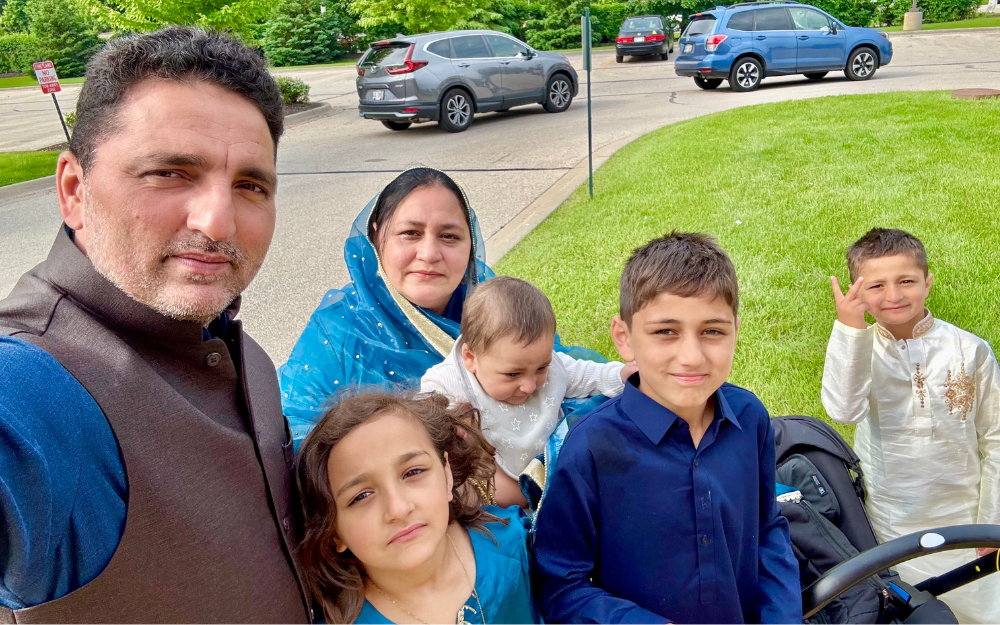
Left to right, Haq Nawaz, Hibbah, 8, Momin, 10, Kumayl, 7. Nawaz’s wife Shamim Haq Nawaz holds 1-year-old Salahuddine
Lesson 4: Life is not easy.
“As I get older, I realize life is tough,” Nawaz reflected. “Nobody promised us an easy life. Islam offers a life of purpose, but not without struggle. You make the best decisions you can. As Muslims, we understand what’s right and wrong. We just need to do our best.”
Nawaz recalled long days and stressful nights of working and studying. “Now, when I look back at working 16-hour days, I don’t remember the stress and hardship. When the good days start coming, you tend to forget what happened. It seems like nothing was hard.”
Not that it’s ever all smooth sailing, he acknowledged. “At certain times in my life, I wanted to help people, sometimes people very close to me, but I couldn’t. There are limits to what we can do. I realized I can’t have a guilty feeling about it. I am not in control.”
At home, surrounded by family and getting hugs from his children, “everything feels good.”
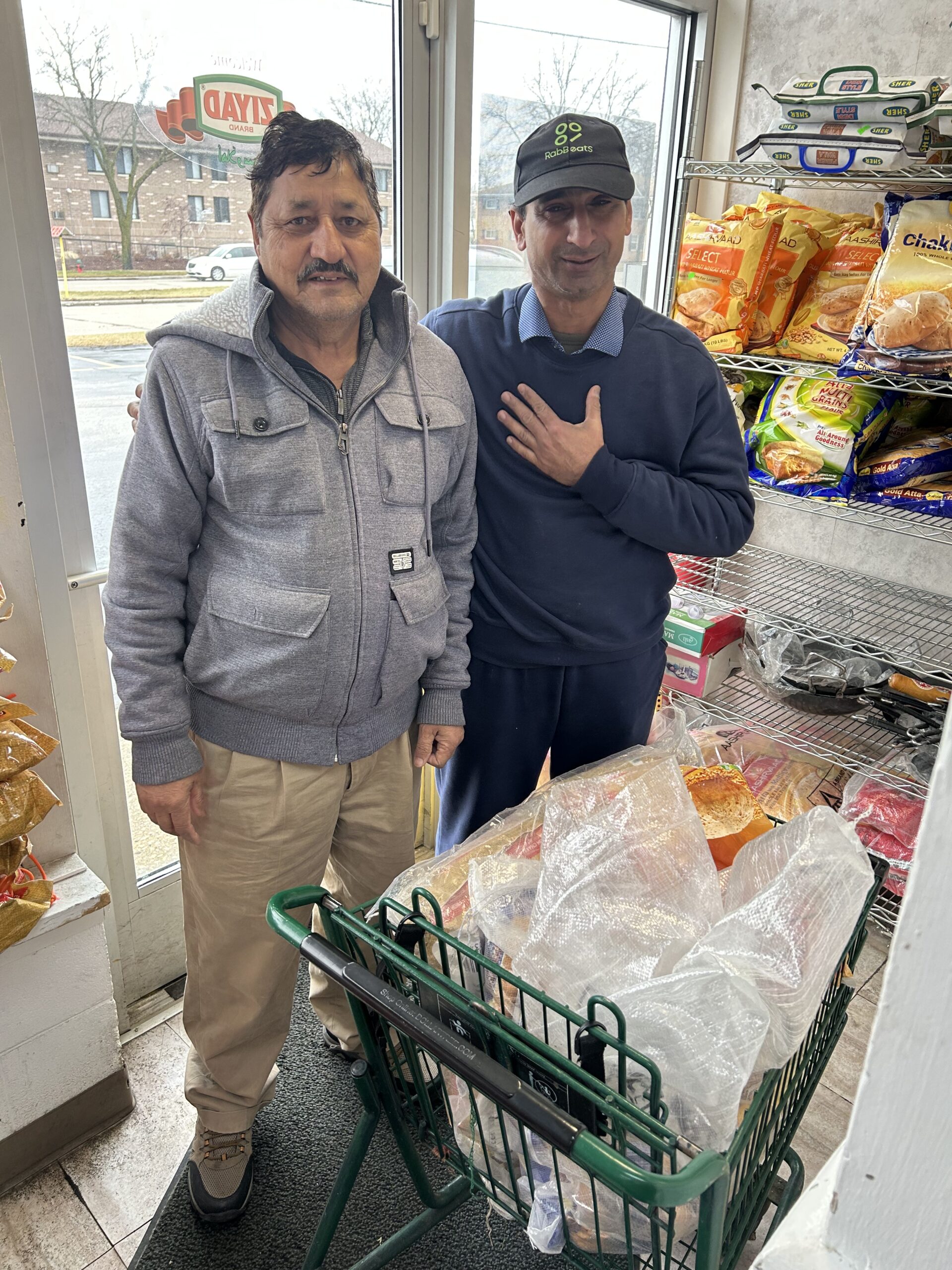
“Ideally, I have five full-time employees,” Haq Nawaz said. “Since one of them is my father-in-law, he can come whenever he likes.” (Left to right) Zulfiqar Khan, Nawaz’s father-in-law, and employee Ehsaan Ur Rehman.
Lesson 5: Business is about relationships
“The biggest thing I’ve learned, the major thing I would say, is that a business is not separate from society. You cannot just sell something, go back home, and not get involved with people.
“I want to share a story. Two families from the same part of Pakistan happened to shop here, but they didn’t know each other. So, I told one of the families about the other family who came from exactly the same area in Pakistan they did. They said, ‘We’d like to meet them.’
“One day, when the family that lived a couple of hours away came to the store, I called the family that lives in Brookfield and they came right over. They got to know each other. One had a son, and the other had a daughter. A year later, they had a marriage between them. Now the couple has a one-and-a-half-year-old boy.
“Our business is not just selling. You talk with people, you understand them, and you create a sense of belonging for the people who come to your business.
“Many times, people tell us they love coming here. There is something special about this store.
“I took someone with me to visit a bigger store. I said, ‘I wish I had that store.’
“When we came back to this store, he said, ‘Do you want me to tell you something? You took me to the bigger store, and I like big aisles and all that, but I didn’t feel anything over there. I feel much better coming to your store.’
“I think maybe it’s the way that we treat people. If we don’t have what they are looking for, I try hard to get it. And I try to find some way to compensate them so they won’t feel they came for nothing. I want them to know we’d love to have them back.”
Lesson 6: Work within your means
When Nawaz bought the store, he knew it would be hard to squeeze in the inventory. “It’s not even 2,000 square feet. I think the very minimum a store like this should be is 2,500 to 3,000 square feet, with 1,000 square feet for a back room,” he said.
But this is what they could afford, he said.
When Babies R Us went out of business, Nawaz bought their shelving. He pointed out the rounded, baby-proof corners. You can still see the red “Sold” stickers on them.
The coolers and freezers came from a Pick’n’Save that was going out of business. He picked up some additional shelves during COVID, when an office was closing.
“It took us about two months to figure out how we could lay this out in the store,” he said. Now he’d like to purchase taller shelves to take advantage of the only space left, the vertical space.
They’ve made do with their limited space since opening in 2018, carefully managing inventory because they have nowhere to store things, especially frozen items.
Now that the business is a success, Nawaz has the money and opportunity to buy another store and a restaurant on Mitchell Street in Milwaukee. Negotiations are currently underway. The new businesses would include walk-in freezers and coolers, and additional storage rooms that could help them manage the needs of Raja Bazaar as well as the new businesses.
The restaurant, which features dishes from Karachi, is a family favorite, he noted. “What a blessing to be in a position where I can buy a place I already love.”












![15 Things You Didn’t Know About Makkah and the Ka’bah [Part 1]](https://wisconsinmuslimjournal.org/wp-content/uploads/2026/03/AdobeStock_87517185-scaled-e1774211732813-150x150.jpeg)