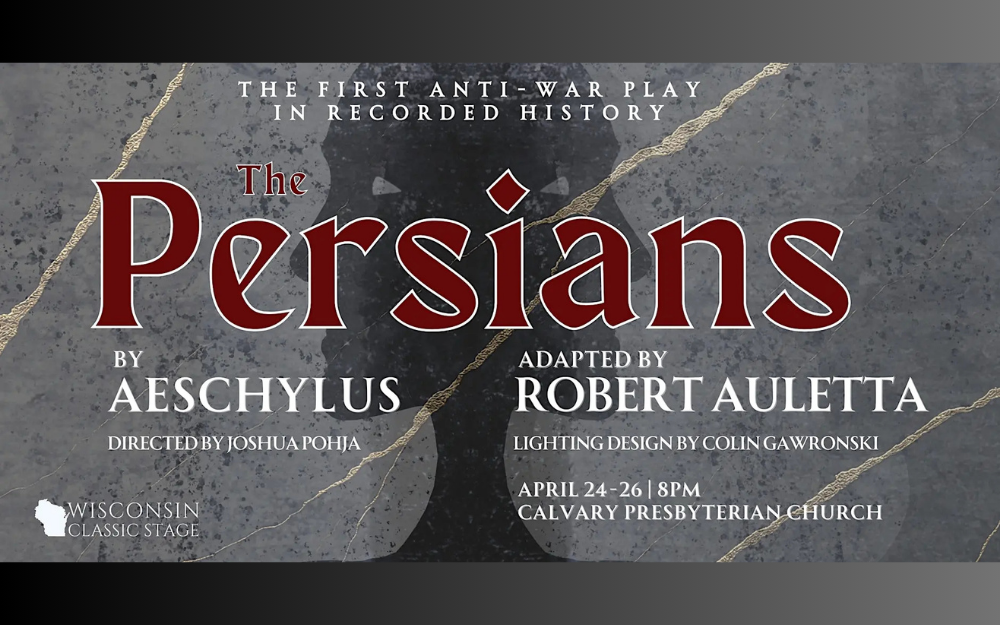
A new Milwaukee theater company opens its first season with The Persians, an ancient play about the price of war. Two dollars from every ticket sold directly benefits WarChild, a nonprofit that protects and supports the wellbeing of children impacted by conflict.
When accomplished Milwaukee theater professional Joshua Pohja decided to launch Wisconsin Classic Stage, his new theater company, with the world’s oldest surviving anti-war play in history, The Persians (472 BCE), he had no idea how timely it would be.
“This groundbreaking ancient tragedy by Aeschylus and adapted with a razor-sharp contemporary edge by Robert Auletta (who transplants the story to the first Gulf War era), The Persians dives headfirst into the human wreckage of war, forcing audiences to confront empathy for the ‘enemy,’ the perils of hubris and the enduring arrogance of empires,” says a March press release from Wisconsin Classic Stage. “Aeschylus reveals war’s brutal truth: victory is hollow when the defeated are humanized.”
Sound familiar?
When the United States and Israel started the Iran War on Feb. 28, code-named “Operation Epic Fury” by the U.S. and “Roaring Lion” by Israel, Wisconsin Classic Stage postponed ticket sales and posted an announcement titled “In Light of Recent Events.” It explained, “Given the gravity of this moment, we are postponing today’s cast announcement and ticket launch by several days. When we share it, it will remain what it was always meant to be: potent, challenging, fiercely human and unafraid to examine the machinery of war and the language that justifies it.”
Directed by Pohja, The Persians runs Friday, April 24—Sunday, April 26, with performances at 8 p.m. in the historic Calvary Presbyterian Church, 935 W. Wisconsin Avenue. It is recommended for ages 14+ due to themes of war, grief and violence.
General admission is $35; students/artists pay $25. Two dollars from every ticket sold is donated to WAR CHILD, a nonprofit dedicated to protecting, educating and standing up for the rights of children affected by war and armed conflict worldwide.
Tickets are available here.
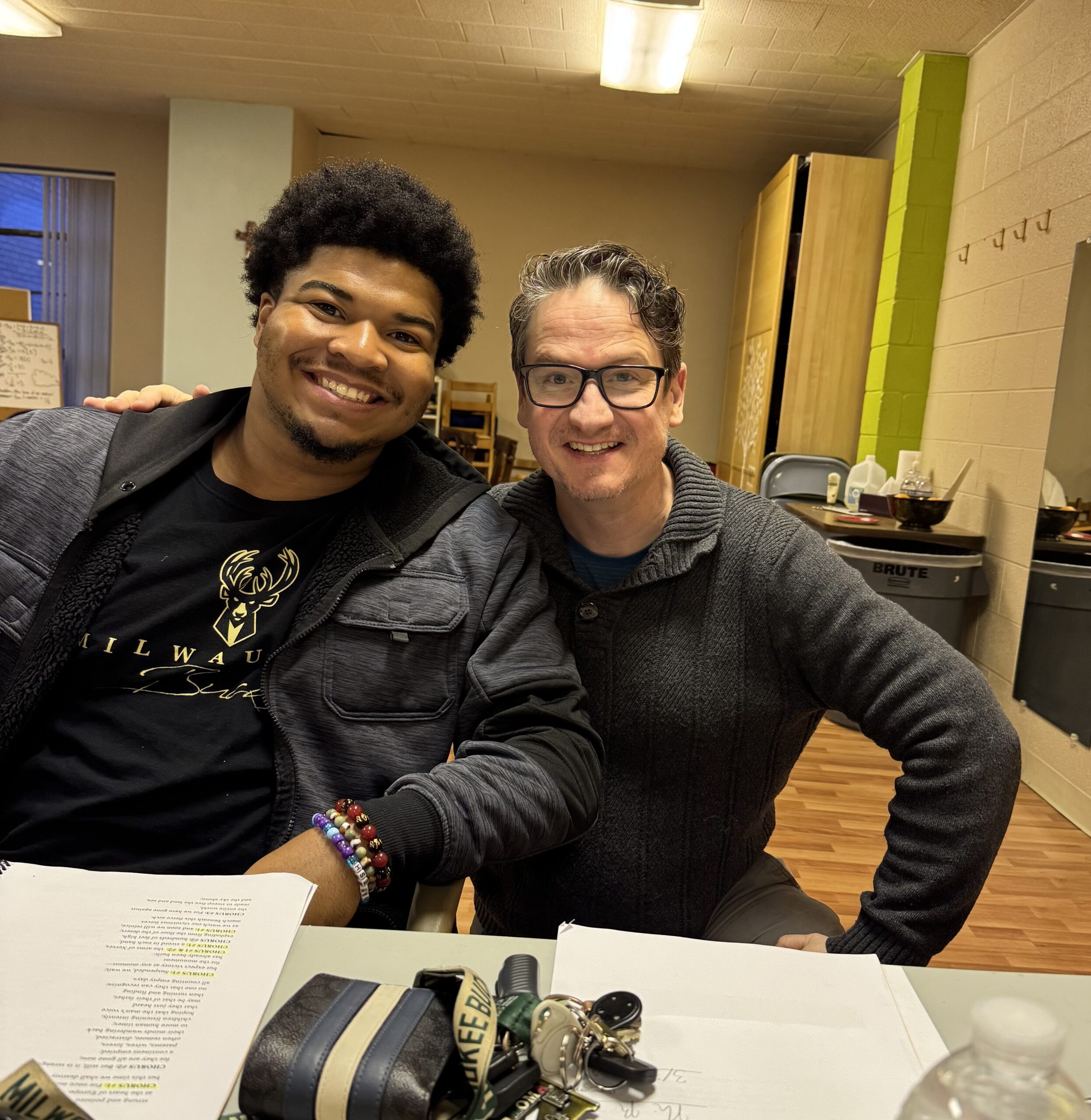
Nahjee Robinson (left), who plays the chorus leader in Wisconsin Classic Stage’s The Persians, and director Josh Pohja (right) pose for a photo during rehearsal.
An interview with producing artistic director Joshua Pohja
Wisconsin Muslim Journal interviewed Wisconsin Classic Stage’s executive artistic producer Joshua Pohja, known for producing and directing anti-war plays, about his new theater company and one of his favorite plays, The Persians, which opens next week. Here are the highlights:
Tell us about your new theater company.
We are a Milwaukee-based theater company, founded in 2025, committed to reimagining the classics through bold Midwestern perspectives, equitable casting, affordable access and fearless community collaboration. We approach classical theatre with a rigor and a modern sensibility that makes great works compelling for contemporary audiences.
The company trains and spotlights local talent while cultivating an ensemble culture. We approach classical texts as living works to be shared with contemporary audiences. We aim to produce inclusive theater that challenges, entertains and inspires.
After our sold-out fundraiser production of Henry V in May, we are now introducing our first full season: The Persians by Aeschylus, Doctor Faustus Lights the Lights by Gertrude Stein and Uncle Vanya by Anton Chekhov.
You’ve been behind the production of many anti-war plays—Henry V, My Name is Rachel Corrie, Antigone, Hamlet and All is Calm: The Christmas Truce of 1914. What compels you to tell these stories?
Those productions and the conversations around them have stayed with me, especially their insistence that war is never abstract, and that its deepest costs are carried by families.
This production of The Persians is especially meaningful to me and is the foundation for the company. I first encountered it in high school, and I’ve been returning to it ever since. Each decade, the play grows more profound. Aeschylus centers the grief of the defeated Persian enemies, revealing the peril of war and its enduring impacts.
Auletta’s adaptation relocates the action to Iraq during the first Gulf War, creating unsettling parallels for American audiences and refusing the comfort of historical distance. It is a haunting, urgent reminder of what survives long after victory is declared.
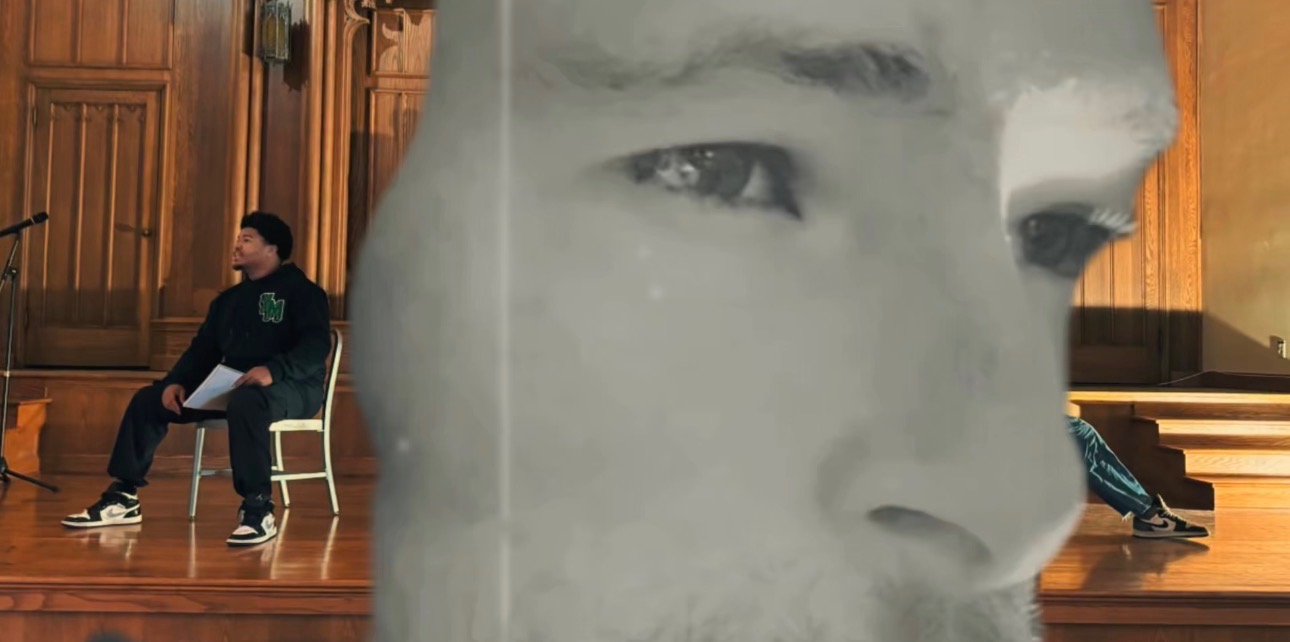
Actor Nahjee Robinson rehearses his role in The Persians at Calvary Lutheran Church, 935 W. Wisconsin Ave.
When did you first encounter this play?
It goes back to 1993, when I went to the Los Angeles County High School for the Arts. We were invited to the Mark Taper Forum to see a performance of The Persians directed by Peter Sellers, this modern adaptation by Robert Aletta that we are doing now.
The 1993 Gulf War had just happened and there was a level of patriotism in the country I had not seen before. It was a rabid kind of patriotism where no matter what America did, we were right. This play elevated another perspective—that Americans were going to Iraq to get the oil. Half the audience walked out. It was the first time I saw political theatre that made people walk out.
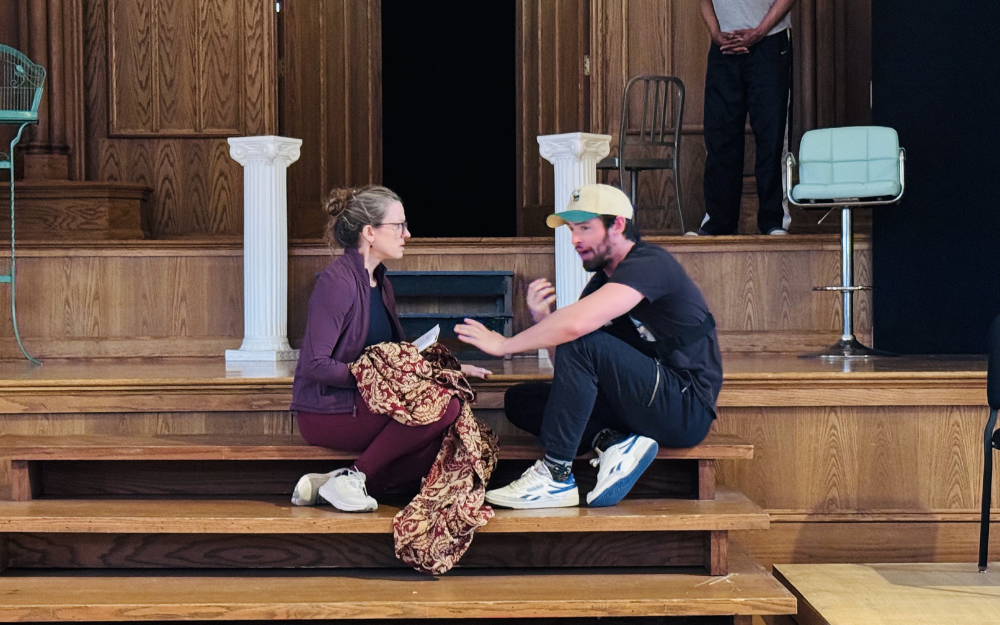
Maggie Marks (left) as Queen Atossa and Cole Castine (right) as Xerxes rehearse a scene.
Do you expect your Milwaukee audience to walk out?
I have a responsibility not to have them walk out halfway through. People have a choice to stay home and watch Netflix. I want to challenge them, make them think and raise the question about the cost of war. I want everyone to be glad they came. I also have great faith in the younger generation. They understand the concept of American imperialism.
The root of why The Persians is so close to me is because I love Peter Sellers’ direction. I love the play—its spectacle, truth and beauty. Saddam Hussein was a tyrant, but what made him that way? It’s stunning. I can’t wait for you all to see it.
How does it feel to finally be producing and directing The Persians?
I’ve been wanting to do this play for 33 years. When I was in that high school classroom, just sitting by myself, I looked at a National Geographic. I opened it to an article on Iraq. There was a boy with his eye blinded, a bandage over his face and collateral debris still on his neck. I cut that photograph out. It’s in my research folder on The Persians today.
I don’t know what became of him, but he still haunts me. I dedicate this production to that child.