Photos by Sandra Whitehead
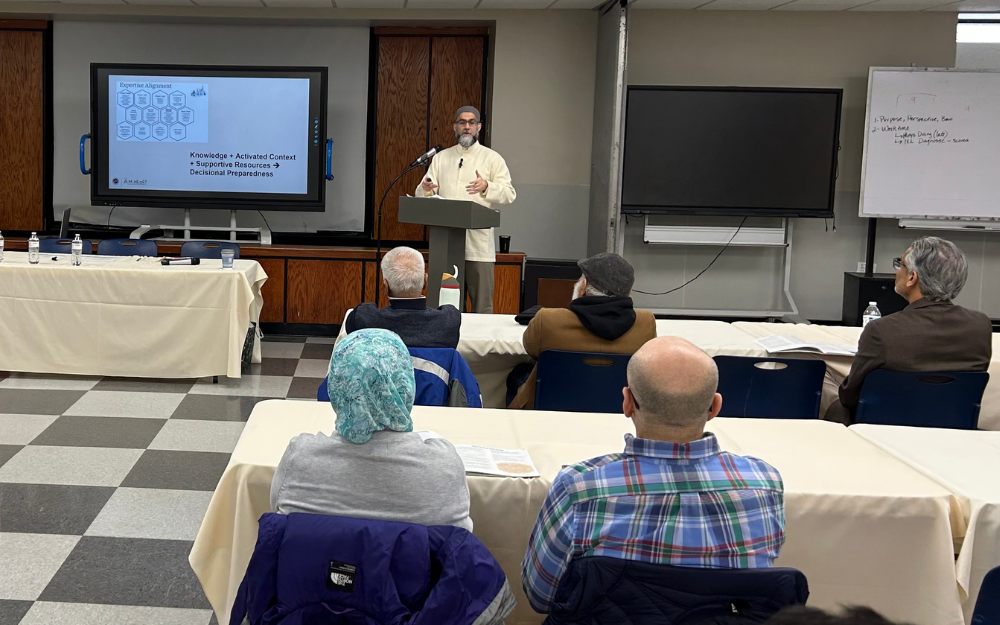
Medical College of Wisconsin Professor Aasim I. Padela, M.D., founder and president of the Initiative on Islam and Medicine, discussed Islamic bioethics during a January workshop on end-of-life decisions at the Islamic Society of Milwaukee.
The Islamic Bioethics & End-of-Life Healthcare Decisions workshop had just begun when one of the speakers received a WhatsApp message. Aasim I. Padela, M.D., Professor of Emergency Medicine and Medical Humanities at the Medical College of Wisconsin, and the founder and president of the Initiative on Islam and Medicine, stepped up to the podium.
“While I was sitting here, I got this on my phone. ‘My brother has been dealing with AML (acute myeloid leukemia), which is an aggressive cancer type, for the last two years,’” he read. “’He’s a medical student and most of us in the family are physicians. We were discussing end-of-life decisions. As a medical family, we are very well-versed in the medical aspects. Basically, AML has a five-year survival rate of 33%. We are having a hard time with trying to understand the Islamic side. He is intubated in the ICU. What should we do?’
“I often get texts like this,” Dr. Padela said. “Obviously, they want an Islamic response. Should they keep him on intubation or should they withdraw life support?”
Dr. Padela asked the audience, “Imagine this is your child in the I.C.U., a young person with aspirations to be a doctor, facing an aggressive cancer. What do you do? What does Islam have to say?” He promised to return to this question after providing frameworks for the many aspects one must consider when making decisions about the end of life.
About 50 people attended the four-hour workshop, Islamic Bioethics & End-of-Life Healthcare Decisions, held Jan. 31 at the Islamic Society of Milwaukee. It featured experts with backgrounds in medicine, palliative care, hospice and Islam. Speakers made presentations and led discussions about practical steps, resources and strategies to help Muslims “transition from a state of uncertainty about end-of-life healthcare to thoughtful preparation for it,” a workbook given to participants stated.
The workbook, Islamic Bioethical Considerations for End-of-Life Healthcare: A Guide for Muslim Americans Navigating End-of-Life Decisions with Islamic Values and U.S. Healthcare Tools, aims to support Muslim Americans as they navigate end-of-life healthcare in a way that honors both Islamic ethics and U.S. laws, it states. Its publication was sponsored by the Initiative on Islam and Medicine, the Muslim Community & Health Center and the Medical College of Wisconsin. For more information about the workshop and workbook, email contact@medicineandislam.org.
At the workshop, Dr. Padela, an Islamic bioethics expert and clinical researcher, addressed Islamic bioethics in end-of-life decisions. Renee Foutz, M.D., a hospice educator and clinician, explained what hospice is and isn’t, clarifying misconceptions and answering questions from the audience.
A case study review concluded the workshop. A panel of three medical professionals, Padela, Foutz and Ismail Quryshi, M.D., from Froedtert and MCW (who practices hospice and palliative care and internal medicine) used the case study “to bring all the workshop topics from theory to practice,” team member and community academic researcher Laila Azam, Ph.D., M.B.A., told the Wisconsin Muslim Journal.
This article focuses on Dr. Padela’s discussion of Islamic bioethics in end-of-life decisions.
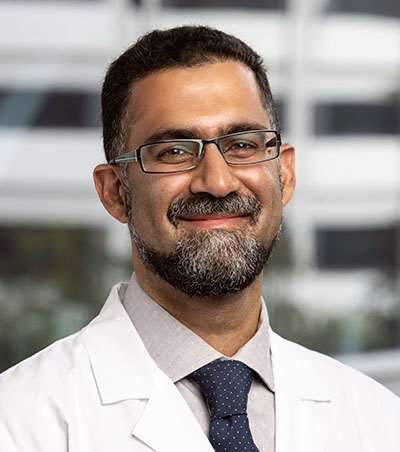
Aasim I. Padela, M.D., is a professor of Emergency Medicine and Medical Humanities at the Medical College of Wisconsin.
Developing education about Islam and end-of-life decisions
Both the workshop and workbook drew on more than a decade of research, community engagement and Islamic ethical scholarship. Over the past four years, a multidisciplinary team of academics and community leaders in southeastern Wisconsin advanced the research and developed educational materials. The team included representatives from MCW, MCHC, and local and national hospice and palliative care programs.
Dr. Padela explained: “We brought together experts from different domains, from chaplains to hospice directors, to people like myself bringing Islam and Biomedicine, and members of the Muslim community to create this workshop and other materials like the booklet.”
The goal has been to give Muslim Americans the knowledge and context of end-of-life decisions they will face, as well as resources and guidance to prepare for those decisions, and engage in planning with their families.
Applying Islamic ethics to end-of-life decisions
Dr. Padela’s “entire career has been devoted to exploring both sides of Islamic biomedicine,” he said. “I spent time studying in Cairo, studying sharia and Arabic. I also spent some time as a fellow at the Oxford Center for Islamic Studies, researching issues related to Islamic moral theology, and I continue to spend time with scholars from our tradition, studying various topics privately or in classes to try to get a handle on how we mine our tradition to address issues at the intersection of Islam and biomedicine.”
Dr. Padela also has a B.A. in Classical Arabic & Literature and a B.S. in Biomedical Engineering, both from the University of Rochester, an M.D. from Weill Cornell Medical College, an M.S. degree in Health & Health Care Research from the University of Michigan and experience in multiple fellowships and research positions.
“A lot of us want to hear an expert explain just what Islam has to say,” he said. “This is not that kind of talk. Our tradition has many different ways of thinking about what is right and good. And medicine is not just the healthcare system,” he explained. “There’s a philosophy and theology to medicine. There is sociology and economics, financial drivers and healthcare policies.
“There’s an entire social science perspective about what’s occurring. You also have to look through social, scientific, biomedical and philosophical lenses. The Fiqh Council of North America, for example, brings experts together from different domains so they can understand the problem correctly and offer new U.S. guidance … about how to prepare for and think about death.” The purpose of this workshop is to help community members begin preparing for decisions about the end of their own lives and those of their loved ones.
“Islam encourages planning for all stages of life—including our return to Allah,” the workbook says. The workshop and the guide serve as starting points for individuals to explore Islamic teachings and their own wishes regarding death and dying. They “support approaching the end-of-life with peace, understanding and trust in Allah’s mercy.”
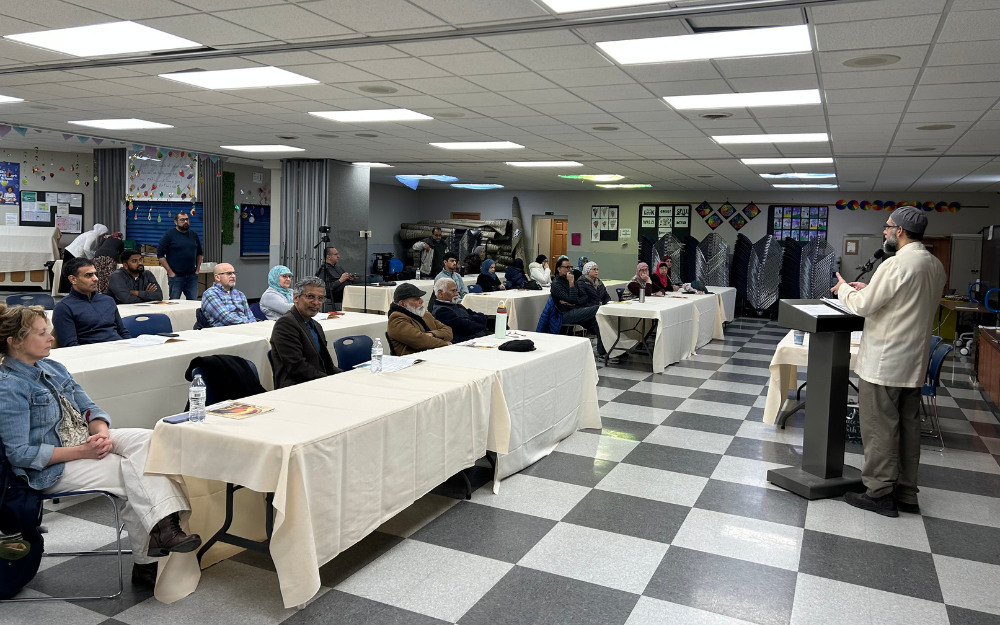
About 50 people attended a community education workshop Jan. 31 on Islamic bioethics and end-of-life healthcare decisions.
Preparing for death in America
When we think about a “good death,” we picture ourselves at home, surrounded by comfort from a loving family. “But here in the United States today and in many industrialized countries, what we have is ‘medicalized death.’ The fact is that the majority of people here die in a hospital, sometimes sedated, in sterile environments, surrounded by the beeps and bongs of machines.”
While people desire to die at home, often they’re not prepared to think of how to get there, he said. The system is set up in a way that makes it easy to end up in a hospital. It requires work on our end to die at home.
“And 80% of deaths in the United States occur where there is some conversation about withdrawing or withholding life support. Do you want to have CPR? Do you want to be DNR (do not resuscitate)? Most Muslims ask religiously, ‘What can we or can we not do?’
“A lot of healthcare resources are spent in the last moments of life,” he observed. “There’s a larger myth in our society that more is better, that new is better. Neither is necessarily the case. More interventions don’t necessarily lead to better health outcomes. New technology doesn’t necessarily mean better. That myth drives people to the healthcare system.
“We can’t just ask ourselves these questions at the last moment,” Dr. Padela said. “That’s why we are having this workshop … I would argue that what we need is to consider what dying well looks like in our tradition and for ourselves, then fit our decisions in that.”
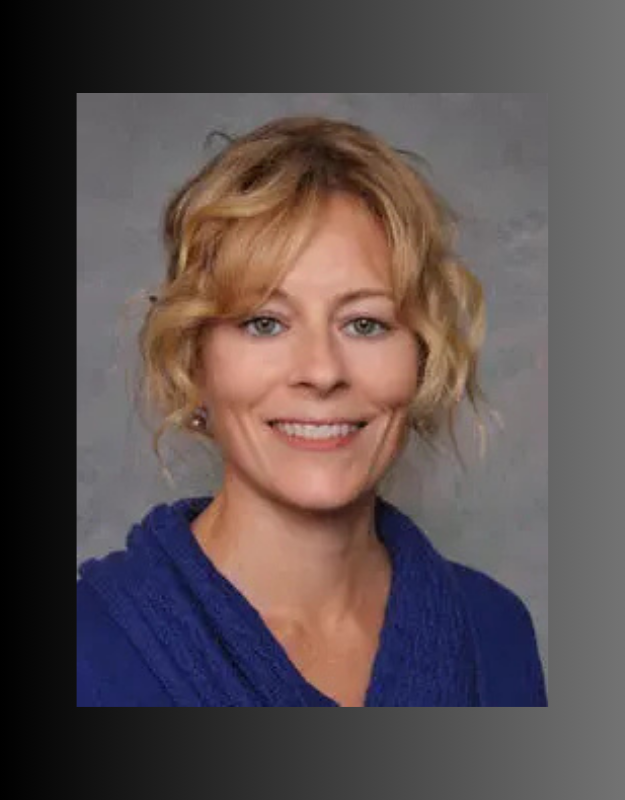
Renee Foutz , M.D., is an assistant professor of Medicine and Emergency Medicine at the Medical College of Wisconsin.
Let’s talk about death
The team surveyed 150 Muslim Americans in Chicago, asking if they had talked with their doctor or loved ones about their end-of-life care decisions. They found the majority of individuals had not even thought about talking with someone else. “They said they were not ready to talk,” Dr. Padela noted. “Why are we passive participants in one of the most important aspects of our life, our death?”
One problem is knowledge gaps about medicine—what is palliative care? What is hospice? What exactly does a “Do Not Resuscitate” order mean? Are these things Islamically approved? How does medicine define death? What is death in Islam?
Another problem is that we don’t talk about the end of life with our families and in our communities. “We should today unburden our future selves and our loved ones by investing in these conversations, seeking knowledge and understanding,” Dr. Padela said.
Exploring end-of-life decisions now will give us much more than the preparedness for that time in our lives or in the lives of our loved ones, Dr. Padela explained. “That’s because to understand the end of life, we have to have a complete picture of what our life journey is.”
Facing questions in the I.C.U.
Ideally, Muslims will pursue answers to various end-of-life questions long before they must make them, Dr. Padela said. To learn to make the right decisions, he suggested considering the example of the Prophet, hadith and fiqh (Islamic jurisprudence). “To follow the Prophetic example, we have to set our affairs in order because we don’t want to have that baggage when we are facing the Day of Judgment.” Dr. Padela urged the audience to look up the stories about the Prophet as he faced his last days. He asked if he owed anyone anything or any retribution for something he had done, Dr. Padela noted.
In addition to examples from the Prophet’s life, Dr. Padela discussed medical and Islamic definitions of death, and Islamic jurisprudence.
“Now, let’s talk about withholding or withdrawing life support,” Dr. Padela said. In Islam, “healthcare seeking is not mandatory except in cases where it is life-saving … And it is often not the dying individuals themselves who will be making the decisions. It is often family members or physicians. The obligation moves to us.
“So, if a patient is obligated to seek treatment, then we, as their caregivers or physicians, are obligated to provide the treatment they are obligated to take.” An exception is when the treatment is neither lifesaving nor certain to prevent death or harm, he said.
The decision to withhold or withdraw care becomes complicated when a patient has an advanced directive in which they said they don’t want some lifesaving support. As the surrogate decision-maker, you must decide not only what your loved one wants but also what you can and cannot do.
He gave the example of a woman who had a tracheostomy and had been attached to a ventilator for a long time. She didn’t want to live that way and asked to be taken off the ventilator when she came down with pneumonia. “But the pneumonia was not going to kill her.” If you were her son, you would have to think about not just what she wanted but what you can do. “Do you want to be a party to sin or not?
He would have to consider not only how she defined the quality of her life but also what Islam requires, Dr. Padela said. In Islam, the goal is not, ‘Can I live independently?’ The goal is to be able to perform good works that will benefit me in the afterlife. Will the medical treatment bring someone back to a state where they can cognitively do things that are of benefit for their afterlife?
“From the fiqh, when people who are invalids make dua (prayers), their prayers are like the prayers of the angels; you might say they’re experiencing a very poor quality of life. I’m telling you theologically that they are at the level of the angels.”
As the workbook concludes: “For Muslims, caring for a loved one who is nearing death is not just a medical or logistical obligation; it is a deeply spiritual act with plentiful opportunities for service and patience that carries tremendous reward.
“Providing comfort, maintaining dignity and surrounding a loved one with care and remembrance of Allah can turn a difficult experience into a profound and transformative moment, for both the patient and those who care for them.”