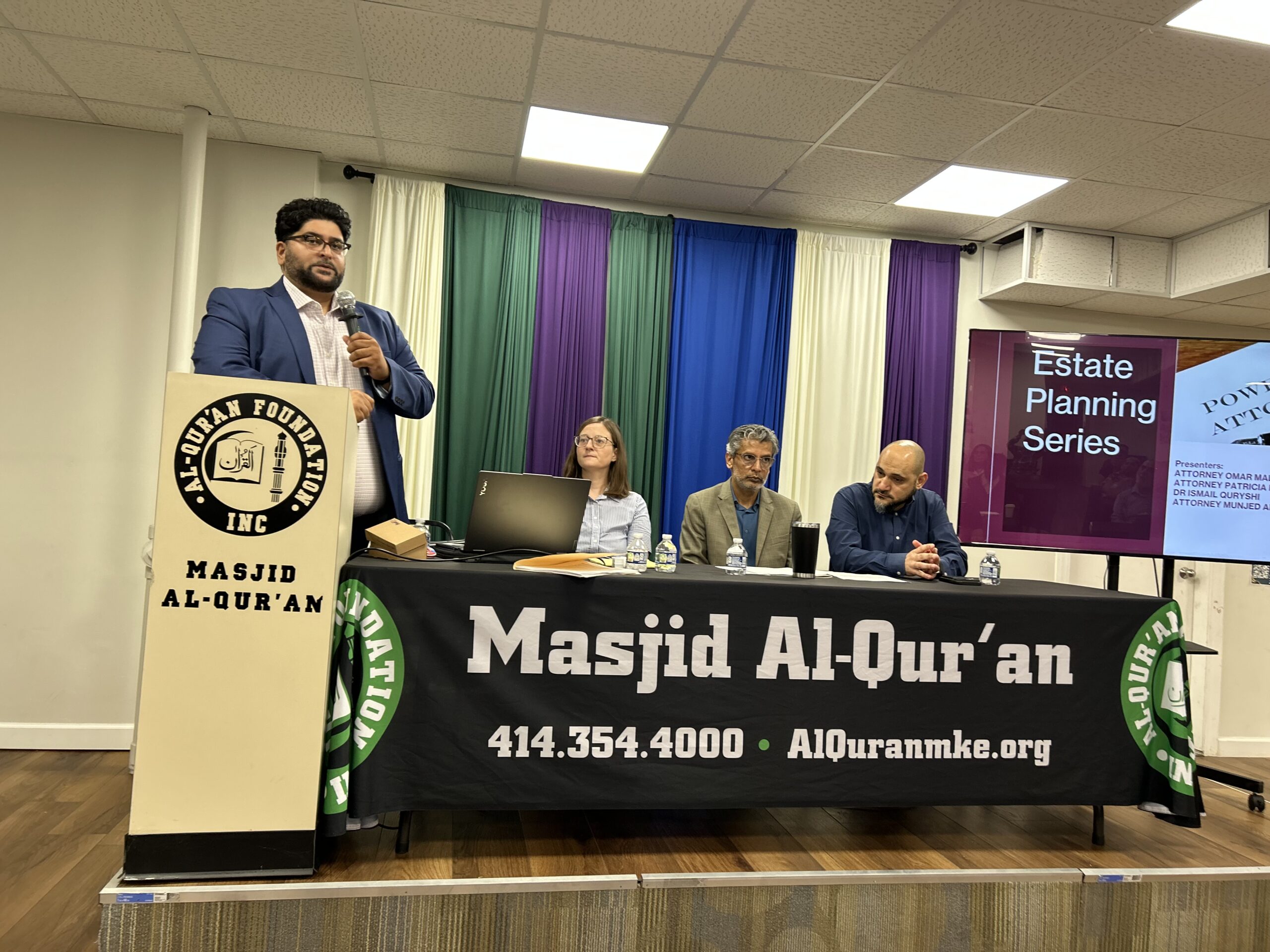
Attorney Omar Mallick introduces his fellow panel members, Attorney Patricia Foley, Dr. Ismail Quryshi and Attorney Munjed Ahmed who led a seminar Satuday on establishing medical and financial powers of attorney.
Attorneys Omar Mallick and Patricia Foley of MPO Legal Group in Brookfield know some horror stories about Wisconsinites who spent thousands of dollars and many hours in court because they didn’t establish a power of attorney for themselves before they lost the ability to make their own decisions.
“We both get appointed a lot by the court as guardian ad litem (a court-appointed attorney who represents the best interests of a child or vulnerable adult in a legal case) or adversary counsel in situations where there isn’t a power of attorney,” Mallick told about 60 people gathered at Masjid Al-Quran in Milwaukee Saturday for a free seminar called “Protecting Your Future.”
Three attorneys, a physician and a judge shared tips on establishing powers of attorney for financial and medical decisions at the two-hour seminar that included a lively Q & A session. It was the first of a two-part series on estate planning, the strategic process of organizing your assets and establishing legal directives to manage your affairs in the event of incapacitation or death.
Masjid Al-Quran was their first stop. They plan to take the show on the road, making the free two-part seminar series available to libraries, community centers, places of worship and others. The first session provides information on financial and health powers of attorney. The second addresses wills and trusts.
For more information or to book the seminar, contact Mallick at omar@mpolegalgroup.com.
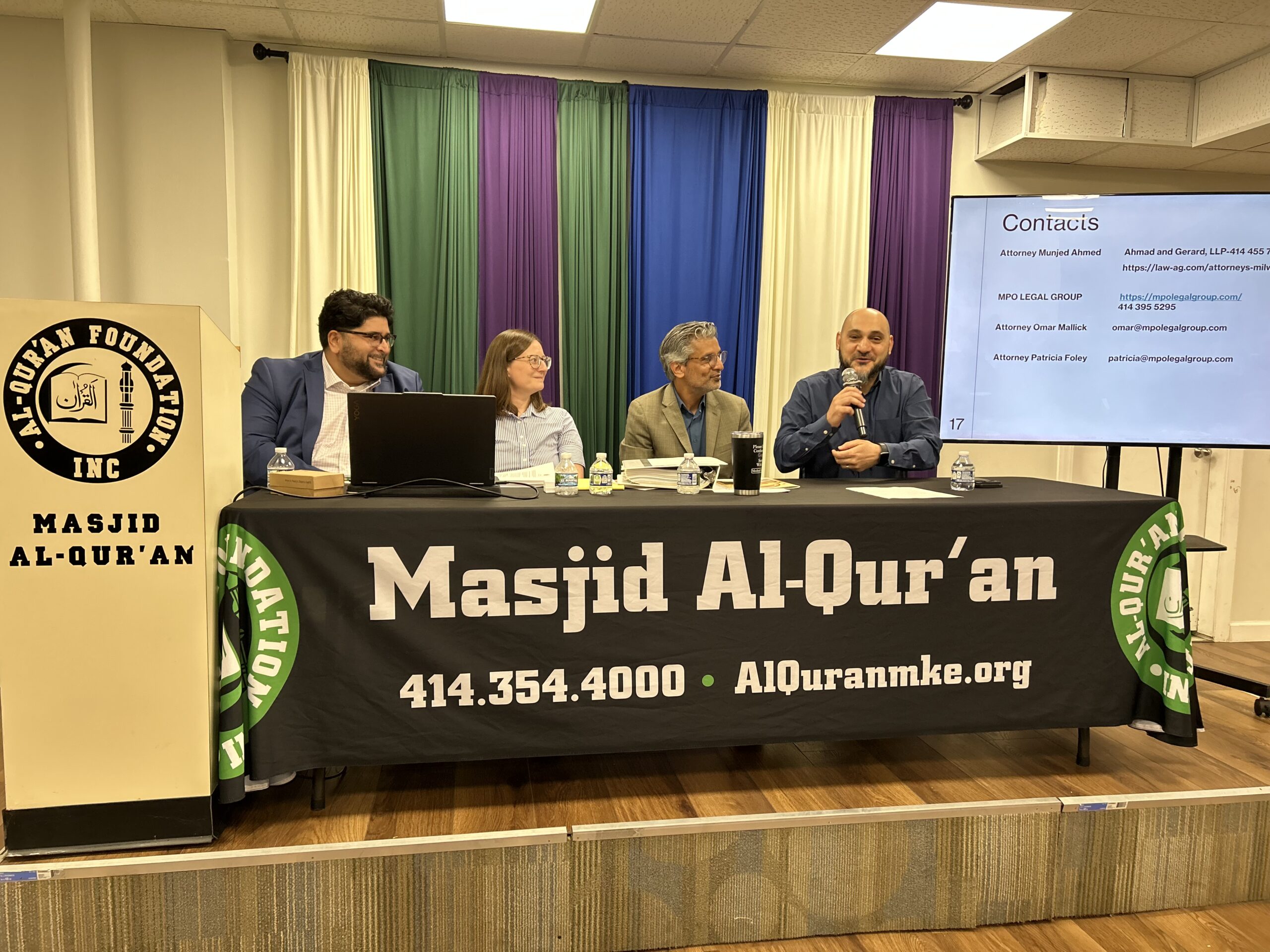
Attorney Munjed Ahmed (right) said establishing a power of attorney can be beneficial for people at risk of being detained by U.S. Immigration and Customs agents.
Avoid! Avoid! Avoid!
Attorneys Mallick, Foley and Munjed Ahmed, retired Milwaukee County Judge Marshall Murray and Dr. Ismail Quryshi, a specialist in internal medicine, hospice and palliative medicine at Froedtert & the Medical College of Wisconsin, all advise to avoid establishing a guardianship in court.
“Omar and I both often get appointed to serve as guardian ad litem for folks who either don’t have a power of attorney document or their power of attorney document is insufficient for some reason. We served as ‘adversary counsel’ in these situations. So, sometimes our role is to represent the best interest of the person.
“Other times, our role is to help the person who allegedly needs a guardianship avoid having that happen, even if we think that person could benefit from having the assistance.
“Another problem is the stress a family can go through. Say your aunt is in a car accident and needs a guardian, but she doesn’t think so. Then the whole family may get swept up into a lengthy, expensive court procedure. Your family members will likely have no say over who the court-appointed attorneys are and what fees they are charging.”
Speaking from experience, Attorney Ahmed added: “You’re going through an emotional roller coaster when dealing with a loved one with dementia. You are already under the stress of dealing with the day-to-day aspects. On top of that, come the issues of decision-making, medical care and financial issues. It puts a strain on the family. By planning ahead, you’ll save a lot of money, time and stress. And you retain control. That’s important to me.”
“Guardianships can spiral out of control and be very lengthy, costly and stressful,” Foley added.
“I’ve been a judge 24 years serving in probate court as a presiding judge in probate court for four years,” said Judge Murray. “You don’t want to give a decision to me because we’re very busy and will only be busier. I have to move cases along. This is one more case on the calendar that needs to be handled.”
The absence of medical powers of attorney may cause suffering or significant inconvenience. “There are many examples of where someone in a hospital has been medically cleared to move to a rehab facility, but they’re just waiting because there is no designated decision-maker,” Mallick said. Without a power of attorney, a guardianship must be established. “You can all make a decision right now about who you want to serve as your decision-maker or the court will decide and you might not have any say in it.”
“You don’t want guardianship when it comes to your health,” said Dr. Quryshi. “Court-appointed attorneys don’t know you,” he said. “They don’t know your wishes. They will abide by what is documented or what has been done before. That means resuscitate, unless there is a lot of proof (that you don’t want to be resuscitated). You’ll go through torture even when doctors are pleading with them, and it will take a long time to resolve.”
“In healthcare, we deal with it all the time,” he said. “That’s why I need to partner with (these attorneys) and get the word out, and the word is ‘avoid, avoid, avoid’ (guardianship). It is much better to do this planning on a weekend, peacefully, outside of the ICU, without all the stress, without three or four kids emotionally involved. When you are in a rush, under pressure, you’ll make wrong decisions.”
Dr. Quryshi held up a thick, three-ringed binder. “I did this 25 years ago, when I was a young physician, busy with little kids running around. It was not the priority for me but Omar’s dad and I worked together as physicians. His dad said, ‘Estate planning and power of attorney, these legal documents are very important,’ and he gave me an attorney’s name.
“This,” Quryshi said, waving the binder, “is peace of mind. This is what the kids need to do after I’m gone. It includes matters of faith and religion, like what the burial should be, all the details.
“I had a case recently where a woman was on a business trip in Las Vegas and had a stroke,” Foley said. “She was essentially trapped in Las Vegas while the whole guardianship process had to play out. Unfortunately, she passed away while it was all going on. Our goal is to help you avoid any experience like that.”
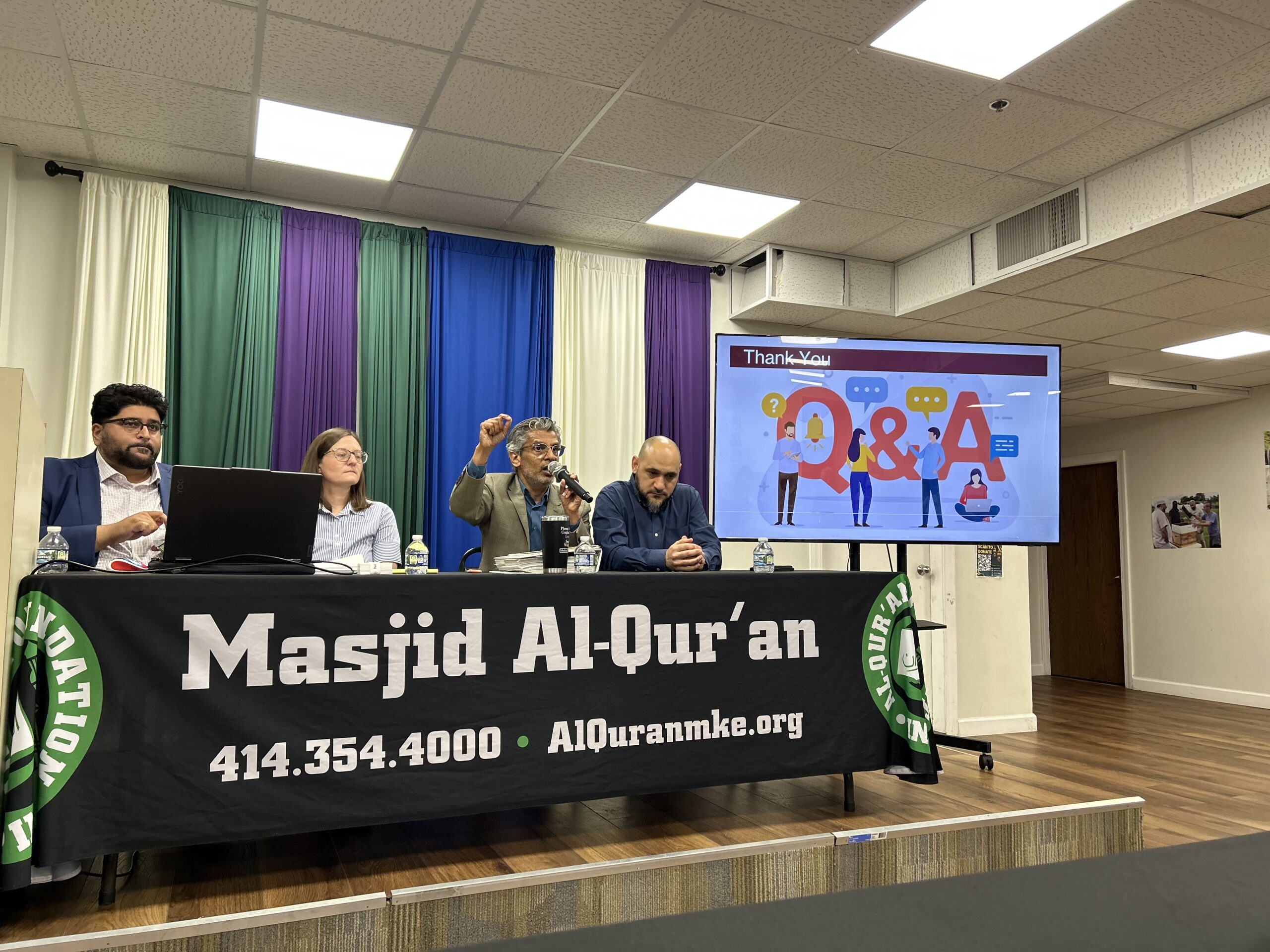
Ismail Quryshi, M.D., advises his patients to establish a medical power of attorney, especially older or at-risk patients.
Planning for your family’s future is an amanah (moral responsibility)
Masjid Al-Quran Imam Hafiz Shafique noted that Muslims have a duty to plan for the end of life. “Islam teaches us that our wealth, our families and our responsibilities are matters the Prophet took very seriously. They are amana (moral responsibility),” he said.
The meaning of the hadith (teaching by Prophet Muhammad) is that “it is not right for a Muslim who has something to bequest to someone to remain two nights without having his will written.
“None of us knows what tomorrow will bring. A sudden illness or accident or incapacity can create tremendous difficulty for our families if we have not prepared.”
Power of attorney—What is it? Who needs it?
When Wisconsin residents become 18, they are considered to have reached the age of majority, Mallick explained. “That means you acquire all the rights and responsibilities of an adult, unless there is a specific provision or power of attorney. You can make all your own decisions.
“But what happens if you’re in an accident, have a traumatic brain injury and can’t make decisions,” he asked. “Or if you have dementia, become incapacitated or are deemed incompetent? Unless you have established a power of attorney and have a decision-maker in place, you will have to go to the court for guardianship.
“A power of attorney is a legal document that grants another person, called your agent, the authority to act when you’re unable to,” Mallick said. “It’s saying, ‘This is who I want to act on my behalf when I’m not able to.”
Wisconsin is not a “next-of-kin” state, panelists noted. Therefore, decision-making does not automatically go to a spouse. “I will always ask, ‘Who had the medical power of attorney?’ when determining who to talk with, Dr. Quryshi said. Without the power of attorney established for both medical and financial decisions, the matter goes to court.
There are two types: a durable, financial power of attorney and a healthcare power of attorney. A durable, financial power of attorney establishes “the person of my choice to manage and pay bills, including taxes and any relevant debts, manage bank accounts and security deposits, buy, sell and manage any real estate on my behalf, handle retirement benefits and commence legal proceedings on my behalf. He would also have the ability to transfer assets.
“A lot of times, people think, ‘Well, I don’t really have huge assets or an estate so I don’t really need a power of attorney for finances.’ Everyone needs a power of attorney for both healthcare and finances. A financial power of attorney has the ability to apply for public benefits on my behalf. That’s tremendously important.”
“A healthcare power of attorney handles medical decisions, while respecting your preferences,” Mallick continued. Your agent “can communicate to medical professionals to accept or refuse treatment. He has access to medical records, as needed, and can admit you to a nursing facility, as needed.”
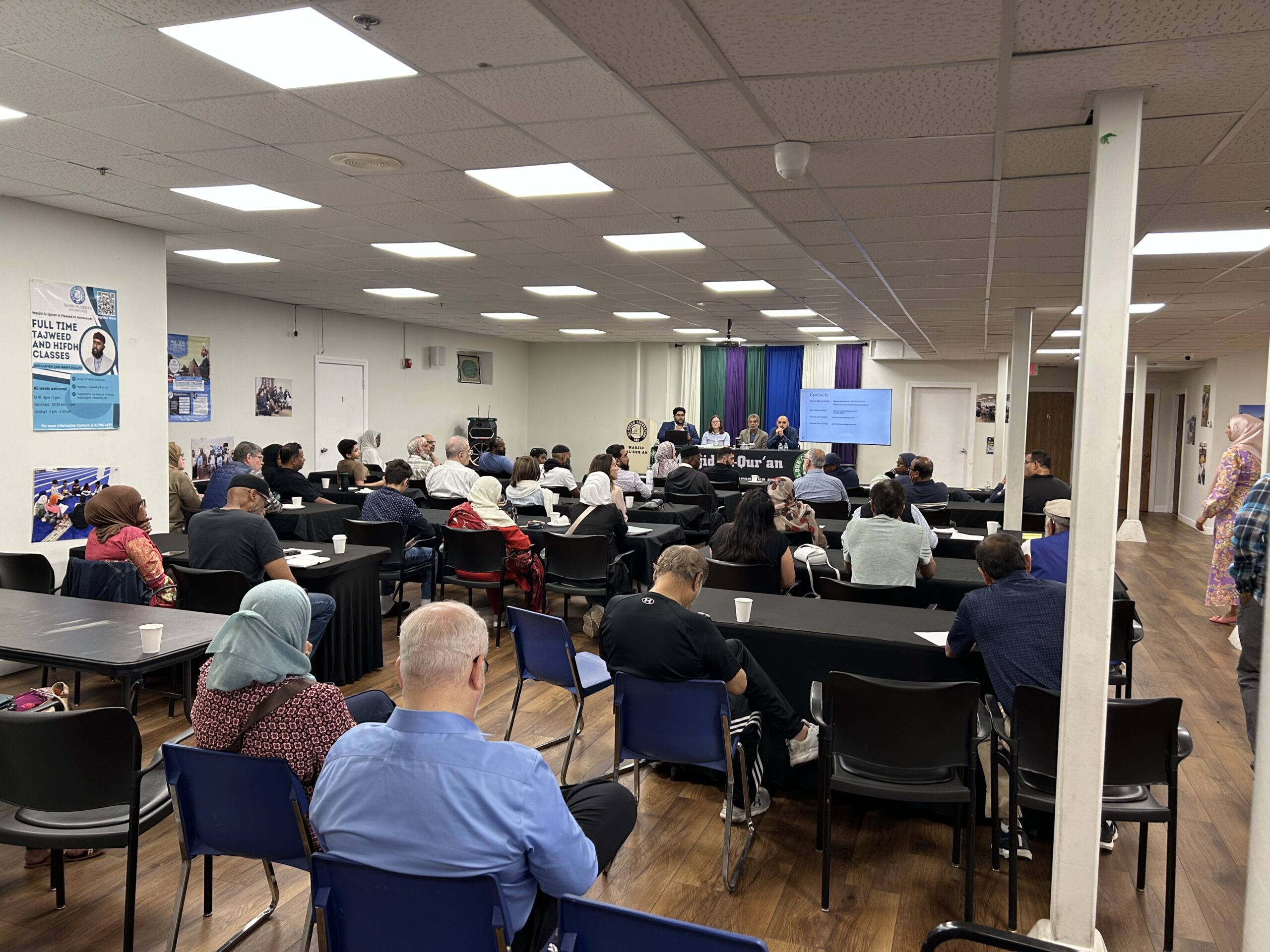
About 60 community members attend the “Protecting Your Future” seminar Saturday at Masjid Al-Quran.
Who should you choose as your decision-maker?
It’s very important to choose your agent (the one you give power of attorney) well and have a back-up, or several, Mallick said. It does not necessarily need to be your spouse. For example, if you have a daughter who is a doctor and a son who is an accountant, you may benefit from their knowledge by making them your medical and financial agents respectively.
“We always recommend you have a second person as a successor,” he said. “If, for example, your agent can’t be reached, you have another in place,” he said.
Often people choose their spouses for both roles but that is not always advisable, Ahmed noted. Many couples travel together and you need someone who is here on the ground to handle matters.
Some details
In addition to establishing the powers of attorney well in advance of when you need them, the panels had some additional tips:
- Consult with a religious scholar about end-of-life treatment and add language to your medical power of attorney about them.
- Carefully review the wording in your legal documents with your attorney to avoid problems.
- Talk with your family member about who you have designated as your agents for financial and medical decisions.
- Talk with your family and agents about your wishes.
- Keep your documents in a safe place and tell family members where they are.
Because our stories matter
Wisconsin Muslim Journal reports on people, stories and experiences of Muslims across our state. As a nonprofit publication, we are committed to making this work available to everyone without a subscription or paywall.
Every story we publish is produced by professional journalists, photographers and editors committed to reporting on Wisconsin’s Muslim communities. Keeping this work going requires time, talent and resources.
If you value dedicated, fact-based coverage that documents Wisconsin Muslim history, please consider supporting us with a donation. Gifts of any size make a difference and help us continue reporting narratives that might otherwise go untold.
We are grateful for your readership.