In 2025, Palestinian music, food and fashion transcended borders, transforming culture into a global language of resistance, identity and survival
For the past two years of Israel’s genocide in Gaza, there’s one truth that’s impossible to ignore: Palestinian culture is now reaching the world in a whole new way.
What was once confined mainly to local communities — like the melodies of folk songs, the intricate stitching of traditional dresses, and the flavours of home cooking — has now become a powerful form of activism, a declaration of identity, and a bridge to global audiences eager to understand Palestinian life beyond the conflict’s headlines.
In many ways, this shift has allowed Palestinian culture to become something more: a universal language.
Take, for example, Shil Shil (Carry On) by composer Zeid Helal. The song emerged from the heart of the recent bombardment in Gaza, born out of an urgent need to express what statistics and official statements could not: the lived reality of Palestinian suffering and resilience.
That urgency was mirrored in the public response when Zeid premiered the track alongside its accompanying video. Thousands of Palestinians shared it, performed it, and made it their own, transforming a personal expression into a collective voice.
For Zeid, the song transcended its role as a piece of music. “It’s not just a melody,” he explains. “It’s an embodiment of resistance and Palestinian identity, a vehicle for spreading awareness of our cause.”
The influence of Palestinian culture, particularly through music, did not stop with Zeid’s song; rather, it has reached far beyond the borders of Palestine.
For example, international artists began drawing on Palestinian musical heritage, while social media platforms were filled with videos of people across continents, from South America to Southeast Asia, learning and performing Palestinian songs.
For many, this was the first time they encountered the Palestinian language and the lived experiences of its people.
Redefining Palestinian sound
Khalid Sadouq, a composer and music professor at An-Najah National University in the West Bank city of Nablus, has witnessed this transformation firsthand.
Through his dual role as an educator and an artist, he has a clear view of how conflict reshapes creative expression.
“War has been a pivotal force in the evolution of Palestinian music,” Khalid reflects, noting that in recent years the rise of songs documenting collective pain has given compositions new depth, transforming music that was once primarily entertainment into a record of daily life.
This shift, he adds, has also led to the emergence of new genres, with electronic music producers blending traditional Palestinian instruments with contemporary production techniques to create music that feels both rooted in heritage and urgently relevant, reflecting the Palestinian experience where long-standing cultural traditions intersect with present-day struggles.
However, creating this work comes at a cost, one that Khalid knows well.
“I face multiple challenges in expressing Palestinian issues through music,” he says.
“First, there are social and political pressures that attempt to suppress creativity. There is often censorship around what can be expressed. Second, access to music production tools and distribution platforms is difficult, especially given our economic circumstances.”
Despite these limitations, creativity continues to flourish, with Palestinians long relying on cultural production as an alternative form of expression, especially in areas where media freedoms are restricted.
For Khalid and his peers, these constraints often become a source of motivation, and he explains to The New Arab that he draws inspiration from people’s suffering, which makes the music more authentic.
Looking ahead, Khalid believes that the current global attention could have a lasting impact on Palestinian culture.
“Current events have shown the world Palestinian suffering, which has increased interest in artistic works reflecting this reality,” he says.
“Music has become a tool to capture global attention and deliver a humanitarian message expressing the hopes and pains of our people.”
A kitchen as cultural archive
Beyond music, Palestinian food has become a powerful medium for cultural expression and global recognition.
In her Ramallah kitchen, Heba Al-Haytan works with the same intentionality as a museum curator. Every dish she prepares — the upside-down rice of Maklouba, the roasted tomato and sumac of Musakhan — carries layers of family history and political meaning.
Heba explains that the wider political context shapes daily life, including what happens in the kitchen. “Political circumstances have a tremendous impact on our daily lives, including our kitchens,” she says.
She notes that periods of scarcity and crisis, such as famines, have long inspired Palestinians to innovate with local ingredients, creating new recipes out of necessity.
Over time, these innovations have begun to reshape how the world understands Palestinian foodways.
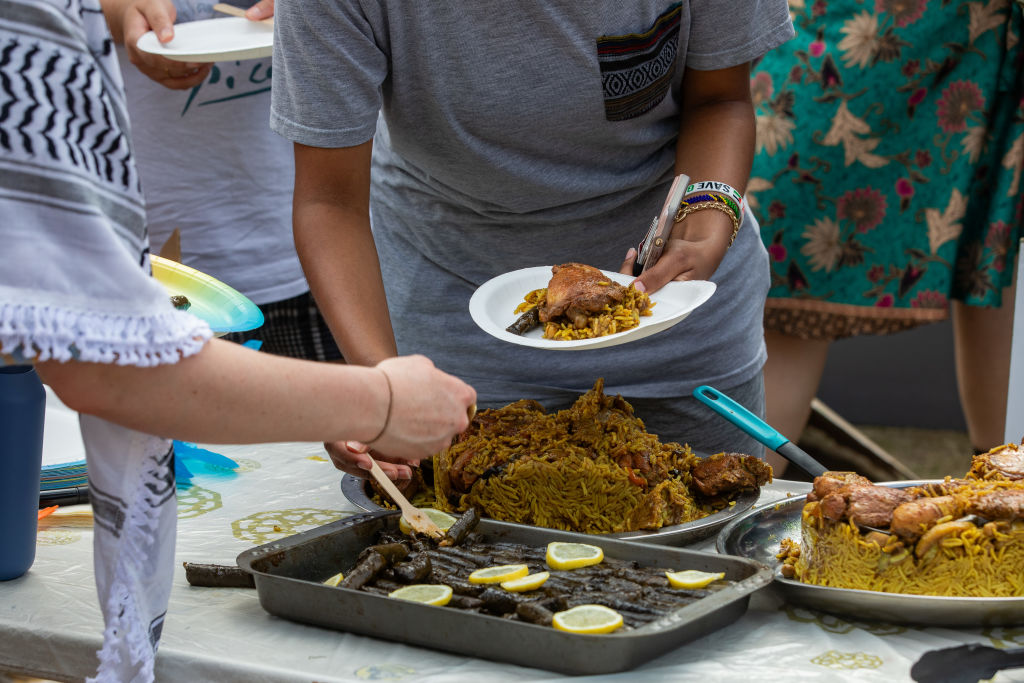
Palestinian food, with dishes such as Hummus, Falafel, Tabbouleh, Maqlouba, and Musakhan, reflects the strong connection of its people to their land [Getty]
Furthermore, Heba also stresses that what was once hyperlocal — dishes shared within extended families — has increasingly gained international recognition.
Palestinian restaurants now operate across Europe and the Middle East, while international chefs draw on Palestinian ingredients and techniques.
Staple dishes such as hummus, tabbouleh, and falafel, for example, long a part of everyday Palestinian life, are no longer confined to “ethnic cuisine” sections; they now occupy centre stage in the global food conversation.
Heba highlights the cultural significance of this recognition. “Palestinian food has become an integral part of global dining experiences,” she observes.
“Traditional dishes are no longer just meals; they’re embodiments of heritage and family values, places where people gather to strengthen bonds.”
Heba acknowledges that the roots of Palestinian cuisine stretch back thousands of years, drawing on Mediterranean, Levantine, and Arab culinary traditions and often being passed down orally through generations, preserving both taste and memory.
Each dish also reflects the geography of Palestine, from olive oil produced in the West Bank and citrus from historic Palestinian groves to herbs growing wild in the hills.
In this sense, food becomes a map of the land, and cooking becomes a form of cultural and territorial expression.
The thobe as a symbol
As Palestinian music and food reach global audiences, clothing too is gaining recognition as a form of cultural storytelling.
Ischar Assi, a young Palestinian fashion designer, witnessed the moment when a traditional garment became a global statement.
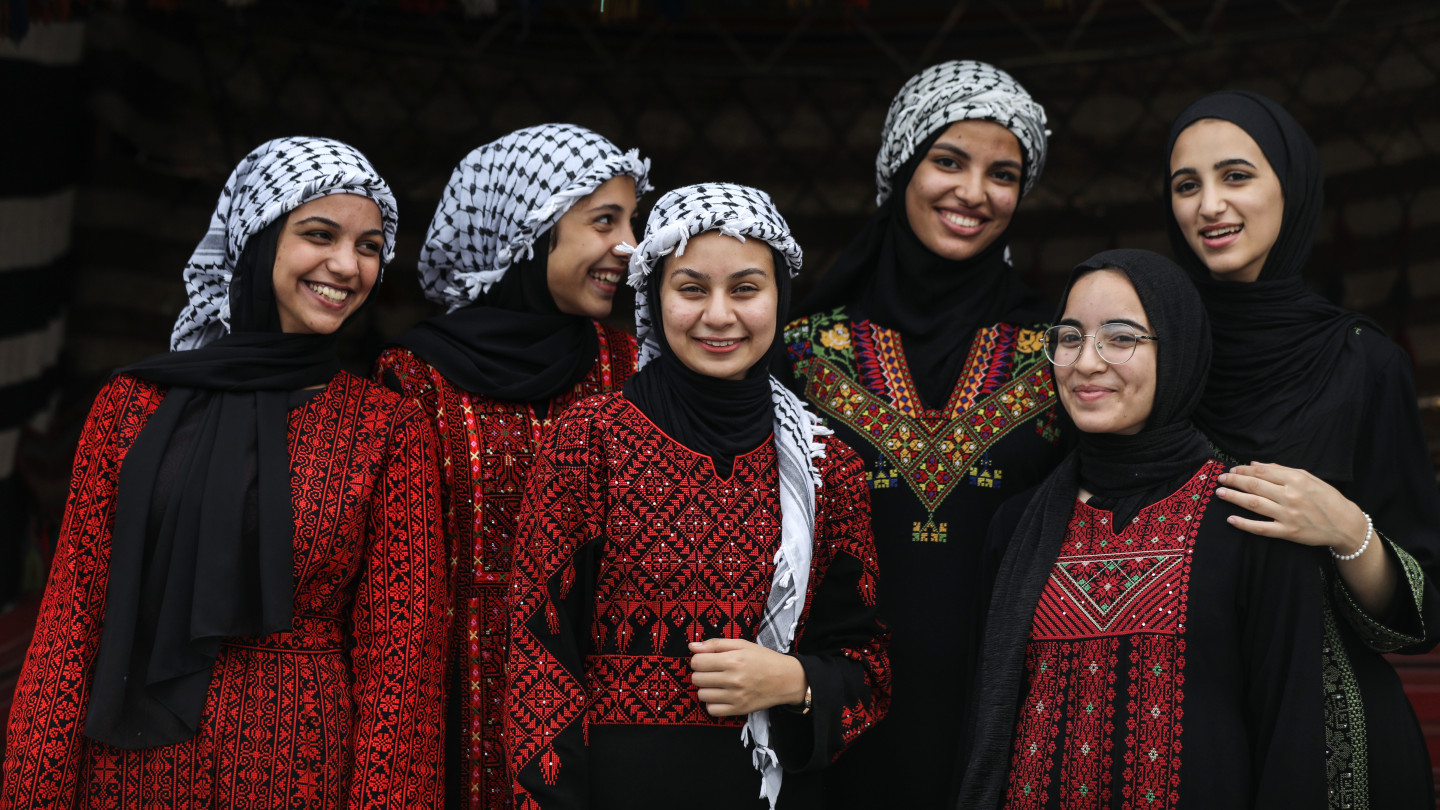
In her workshop, where vibrant colours meet traditional embroidery techniques, she observed an unexpected phenomenon: the thobe, the Palestinian long dress typically worn at celebrations, transformed into an everyday assertion of identity.
“After the war, people began wearing the thobe as a way to express solidarity with Palestine, not merely as a traditional garment,” Assi explains.
“It’s an expression of identity, of resistance, of hope.”
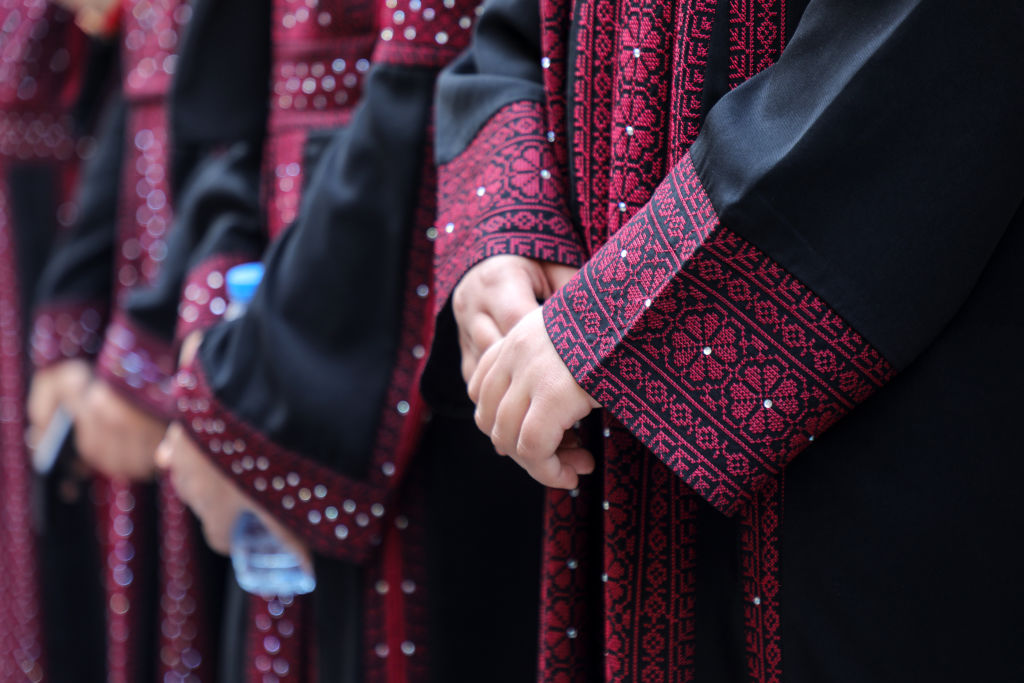
Stunning Palestinian embroidered dresses, known as ‘thobes’ [Getty]
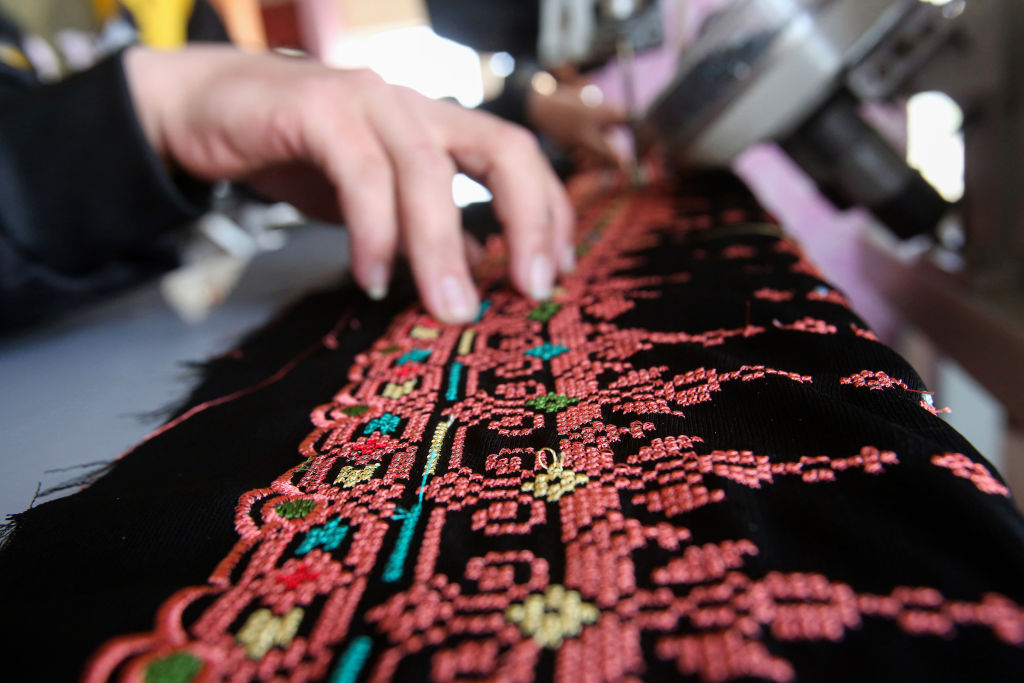
Tatreez (تطريز) is the traditional Palestinian art of intricate hand embroidery [Getty]
Social media accelerated this shift. Images of people wearing the thobe multiplied: Palestinians in the diaspora wearing it to protests, international activists wearing it in solidarity, and young people incorporating it into streetwear.
As Ischar explains, the dress went beyond its ceremonial use to become a “floating signifier,” a symbol whose meaning grew beyond its original context.
Ischar and other Palestinian designers seized this moment. They began reimagining the thobe for contemporary wearers, introducing modern silhouettes and colour palettes while maintaining the intricate embroidery that identifies specific Palestinian regions.
“We’ve added contemporary touches, but we’ve preserved the spirit of heritage,” Ischar says.
“We want to show the world that the Palestinian thobe has a deep history and is inseparable from our identity.”
But of course, Ischar is aware of the challenges. Palestinian designers face supply chain disruptions, import restrictions in the occupied territories, and limited access to international markets due to political and economic constraints.
Despite these obstacles, Ischar and her peers have persisted and continue to do so.
“Every piece I work on tells a story — the story of an entire people. We want to show the world that Palestine is not only a conflict, but a rich culture and ancient history,” she says.
Ischar adds that cultural organisations began hosting exhibitions and events celebrating the thobe’s role in Palestinian identity.
What had been dismissed in some international circles as merely “traditional dress” became recognised as a sophisticated, evolving art form — proof that Palestinian culture is not static or frozen in time, but living and adaptive.
A collective awakening
Upon reflection, these parallel movements in music, food, and fashion share a common origin and trajectory.
Israel’s horrific genocide catalysed a global reckoning with Palestinian existence beyond conflict, as international audiences, suddenly confronted with the scale of suffering in Gaza, sought ways to understand Palestinian humanity, with culture providing that bridge.
Zeid Helal’s songs, Khalid Sadouq’s compositions, Heba Al-Haytan’s recipes, and Ischar Assi’s designs all do the same work: they insist that Palestinians are not merely victims of history, but creators within it.
Through their work, they assert presence, continuity, and the right to be understood as complex human beings, with aesthetic traditions, family rituals, and artistic visions that both predate and will outlast the current conflict.
As Palestinian music, food, and fashion reach global audiences, the narrative begins to shift. What was once framed by destruction and despair is now told as a story of resilience and cultural sovereignty, transforming a people defined by what is done to them into a people defining themselves through what they create.
This does not mean that celebrating culture erases political struggle — it does not. However, it does complicate the discourse, making it harder to reduce Palestinians to mere statistics or political abstractions.
For those engaging with Palestinian culture, the experience is transformative. Someone who has learned a Palestinian song, tasted Palestinian food, or worn a Palestinian thobe encounters Palestinians as artists, hosts, and teachers. They experience culture not as a museum artefact but as a living, breathing, and evolving expression of human creativity.
For the artists and creators at the centre of this movement, the stakes are both personal and collective.
“The future of Palestinian music after the conflict ends will be bright,” Khalid envisions.
“Music will continue as a means of expressing identity and heritage, able to reach wider audiences. The hope is that with peace, Palestinian music will develop to become part of global cultural dialogue, reinforcing its place on the international stage.”
This hope drives all Palestinian cultural work today. It is not an escape from present hardship, but a statement of future possibility — a declaration that Palestinian culture belongs to the world, and that the world is finally beginning to pay attention.
Through the songs of composers, the recipes of cooks, and the designs of artists, Palestinians continue to tell their stories. In doing so, they remind the world: we are still here. We are creating. We endure.
Aseel Mafarjeh is a West Bank-focused journalist, focusing on stories that speak of the challenges and creativity of youth in Palestine