Photos courtesy of Milwaukee Islamic Dawah Center
Milwaukee Islamic Dawah Center’s food pantry has been an important resource for North Milwaukee residents since 2007 when former Dawah Center Executive Director Will Perry started it in the parking lot, distributing food from his mini van.
“The Milwaukee Islamic Dawah Center adamantly opposes and condemns in the strongest terms the use of hunger as a weapon,” says the Dawah Center in a statement prominently featured on its website, “whether it’s a weapon of oppression to starve civilians, or as a political weapon to drive hardships on the most vulnerable while bureaucrats argue over our fate.”
Prompted by a spike in food insecurity in Milwaukee that began Oct. 1, when the U.S. government shut down and announced it would cut off SNAP (Supplemental Nutrition Assistance Program) benefits by Nov. 1, followed by weeks of conflicting court rulings, the Milwaukee Islamic Dawah Center board discussed how to address the crisis facing low-income Milwaukee families.
It’s response: a strong public stance against government policies harming society’s most vulnerable people and a doubling down on efforts to provide food to the needy.
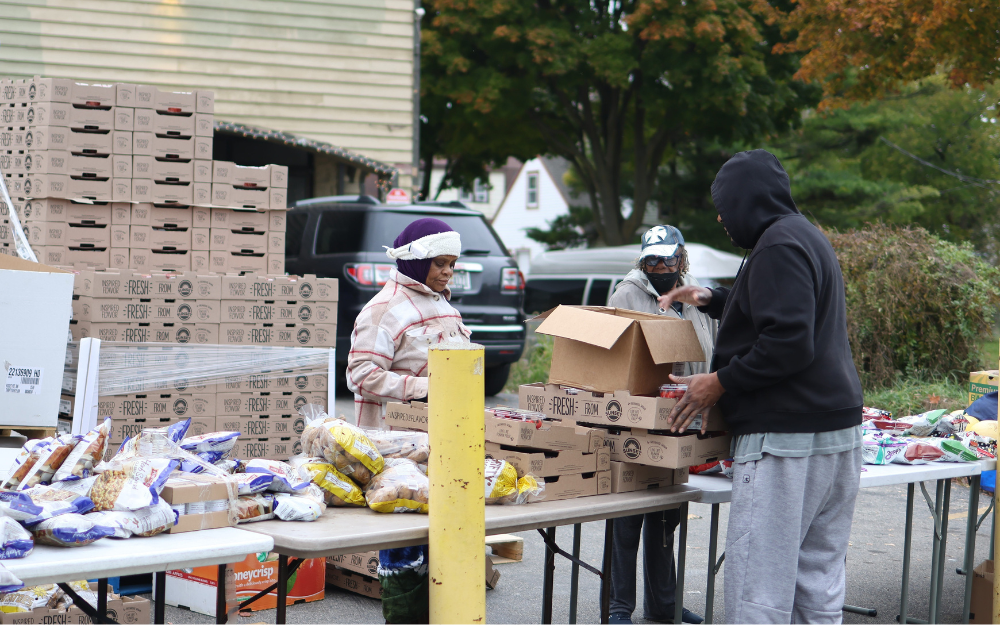
Milwaukee Islamic Dawah Center’s food pantry in North Milwaukee distributed about 10,000 pounds of food a week for years. In the past two weeks, its distribution has more than doubled to meet rising demand.
Standing with those in need
Taking a position on government decisions about SNAP is important, said Milwaukee Islamic Dawah Center board member Burhan Clark. “It’s not like the money isn’t there.
“It’s so primal. The idea that you’re going to starve people, besiege people and use food as a weapon. We’ve seen this in Sudan and Gaza.
“But it doesn’t just happen to people in conflict. The ability to withhold such basic resources as food is an easy grab for anyone who wants to be totalitarian. To starve people in order to influence something is against all our modern moral standards. It’s against our legal codes in how we conduct war. It is detestable for whoever does it. This calculus in human lives isn’t something we should ever accept.”
In addition to fighting immoral government policies, we are also challenged as individuals, he added. “When resources become limited and as you have less, there can be a big focus on making sure me and my family have what we need. But we should really try to keep our heads up and look around at some who are in even worse situations.”
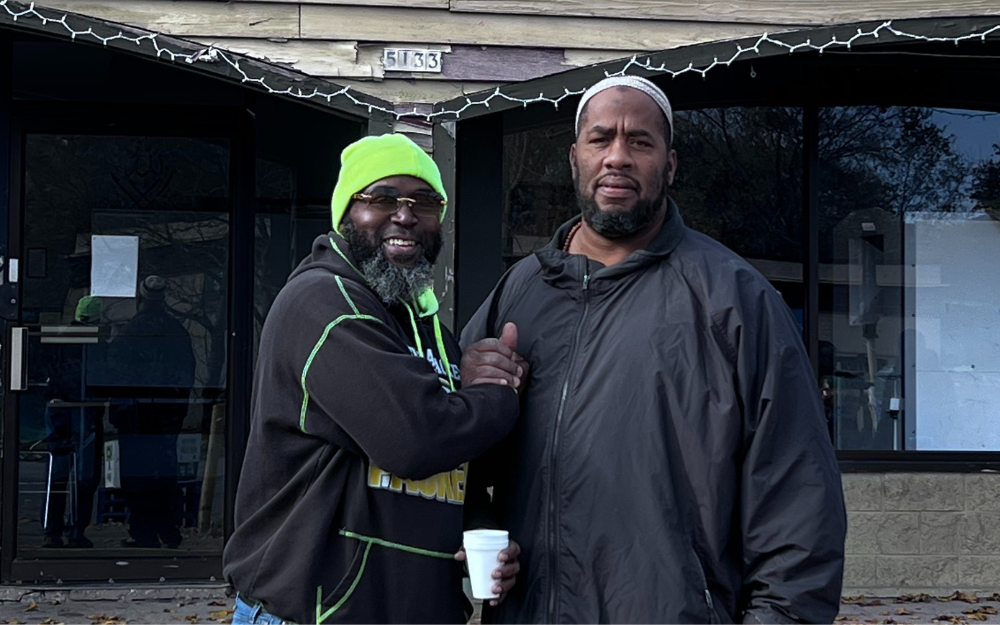
Yameen Muhammad and Nasir Williams work together to operate the Islamic Dawah Center’s food pantry four days a week. Williams is onsite while Muhammad drives the center’s truck to pick up food items.
Stepping up
Following the halt on SNAP benefits, court decisions rolled out with a whiplash effect, so much so that the New York Times published a play-by-play timeline. The Milwaukee Islamic Dawah Center board decided they couldn’t wait to see what would happen with SNAP payments.
“There’s been a lot of fear,” Clark said. “So, we were asking each other, ‘What’s the plan?’”
The Dawah Center’s public statement noted, “There is a fear implicit in unstable governance, and individual organizations can’t make up the gap of government programs that affects millions of families. In Milwaukee, the Dawah Center is on the front line.”
North Milwaukee neighbors of the Milwaukee Islamic Dawah Center, 5135 N. Teutonia Ave., have long seen its food pantry as a crucial lifeline.

“Dr. Nauman Siddiqi, a nephrologist doing a fellowship at the Medical College of Wisconsin, conceived and initiated the Dawah Center Food Pantry, and financed the start-up” in the mid-1970s, explained Dr. Waheeduddin Ahmed, the first president of the Islamic Center of Milwaukee.
He was assisted in this effort by the late Br. Ayyub Al-Amin, the Milwaukee Islamic Dawah Center’s first chair of dawah (sharing the message of Islam), “with the help of a brother who ran the warehouse,” Dr. Ahmed added.
“It had several iterations,” Dr. Ahmed continued. Former Dawah Center executive director Will Perry ran the pantry out of his minivan in 2007.
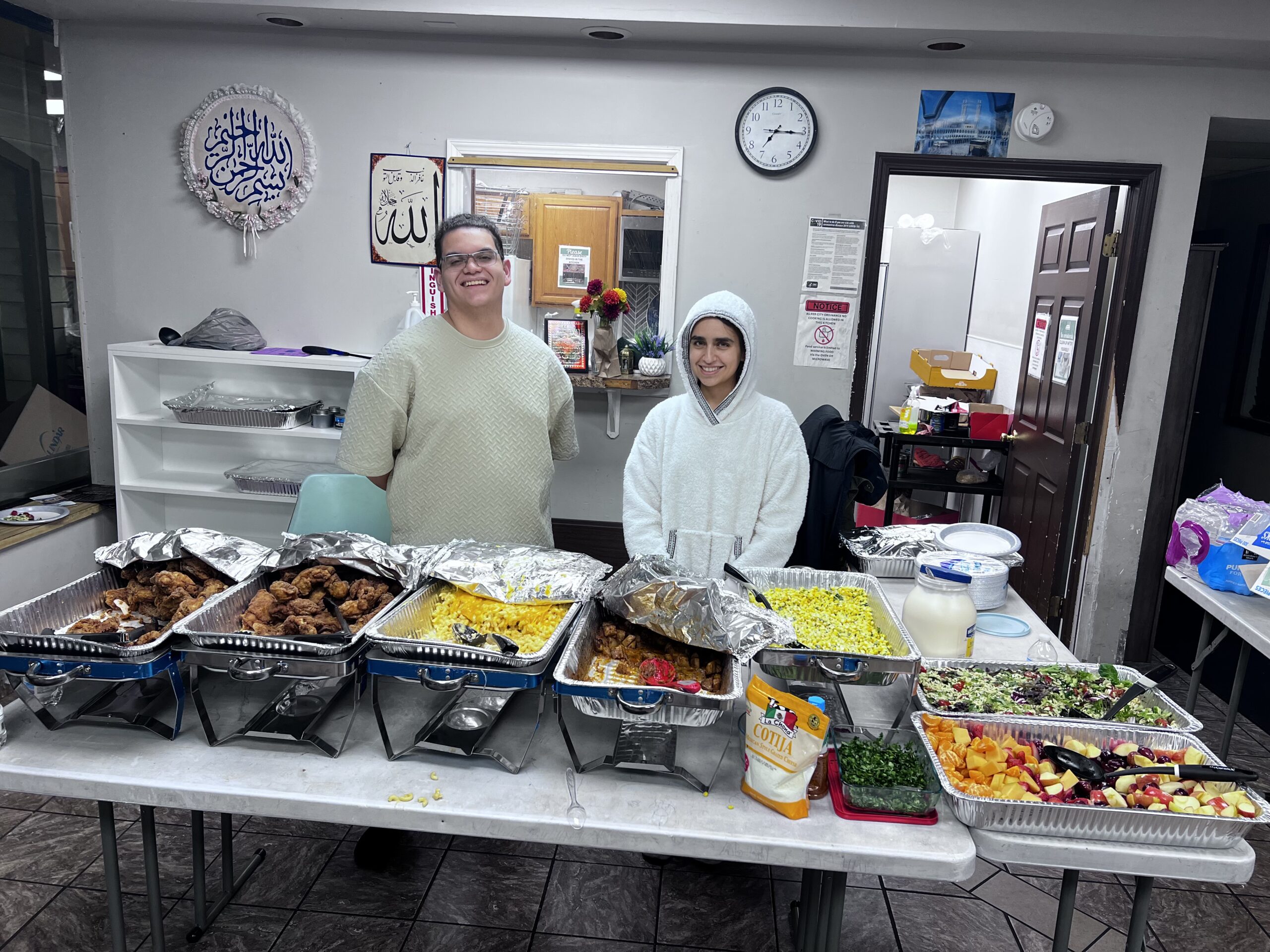
Volunteers served food Monday night at the Dawah Center Community Dinner. The dinners, on Mondays and Thursdays at 6 p.m., are open to the public.
PBS Wisconsin, in a 2023 episode of Wisconsin Life, featured the pantry’s truckloads of food on tables and palettes in the parking lot, and its dozens of volunteers and community partners.
In the 2023 interview with PBS Wisconsin, Perry noted it distributed 10,000 pounds of food a week and that it had “a significant impact on the quality of life.”
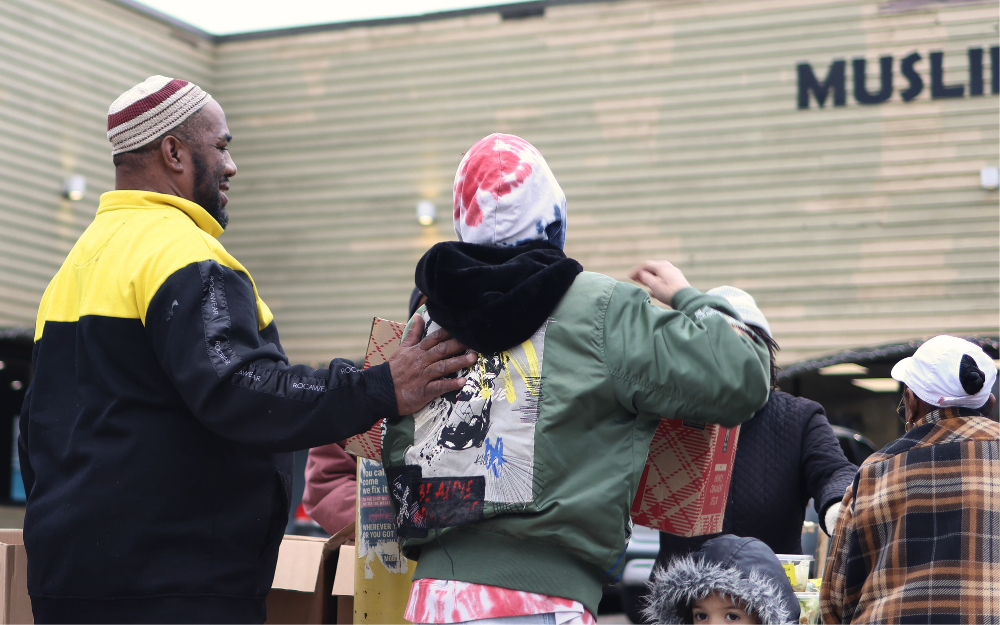
The pantry runs four days a week, opening Monday at 11 a.m. and Tuesday, Wednesday and Thursday at about 9 a.m., as soon as a truck delivers the food. It stays open until all the food is gone, which usually takes about two hours. “We don’t keep any food,” Clark explained.
Until the SNAP crisis began a month ago, “our average numbers of people in line each day were about 150,” said Rebekah Bissen, Dawah Center office manager. “Our attendance has doubled of people standing in line to fill up their boxes. Each person in line represents a family, so we are helping over 1,000 people a day.”
Although the food pantry operates on alternating days, with Mondays and Wednesdays for families whose last name begins with A-L, and Tuesdays and Thursdays for M-Z, “we don’t turn anyone away,” Bissen noted. “We just ask everyone to let those whose turn it is go first.
“Many people we serve are non-Muslims,” she said. “They plan to cook for the holidays – Thanksgiving and Christmas. Now they are uncertain about how they’ll manage the holidays coming up.”
In another initiative since the crisis around SNAP began, the Dawah Center extended what were small meals twice a week for a small number of Muslims who were fasting to large family meals for the general public. Meals are served Mondays and Thursdays at 6 p.m. On Thursdays, families can pick up additional food goods to take home.
“Some sisters in the community began cooking and bringing in meals,” Bissen said. “Others make donations towards the cost of the meals.”
“The more we do, the more the word spreads,” she added. “We are seeing 50-75 people at each meal. We prep for 100 because we want to have enough for everyone.”
Tackling the challenge
As the board discussed the rising food insecurity, “one of our concerns was just numbers,” Clark said. “In just over two weeks, the traffic at the pantry has steadily picked up significantly. How do we get more food? How do we process more people in and out of the pantry? Do our volunteers feel supported? Is everyone who shows up treated well?”
The Dawah Center acquires some food from Feeding America, a national network of food banks. “The way that works is there are some free items and others you purchase at reduced rates,” Clark explained. “The past couple of years, there have been more items you have to purchase and prices have gone up.
“We’ve been overspending a bit. We were already working to cut back on our Feeding America purchases before all this happened. Some families responded with more donations of goods. Others have donated money to be used to purchase from Feeding America.
“We also have a truck now where we can go to places and pick up food to distribute for free,” he said. “That’s a main reason we can operate the pantry so many days a week.”
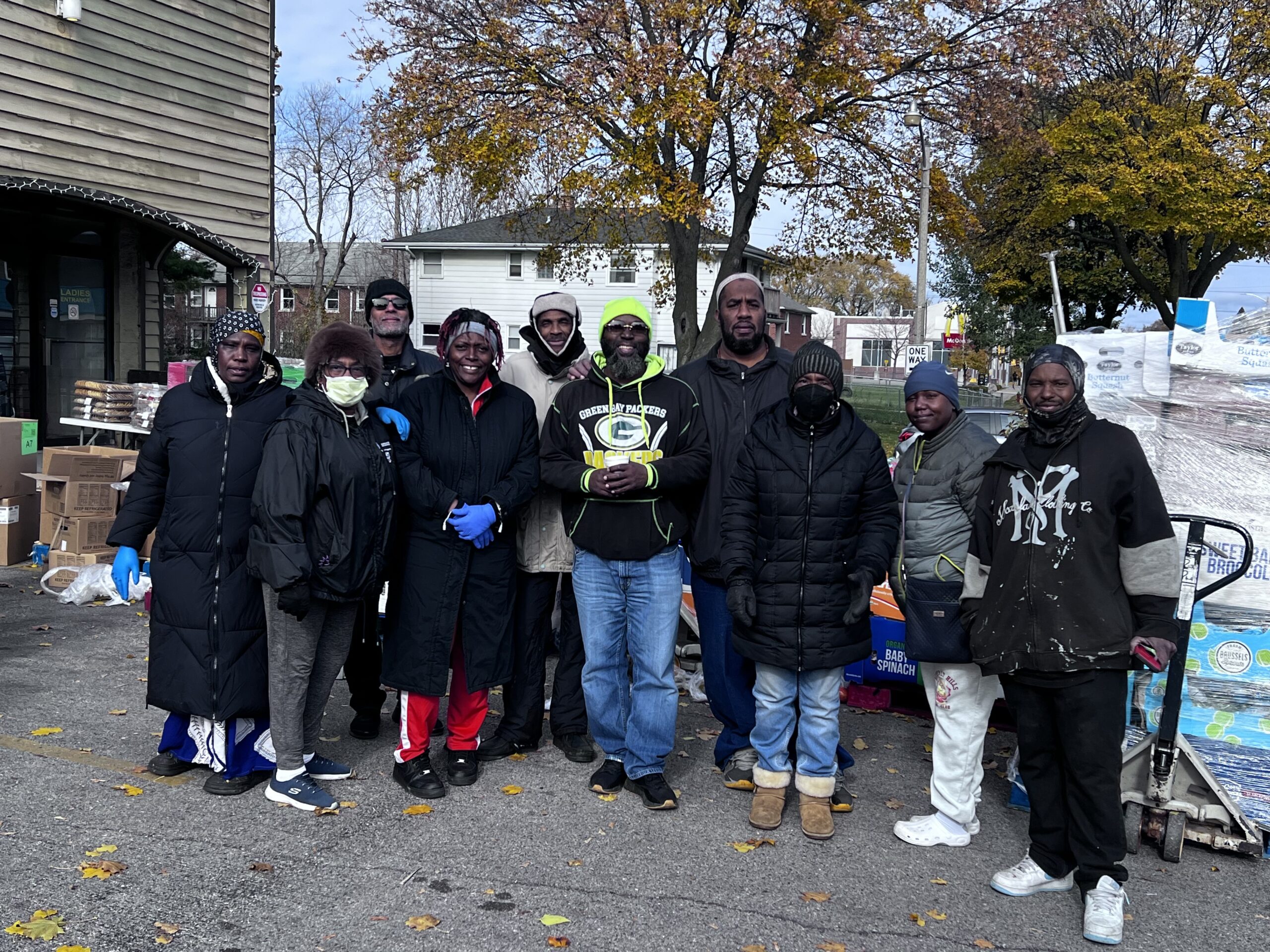
A strong core of about 15 volunteers run the food pantry four days a week, rain or shine, sleet or snow, said Dawah Center office manager Rebekah Bissen. She especially wants to thank them because “we couldn’t do it without them.”
“Franklin High School did a beautiful thing for us,” said Bissen. “At the start of the SNAP problems, they reached out to us to ask if they could do food drives for us.
“Someone else gave us $450 to increase our purchases of food,” she added.
“And, most important, we have a core group of volunteers who have been with us for 15 years or more,” Bissen said. “With all we throw at them, they still show up. They are there every single day—hot, cold, raining, snowing. When the demand for food increased, they flowed with us to meet the need.”
“I’m continuously overjoyed by the way I’ve seen the greater Muslim community in Milwaukee show concern about people in need and do their best to help,” Clark said. “I’m really thankful.”