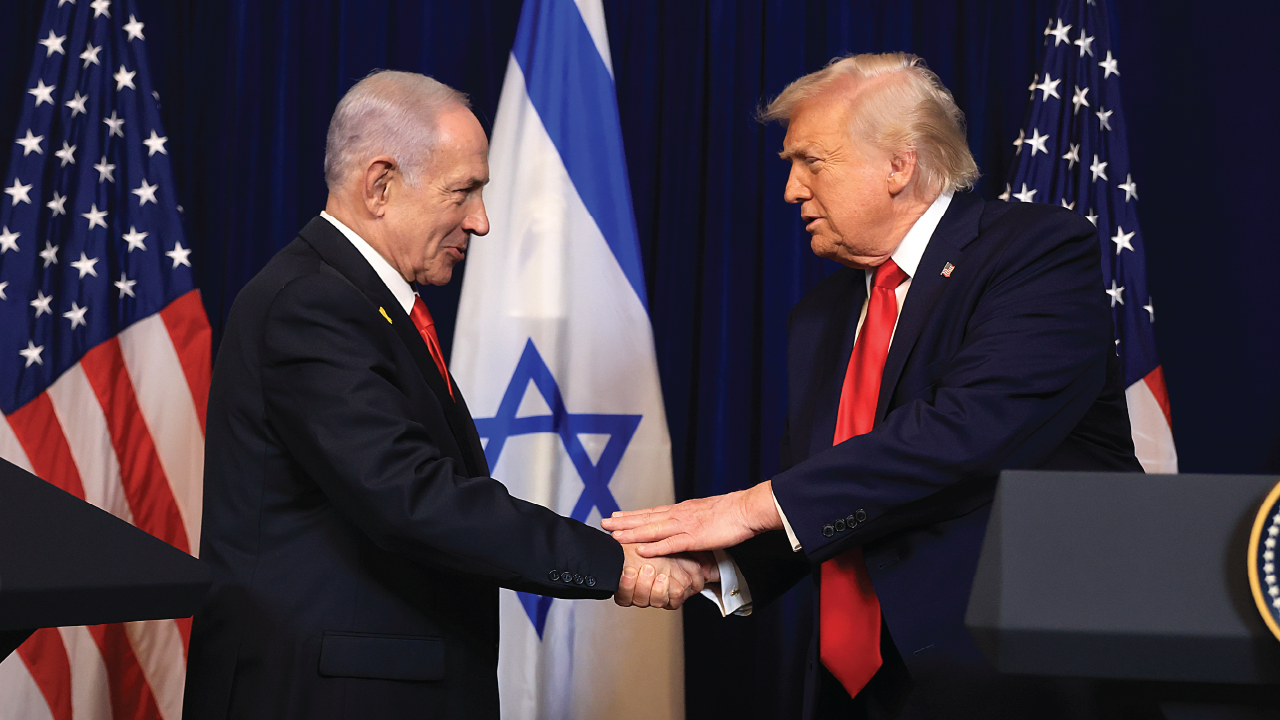
U.S. President Donald Trump and Israeli Prime Minister Benjamin Netanyahu shake hands during a press conference at Trump’s Mar-a-Lago club in Palm Beach, Florida, on Dec. 29, 2025. (Joe Raedle/Getty Images)
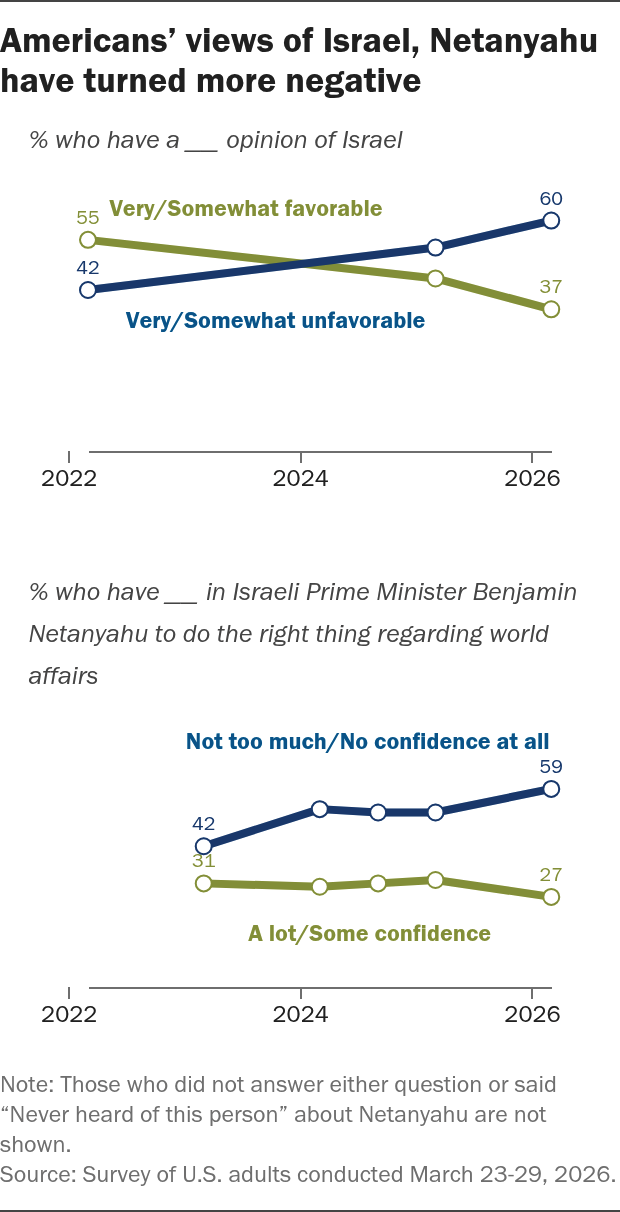
Americans have increasingly negative views of Israel and its prime minister, Benjamin Netanyahu, according to a new Pew Research Center survey.
- 60% of U.S. adults have an unfavorable view of Israel, up from 53% last year.
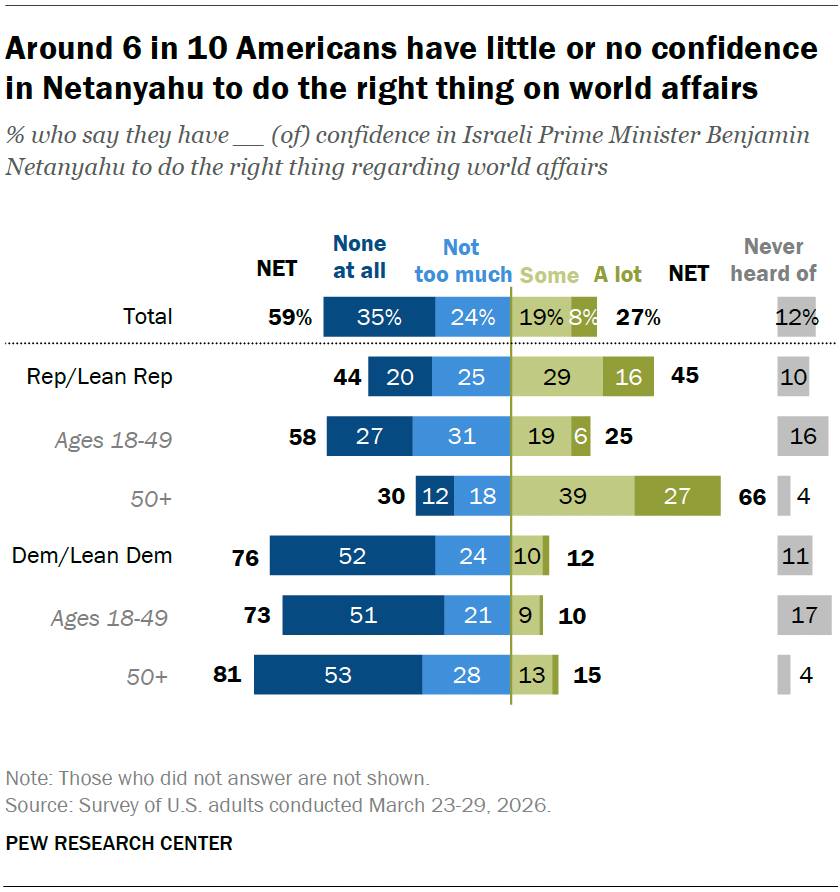
- 59% have little or no confidence in Netanyahu to do the right thing regarding world affairs – up from 52% last year.
- In both political parties, majorities of adults under the age of 50 now rate Israel and Netanyahu negatively.
The survey was conducted March 23-29 among 3,507 U.S. adults. It was fielded about a month into the U.S.- and Israeli-led war in Iran. The sections below take a closer look at the results of the survey.
For more on American views of the war in Iran, read “Gas Prices Are Americans’ Top Concern in Iran War.”
Americans’ views of Israel
Six-in-ten Americans have a very or somewhat unfavorable view of Israel, up 7 percentage points since last year and nearly 20 points since 2022. The share of U.S. adults with a very unfavorable view of Israel (28%) has also increased 9 points since last year – and nearly tripled from 10% in 2022.
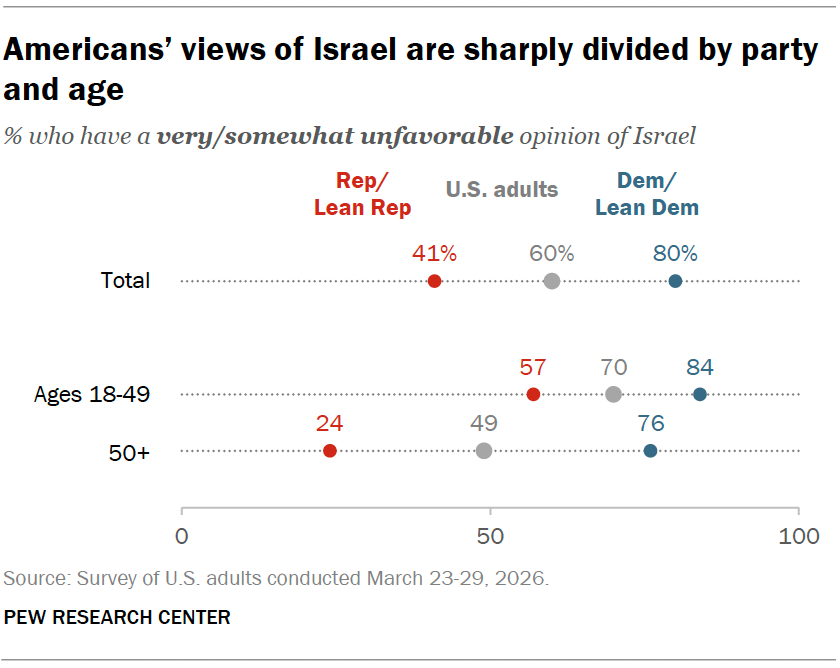
Eight-in-ten Democrats and Democratic-leaning independents currently have an unfavorable view of Israel, up from 69% last year and 53% in 2022. Democrats under 50 are slightly more likely than older Democrats to say they have a very unfavorable view of Israel (47% vs. 39%).
More Republicans and Republican leaners have a favorable than unfavorable view of Israel (58% vs. 41%). Still, the share of Republicans with a negative view has ticked up since last year, driven by those under 50. Today, 57% of Republicans ages 18 to 49 have an unfavorable opinion of Israel, up from 50% last year. Large majorities of Republicans 50 and older continue to view Israel positively.
Views of Israel also differ substantially among U.S. religious groups that are large enough to analyze. Jewish Americans and White evangelical Protestants have mostly positive views of Israel, at 64% and 65%, respectively.
Favorable views of Israel are much less common among White nonevangelical Protestants (39%), Catholics (35%), Black Protestants (33%) and the religiously unaffiliated (22%) – that is, people who say they are atheist, agnostic or “nothing in particular.” Among Muslim Americans, only 4% see Israel positively.
Americans’ confidence in Netanyahu on world affairs
More than half of Americans (55%) lack confidence in President Donald Trump to make good decisions when it comes to the relationship between the U.S. and Israel. Opinions haven’t shifted much since August 2025, when we last asked this question.
Still, Americans are slightly more confident in Trump’s approach to the U.S.-Israel relationship than they are in him to make good decisions about many other foreign policy issues asked about, including U.S. policy toward Iran (35%). (For more, read “Confidence in Trump’s ability to make good decisions about U.S. policy toward Iran has declined among both Republicans and Democrats.”)
Around three-quarters of Republicans (73%) – but only 16% of Democrats – have confidence in Trump to make good decisions about the U.S.-Israel relationship.
Notably, Republicans under 30 are much less likely than those 65 and older to have confidence in Trump’s handling of the U.S.-Israeli relationship (52% vs. 93%). Democrats, by contrast, are much more united in their views on this question.
Importance of Israel-Hamas conflict to Americans
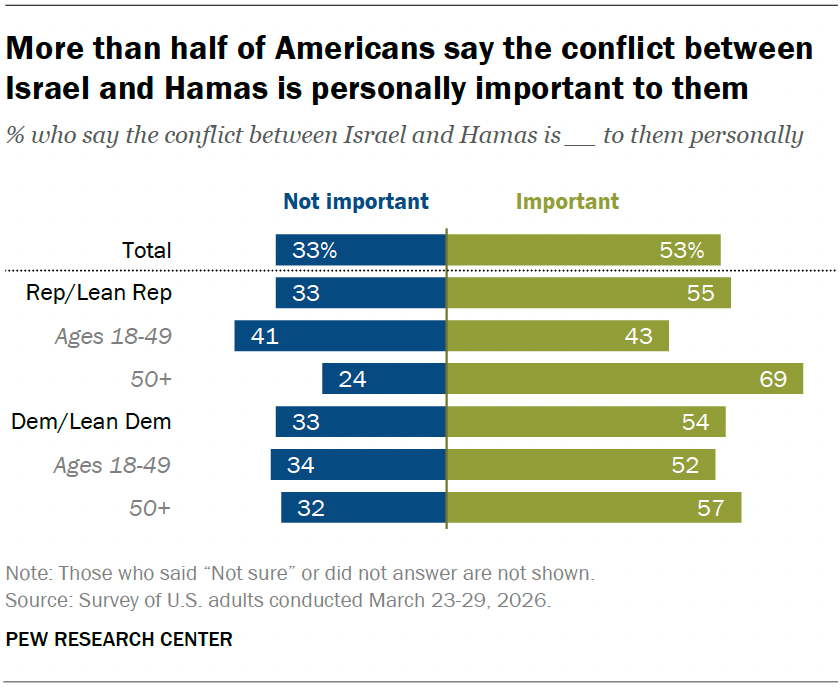
More than half of Americans (53%) say the conflict between Israel and Hamas is either very or somewhat important to them personally. This is largely unchanged from last year – before there was a ceasefire in the conflict – when we asked a slightly different version of this question.
Americans are much less likely to describe the Israel-Hamas conflict as personally important than to say the same about the U.S. military action against Iran (53% vs. 77%). This includes 22% who say the Israel-Hamas conflict is very important to them – compared with 48% who say this about the U.S. military campaign against Iran.
Republicans and Democrats are equally likely to see the Israel-Hamas conflict as personally important to them. But among Republicans, those ages 50 and older are much more likely than their younger counterparts to say so (69% vs. 43%). Democrats differ little by age.
When it comes to religion, 91% of Jewish Americans say the Israel-Hamas conflict is personally important to them. Large shares of Muslim Americans (70%) and White evangelical Protestants (65%) say the same – all broadly unchanged since last year.
Jewish and Muslim Americans are about as likely to see the Israel-Hamas conflict as personally important as they are to say the same about the U.S. military action in Iran. White evangelical Protestants, however, are less likely to say that about the Israel-Hamas conflict than the U.S. military campaign in Iran (65% vs. 86%).
Note: Here are the survey questions used for this analysis, the detailed responses and the survey methodology.

Laura Silver is an associate director focusing on global attitudes at Pew Research Center.