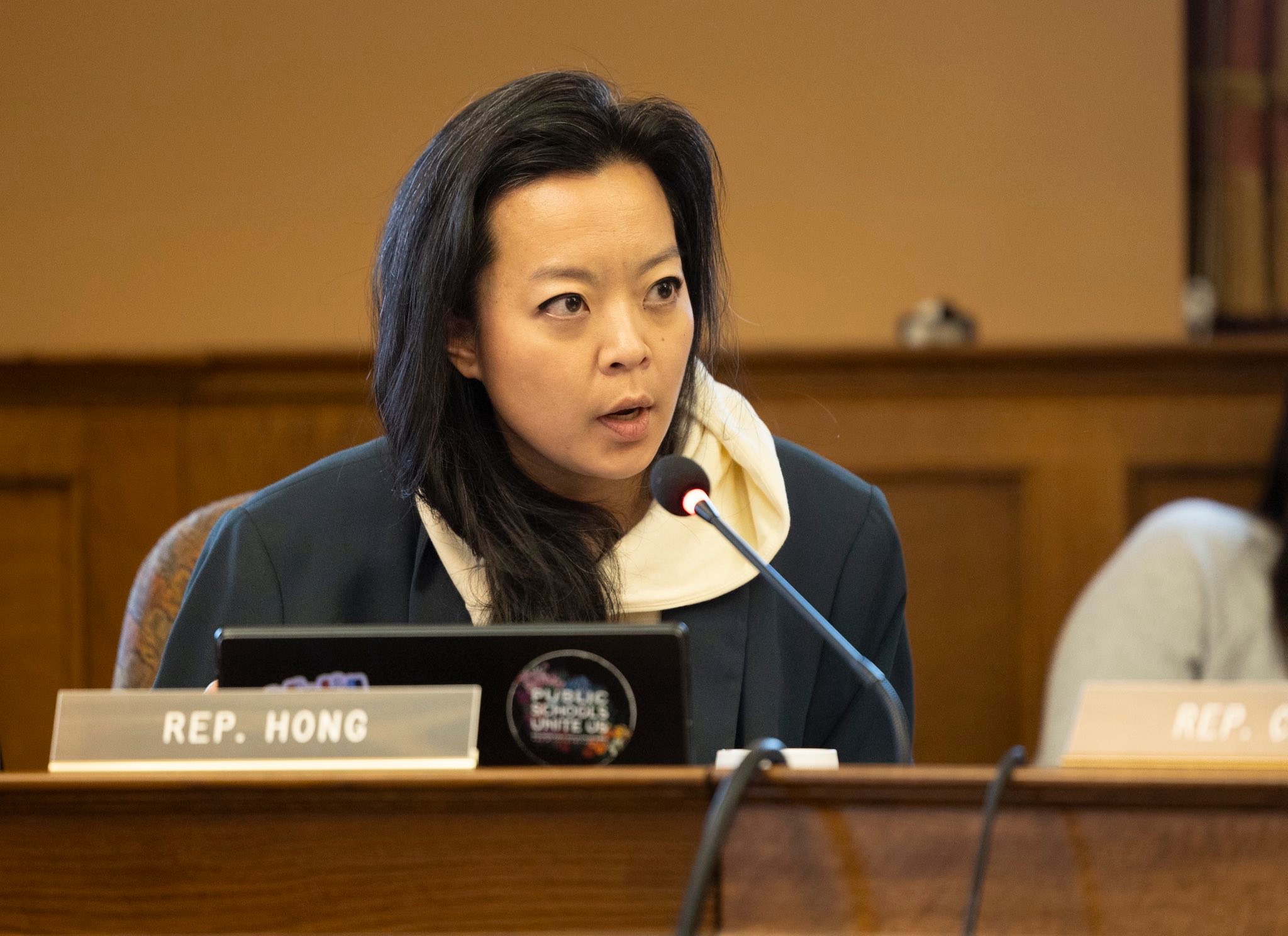
Wisconsin Rep. Francesca Hong (D-Madison) authored legislation to repeal Wisconsin’s anti-BDS law that has banned boycotts against Israel by companies and individuals doing business with state government and institutions for almost a decade.
For almost a decade, Wisconsin has prohibited state contracts and allowed the termination of contracts with businesses that boycott Israel. A growing number of state lawmakers aim to repeal the Walker-era ban and restore Wisconsinites’ Constitutional rights to free speech.
Scott Walker was a two-term governor of Wisconsin, from 2011 to 2019.
“Since the original anti-BDS bill was introduced (in 2017) and passed (in 2018) by the (Gov. Scott) Walker administration, I have been concerned about it,” said Rep. Francesca Hong (D-Madison), the lead author of legislation introduced last Wednesday to restore the right to boycott. “Once the genocide began, I knew there would be potential danger for everyone who would be fighting for Palestinian liberation and against Zionism.”
In an interview last week with Wisconsin Muslim Journal, Hong described the newly released legislation (LRB-0750) as “a very clean repeal of the Walker legislation.
“It ensures that people can protect their right to free speech, their right to boycott and their right to protest,” Hong said. “These are Constitutional rights of every single person. We have to ensure they are maintained without the state interfering and stripping them of these rights.”
Growing support
Today is the day for legislators to sign on to co-sponsor the right to boycott legislation before it is submitted. Its original authors (Reps. Hong, Ryan Clancy, Christian Phelps, Darrin Madison and Angelito Tenorio, and Sen. Chris Larson) circulated a memorandum last Wednesday that invites legislative colleagues to co-sponsor the bill with the deadline to sign on by the end-of-day today.
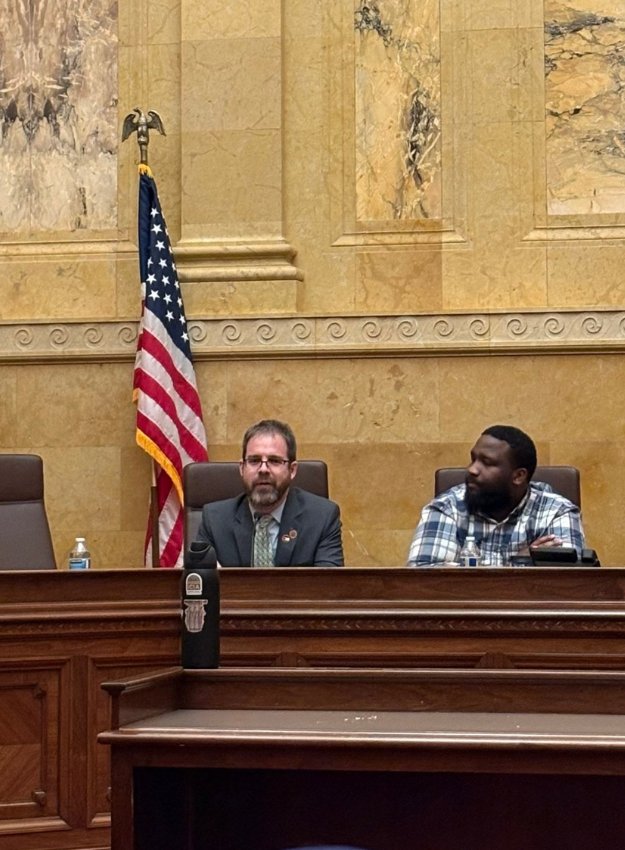
Wisconsin Reps. Ryan Clancy (left) and Darrin Madison (right) spoke to participants at the Wisconsin Muslim Civic Alliance Advocacy Day, Feb. 11. They included a discussion of the Right to Boycott legislation being submitted today.
The memorandum explains the authors’ reason for proposing this legislation. It states:
“Freedom of speech is enshrined in our Constitution, and since the founding of our nation, this right has been a cornerstone of our judicial, social and political systems. The right to boycott, recognized by the courts as a form of protected political expression, is an extension of that free speech and must be guaranteed for every American.
“In Wisconsin, however, a Walker-era law restricts this fundamental right by prohibiting state entities and local government units from contracting with individuals or companies that engage in boycotts of one specific country. Existing law compels political speech and punishes political beliefs, placing Wisconsin out of step with longstanding First Amendment principles.
“LRB-0750 seeks to repeal this law and restore constitutional protections by ensuring that the State of Wisconsin does not condition public contracts based on an individual’s or entity’s political viewpoints or participation in peaceful political boycotts. This legislation does not mandate or endorse any boycott; rather, it affirms that the government may not penalize people for exercising their right to free expression.”
Restoring rights
“Current law prohibits any state agency or other body in state government and any local government unit, including a special purpose district, from adopting a rule, ordinance, policy, or procedure that involves the state agency or local governmental unit in a boycott of Israel or doing business in Israel or in a territory under Israeli jurisdiction (prohibited boycott). This bill eliminates that prohibition,” says an analysis of the LRB-0750 by the Wisconsin Legislative Reference Bureau. (The LRB drafts all bills, resolutions and amendments for introduction into the legislature; its attorneys assist legislators in all phases of the development of legislation with nonpartisan legal advice.)
“Current law also requires contracts for materials, supplies, equipment, and services between state purchasing agents and nongovernmental entities to include a provision that the nongovernmental entity is not currently participating, or will not for the duration of the contract participate, in a prohibited boycott, unless the estimated cost associated with the contract is less than $100,000. The bill eliminates that requirement,” the LRB statement adds.
That means businesses contracting for government jobs must sign a document confirming they will not boycott Israel. Legal challenges have been raised through the courts to similar state laws. In 2022, the ACLU brought a case on behalf of the Arkansas Times, which lost a contract with the state-run university because the editor refused to sign a pledge not to boycott Israel. He said it required the newspaper “to take a political position in return for advertising,” The Guardian reported. A circuit court upheld the anti-boycott legislation and, in 2023, the Supreme Court declined to review the case.
“What is more American than a boycott, starting with the Boston Tea Party!” exclaimed Rep. Ryan Clancy (D-Milwaukee), in an interview with WMJ. The BDS movement, supported by the Quakers, Amnesty International, the ACLU, Jewish Voice for Peace, The Wisconsin Democracy Campaign and others, promotes using financial means to pressure Israel to stop oppressing the Palestinians.
In April 2025, more than 100 advocates of the right to boycott filled the State Capitol to lobby, Madison365 reported. The Wisconsin Coalition for Justice in Palestine, a coalition of more than 90 diverse organizations, and the Wisconsin Right to boycott organized a statewide effort to call on elected officials to repeal current anti-BDS laws.
Yet, boycotts against Israel are illegal in 35 U.S. states, including Wisconsin, Newsweek reported in April 2024. They are: Alabama, Alaska, Arizona, Arkansas, Colorado, Florida, Georgia, Idaho, Indiana, Illinois, Iowa, Louisiana, Kansas, Kentucky, Maryland, Michigan, Minnesota, Mississippi, Missouri, Nevada, New Hampshire, New Jersey, New York, North Carolina, Ohio, Oklahoma, Pennsylvania, Rhode Island, South Carolina, South Dakota, Tennessee, Texas, Utah, West Virginia and Wisconsin.
“We’re in the midst of a violent authoritarian clampdown, one that accelerated at the start of President Trump’s second term but did not start there,” Rep. Clancy stated in a press release from his office, released last week. “2017 Wisconsin Act 248 is an asset to those trying to repress free speech and free expression in Wisconsin. It arbitrarily limits businesses’ freedom to decide where to do business. It should be reversed.
“People standing up for their immigrant neighbors in Minnesota and people opposing the ongoing genocide in Palestine have much in common. They’re demonized, with violence against them regularly excused or even cheered by people in power. They embody the beauty of collective action, the bravery in struggling against state violence, and the essence of protecting free speech and free expression to have any hope of a just, democratic future.
“Boycotts are key tools for people fighting against human rights abuses abroad and are among the few tools available to normal people witnessing atrocities from afar. These tools were key to stopping apartheid in South Africa: they should be available to those opposing Israel’s actions now.”
Besides limiting freedom of speech, Rep. Clancy contends that the current state law “jeopardizes (Wisconsin’s) economy to support Israel’s genocide in Gaza,” as he explained in October an editorial in the Wisconsin Muslim Journal.
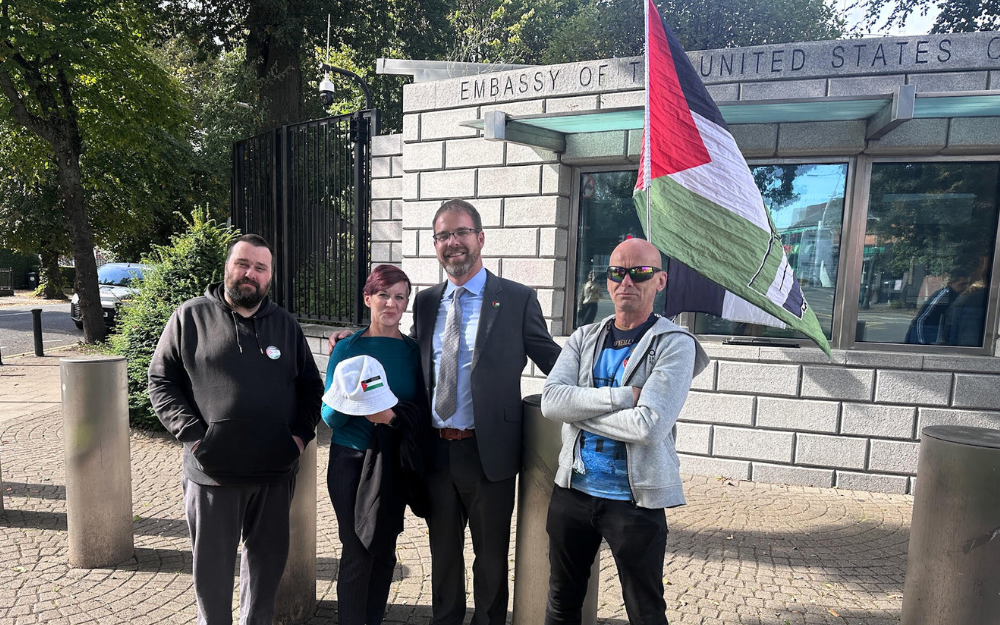
Photo credit: Photo by Wisconsin Rep. Brianne Brown (D-Whitewater)
Wisconsin Rep. Ryan Clancy (third from left) poses with his wife Becky Cooper (second from left) and pro-Palestinian protesters outside the U.S. Embassy in Dublin in September. In an editorial for Wisconsin Muslim Journal, he noted Wisconsin’s anti-boycott legislation could hurt Wisconsin’s trade relations with Ireland.
Public support matters
“Continue to encourage your state senator and your state representative to support this bill,” Hong told WMJ. “They have until the end of this year to co-sponsor the bill. And call the governor and urge him to voice his support. This is about everyone’s Constitutional right to protest and exercise their free speech. This legislation is about protecting our Constitutional rights.
“I think this bill should have bi-partisan support,” she added. “It’s important to know which lawmakers support our right to protest and our right to boycott, to have folks on the record supporting this legislation.
“I’m very grateful for the advocates for their strong organizing and coalition building around this important piece of legislation,” Hong said.









![15 Things You Didn’t Know About Makkah and the Ka’bah [Part 1]](https://wisconsinmuslimjournal.org/wp-content/uploads/2026/03/AdobeStock_87517185-scaled-e1774211732813-150x150.jpeg)