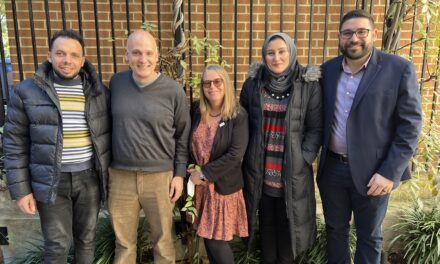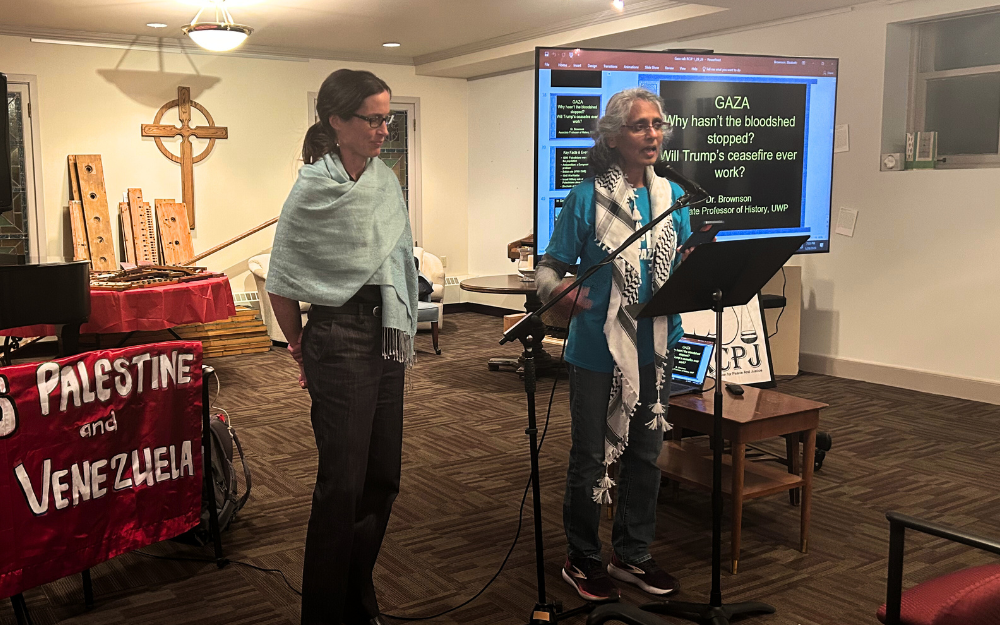
Elizabeth Brownson, Ph.D., (left) stood by as Racine Coalition for Peace and Justice president Sonali Knotek (right) introduced the University of Wisconsin-Parkside associate professor of history before her public talk on the often untold history behind the Israeli military’s assault on civilians in Gaza.
Racine Coalition for Peace and Justice hosted Gaza: Why hasn’t the bloodshed stopped? Will Trump’s ceasefire plan ever work? on Jan. 29, a public program presented by University of Wisconsin-Parkside historian Elizabeth Brownson, Ph.D.
It was held at the First Presbyterian Church, 718 College Ave., Racine, where the RCPJ frequently hosts educational programs. Rev. Darren Utley, who serves as the church’s pastor, is an RCPJ member.
“Our mission is educational,” explained RCPJ president Sonali Knotek in an interview after the program. “We want to educate the public about whatever is happening in the world with a focus on U.S. foreign policy.”
Dr. Brownson, an expert on the history of Palestine and the Israeli state, gave a talk that filled in the gaps in the general public’s understanding of that history, from the 1890s to the present. RCPJ member Sandra Pendell, who has attended other talks Brownson has given, called the scholar “brilliant” and said her willingness to share her knowledge is important to RCPJ’s work.
See Dr. Brownson’s full talk on Gaza here.
What’s happening now in Gaza
With encouragement from the audience, Dr. Brownson spoke well over an hour, explaining the historical background to the crisis in Gaza and answering questions.
She started with the present moment in Gaza. Israel has killed more than 70,369 Palestinians in Gaza directly, “a vast undercount,” she said, and injured over 171,609. At least 461 Palestinians in Gaza have been starved to death and 98 Palestinians, mostly civilians, have died in Israeli detention since Oct. 7, 2023, she added.
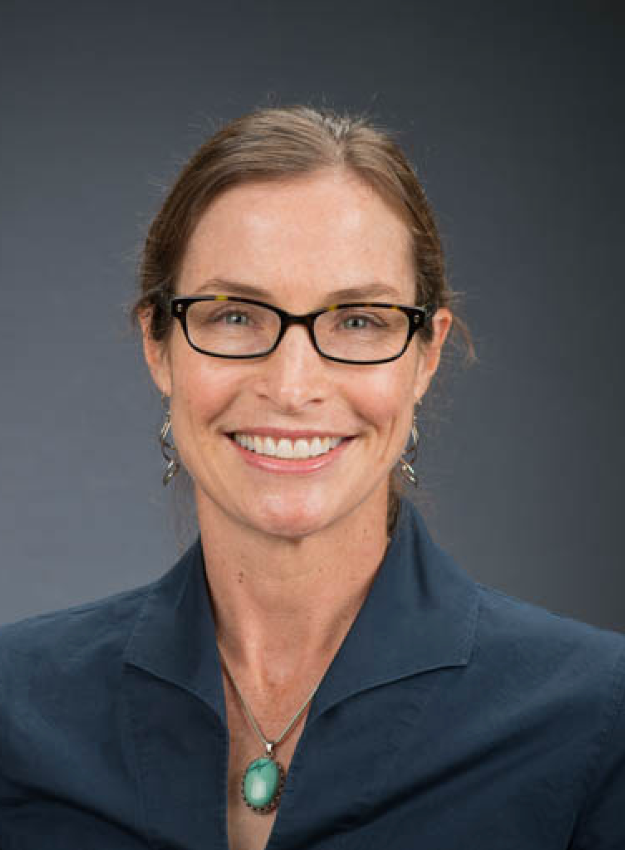
Elizabeth Brownson, Ph.D., University of Wisconsin-Parkside associate professor and historian
“We know that these stats are actually very low,” Brownson said. “They only count direct deaths. They only count people who have been killed by a bomb or a sniper or a quadcopter. They are not counting people who were wounded in an attack and died a couple of days later, or people who died from exposure. It’s only direct deaths and then only if there is complete identification, including a number that Israel assigns them, so only victims with their full name and number, who have made it to a hospital or a morgue in a hospital. A lot of families bury their loved ones wherever they are.
“And there are all the people under the rubble or dying from diseases, and you know Israel is blocking a lot of medications from going into Gaza.”
Amnesty International, Human Rights Watch, B’Tselem (Israel’s leading human rights organization), the International Association of Genocide Scholars, the U.N. Independent International Commission of Inquiry on the Occupied Palestinian Territory and other experts have determined that Israel is committing a genocide in Gaza.
In September 2025, 10 new European states recognized Palestine, totaling 157 U.N. member states, representing 81% of the world.
“Some facts about what has happened in Gaza, that are basically forgotten, should be remembered,” Brownson said. “Hamas did offer (on Oct. 8, 2023) to release all the civilian hostages in exchange for a ceasefire and a commitment from Israel not to pursue a ground invasion. And B.B. (Israeli Prime Minister Benjamin Netanyahu) said, ‘No.’
“Also, Hamas had given strict instructions to only attack military installations and military targets, and not to attack civilians. They said things got out of hand, definitely an understatement, but they also said they were willing to have an international body investigate and would punish ‘our people who are responsible.’ Israel has not allowed an international investigation of any kind, even an Israeli investigation … And, of course, Israel has not allowed journalists to go into Gaza. Palestinian journalists, however, have been heroic. Unfortunately, our corporate media seems to think it has to be one of their people to do the job (to share the reports).
“And if you haven’t heard of the ‘Hannibal Directive,’ check it out. Israel prefers killing its own soldiers, and that was later extended to civilians, so no one would be captured by Hamas. That was widely reported in the Israeli press but hardly mentioned in the U.S.
“Ever since the ceasefire, Gaza is off the headlines,” she added. “It really hasn’t been talked about.”
Brownson provided an overview of multiple remaining (and all well-documented) issues:
- Palestinians still languish in the Israeli prison system, a system that inflicts torture. As a comprehensive B’Tselem report puts it, they are in “living hell,” she noted. “We still have over 9,000 Palestinians who are really hostages because they were kidnapped from their homes in the middle of the night, a lot of them in administrative detention, which means they’re not charged with any crime.
- “Gaza has been utterly destroyed,” Brownson said. “Every single hospital was attacked and many of them are demolished. Only a handful are partially operating.”
- Ninety-two percent of homes are destroyed (71,000) and these stats are actually low.
- “Gaza has the most child amputees anywhere in the world, and Gaza is a tiny place.
- Almost 300 journalists have been killed, over 500 aid workers … Healthcare workers are not wearing their scrubs to work because they are afraid of being targeted.
- The only heavy equipment Israel let into Gaza was used to look for Israeli bodies. They wouldn’t let any other heavy equipment in to remove 61,000 tons of rubble.
- Also, between 500 and 700 Palestinian children over 12 are put through Israel’s military court system and treated as adults.
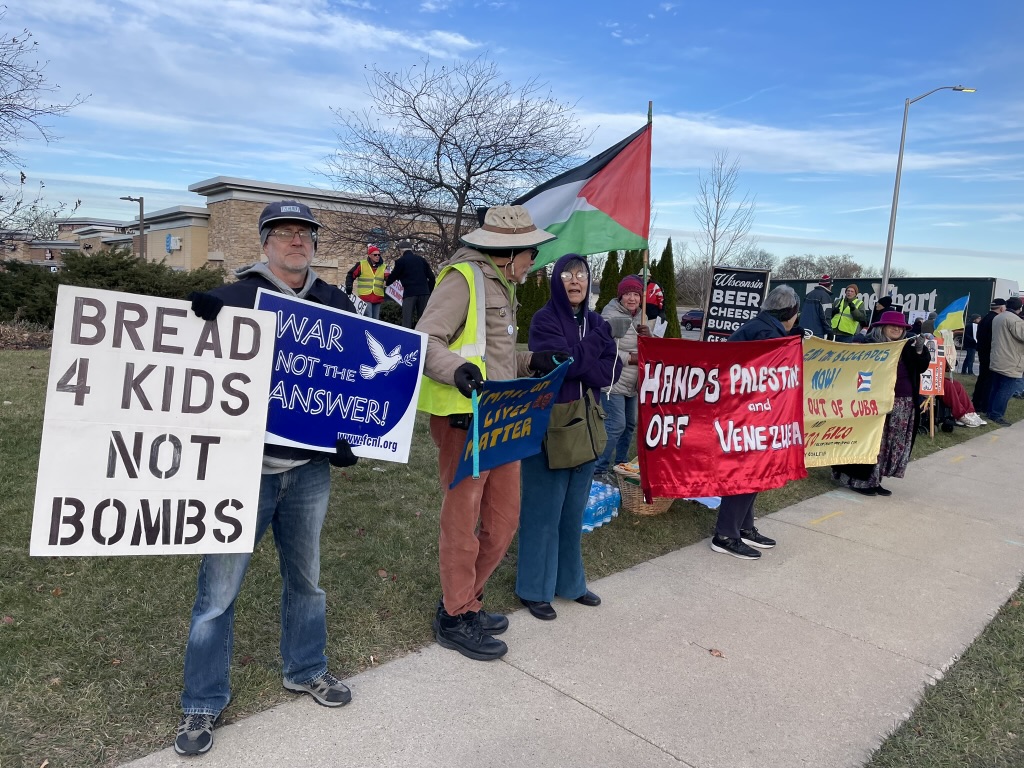
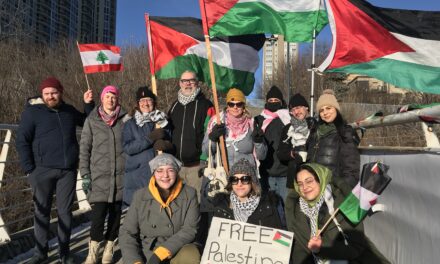
Members of Racine Coalition for Peace and Justice lined a street in Racine Nov. 17 to protest U.S. support of the Israeli military’s attacks on civilians in Gaza and U.S. military strikes on alleged drug-trafficking boats off the coast of Venezuela.
Filling knowledge gaps
To understand the plight of the Palestinians, it is important to fill some knowledge gaps with facts not often stated, Brownson said. “First of all, in 1890, before Jewish immigration to Palestine from Russia and Eastern Europe, Palestinians were 97% of the population in Palestine, according to Israeli historian and political scientist Ilan Pappe. That is something almost never acknowledged.
“Also, antisemitism is brought up in this conflict but antisemitism was really a European problem and the whole reason for Zionism in the first place. It is important to note that the reason Zionism became a movement was because of antisemitism in Europe and Russia, not in the Middle East. The people (Arabs and Jews) living in the Middle East actually got along quite well.”
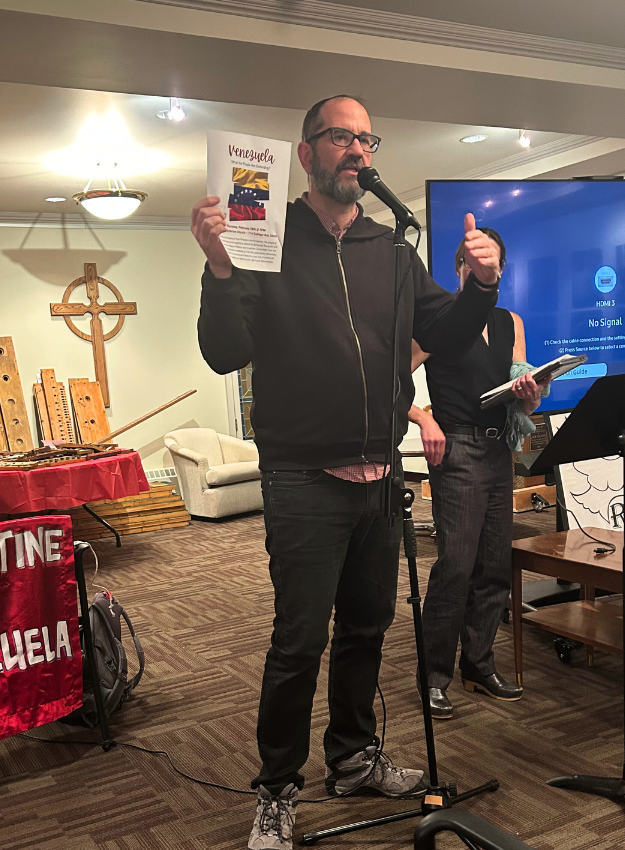
Rev. Darren Utley, First Presbyterian Church of Racine
About the impact of British rule in Palestine from World War I until 1948, Brownson used a quote from Avi Shlaim, an Israeli and British historian of Iraqi Jewish descent, that “sums it up quite well,” she said. “Britain stole Palestine from the Palestinians and gave it to the Zionist movement.
“In 1948, we had what for Palestinians is the Nakbah, when 750,000 Palestinians were ethnically cleansed from their homes to create the state of Israel. You can’t understand anything about this conflict unless you understand that until this issue is dealt with, there will never be peace in the Middle East.
“The Palestinians who were expelled have never been able to go back, even though the U.N. passed a resolution in 1949 that says Palestinians had the right to go back to their homes and be compensated for everything they lost. They’ve never received compensation of any kind.”
Then, in the 1967 War, Israel conquered the West Bank, Gaza, East Jerusalem, the Golan Heights and the Sinai Peninsula. “Guess what, folks? You’re not supposed to conquer land anymore,” after the U.N. member states signed the U.N. charter, which is a treaty that says states are not to use force to take territory, Brownson said.
The U.N. Security Council passed Resolution 242, saying Israel must withdraw from those territories. “But the Johnson administration didn’t make Israel do it, so we have an ongoing occupation up until this day,” she said.
Another “important piece of history people need to know” is that Israel has enforced a blockade on Gaza since 2007. “Israel has been progressively closing off Gaza since the 1990s. This heightened in 2007 after Hamas won elections in 2006. This blockade was really punishing. And blockades are illegal in international law because it’s collective punishment. That’s what led to Oct. 7.
“This history is a big part of the context that’s often missing when we talk about what is happening in Gaza.
Racine Coalition for Peace and Justice’s deep roots
RCJP’s roots are in the nationwide Central America Solidarity Movement of the 1980s, when a group of activists in Racine formed the Central America Solidarity Committee to raise opposition to the Reagan administration’s secret wars in Central America.
In 2002, members of that committee and others formed RCJP as the United States prepared to invade Iraq. A lay member of the Unitarian Church, Jerry Meiers, proposed the formation of the new group, RCPJ President Sonali Knotek said. Since then, “its principal, but not exclusive, focus has been U.S. military and security policy in the Middle East,” its mission statement says.
RCPJ’s mission is “to promote citizen understanding, raise public awareness and encourage participation in the democratic process for the purposes of achieving peace and just relations among peoples and nations and protecting civil liberties.”
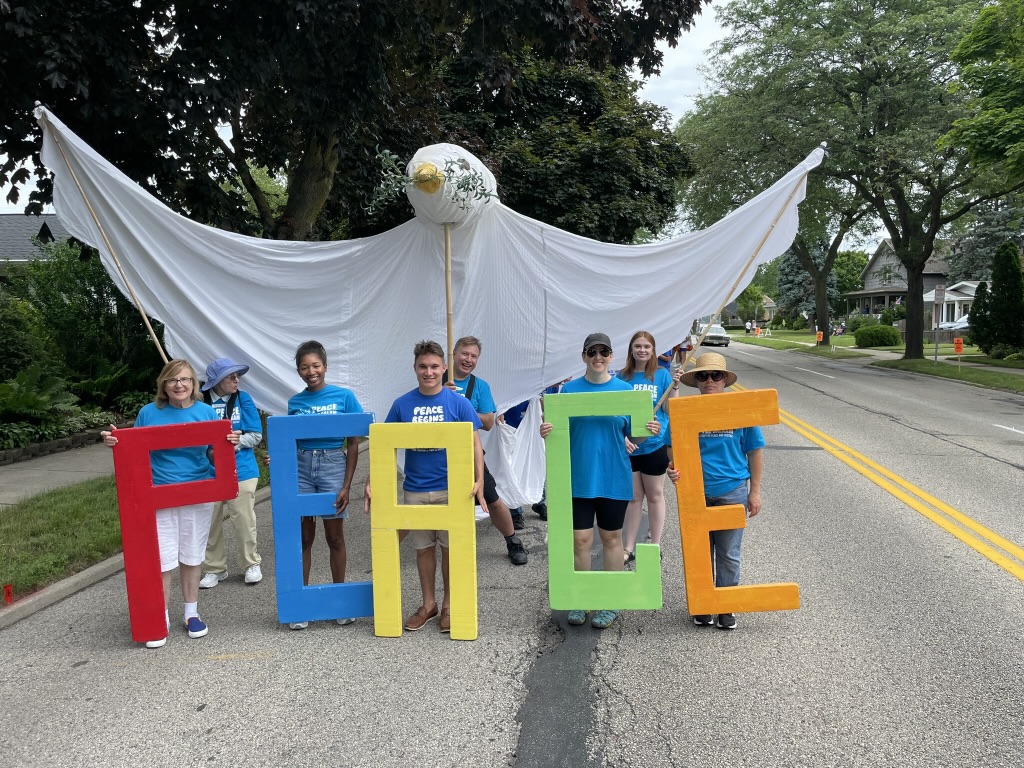
Racine Coalition for Peace and Justice’s peace dove, pictured here in 2024, is a well-known
spectacle in Racine’s Fourth of July parade.
Knotek recalled the days of the Iraq War. “Everybody was demonstrating against the war, and we were a huge part of it here. We’d line up on Highway 31. Lots of people showed up every week. Paul Ryan and other legislators would come and we would ask him questions about where those weapons of mass destruction were hiding.”
For more than two decades, RCPJ members have been standing on Racine street corners twice a week, rain or shine, sleet or snow. Over the years, they’ve held signs calling for justice in Palestine, peace in Syria and other slogans to promote awareness. They hold monthly planning meetings and organize frequent programs open to all with expert speakers who explain crises in the world and the impacts of U.S. foreign policy.
Since October 2023, following a surprise attack by Hamas militants on Israeli towns, when Israeli declared a “War on Gaza” that became a genocide, officially determined by the United Nations, RCPJ has worked to promote a ceasefire in Gaza. It joined the Wisconsin Coalition for Justice in Palestine, a coalition of more than 90 diverse organizations in Wisconsin calling for peace and justice for Gaza’s inhabitants (who were 2.3 million in 2023 when the Israeli assaults started).