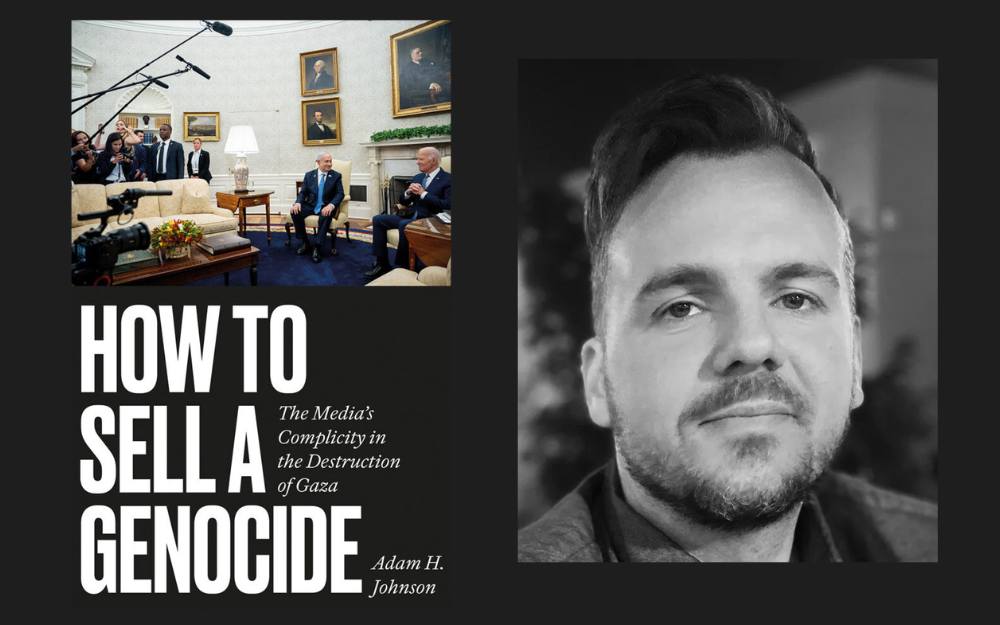
Author Adam H. Johnson will discuss “How to Sell a Genocide: The Media’s Complicity in the Destruction of Gaza” with Wisconsin Coalition for Justice in Palestine co-chairs Rachel Ida Buff, Ph.D., and Janan Najeeb, Wednesday at Haraz Coffee Shop in Oak Creek.
Many of us knew intuitively something was wrong with the media’s coverage of the genocide in Gaza; media analyst Adam H. Johnson confirms it, says Speaking Out of Place host and Stanford University Professor David Palumbo-Liu.
In his new book How to Sell a Genocide: The Media’s Complicity in the Destruction of Gaza, Johnson not only explains “just how bad the media coverage of the genocide in Gaza and beyond was—not just in the right-wing media, but also in the center-left media. Adam Johnson scoured thousands of stories, articles, news programs, cable shows and social media posts to not only confirm our worst suspicions, but also, and critically, to fit them into an analytical framework to show the myriad tactics, rhetorical strategies and instances of journalistic malpractice that not only sold a genocide, but also facilitated it,” Palumbo-Liu wrote.
As Johnson puts it in his book’s introduction, he shows “a direct line between the subjugation and slow deaths (of Palestinians) buried under rubble, and American media’s decision to incite against them, dehumanize them, ignore them, strip them of their history and their narratives, and prioritize domestic political convenience and crude chauvinist narratives over doing what news media’s job ostensibly is: to tell the truth.”
Johnson is a media analyst and co-host of Citations Needed, a podcast about the intersection of media, public relations and power. Johnson’s Substack, The Column, presents his media criticism and political analysis. His writing has been featured in The Nation, In These Times, The Intercept, Los Angeles Times and San Francisco Chronicle.
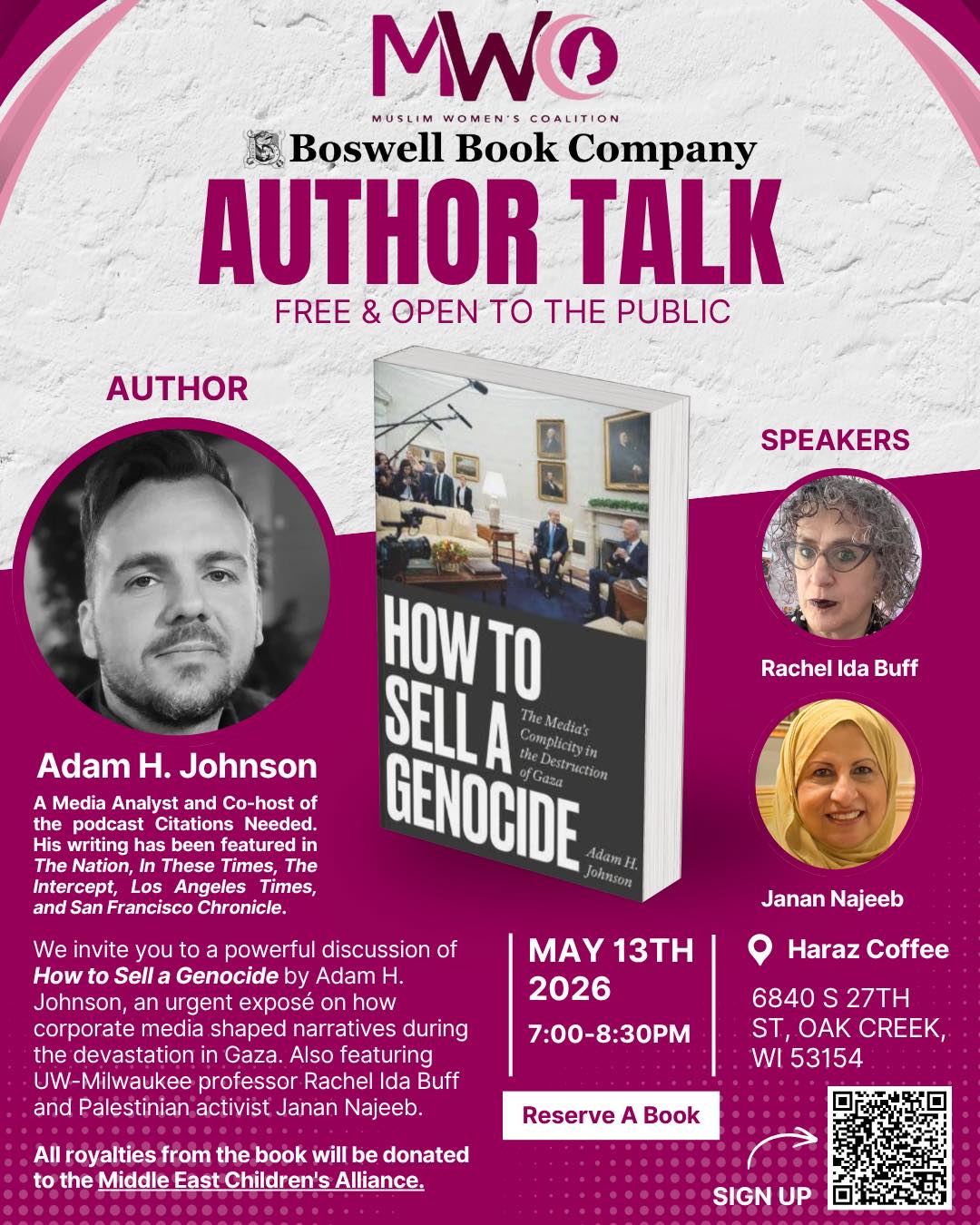
How to Sell a Genocide is based on Johnson’s analysis of 12,000 articles and 5,000 clips from both network and cable TV from what he calls “Center-Left, liberal, legacy or even mainstream media” and anonymous interviews with a range of journalists. He explains in his introduction that he saw no point in assessing the “conservative or MAGA media” like “Fox News, Daily Wire, right-wing AM radio, Sinclair News and the pages of the Wall Street Journal.” They are, he wrote, “for the most part, openly genocidal against the Palestinians and make no pretense otherwise.”
Johnson will be in Oak Creek Wednesday for an author talk that features a conversation with local leaders from the Wisconsin Coalition for Justice in Palestine, Rachel Ida Buff, Ph.D., and Janan Najeeb, about the role of corporate media in the devastation of Gaza. Buff is a professor of history at the University of Wisconsin-Milwaukee and co-founder of the Milwaukee Chapter of Jewish Voice for Peace. Najeeb is the founder and executive director of the Muslim Women’s Coalition, the publisher of the Wisconsin Muslim Journal.
MWC, in partnership with Boswell Books, presents Author Talk with Adam H. Johnson, Wednesday, May 13, 7 – 8:30 p.m., at Haraz Coffee House, 6840 S. 27th St., Oak Creek. The event is free and open to the public. Registration is required.
An interview with Adam H. Johnson
Wisconsin Muslim Journal interviewed Johnson just before he launched his book tour for How to Sell a Genocide. The Texas native and Chicago resident is in New York City now. Milwaukee is his next stop, then Chicago. From there, he’ll go to Baltimore and Washington, D.C.
We’ll save the discussion about his findings on the U.S. media’s complicity in the genocide of Palestinians for his conversation with Buff and Najeeb. Rather, we chatted about his work and what he sees the future holds for the Palestinians and U.S. politics.
Here are the highlights.
What is a media analyst? How does it differ from a journalist reporting on the news?
In my view, a journalist is someone who reveals new information. I don’t call myself a journalist. There’s actually quite a bit of reporting in this book done by my partner, who is a journalist at Workday Magazine, a labor magazine in Minnesota.
I do media analysis. I do original research and dig up history. I sometimes call myself a “pundit.” It is kind of pejorative, but I think it is a perfectly fine thing to call oneself. (The definition of pundit in the Cambridge Dictionary is “a person who knows a lot about a particular subject and is therefore often asked to give an opinion about it.”
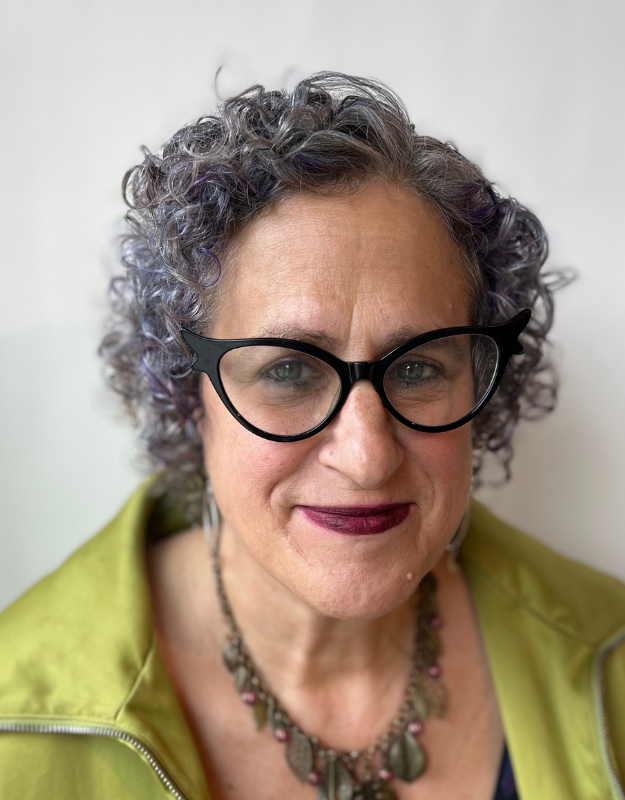
Rachel Ida Buff, Ph.D., co-founder of Jewish Voice for Peace Milwaukee
How did you decide to be a media analyst?
It’s a weird job. Very few people do it. Obviously, if you criticize the media all day, you are foreclosing working at any big media outlet. Like the New York Times, it’s never going to review my book, much less hire me, because my book accuses the New York Times of incitement to genocide. So you have to exist outside the mainstream.
It’s also real work and not everyone wants to do it. You have to be obsessive and read a lot. I think you have to have some ideological disposition to make the writing interesting. I got into it as a gateway to broader ideological issues that are very pressing.
What does a media analyst do all day?
Mostly I yell at people on Twitter, but a lot of it is doing text analysis and trying to compare what’s being reported to what the underlying reality is and whether they match up.
Typically, you try to suss out spin or public relations messaging and various messaging influence operations. You discover what is misleading or pandering to certain racist notions by comparing it to other reporting.
How have you succeeded in this field?
I have no formal training, other than film school 20 years ago. I have no authority other than my output, I suppose. I’m a freelance writer with a sufficient amount of following to make a living out of it.
Why did you focus on Gaza?
Well, certainly it was the biggest scandal of the last three years. The reporting was obviously atrocious, and consistently so, and I was writing about it all the time. I decided to really crunch the numbers, do a quantitative analysis and put it in a book. The situation is quantitatively provable.
And because my country was arming and funding the killing of tens of thousands of people, I think it’s a very urgent priority. Anyone who cares about the future of humanity needs to try to stop it.
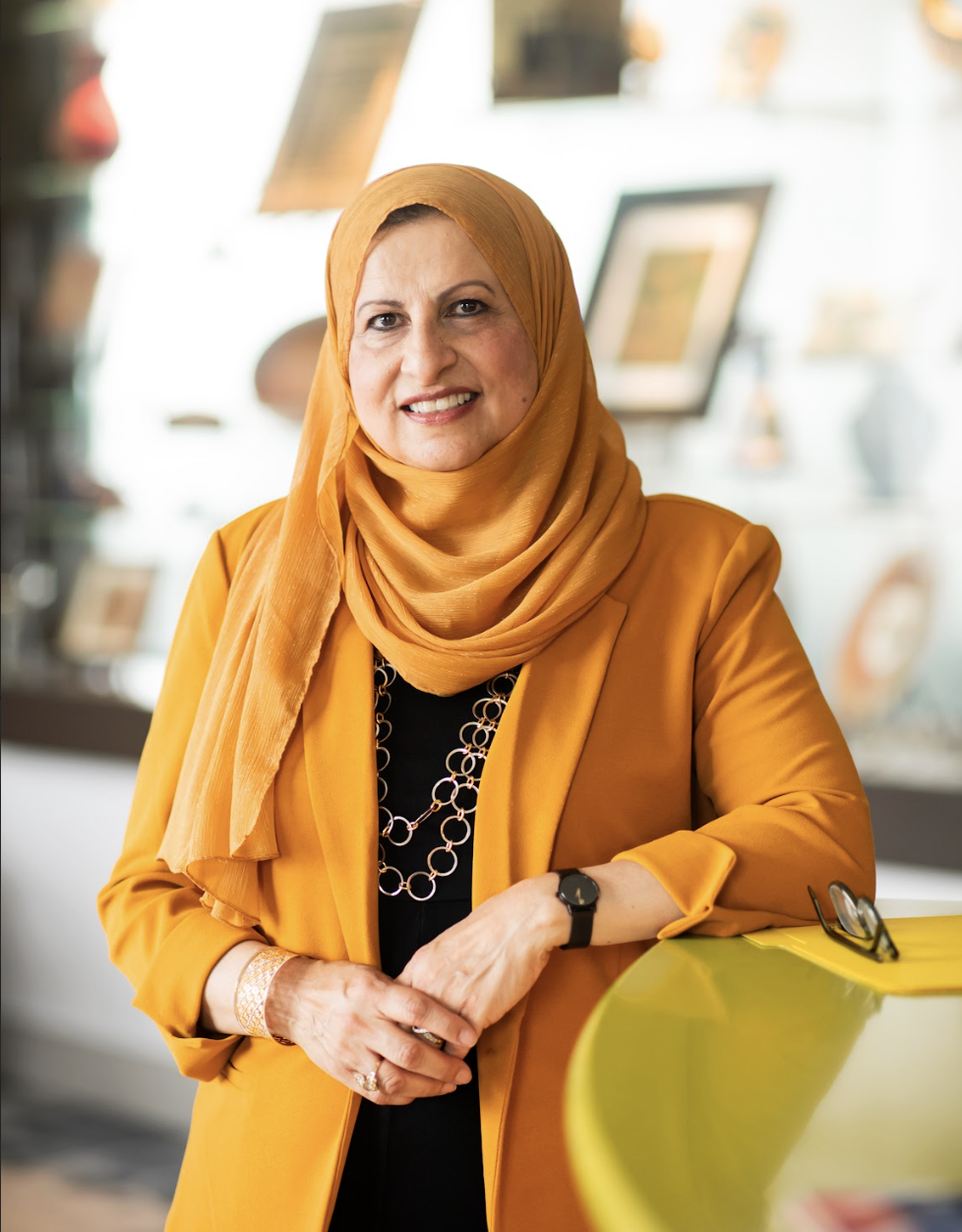
Janan Najeeb, founder and executive director of the Muslim Women’s Coalition
You focus your analysis on Center-Left media. Why?
The media’s role in dehumanizing the Palestinians is worse than in the War in Iraq, when they sold a bunch of lies. Lies told about Gaza paved the way for the killing and dispossession of the people in Palestine.
In spite of the ostensibly liberal disposition of the U.S. media, when it comes to Palestine, it is consistently illiberal and engages in dehumanization. There’s been so much focus on right-wing media. I think its bias is obvious. What’s interesting is the highly sophisticated ways in which the Center-Left media also helps advance a genocide.
What do you hope comes out of your book tour?
Book tours are about promoting a broader argument you make in the book. They are also about getting feedback from individuals, organizations and communities. Engaging with them is really helpful to me.
It’s a useful exchange of ideas. I’m excited to go to Milwaukee to talk to my co-panelists and others who attend.
Weirdly enough, half the book was written in Milwaukee. I’d take writing retreats to knock out whole chapters. When you live in Chicago and you need to leave the city, there’s only one place to go and that’s Milwaukee. So, I’d take the train to Milwaukee, get a hotel and find a co-working space to write for three or four days. I did that three or four times.
In the conclusion, you mention you don’t think things will change. Are you pessimistic about the future?
Well, there’s an important qualifier there. The important qualifier is, and I believe I’m quoting myself directly, “unless something radically changes in our politics.” The status quo, with the media ownership and political people in power in both parties, I don’t see why some of the underlying dynamics would really change much.
There’s definitely alternative media and that’s one of the reasons there has been such a shift in polling. But how that shift manifests politically is a different question. The issue is less of preserving the image of Israel; that ship has sailed. You can’t kill 80,000 to 100,000 people and use pr to hide it.
What the Democrats have done is create systems to distance themselves from that reality while still maintaining the status quo. Their goal was not so much to argue on principles or even to defend Israel. It was just to buy time. And they bought themselves all the time they needed.
I put that qualifier in there as a call to action. There needs to be more engagement on the fundamental elements of the erasure of Palestinians and Zionism, and how to transition away from an ethno-supremacist worldview that’s obviously caused untold violence and harm.