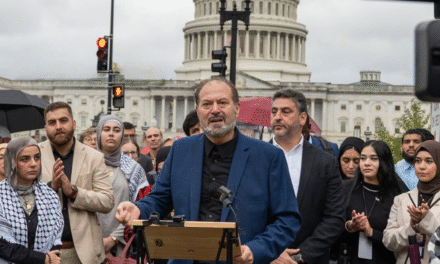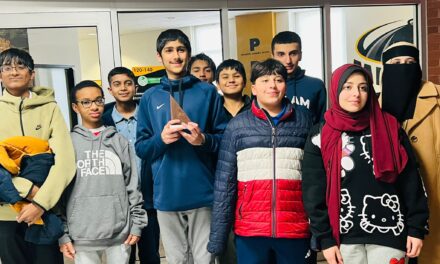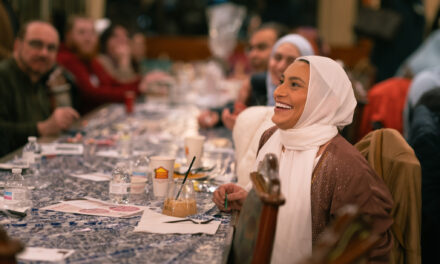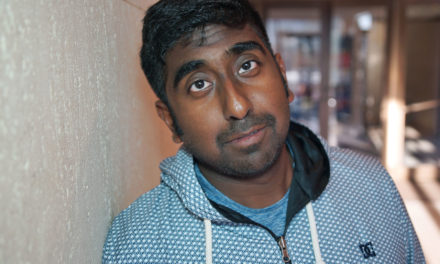
Screenshots from PalTalk podcast
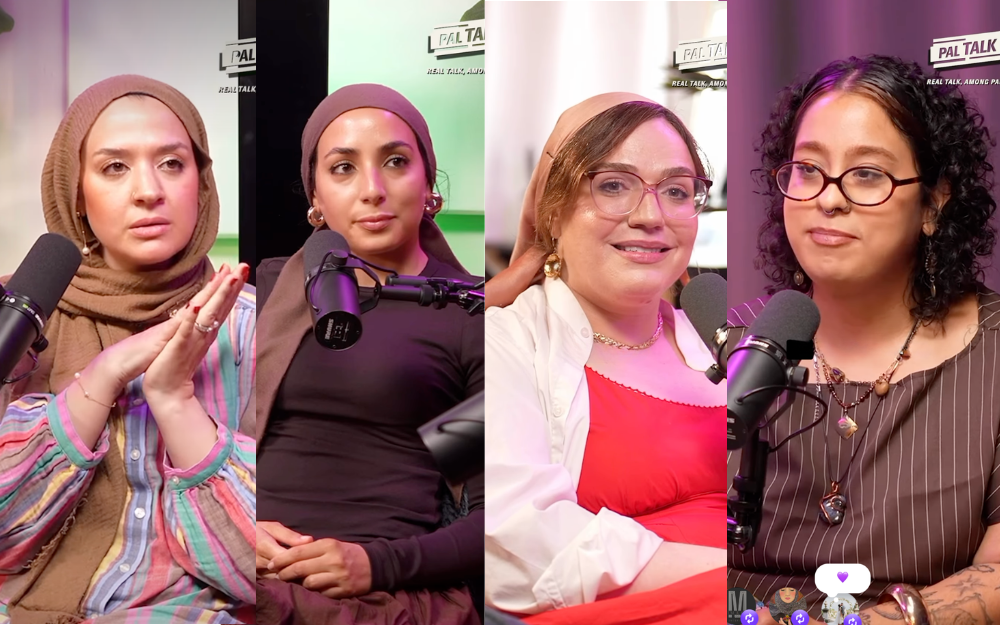
(Left to right) Palestinian American Muslim artists Liala Amin, Amal Azzam, Muna Sharma and *Aya are featured guests on the PalTalk podcast, which features roundtable discussions with like-minded guests. Its tagline is “Real talk. Among pals. In pursuit of humanity and justice.”
The latest episode of the Chicago-based podcast PalTalk aired Tuesday, featuring four Milwaukee-based Palestinian American Muslim artists for a roundtable discussion titled “The Artist as Witness.”
Podcast producer Umair Khan got the idea for the episode after coming across Amal Azzam’s work on Instagram. “I looked at all the work and noticed it was tying back to who they were and activism,” he said in an interview with the Wisconsin Muslim Journal. “That’s where I came up with the idea of the ‘artist as witness’ theme. I reached out to Amal and asked her if she and other (like-minded) artists she knew would be interested in having a conversation on our podcast.”
In PalTalk’s Episode 6, Amal Azzam, Liala Amin, Muna Sharma and *Aya (a musician who asks that her artist’s name be used in this story) discuss what it’s like to be Palestinian American, Arab, Muslim, female artists in Milwaukee today. The conversation touches on identity, reactions to their choice of art as their vocation, responses to their work from the local art community, the need to create their own spaces and more.
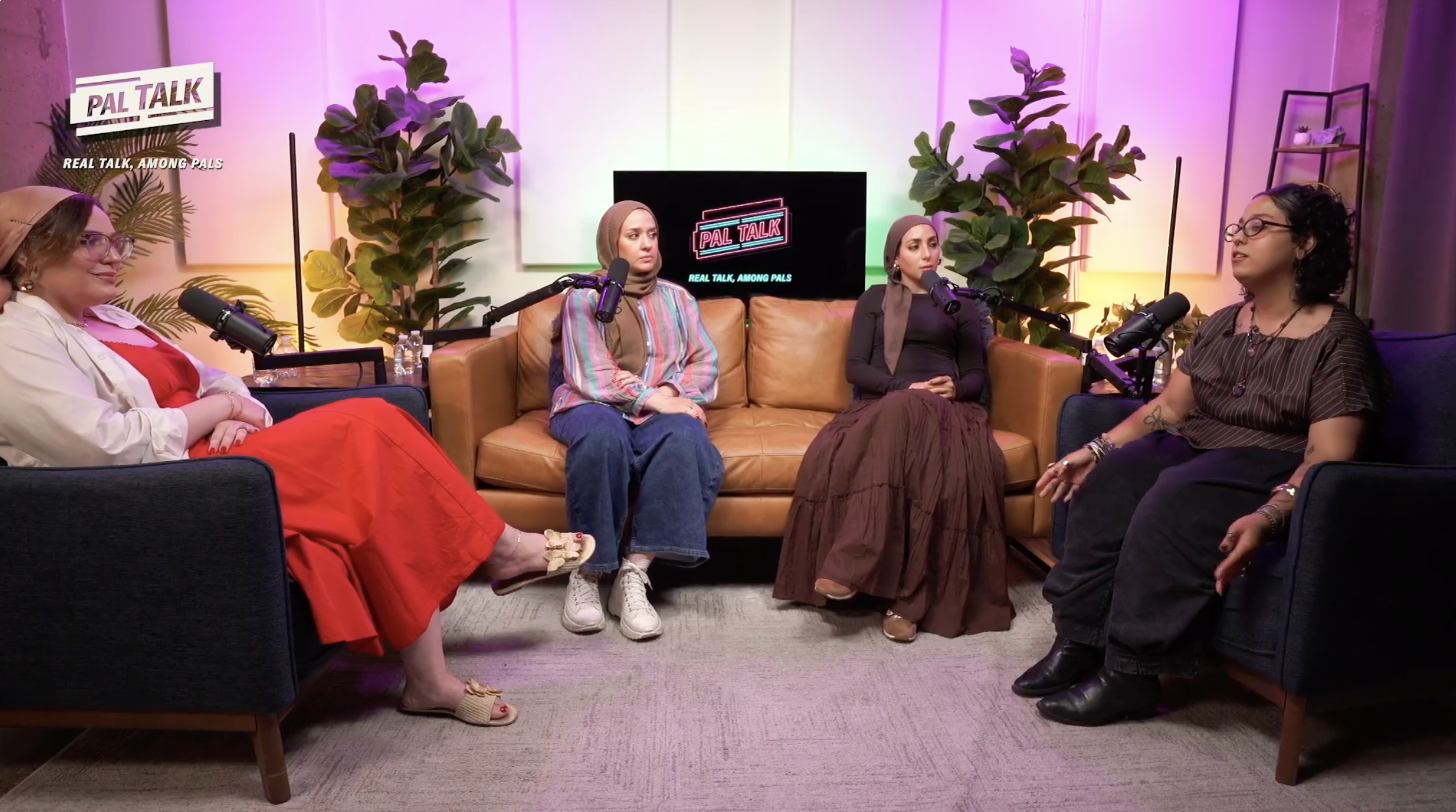
In the PalTalk studio, four Palestinian American artists from Milwaukee talk about creating art during these turbulent times.
“This podcast is about connecting voices speaking up for humanity and justice,” Khan explained. “What is special about a conversation with these four women is that they are in such a niche as women, women of color, Muslim, Arab, Palestinian. I wanted to get their POV on what it’s like for them to be artists in this world today.
“What I learned is that it’s very difficult. The art world can be very excluding. There aren’t spaces for them,” he said.
“What are they doing? They’re making their own spaces. They are empowered to do what they want, and they are not waiting for anybody. They are going and doing, whether you like it or not, whether you are comfortable or not. They are taking their talent and running with it. And that is really important for other people to see.”
Behind the podcast
Rather than having pundits debate, as we often see in mainstream news, PalTalk hosts people from shared backgrounds for roundtable discussions that aim to go beyond the headlines. It addresses a wide range of topics, including “justice, healthcare, global crises and everything in between. No debate. No performance,” it declares on its platform.
“The way I’ve started categorizing is to have artists, politicians, physicians and healthcare workers, filmmakers, comedians, artists—individuals from those backgrounds that are tying their work back to their humanity. We have those conversations. I think this is a more purpose-driven podcast than most.
“This podcast is an offshoot of my mission to connect voices speaking for humanity and justice,” Khan said. When the genocide in Gaza started in 2023, Khan looked for ways to use his background in marketing and graphic design to do something, he said.
PalTalk is a production of EverydayPal.org, an advocacy and e-commerce platform Khan founded in 2023 “with the mission of amplifying Palestinian voices during the ongoing genocide in Gaza,” its website states. Since then, its mission has been “to harness our shared voices to create positive global change.”
EverydayPal.org sells merchandise designed in collaboration with Palestinian artists and donates 100% of its profits (after covering costs) to support relief efforts like food distribution, medical care and solar power projects in vulnerable regions including Gaza, Lebanon, Sudan and the Congo. It also features artwork and products created in collaboration with artists in Gaza.
“I’m not Palestinian. I’m Pakistani,” Khan said. “A first-generation immigrant. What we are seeing today—everything happening overseas and here with ICE—touches that part of me that makes me feel we need to speak up because what is happening now is not right. I have two little boys, a 6-year-old and a 3-year-old. This is not the America that you want your kids to grow up in.”
The artists
WMJ interviewed Azzam, Amin, Sharma and *Aya about the experience of being on the podcast and about their work. Here are the highlights.
Amal Azzam
How did this opportunity to be on the podcast come about?
Through an invitation on Instagram from Umair Khan, the founder of Everyday Pal. He runs a video series called “Pal Talk” where small groups of guests from shared backgrounds sit down for honest, in-depth conversations. He wanted to feature me alongside three other female artists from my community. I provided Umair with a list of artists and information, and from that list, he selected Muna, Liala and Aya.
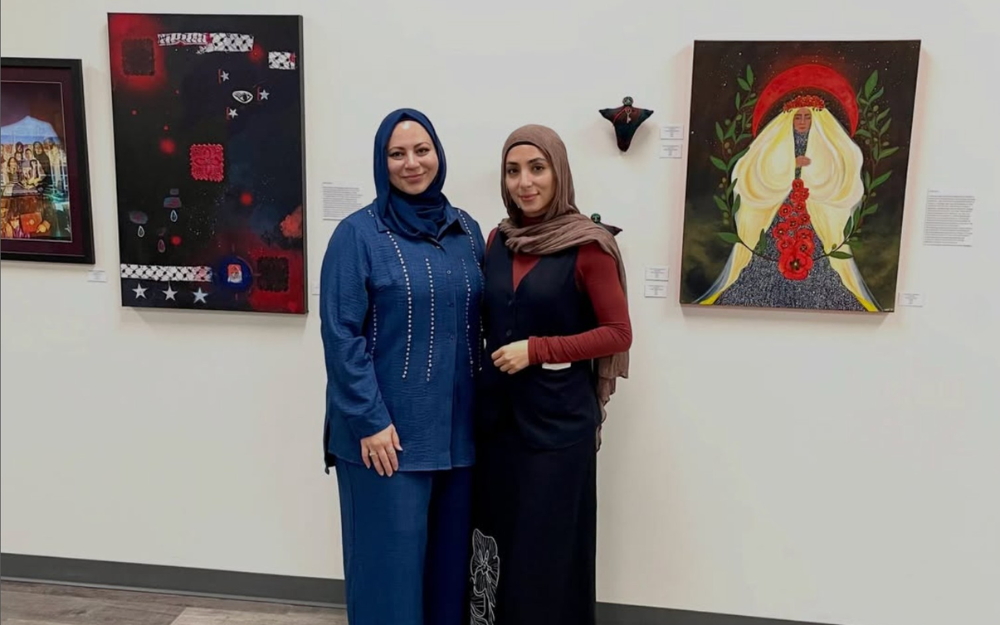
Nadia Alkhun and Amal Azzam pose for a photo on opening night of “Our Shared Stories: Movement, Memory & Belonging,” on view at Nadiana Gallery in Greenfield through Oct. 8.
What were the highlights of the experience?
It was meaningful to hear the stories of fellow artists I’ve known for some time and often see at community events. The experience offered a level of intimacy that allowed me to learn more about their individual journeys and connect with them on a deeper level.
Tell us about your work.
I’m an interdisciplinary artist and cultural organizer whose work explores identity, belonging, cultural memory and the experience of being Palestinian and Arab American. I work across mixed media, fiber, photography, video and found objects.
Community is also an important part of my practice, and I create gatherings and participatory projects that bring people together through art, storytelling and shared cultural experiences.
Liala Amin
What was your initial thought about being on the podcast?
It was an opportunity that presented itself and I jumped on it.
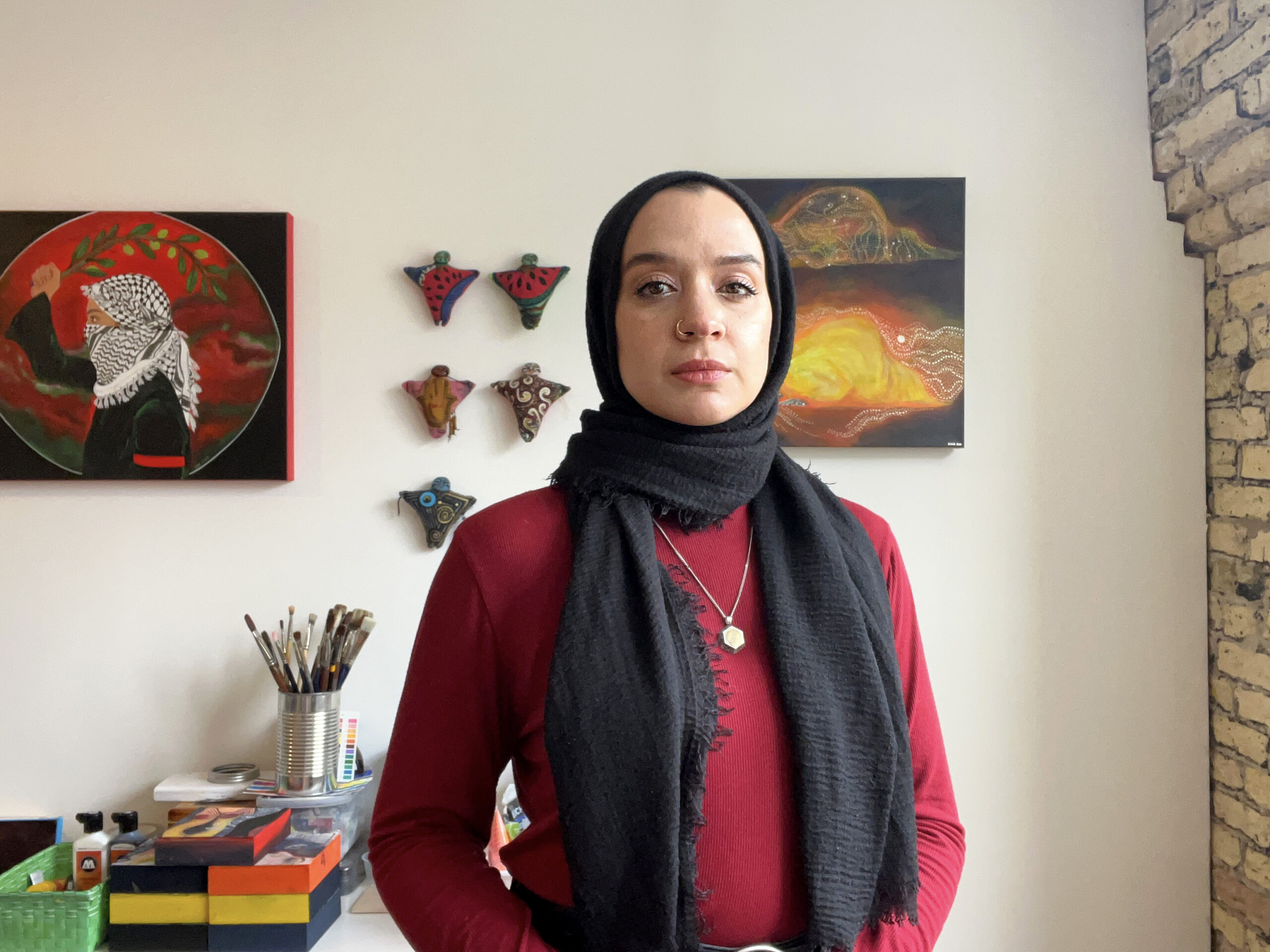
Milwaukee multidisciplinary artist Liala Amin stands in her studio with her paintings and hand-stitched talisman dolls in the background.
Did you have any revelations during the conversation?
The biggest takeaway I have is that Amal deserves so much praise for the work she has done to create spaces for Arab and Muslim creatives, especially female artists. While we were talking about how we’re using our talents to talk about and share our identity, to talk about the genocide and educate others, I thought, ‘Ten years ago, this didn’t exist. There wasn’t a space for us to exist, and now there is because of her work in putting Fanana together. (Fanana Banana, a Milwaukee organization co-founded by Azzam and Nayfa Naji in 2019, provides local Muslim artists with platforms where their work can be seen.) We needed to have our own spaces where we could be ourselves in safety. I’ve known Amal for a long time. Through work with Fanana, I met Muna when we organized a show in January 2024 called For Palestine. For Humanity. And now I’ve met Aya. It’s so beautiful to see how our efforts have grown.
Tell us about becoming an artist. When did you start?
When I was 4. I’ve just always known this is something that needs to be part of my life.
In the past three years especially, my art has focused on not caring what people think, speaking a lot about being Muslim, my Arab culture and being part Lebanese. I’ve really just been rediscovering myself in my art in the last three years.
At the same time, I am always trying to include something that will get people talking about what is happening in Palestine and in Lebanon as well. I’m very intentional about that now.
We are this next generation that doesn’t want to stay quiet. Amal summed it up, saying if you’re not going to make the space for us, we’re just going to make it for ourselves. We have stories, and they deserve to be heard. Whether it’s here in Milwaukee or spreading out to Chicago, there is so much more to come!
Muna Sharma
What did you think about being invited to participate in the Pal Talk conversation?
I was curious. When I saw the other women who would be in the conversation – artists whose work I really appreciate – and because Amal suggested it, someone I trust and respect, I felt very excited. To sit down and have this conversation with these three incredible women was amazing.
To be invited to speak at a roundtable with other artists who are very much established and for what I do to be viewed and valued as art was a very rewarding experience.
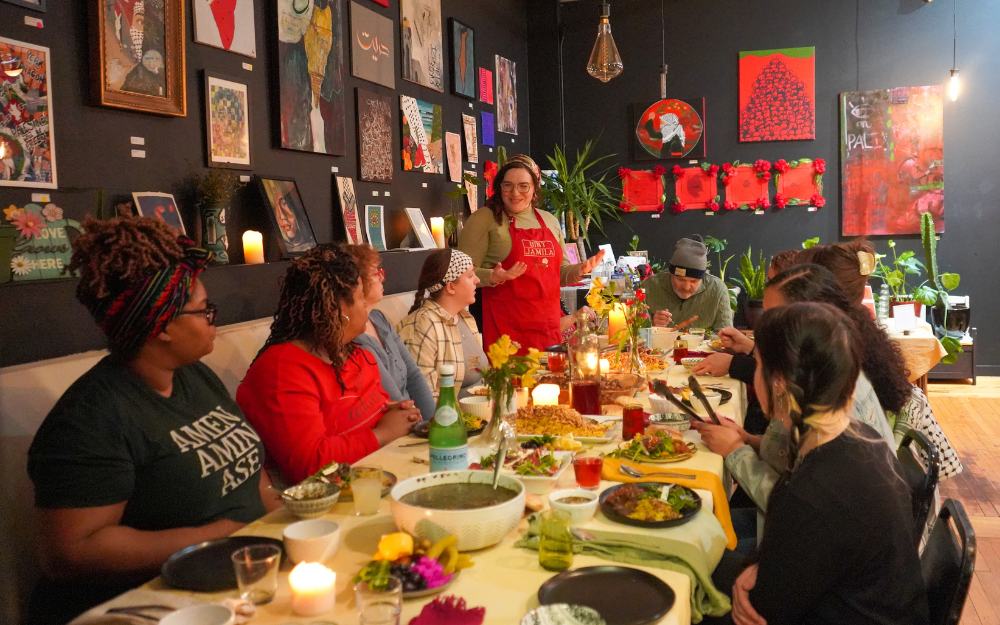
Photo by Kamal Moon
Food artist Muna Riyad Sharma of Bay View (left), an event stylist and producer, named her business “Bint Jamila’s Table.” Bint Jamila is Arabic for “daughter of Jamila.” Her mother Jamila (right) is her inspiration, she said. (2024)
What were the highlights of the conversation for you?
I appreciated that we were able to explore different things, and speak openly and honestly. I found it very interesting that each one of us has our different avenues for our art. And the way each of us experience our art and to see our art as a witness was very different. Hearing Aya talk about her music, that her lyrics don’t necessarily talk about Palestine but she comes in as a Palestinian artist, forcing people to witness by simply being herself and very visibly Palestinian, that really resonated with me and is not something I thought much about before.
Being able to talk about my tablescapes and my art through Palestinian food, I was able to talk about that and how my identity is not just translated into the plates I serve but also how I perform Palestinian hospitality. I’ve never put it into those words before. It felt like a revelation to myself.
Getting to hear their experiences was also very meaningful. Like Amal taking a stand against Mitchell Street Art (when her show was canceled). She decided to not shrink herself but to take up room and speak her truth. Hearing her talk about it with such confidence made me so proud of her. And Liala as well. The way she speaks about her art and how she is as a person—I’m just in awe.
How do you describe yourself as an artist?
I’m a multisensory artist. I’m a food and tablescape artist, and a photographer. That doesn’t really cover all that I do, but those are the ones easiest for me to identify and pinpoint.
What I like to do is to create multisensory, multidimensional experiences for people. Mm-hmm. I do that through the use of food, through the use of flowers and through the use of design. And, most recently, with the opening of our studio, the use of space.
You’ve been in Milwaukee five years now. What’s it like to be an artist in Milwaukee?
You know, it’s funny. I’ve always considered myself a creative person. But I never identified as an artist. It wasn’t until I started Bint Jamil’s Table that I started to see myself as a food artist, utilizing food design and flowers to tell a Palestinian story. Creating artistic tablescapes that not only feed people, but tell a story, has been groundbreaking for me. I’m able to express myself in this multidimensional, multisensory way.
I feel there should be more opportunities for women artists to be able to speak and talk about things. I really hope our community as a whole is open and welcoming of us as artists, and invites us to be part of the bigger community through the work we do.
*Aya
How did you feel about participating in the podcast?
I’ve done radio interviews. I’ve never done a podcast. And they were usually about this or that new song. I’ve also never done it regarding my identity. It’s never been about my experience as a Palestinian woman musician.
What were the highlights of the podcast for you?
My music isn’t really about being Palestinian. It’s about my emotions, a way to express my emotions. My biggest take away from the conversation was that my art is important because it’s representation. Representation is really important. The emotions I express are felt by others like me. I also touched on how I have felt isolated and different for being a creative Palestinian.
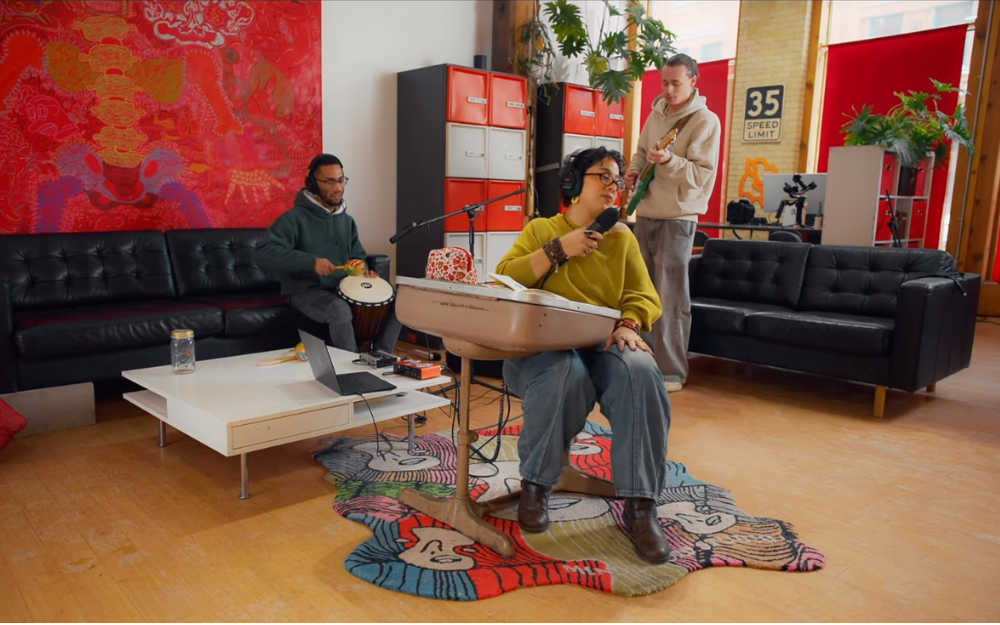
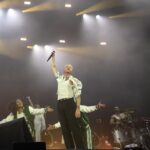
*Aya records her official @nprmusic Tiny Desk contest submission of her original song”Pink Lady.” (Click here to listen.)
The discussion we had made me feel very seen. We have all experienced similar things, like being used as a token, acceptance from family, all those things. Ultimately, I left with a sense of the importance of continuing to create music and being loud about being Palestinian.
And I think all of us came to the conclusion that our goal isn’t to be digestible. Our goal is to be authentic.
You’re a singer/song writer. Tell us about your music.
The things I talk about in my music are my real-life experiences. A lot of it has to do with love, my insecurities and mental health. In our culture, in previous generations, it was taboo to talk about these things. But they’re real things I feel emotions about, so I decided to use it as my subject matter.
I sang my whole life, and in middle school and high school I was in choir. And I was in musicals and I really loved performing. After high school, I grew to really miss my connection to music. I was listening to a lot of artists like Amy Winehouse and Ari Lennox, who made music about things they were going through. They conveyed a lot of emotion in their music. That’s when I decided to give it a go.
I ended up writing and recording a whole EP’s worth of music. And I started performing. Now four years later, I’ve done over 100 shows, Summerfest and others.
Our art can highlight that, as much as we are taught to be strong and not express emotion, it’s important to express it somehow. Art is the healthiest way to express emotions, the most truthful, raw, honest and unfiltered way.
Art is important, and we should all indulge in it.