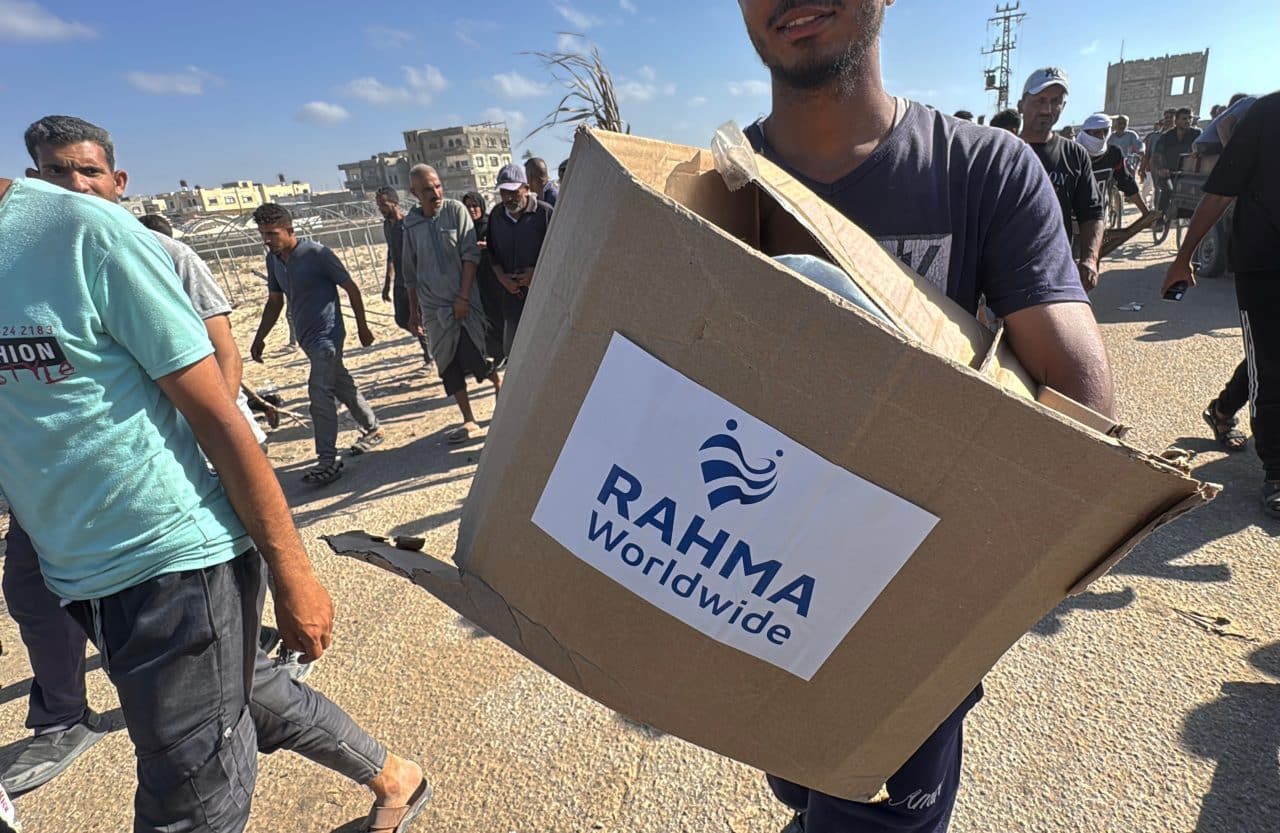
Palestinians aid-seekers carrying Rahma Worldwide aid boxes from an aid distribution site run by the U.S.-backed Gaza Humanitarian Foundation, in Rafah, southern Gaza. May 27, 2025. The boxes were distributed at the GHF site without the knowledge or consent of Rahmah Worldwide, according to the organization’s Director, who spoke to Mondoweiss. (Photo: Ahmed Ibrahim/APA Images)
Israel’s decision to cancel the registration of 37 international aid organizations at the beginning of the year has dealt a severe blow to the international presence in Palestine. Beyond that, it has delivered a serious blow to Palestinian society itself. The banning of dozens of international NGOs threatens many social assistance and development programs, many of which are Palestinian-run and crucial to sustaining essential services in communities across Palestine.
The ban followed a new set of registration conditions imposed by Israel on international organizations earlier in December, including a requirement to provide Israeli authorities with the personal data of Palestinian staff. Israel said the 37 organizations failed to comply with this requirement, with Israeli Diaspora Affairs Minister, Amichai Chikli, saying the decision aimed to prevent the “exploitation of humanitarian aid for terrorism,” although Israel has never provided evidence of such links.
The decision includes several prominent international humanitarian organizations, such as Oxfam, Doctors Without Borders, the Norwegian Refugee Council, and even the Catholic Relief Services (Caritas), all of which were notified to cease operations in the Palestinian territories by March. The ban does not apply to any UN body.
The impact of the ban is expected to be felt most acutely in the Gaza Strip, where all two million Palestinians depend partly or entirely on humanitarian aid. Aid deliveries remain restricted following months of near-total shutdown prior to the ceasefire between Israel and Hamas that came into effect in October 2025.
The move was far from a surprise, according to Shaina Low, spokesperson for the Norwegian Refugee Council (NRC), who told Mondoweiss that Israeli authorities have been “restricting the work of international aid agencies for months.”
“Israel has been denying visas to our staff and has rejected 17 requests we made for allowing the entry of humanitarian aid to Gaza, in addition to movement restrictions,” Low said. “Then came the requirement to provide information about our staff, which we cannot do, because we are legally bound to protect the privacy of our workers, especially since we receive funding from European countries, which is also conditioned with the protection of our staff personal information in zones of conflict.”
“This is why we also refused to give our staff information to Hamas in Gaza when they asked us to in the past, and we do the same in every country we work in,” Low continued. “We tried to engage in good faith with Israeli authorities, offering a third-party vetting, but they refused.”
The NRC heads a cluster of organizations dedicated to providing shelter for displaced Palestinians, particularly in the Gaza Strip. Along with other banned organizations, it also distributes clean water and provides temporary education spaces for children who have been unable to attend school for two years. According to Low, the number of beneficiaries is in the hundreds of thousands.
“Most importantly, international aid agencies are a key part of aid distribution,” Low continued. “Even when it is the UN or the World Food Program that brings aid into Gaza, it is often international NGOs who do the last mile to families where they are, because we have staff and knowledge of the place in every place, and this will also be affected if we go absent.”
In Gaza, which relies entirely on humanitarian aid and the institutions operating in the Strip — including medical, relief, and educational organizations — the ban is expected to have a profound impact on public life and the population as a whole. Dr. Shadi Zazzah, director of Rahma Worldwide for Relief and Development, said the consequences would be severe.
“The denial of permits would mean cutting off a lifeline for over two million people, most of whom live below the poverty line and are in urgent need of emergency humanitarian intervention,” Zazzah told Mondoweiss. “Especially in the medical sector, which today depends entirely on the entry of aid through the border crossings with the other side. The suspension of permits to institutions is a blatant violation of humanitarian work.”
Zazzah said stopping permits does not necessarily mean a complete halt to assistance in Gaza, but that it will lead to a significant decline in operations.” Institutions will be forced to purchase from the local market, which carries financial implications like paying twice the price, increasing costs, and leading to a net reduction in the number of beneficiaries.”
Al-Zazzah clarified that financial support from Rahmah would remain available but is expected to decline, as many partners and donors rely on in-kind assistance. The suspension of permits prevents such aid from entering Gaza, meaning that a substantial portion of financial support that arrives in material form will be lost, directly affecting operations on the ground.
Al-Zazzah said his organization’s mission since the beginning of the war has been to prevent famine and protect human life, adding that harassment and restrictions have been in place for the past two years. The latest measures, he said, mark an escalation in pressure on humanitarian organizations, prompting some to scale back their services. Rahma Worldwide, he added, continues to operate to the extent possible.
“Before the war, the organization regularly deployed medical missions to the Gaza Strip, totaling 40 missions,” Zazzah said. These missions entered Gaza with medical aid, including medicines, equipment, medical devices, and ambulances.
He explained that the work helped protect many patients by providing direct medical assistance. But the recent ban on the entry of medical delegations has led to a decline in medical services, particularly in medicines and medical equipment, whose entry had depended on assessments by specialized medical teams operating within those missions. Their suspension, he said, now has negative repercussions for the medical sector.
Al-Zazzah states that over the past two years, his organization has brought in approximately 3,500 trucks carrying shelter supplies, medicines, and food, in addition to providing services such as well rehabilitation, water network maintenance, and safe drinking water within displacement camps.
The suspension of permits has significantly affected both the quantity and quality of assistance Rahma Worldwide can provide in Gaza. It has also affected partner organizations, many of which have redirected support to other regions as a result of the restrictions, despite the scale of the humanitarian crisis in the enclave.
International organizations and civil society in the West Bank
In the West Bank, the anticipated impact is also widespread. In a statement following the Israeli decision, Humanity and Inclusion (formerly Handicap International), one of the 37 targeted organizations, said these groups “are integral to the humanitarian response” in the territory, having worled in partnership with the United Nations and Palestinian civil society organizations to “deliver lifesaving assistance at scale.”
In Nablus, one of the West Bank cities most affected by Israeli raids since 2021, the al-Amal Rehabilitation Hospital is struggling to meet growing demand. “We are one of only two rehabilitation centers in the northern West Bank’s six governorates,” Firas al-Khader, a board member of the Union of Health Care Committees (UHCC), told Mondoweiss.
The UHCC is the parent organization of the hospital and part of what is know as the Health Cluster, a network of Palestinian and international health NGOs. Humanity and Inclusion is also a member of the cluster.
In this cluster, community needs are identified, and local partnerships are crafted to meet them. “This is how we have had a partnership with Humanity and Inclusion,” Al-Khader explained. “This helps in covering the needs of the rehabilitation center.”
“We provide physiotherapy, occupational therapy, speech and hearing therapy, and prosthesis manufacturing and installation for amputees,” he said. “We are a non-profit, and our patients pay symbolic fees, while some are treated completely for free after an evaluation of their background.”
In 2025 alone, the reduction of fees for patients reached $65,000, a difference that could only be covered by donations and partnership programs with international NGOs, such as Humanity and Inclusion.
“Since 2023, many patients can’t reach the hospital due to checkpoints and closures, and many have had to rent apartments in Nablus to be able to come to therapy sessions,” al-Khader said. “This increased the cost on them, forcing us to make more reductions and depend more on international partnerships.”
So far, they have found some ways around the ban “to allow patients to continue treatment in their cities, but this also increases the need for further coordination with international agencies who support our local partners,” he added.
“If international organizations go absent, we will be forced to depend more and more on our local community, as was the case before and during the First Intifada, which will set us back by decades,” Al-Khader said. “Instead of developing capacities to meet increasing needs, we will be forced to focus on bare survival.”
In Masafer Yatta, a community of 12 Palestinian hamlets located in the south Hebron Hills, the local municipality is also concerned about the impact of the ban. Despite facing constant Israeli threats of erasing their community through construction bans, demolitions, and settler violence, Nidal Younis, the mayor of Masafer Yatta, told Mondoweiss that “we, as a local municipality, run six medical centers near the area classified by the Israeli army as a firing zone, and all the 1,200 Palestinians in the area depend on them for primary health care.”
“The doctors who run these centers are either Palestinian doctors from local non-profit medical organizations, as part of a program funded by Care International, or international doctors from Doctors Without Borders. Both organizations are on the list of 37 groups banned by Israel,” Younis said. This means that health care in Masafer Yatta, one of the most vulnerable parts of Palestine, will be finished.
“Doctors Without Borders, for example, provide psychological care in all six centers, as well as other primary health services,” Younis said. “And Palestinian doctors from the Palestinian Medical Relief, who actually run the centers, are part of a program funded by Care, and the Palestinian health ministry can’t fill this gap due to the ongoing financial crisis of the Palestinian Authority,” he added.
The inability of the Palestinian Authority (PA) to meet all social needs only further highlights the importance of civil society in the West Bank. Predating the current crisis, Palestinian civil society has filled gaps left by the absence of state services since the 1980s, before the PA was established. It was these organizations that played a pivotal role in the First Intifada of 1987, and after the Oslo Accords, they were incorporated within the PA system either as non-governmental organizations (NGOs) or as a part of the PA bureaucracy.
According to Palestinian researcher Jebril Muhammad, this conjunction of international and local NGOs became even more crucial after the end of the Second Intifada in 2005, as the PA’s authority weakened.
“During the Second Intifada, Israeli military action targeted the PA institutions, weakening its capacity to live up to its responsibility of reconstruction and social assistance,” Muhammad told Mondoweiss. “This made the PA leave the space for non-profit groups, who increased their dependency on international organizations and created a system where local and international NGOs became complementary.”
This development, Muhammad said, relieved the PA of much of its social responsibility. “The Palestinian social relief system become more dependent on civil society and on an international presence in Palestine,” he explained. “At this moment, the collapse of this system could have more dangerous effects than the collapse of the PA itself, especially in light of the absence of a social protection system supported by the Palestinian government.”