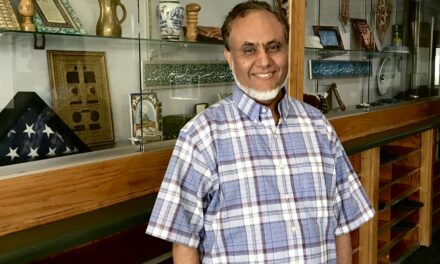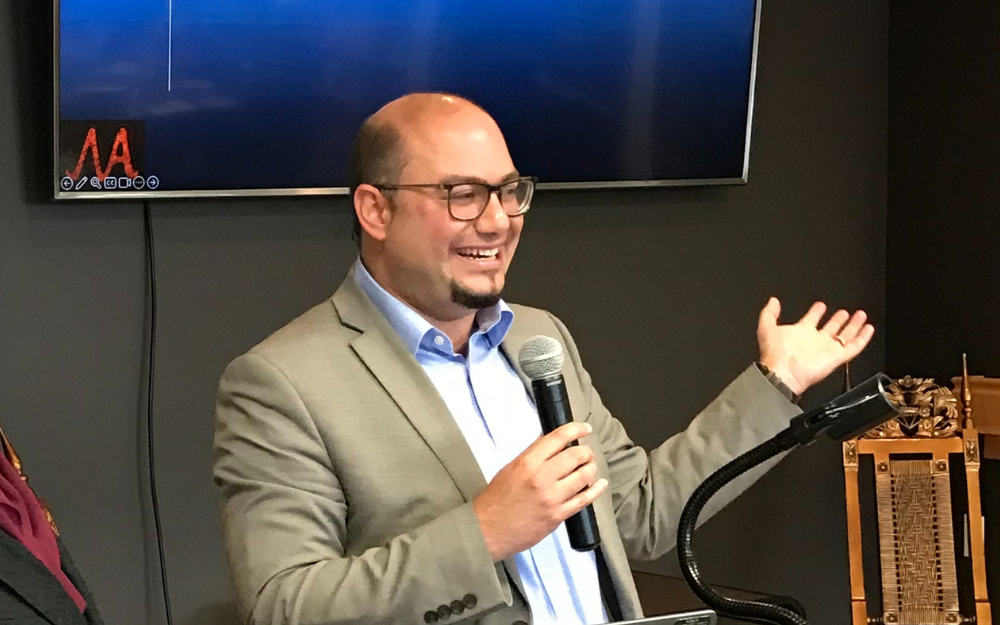
Ahmed Obeidat, M.D., Ph.D., teaches at the Medical College of Wisconsin and cares for adults, diagnosing, treating and managing multiple sclerosis and immune disorders of the central nervous system.
Respected Medical College of Wisconsin neurologist and neuroscientist Ahmed Obeidat, M.D., Ph.D., will speak Jan. 30 at the Muslim Women’s Coalition Networking Brunch on Mind, Brain and the Question of the Soul.
His talk explores the relationship between the mind, brain and soul through both modern neuroscience and classical Islamic scholarship that draws on the Qur’an, hadith (the example and teachings of the Prophet) and philosophy. It aims to give an opportunity for deep, integrated reflection on what it means to be human, he said.
January’s MWC Networking Brunch with Dr. Obeidat will be held 10 a.m. – 12 p.m., Friday, Jan. 30, at the Islamic Resource Center, 5235 S. 27th St., Greenfield. Brunch is provided by Taqwa Bakery & Restaurant. The cost is $15. Register here by Wednesday, Jan. 28.
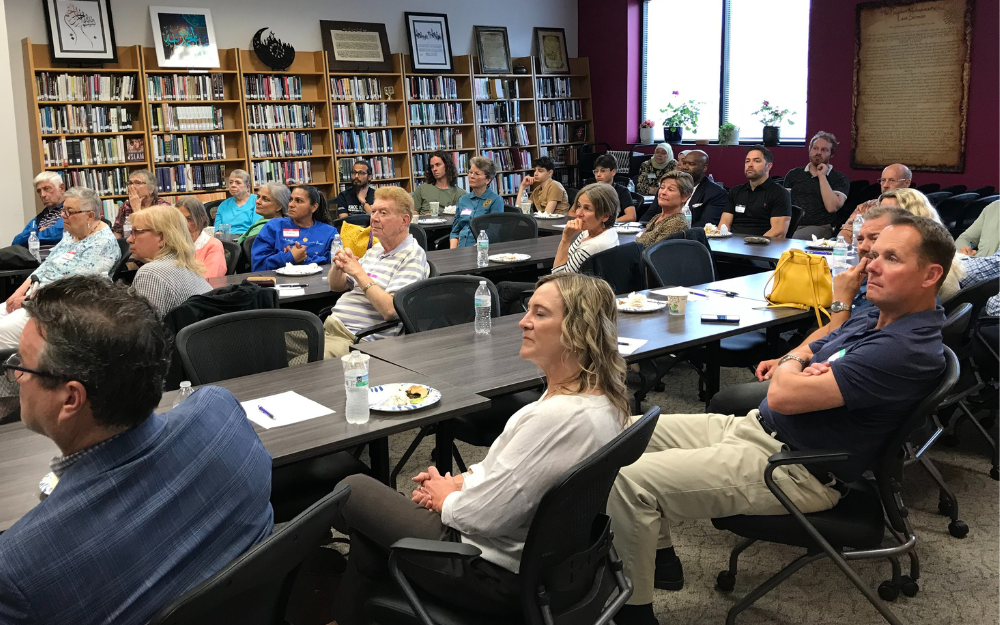
The Muslim Women’s Coalition’s Networking Brunch is a monthly program for the public that includes an enriching guest presentation, a Middle Eastern brunch and the opportunity to make new connections.
A preview with Dr. Obeidat
In an interview with Wisconsin Muslim Journal this week, Dr. Obeidat, 41, glowed with enthusiasm about his upcoming talk at MWC’s Networking Brunch and about life in general. “There’s so much we don’t know about this topic and there’s plenty of room for discussion,” he noted.
Dr. Obeidat practices neurology at Froedtert Hospital and teaches at the Medical College of Wisconsin. He received his medical degree with honors from the Jordan University of Science and Technology and a Ph.D. in neuroscience and physiology from Wright State University in Ohio. He completed a neurology residency at the University of Cincinnati, followed by a fellowship in demyelinating diseases (such as multiple sclerosis) and neuroimmunology, also at the University of Cincinnati.
“A major goal in my life is to find the causes of multiple sclerosis,” he said. “The majority of people who get this disease are in their twenties, thirties and forties. They get it as young people and it’s lifelong. I want to know how we can prevent it.”
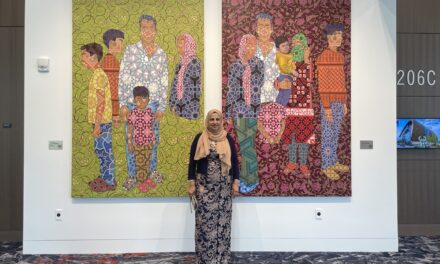
He lives in New Berlin with his wife Nadia Alkun, a MWC board member, and their sons, Zayed and Bassel. Alkun owns Nadiana Art Gallery, 4818 S. 76th St., Greenfield, which sometimes displays Dr. Obeidat’s nature and wildlife photography. He’s always at the gallery on opening nights for new exhibits.
“Nadia, her artwork and the gallery have a big influence on me and our family,” Dr. Obeidat said. “It brings us great conversations around art. And photography lets me see our surroundings from a different lens.”
Dr. Obeidat answered a variety of questions about his interest in and understanding of the intersection of the physical brain, the mind and the soul in his interview with WMJ. He noted that despite the astounding growth of knowledge in neuroscience, the boundaries of the unknown remain limitless.

Ahmed Obeidat, M.D., Ph.D., an associate professor at the Medical College of Wisconsin, conducts neurological research he hopes will improve the treatment of multiple sclerosis.
Here are the highlights:
How would you describe yourself?
I live as a neurologist. Some may say, ‘I work as a neurologist,’ but I’d say I live it. I’m always thinking about the brain, about our patients, and about the diseases I treat, such as multiple sclerosis. It’s a very mysterious disease. It’s always in the back of my mind.
For me, it’s very important to not only to help our patients, but also to advance the field and bring new things to better the lives of people living with chronic neurological disorders.
I’m a person who enjoys the arts and photography. I teach a course at MCW called the Art of Medicine through the Humanities. I teach it every year. Last year, Nadia and I did a gallery session for the students and they learned about the neuroscience of calligraphy.
This year the focus will be on the concept of mind and soul from the perspectives of neuroscience and the Abrahamic religions (Judaism, Christianity and Islam). The networking brunch discussion covers similar ground—What is the soul? What is the mind? What is known? What is unknown?
And I’m a family man—a husband, a father.
What else? Oh, yeah, I love cars, I love walks in nature, our surroundings, birds, flowers, teaching, research—there are so many things I like to do.
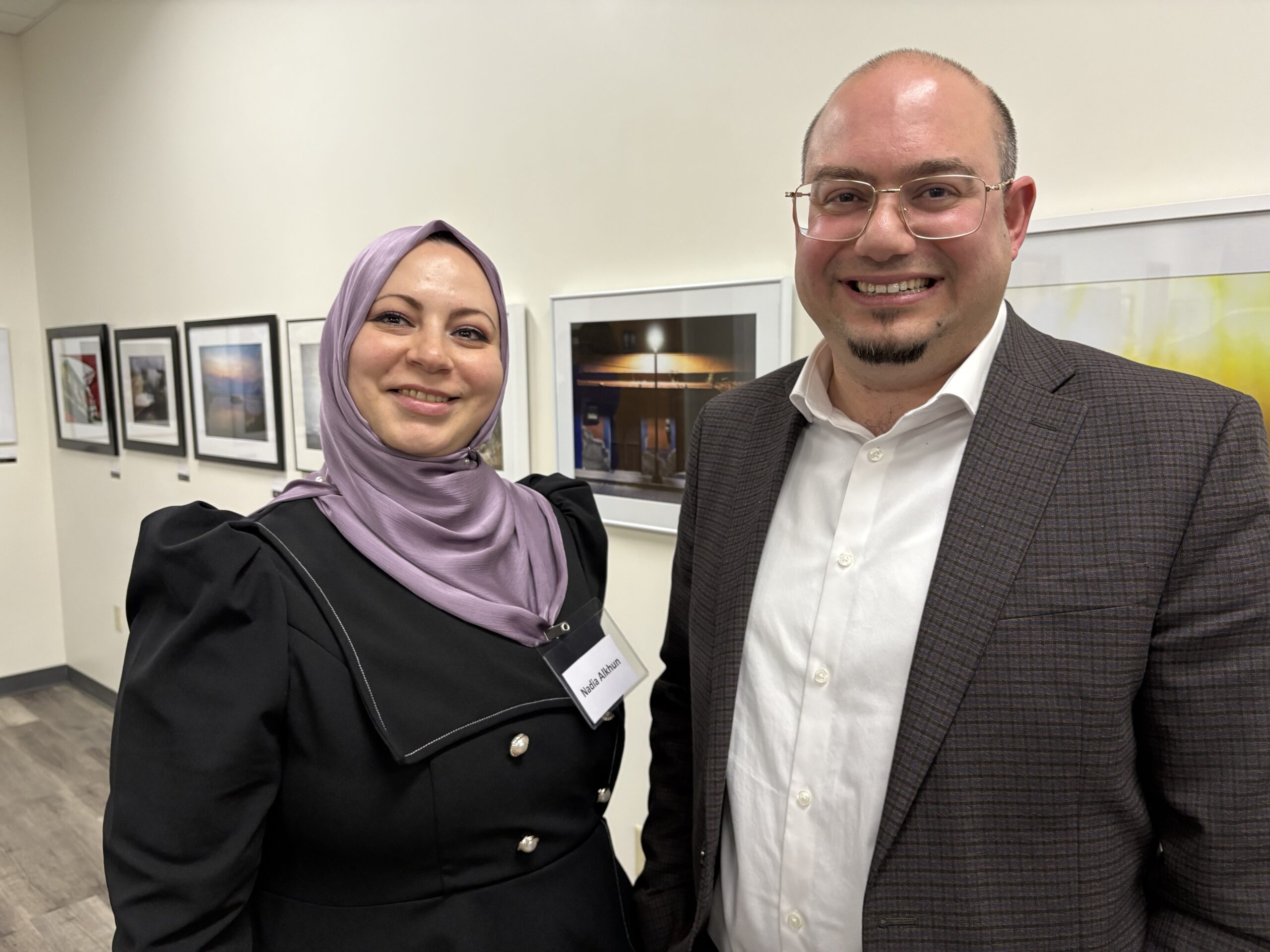
Spouses Nadia Alkhun and Ahmed Obeidat, M.D., Ph.D., enjoy hosting events at Alkhun’s Nadiana Art Gallery in Greenfield.
How can you teach a course about a topic with so many unknowns?
I believe we should always teach about things we want to learn more about because the best way to learn about a topic is to teach it.
Nadia and I were talking and we thought this topic would be good for the networking brunch because it is going to have an Islamic perspective in addition to a very heavy neuroscience focus. I can delve into the neuroscience and simplify it in a way that communicates with everyone.
What do you have planned for the MWC Networking Brunch?
I will share some real-life cases that have taught us about consciousness. For example, I sometimes treat people who are unconscious. Later, when they gain back consciousness and recover, I get to hear their stories about what they were thinking when they were unconscious.
Interestingly, people will tell you they remember things you’ve talked about when you fully thought they were not there. These stories have taught me more about how to think of people who are unconscious and how you can actually talk to them even though they can’t talk.
In addition to describing cases, this lecture will have some neuroscience, theology and philosophy. I hope we have a lot of discussion sparked from the curiosity of the audience.
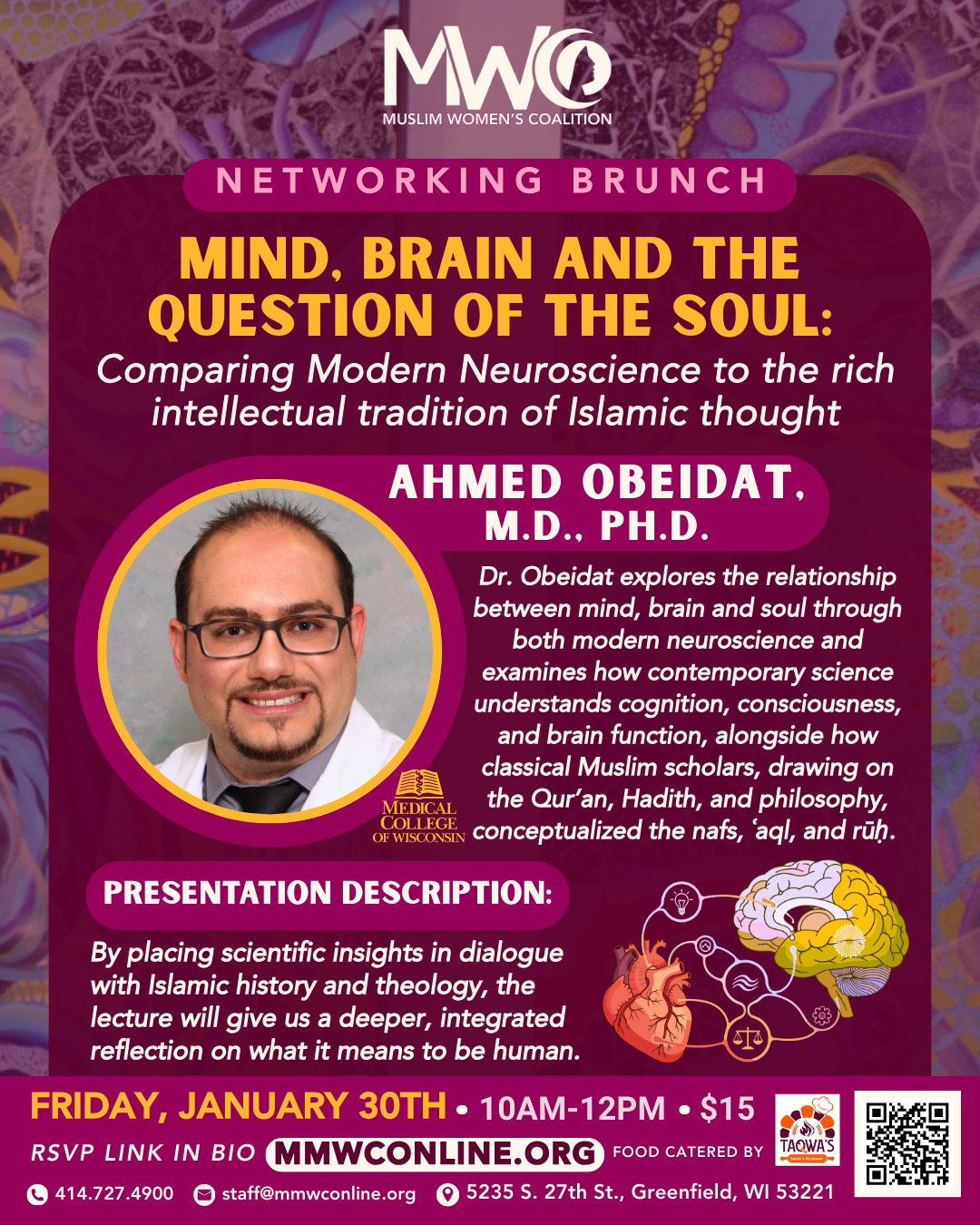
Click on the image above to register for MWC’s Networking Brunch, Jan. 30, with neurologist Ahmed Obeidat, M.D., Ph.D.
Is there a particular case that comes to mind?
Yes. In 2021, we were caring for a woman on a ventilator and in a coma, unable to even move her eyes. We were all thinking she wasn’t really there. We were able to give her some exceptional treatments and, thanks to them and the will of God, she woke up and improved. Now you can’t even tell she had a terribly neurologically devastating attack of multiple sclerosis.
Later, she told me that when she was unconscious, she heard everything I was saying. She heard the moment I saw some movement in her face that gave me a glimpse of hope. I was celebrating and she was there listening, though she couldn’t say anything. She knew exactly what I was saying.
The Froedtert & MCW Magazine did a story about her case.
What connections do you see between the physical brain and the soul?
The soul is from God and is something beyond our understanding. We know we can never fully understand it, but we are given some knowledge and we can reflect on it and unravel some of that.
Now, with advances in neuroscience, we’re able to record brainwaves and look at the function of the brain through imaging. And we are doing brain surgery. We are able to see some of the things happening in the brain.
Still, there is so much more in a human being—a human mind and a human soul—that we cannot understand just by looking at the brain. Everything is intertwined (that’s one of my favorite words), but they are not the same.
What questions would you like to explore?
When someone is losing brain function through a neurodegenerative disease like multiple sclerosis or Alzheimer’s Disease, advanced dementia or even a stroke, is that person losing themselves? They are losing their memory, losing some sense integration, but I believe they’re not losing their essence as a human.
I’m curious about the concept of the soul as separate from the human body, including the brain. I want to learn more and dive into the literature about this dualism.
I want to explore the scientific evidence, what we have learned from research in the modern neurosciences about the relationship between the spirit, the soul and the human body. Some people think the religious concepts don’t align with modern science, but as a neurologist and neuroscientist, I’m convinced they do.