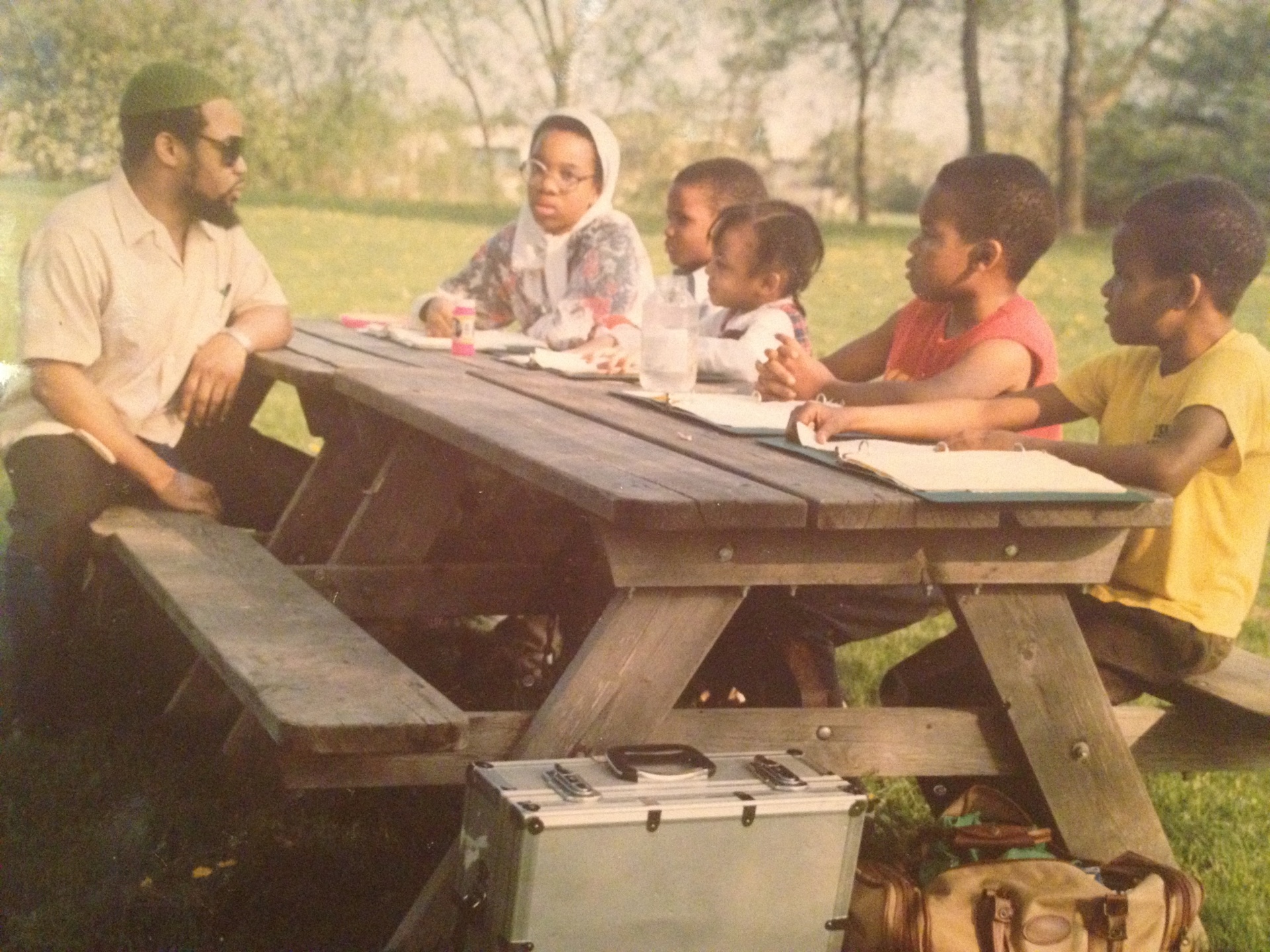
The Clark children studied in a park in 1991 with their father Abdallah Clark (from left to right, Sumaiyah, Abdul-Ghaffaar, Hadiyyah, Burhan and Abdul-Qahdir).
Capturing the story of Wisconsin’s Muslim community is a big part of Wisconsin Muslim Journal’s mission. This is the second of two articles based on interviews in 2022 and 2026 with three generations of one of Milwaukee’s first Muslim families. Following a story on the Hakim family, set 75 years ago, we pick up when revert Abdallah Clark married Karima Hakim. Three of their children are among today’s leaders in Milwaukee’s growing Muslim community.
Sumaiyah, Burhan and Hadiyyah Clark, and their siblings, were “among the children running around” in the Milwaukee Islamic Dawah Center, 5135 N. Teutonia Ave., in 1998 when Will Perry started attending Friday prayers. Perry soon became the center’s executive director, filling a post vacated by Ayyub Al-Amin, one of the founders of the Dawah Center.
Engrossed in his work at the center, 15 years flew by, Perry said. “And, all of the sudden, they were adults.”
“They’re the community’s third generation of Muslims,” he said. “They grew up in the ISM (Islamic Society of Milwaukee) and the Dawah Center (founded in 1993).
“Their father Abdallah Clark, Brother Waheed (Dr. Waheed Ahmed) and Brother Ayyub Al-Amin and others were very active at the ISM and the Dawah Center. So was Sister Karima and her mother (Hadrat Hakim, now 97), the Clark children’s mother and grandmother. In those early days, everybody was struggling (to establish Milwaukee’s Muslim community). Everybody and everything centered around it.
“At the core today are Sumaiyah, Burhan and Hadiyyah,” Perry said. “They’re on their game all the time. Now they’re fine-tuning their skills and spreading out their work into the city, nonprofits, county government and so on.”
While some of the Clark siblings moved away or focused on other work, Sumaiyah, Burhan and Hadiyyah are rising leaders in Milwaukee’s Muslim community—Sumaiyah as an officer in Milwaukee County government, Burhan as the board president of the Milwaukee Islamic Dawah Center and Hadiyyah Clark as director of strategy and community affairs for the Muslim Women’s Coalition. This is their story.
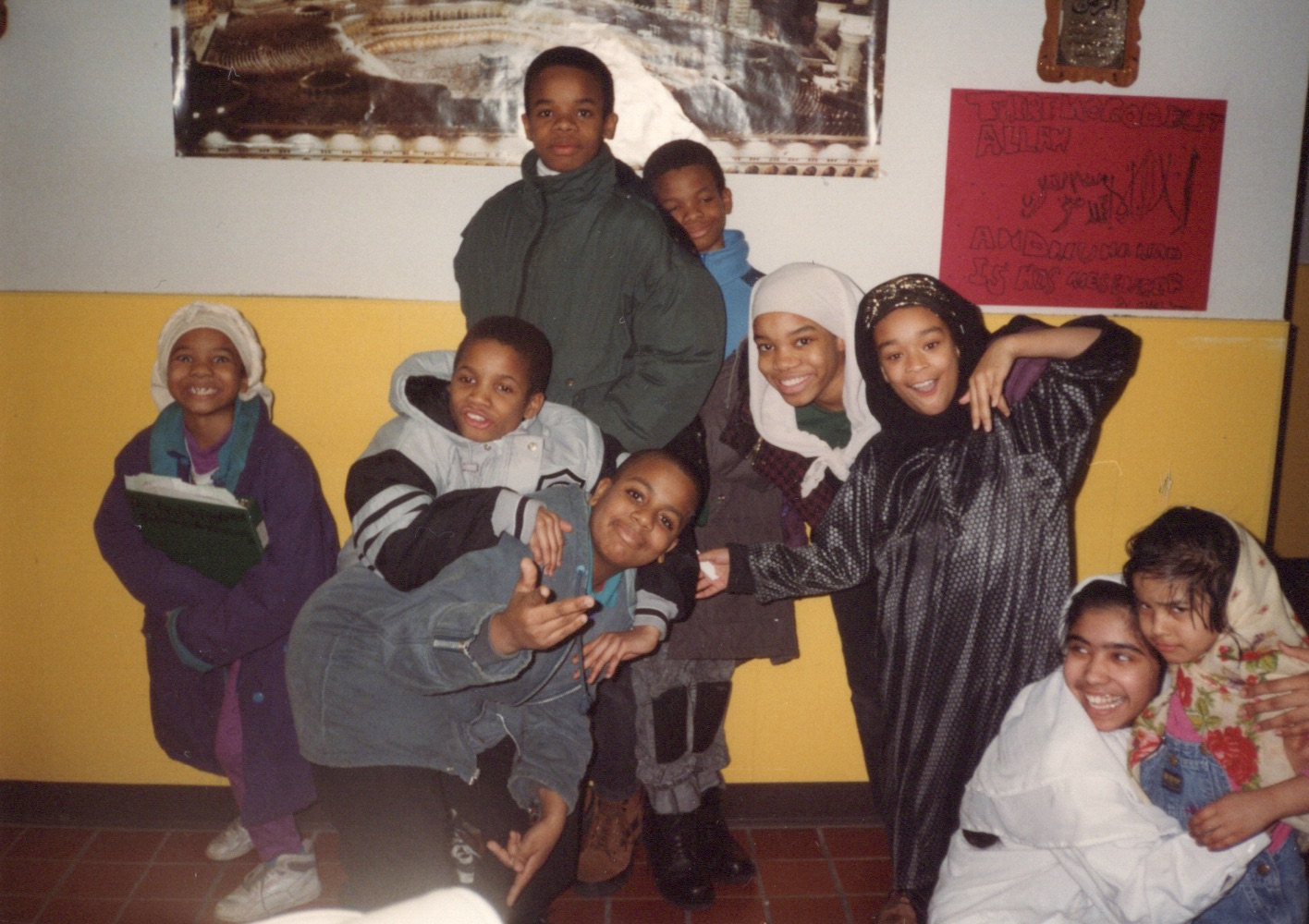
Some of Milwaukee’s third-generation Muslims posed together at the Dawah Center in the 90s (left to right: Hadiyyah Clark, Abdul-Ghaffaar Clark, Burhan Clark, Abdul Hakim, Abdul-Qahdir Clark, Sumaiyah Clark, Ayesha Cooper, Ameera Ahmed and Uzma Ahmed).
The early days
“When I came to Milwaukee in 1976/77, I came to know Abdullah Clark in the Sunday Islamic School run by the Muslim Student Association at UWM,” wrote the Islamic Society of Milwaukee’s first president Waheed Ahmed, Ph.D., in an email to the Wisconsin Muslim Journal. “In parallel with the classes for children, study sessions for adults used to take place. This whole activity was organized by Dr. Suleyman Kurter. Abdullah Clark was a regular in those sessions. Mahmoud Atta and Ayyub Al-Amin were also among the attendants of those meetings. Those meetings were what gave birth to the ISM.”
In an interview with WMJ, Abdallah Clark,73, recalled the early days. “We had to contend with resistance or misunderstanding,” he said. “That was the time when Elijah Muhammad was very active and Milwaukee had a (Nation of Islam) temple that was extremely well-known. It was assumed we were part of that organization. We always had to make the distinction and that caused friction with their organization. But it also began to establish in people’s minds that there was more than one way to look at Islam.”
Originally from Illinois, Clark moved from Madison, where he had been an engineering student, to Milwaukee for work. He aimed to earn money to continue his studies, he said. He “felt conflicted at one point” because he was offered a scholarship to pursue Islamic studies overseas and also offered a job in Wisconsin with a good salary.
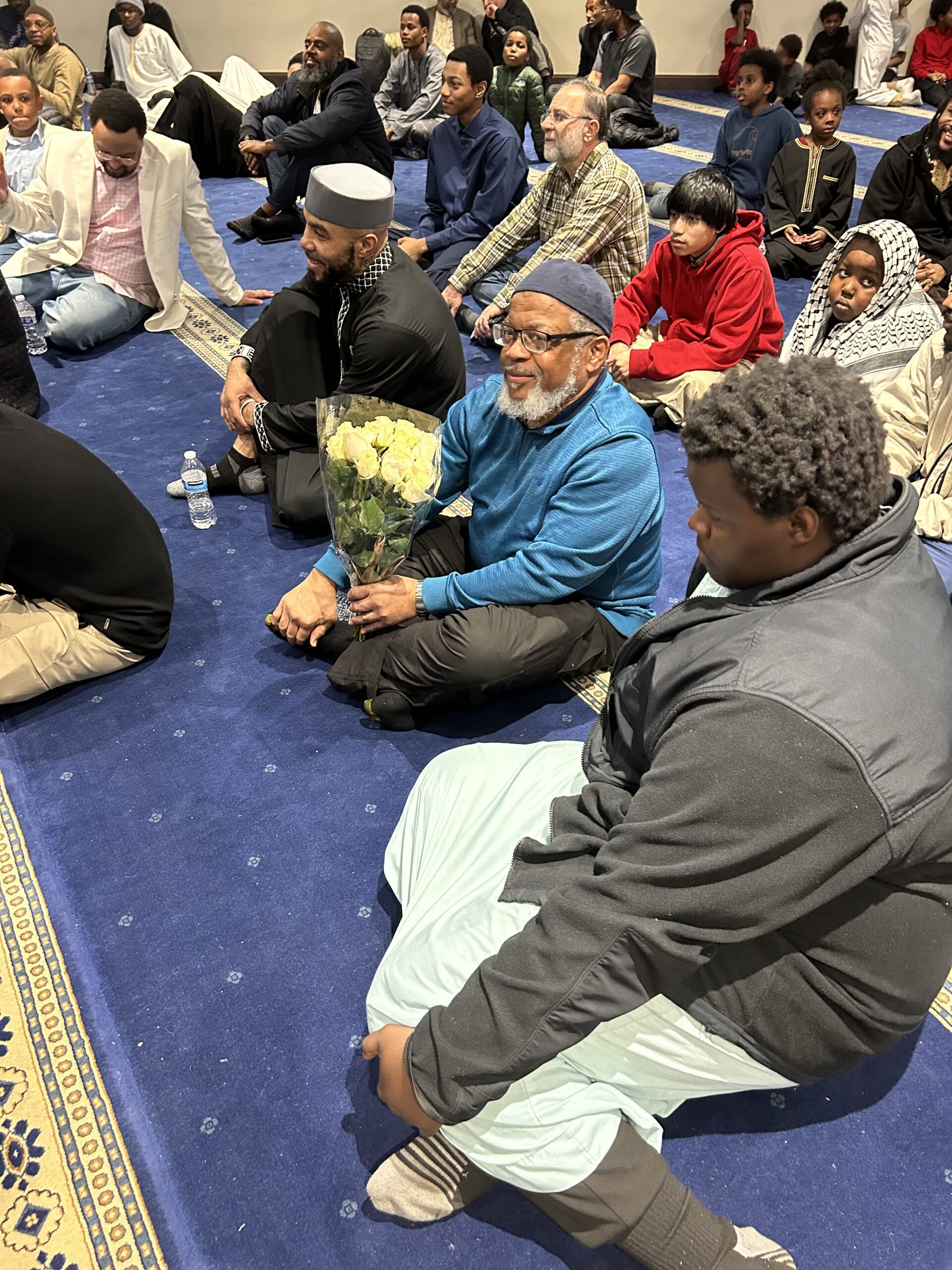
Abdallah Clark received flowers for his “consistent” role in Milwaukee’s Muslim community.
“I most definitely wanted to take advantage of the Islamic scholarship and study to be a scholar. I also felt desperately responsible for my mom and my three young sisters. It took a lot of soul searching, but I decided to remain in Wisconsin and took the job.”
He wasn’t able to get back to his degree program, but took classes at the Milwaukee Area Technical College and kept up with trends in his field, which helped him secure positions as an electronics technician and later as a sales manager. As he progressed in his profession, “it took me out of poverty and allowed me to be available on weekends because I wasn’t trying to do odd jobs,” giving him time to engage in Milwaukee’s Muslim community.
Clark joined Dr. Ahmed, Al-Amin and others in launching a newspaper called “Milwaukee for Muslims.” He also worked with them and others to establish the Muslim House,” a mansion on 31st and Kilbourn the community purchased in 1976 as its first masjid.
Meanwhile, Clark became good friends with the Hakims and met their youngest daughter, Karima. “I noticed and was impressed by her,” he said. Once he secured regular employment, they married.
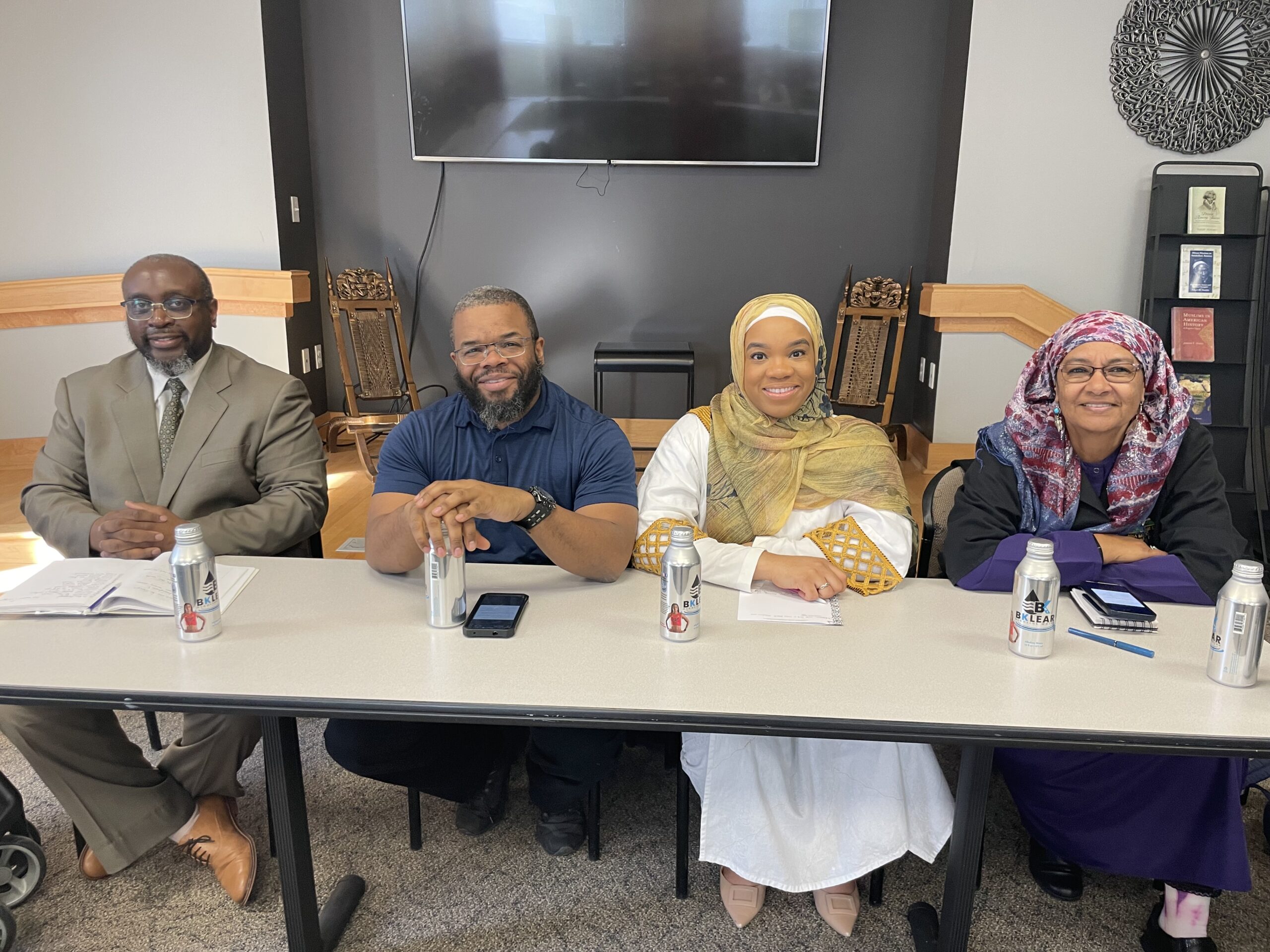
Burhan and Sumaiyah Clark (center) participated in The Black Muslim Experience panel at the Islamic Resource Center. Also shown are Imam Bramouse Fahad Muhammad of Masjid Sultan Muhammad (left) and Basimah Abdullah, principal at the Clara Mohammed School (right).
The community outgrew the Muslim House in the early 1980s. “We wound up using the basement in the Kenwood Methodist Church near UWM for classes and gatherings,” said Abdallah Clark. “It too was not big enough for the growth we experienced in a very quick manner.”
They sold the Muslim House and raised additional funds to purchase a former school building at 13th and Layton in 1982, creating the Islamic Society of Milwaukee, with a mosque, classrooms and a fellowship hall.
The Clark and Hakim families and others worked hard to turn the old building into a clean and attractive place for prayer, fellowship and education, family members said. When the Dawah Center was established in 1993, they worked on it, as well.
Although Abdallah and Karima Clark divorced, and Abdallah moved back to the Chicago area, they both stayed engaged in their children’s lives and Islamic education. And the Clark children continued to spend hours each day at a masjid.
Sumaiyah’s story
“I remember going to ISM when I was around 8 or 9 years old in the late eighties,” said Sumaiyah. “We would pack a lunch and a van would pick us up. In the summertime, we’d go daily. I met a lot of really diverse families from all over the world—Jordan, Palestine, India—as well as people who grew up here. Those were fun times!
“We would get change for doing little chores at home to buy a treat at the ISM store. If we earned the privilege in class, we could buy candy. I would always buy banana-flavored Laffy Taffy. That’s a core memory of mine.
“At some point, we stopped going to ISM and went to classes at the Dawah Center. Brother Amin, Dr. Ahmed, Dr. Pruitt, Brother Jihad and my dad had a goal of establishing a masjid on the north side of Milwaukee. They found a dentist’s office right off about 23rd and Hopkins. We had prayer in the lobby. My dad and other people in the community would teach Islamic classes.
“When I was around 10, they bought the Dawah Center property. It wasn’t a building with an open space like it is now; it had a subway shop, beauty salon and other businesses. We all went to clean. They gave me an empty ice cream bucket and told me to pick up change. I could keep any I found.
“One of the suites became the sisters’ prayer hall. In another, Sister Waheedah had a mental health clinic. She did a lot of mental health and substance abuse treatment for Muslims and others who lived in the community. A storage room became the food pantry Brother Ayyub coordinated.”
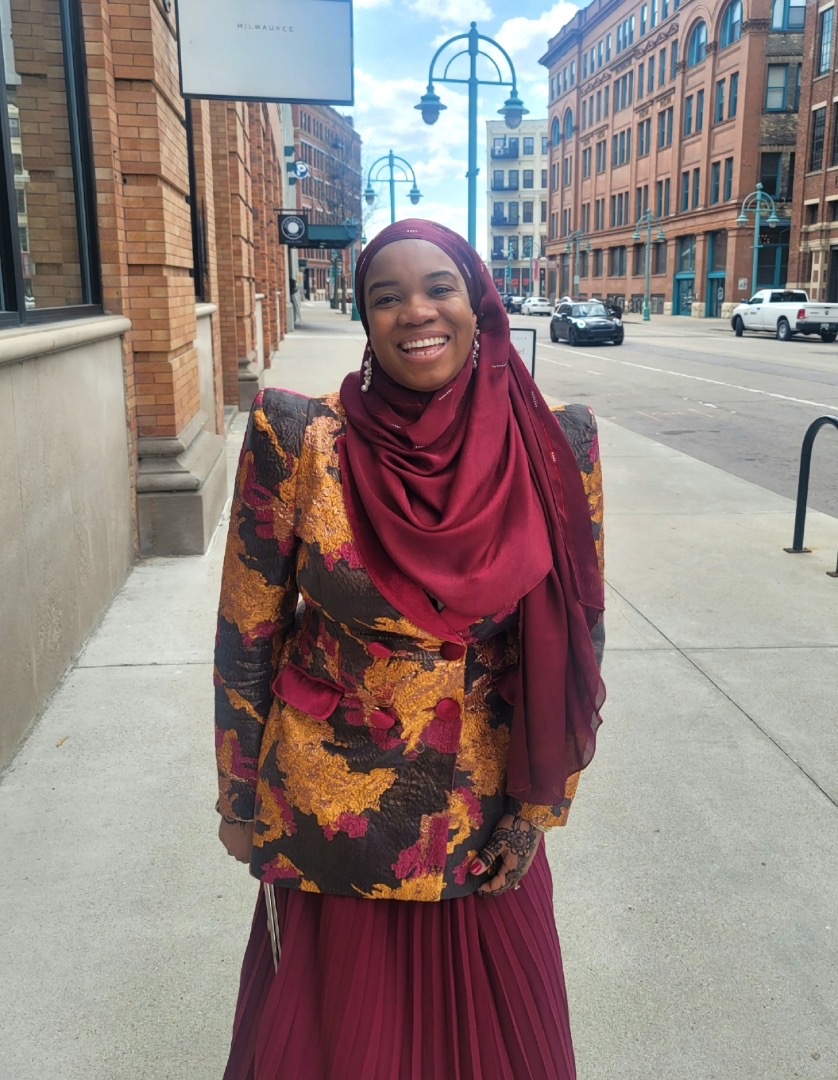
Sumaiyah Clark is Milwaukee County’s chief equity officer.
As a sophomore at UW-Whitewater in 2000, Sumaiyah’s roommate became president of its Muslim Student Association and Sumaiyah the vice president. “There wasn’t a prayer hall on campus,” she said. “Brother Ayyub would drive out to Whitewater to pick up Muslim students who want to pray jummah on Fridays.” He also hosted foreign exchange students of Rufus King High School in the nineties, just to make sure they had access to a place to pray and other things they would need.”
As Milwaukee County’s chief equity officer since December 2023, Sumaiyah works to improve the health and wellbeing of Milwaukee County residents. She sees her job as an outcome of her desire to improve the lives of everyone, including Milwaukee’s Muslim community.
Beyond her work, she has many projects she would like to pursue for the Muslim community, but they are on hold for now. For the last six months, her priority has been on stabilizing her daughter’s health, she explained.
“Life ebbs and flows,” Sumaiyah said. When the time is right, “two key things” she wants to address are, “first, to stand with MUHSEN to support families who can benefit from their work.”
MUHSEN is a nonprofit organization serving families and individuals with intellectual, mental and physical disabilities. “It’s close to my heart because of my daughter’s disabilities,” she said.
Second, she wants to prepare the community for “the impending changes to SNAP and Medicaid eligibility and its impacts.” In her work for Milwaukee County, she considers what education people will need and the best vehicles to get information out to families.
Sumaiyah then listed other issues she wants to work on: food apartheid, supporting young people aging out of foster care and more. “How do we make sure that as Muslims, we’re serving as an anchor, providing support for our neighbors?” she asked.
With her own children, she finds herself in a transition. “Like my parents, I did my best to keep my children connected to the community,” she said. Her father gave them Arabic lessons and lessons on Islam. Her mother used “creative ways,” making up games and singing songs about Islam. “We’d listen to fun, Islamic CDs in the car.
“My kids are now in their early twenties. I’ve done everything I can to lay a foundation. They did Sunday school and summer school at the Dawah Center and Masjid al Quran. Now, I’m at that point where you can just support them and encourage them, and pray Allah will continue to guide them as they come into themselves as adults.”
Burhan’s story
Sumaiyah described her younger brother Burhan, now executive director of the Milwaukee Islamic Dawah Center, as “an all-hands-on-deck person. He’s constantly moving, always trying to think of new, interesting ways to get people to come to the Dawah Center, especially young people.
He is even trying to get the kids interested in the environment, growing food at the Dawah Center to incorporate fresh food in the food pantry, while teaching kids about gardening. That is something he and Brother Will are very interested in.
“When his kids were younger, they’d walk with him to the Dawah Center, him in front with the little kids walking behind him like little swans. Even before he was a leader there, he was always making sure his children were active and volunteering himself. His commitment gave people confidence in him that led to him having a leadership role.
“He is always considering the needs of the community, and how to meet them in partnership with families and other community organizations.
“I admire the fact that he pours all of himself into anything he does,” Sumaiyah said. “It is such a rare gift Milwaukee has in him.”
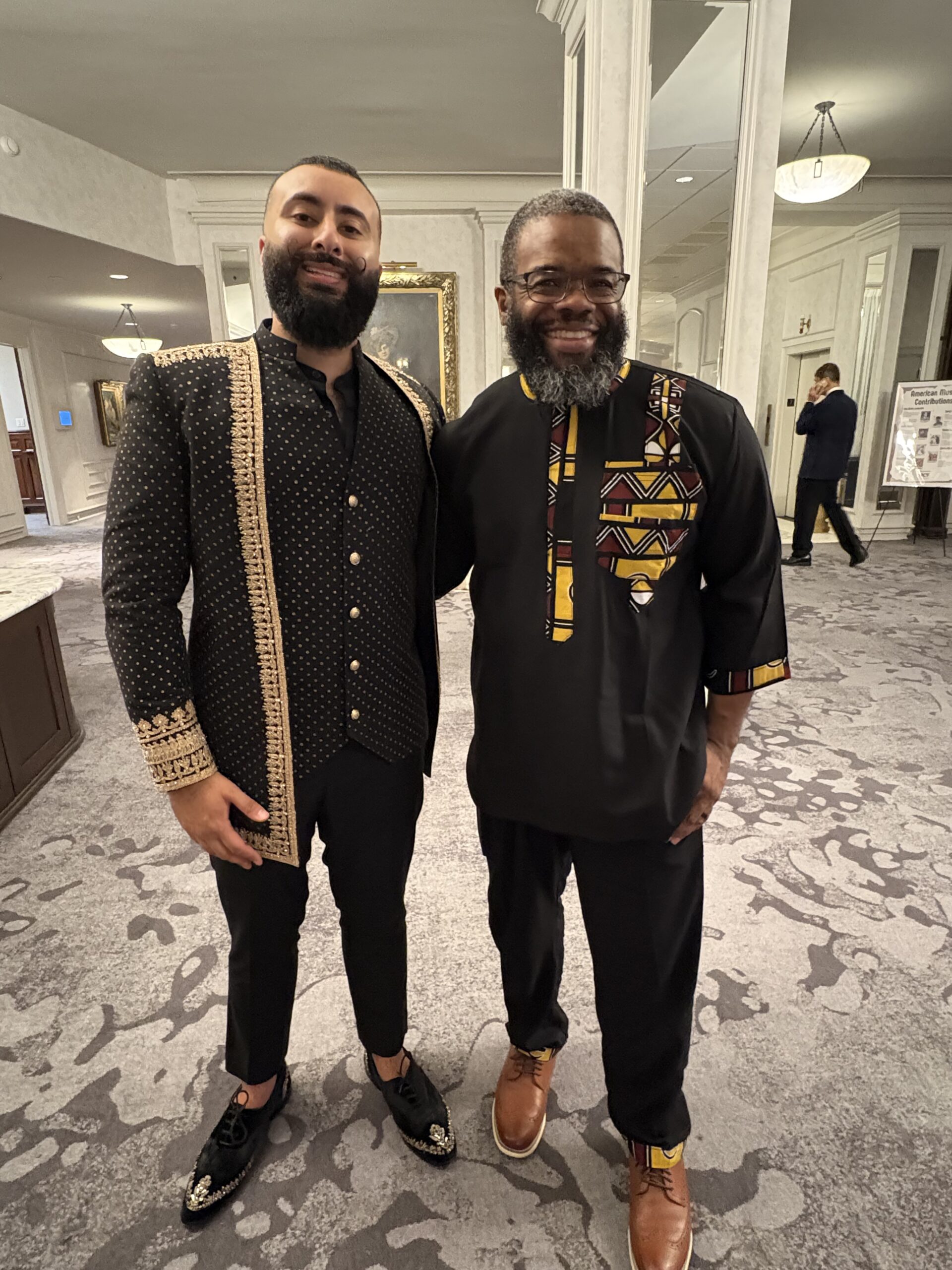
From left to right, Ali Khan and Burhan Clark at the 2025 Wisconsin Muslim Civic Alliance gala
“My father named me ‘Burhan,’ which means ‘the highest level of evidence,’” Burhan said. “He’s a person who finds it important that you think about what you are doing, and bring evidence and proof. He instilled the idea of questioning with humility and curiosity.
“We were also raised in a very active household, with people coming and going, discussing evidence, proof and belief that were so intellectually grounded. We didn’t have a faith built on ‘just believe.’ We were raised in an environment of questioning. My faith felt pressure-tested at a relatively young age.
“And not just about religion. We talked about humanities, history, literature, science. What we learned in school was so limited, where we were still taught about Columbus discovering America.
“At home, I learned some sort of narrative is always being pushed. I understood there’s usually more to a picture than they were showing us.”
Burhan found himself going to masjid all the time growing up, a habit that continued into his adult life, he said. “After school, I would walk over to the library and then to the masjid, mainly because I had family there.
Hadiyyah’s story
“I was at the WMCA (Wisconsin Muslim Civic Alliance) grand opening and one sister came up to me and asked me if I’m related to Hadiyyah,” Sumaiyah said. “I said, ‘Yeah, that’s my sister.’
“And she goes, ‘She is so amazing. I just saw her at the Celebrating Palestine event, where she was organizing different activities. She’s always bringing people together. I’m just so thankful she is here.’
“That’s Hadiyyah in a nutshell. She does a lot of events for women empowerment, education, professional development, leadership development. She has been contracted by the U.S. Council of Muslim Organizations to do these things across the United States. She’s very charismatic and has a jovial, warm personality. People really gravitate to her.
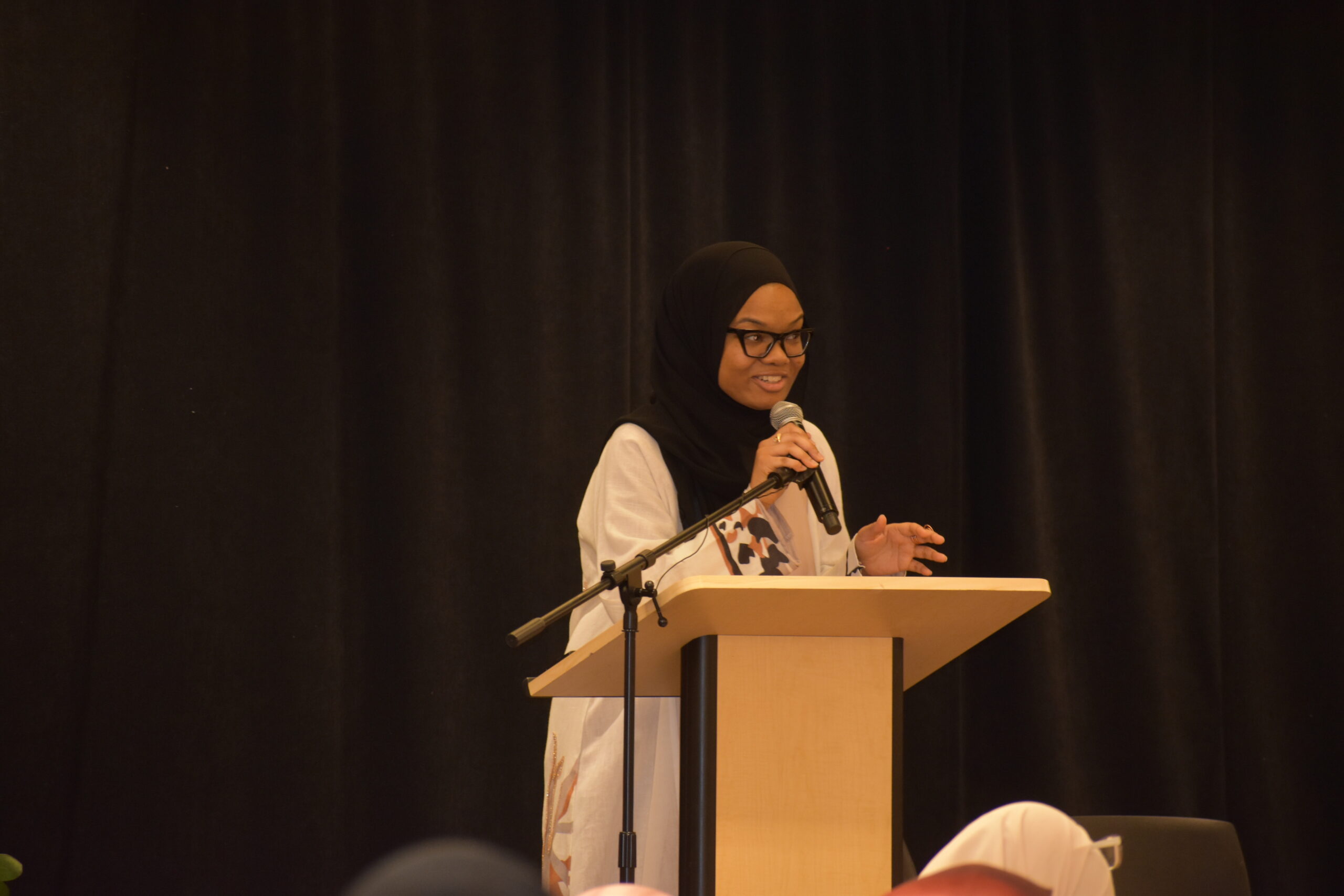
Hadiyyah Clark organized the Muslim Women’s Coalition’s first annual leadership conference, held April 19, at Alverno College.
“She’s very passionate about making sure people are healthy and thriving. She was out in Los Angeles for five years, where she was organizing hikes and all kinds of things. Now she’s been back in Milwaukee for two years. She helped the Muslim Women’s Coalition coordinate its first women’s leadership conference in partnership with Sister Janan (MWC founder and executive director).
“She’s on Instagram as the Muslimah Career Coach, helping professional women feel confident in showing up as Muslimah (Muslim women) in professional spaces.
“Even though I’m older, I always joke and call Hadiyyah my ‘little big sister’ because I really look up to her and her positive energy and outlook on life. She’s always showing up in spaces with hope and sunlight.”
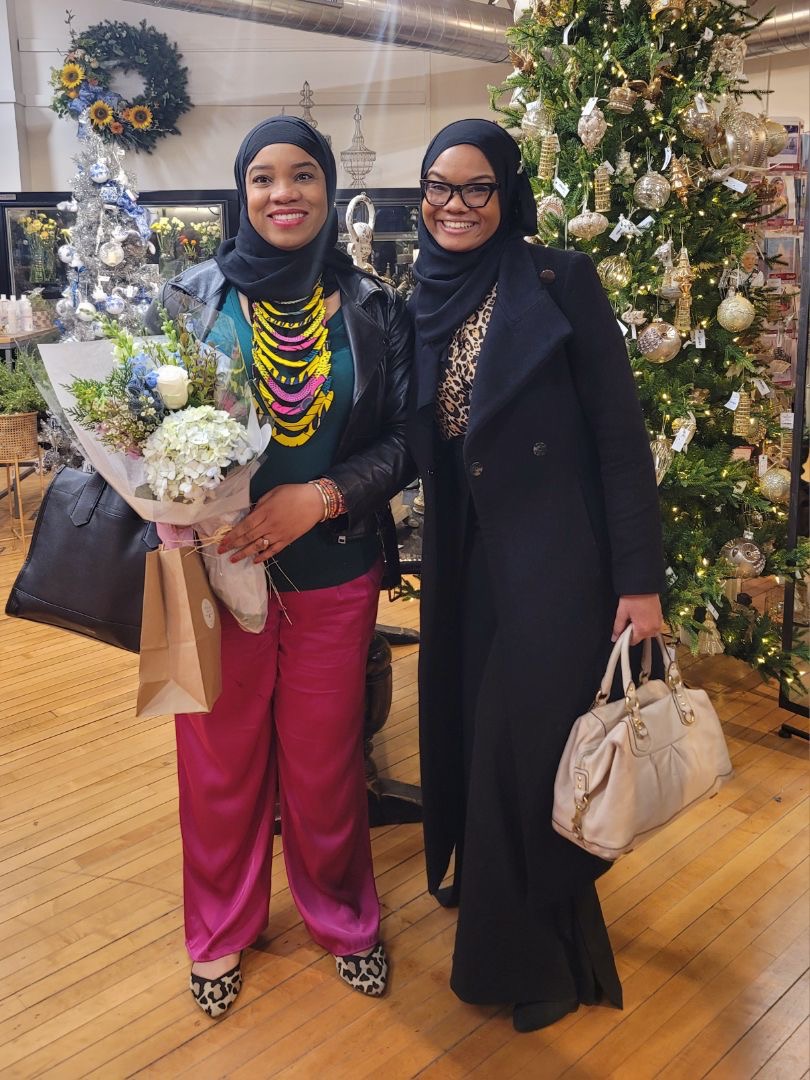
Left to right, sisters Sumaiyah and Hadiyyah Clark
Hadiyyah began working at MWC in April 2025 after serving on the board. “I wanted to give more time, more energy to the MWC,” she told WMJ. “My family and the Atta family have generations of connections. (Janan Najeeb is the daughter of Mahmoud Atta, one of the founders of the ISM.) I’m proud of what Janan’s built over the last 31 years.
“I was a very active board member and I could see that in our sparse foundational structure there was a gap. We needed staff to get work done. We talked about many things we wanted to do but we needed someone to do it.
“One day, Janan said, we got a grant and we can pay you to do human resource trainings, youth development workshops and other entrepreneurial things we were discussing.
“I do like to build businesses. I love to think about where they are now, where they want to be and how to get there. We talked about it and created the role of director of strategy and community affairs.”
In that position, Hadiyyah oversees operations and human resources, and community outreach.
“It’s great to work with a thought leader like Janan because she’s such a visionary and so inspiring. I start there and ask, ‘How do we plan for that? Do we have the human capital and resources we need? How do we execute it? How do we measure if we were successful or not?
“I love our staff. Now we have a full team of about a dozen staff members, nine fulltime and two parttime. It’s been an honor to bring more talent into the organization.
“We know we have to grow to stay competitive. We can do that by increasing employee benefits, offering our employees a reason to stay. Now we are offering full benefits to our employees, good benefits for such a small organization.”
Hadiyyah is especially proud of MWC’s recent first women’s leadership conference, an event she coordinated, she said. “We had around 200 people from all around the community.
“I feel lucky and blessed to be Sumaiyah’s and Burhan’s little sister,” she said. “Because of their character and because of their positive impact, without ever wanting recognition, they have done great work for the community. It takes a lot of sacrifice.
“They are a wife and a husband, a mother and a father, and they always show up for the community, and for their siblings. I want to be a better person because of how great they are!”
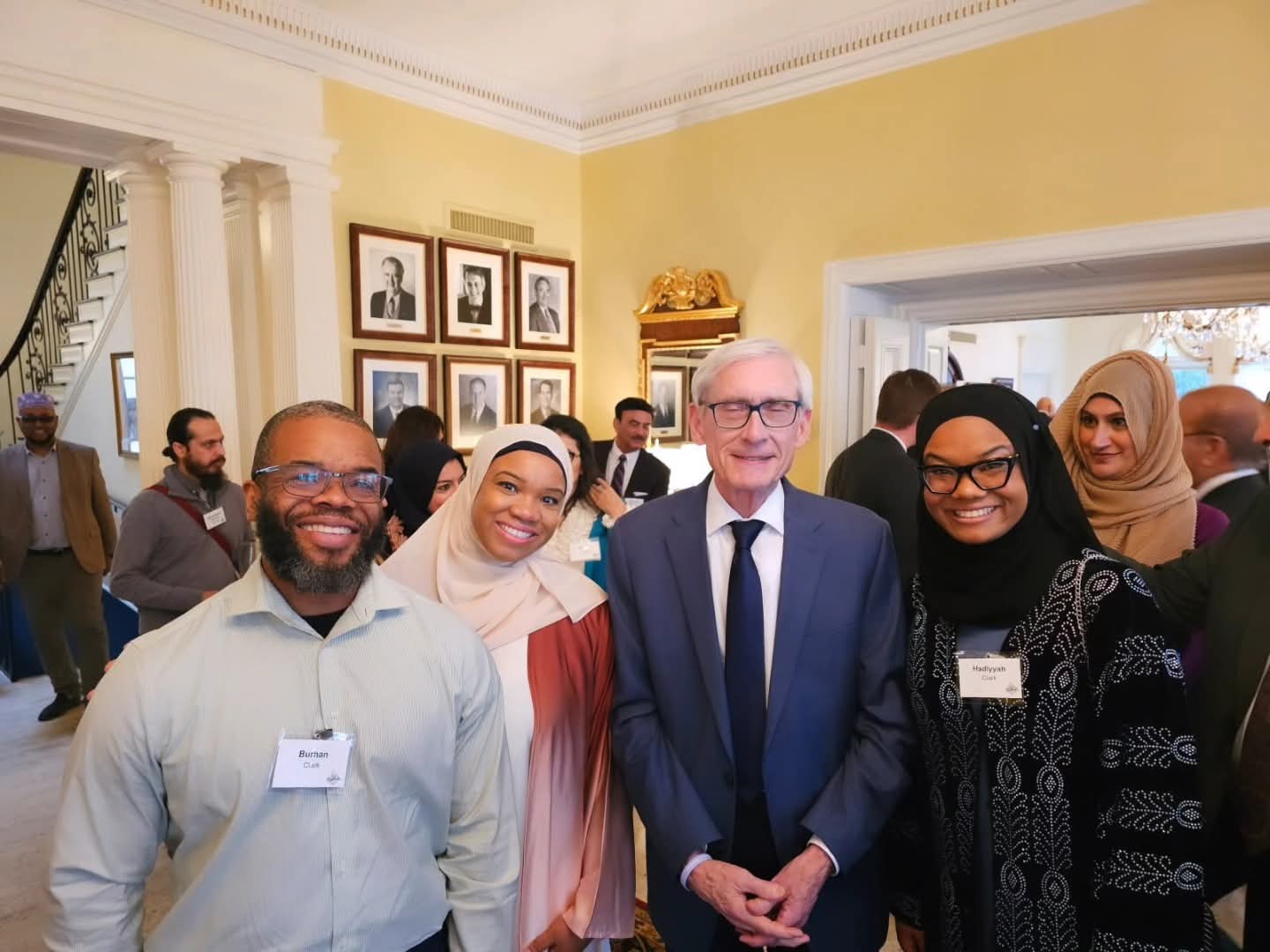
Burhan, Sumaiyah and Hadiyyah Clark joined Wisconsin Gov. Tony Evers for a celebration of the Eid in 2025.