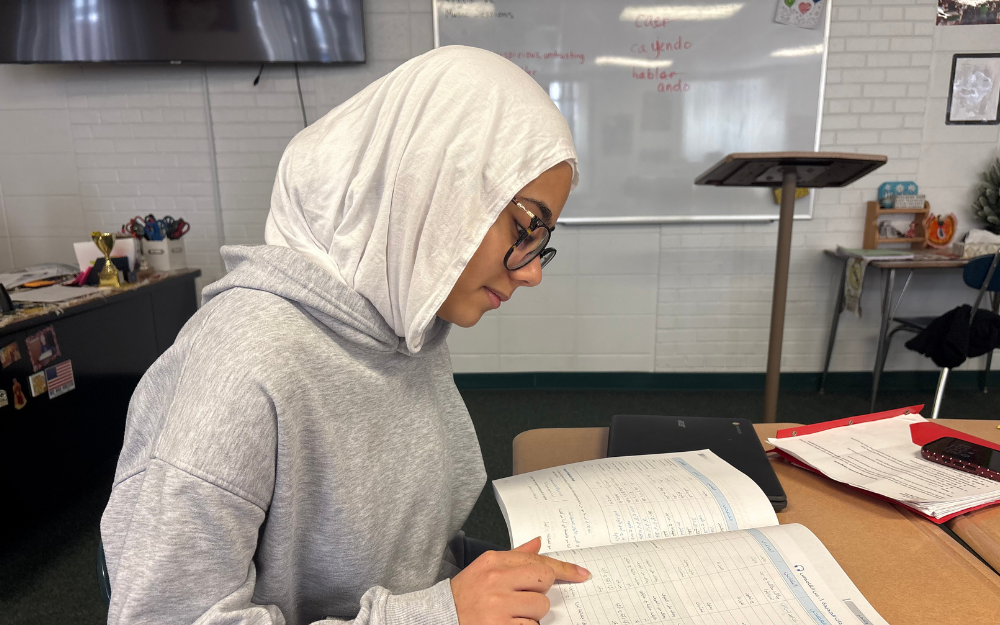
Jana Elsheikh is one of many Wisconsin high school students who take courses on University of Wisconsin campuses for both high school and college credit.
When Jana Elsheikh, 17, of Franklin, starts her freshman year of college this fall, she’ll have two courses left to finish an Arabic minor. That’s because she participated in Wisconsin’s Dual Enrollment Program while she was a student at Franklin High School and earned 16 retro credits for being able to enter the program at a higher level. (Elsheikh, who had moved to the United States from Saudi Arabia when she was 5 years old, grew up with Arabic-speaking parents.)
What’s more, her family did not have to pay tuition for the retro credits or the Arabic classes she took at the University of Wisconsin-Milwaukee while she was in high school.
“One of the most beneficial things about dual enrollment for native Arabic speakers is the money they save because they get retro credits for the Arabic they already know, said Khuloud Labanieh, Ph.D., a senior faculty member at the University of Wisconsin – Milwaukee.
Wisconsin’s dual enrollment programs allow high school students to enroll simultaneously in high school and college, earning both high school and college credits for each course. Students and their families pay no tuition for courses they take through the program. Dual enrollment makes college more affordable for families, provides opportunities for students to take higher-level coursework and gives students valuable experience that helps them learn to navigate college life.
Muslim students and their families also find dual enrollment valuable for Arabic language study, enhancing their understanding of the Quran. And, for students of Arabic heritage, dual enrollment creates opportunities to take Arabic classes.
How dual enrollment works
Wisconsin state law requires Wisconsin public, charter and private high schools to provide a minimum of 18 credits of college courses at universities in the University of Wisconsin system, private or Tribal colleges in Wisconsin to their students. The Early College Credit Program allows high school students to take university courses on campus or online, provided they have the prerequisites. Tuition is paid by school districts, which are reimbursed, or partially reimbursed, by the state at tuition rates discounted by universities.

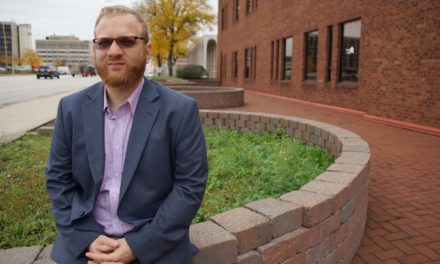
Kathleen Breuer, UW-Milwaukee Associate Director of Dual Enrollment
“A nice thing for families is that the high school pays for the majority, if not all, of the tuition,” said Kathleen Breuer, associate director of Dual Enrollment at UWM. “We charge a reduced rate of a third of our regular tuition. And the student earns two different types of credit by taking one class—high school and college credits.
“Our program is open to high school sophomores who have a 3.0 GPA or higher. A student can take any course as long as they meet the prerequisites,” she explained. “Students come to campus to take courses and they are also eligible for online courses.”
About 2,000 high school students take classes at UWM each academic year, Bruer said. The most common courses to take are introductory English and mathematics, but a growing contingency is pursuing language studies. “Foreign language courses are also popular because it’s very attractive to employers to have employees who can speak multiple languages,” she said.
“Guidance Academy in South Milwaukee is sending a lot of students to us for 200- and 300-level Arabic courses,” Breuer added.
How to sign up
To register for the Early College Credit Program, start with a visit to your high school counselor, Breuer advised. “The state deadlines are very early: March 1 for Fall semester, Oct. 1 for Spring semester and Feb. 1 for summer school. Students must apply to the program through their high schools before those deadlines.
Once a high school approves a student’s application, they have to apply to UWM as a student,” Breuer said. UWM’s application deadlines are closer to the start of each semester. The deadline to apply to begin UWM in the Fall is Aug. 1 and Dec. 15 for the Spring.
UWM promotes the dual enrollment programs by distributing flyers and posters, “but it is up to the high schools to do most of the advertising,” she said. “We work with a lot of school counselors and try to keep them informed about the program and deadlines.”
Big benefits beyond the credits
“All the data on dual enrollment is very positive on the student impact,” Breuer said. “We know students who take dual enrollment classes are more likely to go to college. They’re also more likely to stay in college and eventually graduate.
“The more we can do to get students to take these classes in high school,and see that they’re successful in them and can do college-level work, the better. It really is a good thing for students and universities in the long run.
“We are really trying to focus on the Milwaukee area because we know that is where we will have the biggest impact,” she said.
A staff member in the UWM Dual Enrollment Office works as an advisor to the dual enrollment students. “He really tries to get them to understand dual enrollment is not just a benefit, but a responsibility,” Breuer said. “They are taking college-level courses that are going to go on their college transcript, so it is really important they take them seriously.”
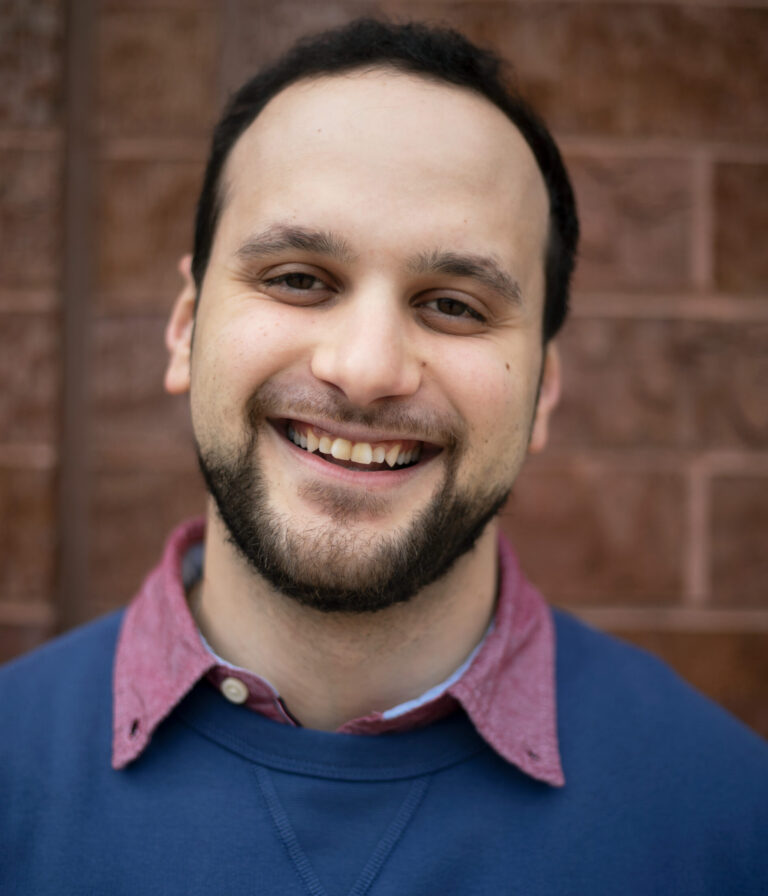
Ali Shana, a doctoral student in Marquette University’s Department of Educational Policy & Leadership who researches dual enrollment, called the program’s benefits “massive.”
Ali Shana, a third-year doctoral student in Marquette University’s Department of Educational Policy & Leadership, researches dual enrollment programs. A recent issue of Marquette Today featured his work. It explained, “His research centers on listening directly to students. Using developmental and educational psychology, Shana studies why students choose to participate in dual enrollment, what challenges and supports they encounter, and how those experiences shape their identity, confidence, and understanding of college over time.
“Alongside his research team, he interviews thousands of students across Milwaukee-area high schools and universities and analyzes their responses using qualitative methods that look for shared patterns and meanings.
“The goal of his work is to translate student experiences into concrete policy recommendations that improve dual enrollment programs at the local and state level.”
While there are several dual enrollment program options, including ones where high school teachers offer college courses at the high school, Shana recommends taking “the more collegey option” — the Early College Credit Program. “The student has to have transportation to the college, but being on campus has big benefits,” he said. “They gain self-confidence and learn self-navigation skills, like how to email a professor or who to call if you don’t know where to park on campus.
“The economically disadvantaged students would benefit most by having less credits to take come college time,” he added. But for everyone who participates, “I would say the benefits are massive.”
Shana offered one warning. “If they take it seriously, it can save you a lot of money. If not, it will really bite you.
“You’re really rolling the dice if your student does not take it seriously,” he emphasized. “Two bad dual enrollment classes in two concurrent semesters could put a kid in early academic probation.”
Students’ first-hand experiences
Jana Elsheik, 17, is a native Arabic speaker at Franklin High School. When she applied to the Early College Credit Program, she wasn’t sure what level Arabic class she needed. She applied to all of them so her school would accept any of them, then she reached out to UWM Arabic senior faculty Khuloud Labanieh, Ph.D. Labanieh tested her to determine her appropriate level. Now a high school senior, she has reached the highest level in UWM’s Arabic language program.
“It’s really going well,” she said. “Two more courses and I’ll have a minor. Having an Arabic minor is something really good to have on my transcript and make me stand out.” ”
More than the additional credential, Elsheik has personal reasons for wanting to learn Arabic. “I’d love to be able to learn my language more, and it will also give me some background if I want to teach other people.
Elsheik will start at the University of Wisconsin-Parkside this fall in a pre-med track, she said.
She heard about the opportunity to use UWM’s dual enrollment program to study Arabic from her mother, Asmaa Mostafa, who teaches health and physical education at Guidance Academy. “She heard a lot of the students at Guidance did it and she told me to check it out. Then I learned my friend at Franklin High School was also doing it.”
Taking a college course “was intimidating at first,” Elsheik said. “But the Arabic class is small and everyone is friendly. Of course, the work is more difficult, and there is more work than in high school, but I’m very glad I took it and was able to keep up. It’s very beneficial.”
Her mother agrees. “I want my kids to know about other languages,” said Mostafa. “I encourage them to take Spanish, Arabic, any language. It’s a great addition to their education.
“I observed the students at Guidance Academy who participated and saw them succeed,” she said. “I told Jana, ‘Don’t be afraid.’”
Elsheik added, “Dual enrollment is a lot more helpful than AP classes. I spent a lot of money on AP classes throughout my high school career, hundreds of dollars on the exams. You take the exam to get credit for the course, but there is no guarantee. With dual enrollment, you don’t need to take an additional exam beyond the tests in the course. When you complete the course, you get official college credit.”
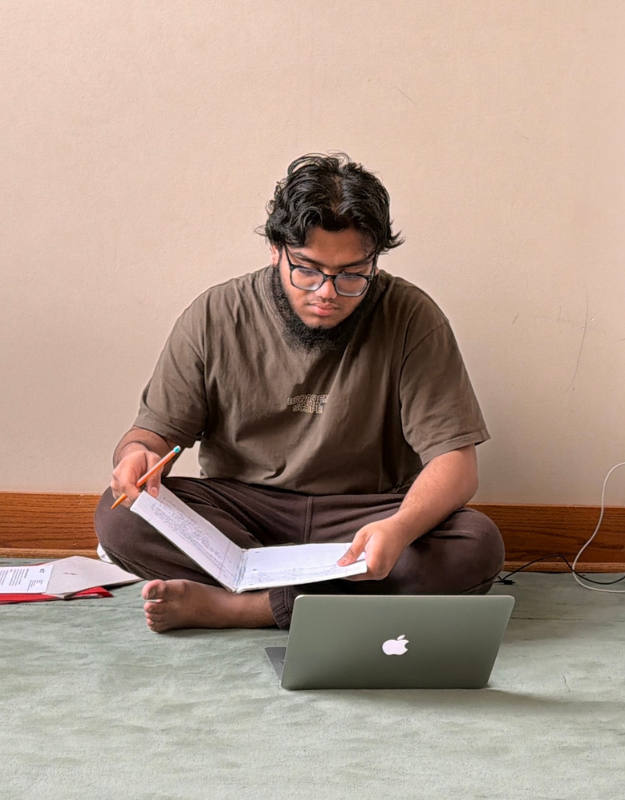
Guidance Academy High School student Zakariya Razi
Zakariya Razi, 16, of Milwaukee, attends Guidance Academy, where he has been studying Arabic for five years, he said. He began taking Arabic language courses at UWM through the dual enrollment program this semester.
“I decided to take it because I saw I could get credits for college early on,” he said. “I would be able to take language classes now and when I get to college, I can concentrate on my major, engineering.”
At first, it felt “a little strange” to be in the college class, Razi said. “When I’m at school, I’m usually surrounded by people I have always known. But I got used to it.”
He also got used to the self-discipline and effort required by college classes, he said. “In high school, the teachers really push you to submit your assignments on time. But in college, it’s on you.”
He also noticed the pace of college courses is faster. It surprised him in the first and second weeks, then he caught on, he said.
His mother, Sameena Farheen, said she likes the opportunity he has to earn college credits and also to get an idea about how college works. “It’s like when we enrolled them in K-3 to get an idea about what is going to happen in school and to set a foundation to build on.”
Most important, “he’ll learn the language, which is beneficial, especially for understanding the Quran,” she said. “He won’t see the benefits right away, but in the future, I think he’ll see it was a good choice,” she said.
Razi’s advice to other students is to hit the ground running. “It’s really up to you. If you don’t pay attention in the beginning, you’re going to have a hard time catching up later. It moves fast.”