Photo by Rey Tang
Colette Ghunim’s debut feature film, Traces of Home, won the Grand Jury Prize for Best U.S. Documentary at DOC NYC, the premier competition for documentary film in the United States.
Nine years ago, filmmaker Colette Ghunim decided to travel with her parents to the ancestral homes they were forced to flee as children—her father from Palestine during the Nakba (Arabic for “catastrophe,” a term used for the forced evacuation in 1948 of Palestinians from their homeland) and her mother from Mexico. What began as a desire to understand her parents’ displacement stories and to connect to her own cultural origins turned into an almost decade-long internal quest that resonates powerfully with audiences.
Traces of Home, directed by Ghunim and produced by Sara Maamouri, Dan Rybicky and Capella Fahoome, won the Grand Jury Prize for Best U.S. Documentary in November at DOC NYC, the premier competition for documentary film in the United States. “The jury was moved by the film’s vulnerability,” wrote the panel of judges, Deadline reported. “Using an intimate family lens, it offers a powerful portrayal of parenthood and identity. With tenderness and courage, the filmmaker uses the camera as a tool for reconciliation that bridges generations and cultures. In a time of division, Traces of Home stands out for its compassion and timely representation of Mexican and Palestinian experiences united by love and resilience.”

Traces of Home will screen at the Milwaukee Film Festival on 4/18, 4/19 and 4/21 at the Oriental Landmark Theater.
The 18th annual Milwaukee Film Festival presents Ghunim’s award-winning debut feature film this weekend at the historic Oriental Theatre, 2230 N. Farwell Ave., Milwaukee. The 90-minute film is in Arabic, English and Spanish with English subtitles.
Showtimes are: Saturday, April 18, 3:45 p.m.; Sunday, April 19, 10 a.m.; and Tuesday, April 21, 1:30 p.m.
Ghunim and producer Dan Rybicky will join the audience for talkbacks after the Saturday and Sunday screenings. Buy tickets here.
MFF selected Traces of Home “out of literally thousands of submissions,” said Susan S. Kerns, Ph.D., executive director of Milwaukee Film. “We want to bring things to our screens that people may not have the opportunity to see in other places. This is a film that is probably not going to show up at the Multiplex.
“And with a film like Colette’s, it’s important to be able to see it on a big screen with an audience and to experience discussions with her afterwards,” she added. “Even though it’s a very specific and personal journey for her, it’s also very relatable. A lot of people have had their own journeys with their upbringings and cultures. All of those things make the film festival experience special.”
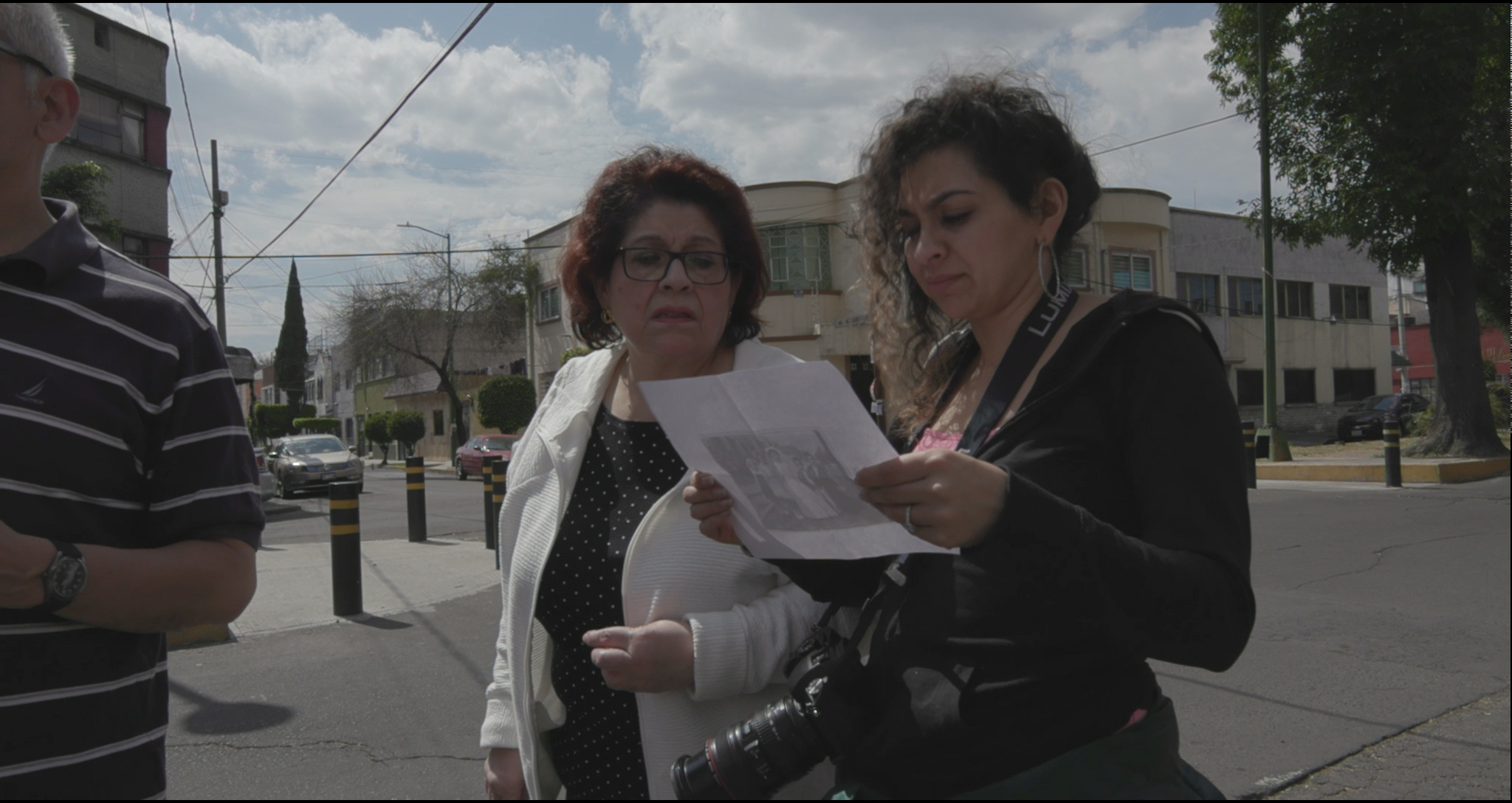
Film director Colette Ghunim’s nine-year exploration of her parents’ ancestral homelands and her own sense of belonging was a life-changing experience, she told the Wisconsin Muslim Journal.
Other festival films of special interest to Muslim audiences:
Rising numbers of Jewish immigrants are arriving to escape persecution in Europe, just as Palestinian villages are uniting in the largest and longest uprising against Britain’s 30-year colonial rule. The region is reaching a breaking point, spiraling toward an inevitable collision that will be a decisive turning point for the British Empire and the land’s future.
Showtimes: Monday, April 20, 6:30 p.m. and Wednesday, April 22, 4:15 p.m. Buy tickets here.
When three American doctors—Palestinian, Jewish and Zoroastrian—enter Gaza with a shared oath to save lives that unites them beyond their differences, they find themselves caught between medicine and politics, risking everything to expose the truth.
Showtimes: Monday, April 20, 1:45 p.m.; Thursday, April 23, 7:30 p.m.; and Friday, April 24, 3:30 p.m. Buy tickets here.
Interview with Traces of Home director and producer
Wisconsin Muslim Journal talked Tuesday with director Colette Ghunim of Chicago and producer Sara Maamouri, who lives in the San Francisco Bay area, during their brief break from touring. They’ve attended screenings of Traces of Home since November, which “began in earnest after the holiday season and have since been nonstop,” Maamouri said. Traces of Home is Ghunim’s debut feature film; Maamouri is a Peabody Award-winning, Emmy-nominated, acclaimed documentary film editor working in the San Francisco Bay area for over 20 years.
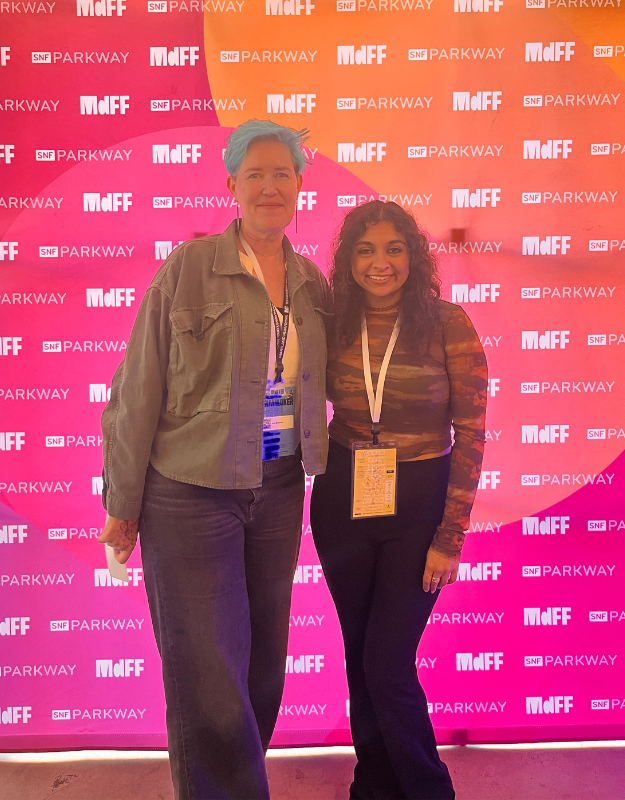
Peabody Award-winning producer Sara Maamouri (left) and director Colette Ghunim (right) share a red-carpet moment at the Maryland Film Festival in April.
We discussed the tour, their collaboration and the powerful impact of Traces of Home.
What has the tour been like?
Sara: We started in November when Traces of Home premiered at DOC NYC. We had three screenings there. Winning “Best U.S. Documentary” was a huge honor for us. We didn’t expect it; we were blown away.
We had a break over the holidays, then in February we were in Montana at the Big Sky Documentary Film Festival. It’s been constant since then, with some back-to-back. It’s been pretty intense.
Colette: Going back to Chicago is special because that’s where we met.
Sara: I got to travel to the Chicago Palestine Film Festival in 2018 with a documentary I co-produced and edited called The Judge about the first female judge in the Middle East. We had a mutual friend in Chicago who made sure we met each other at the festival. I think he knew we both wanted to tell Palestinian stories. We really did have a full circle moment going back to Chicago after nine years of making this film.
Colette, why did you want to tell Palestinian stories?
I’m half Mexican and half Palestinian. I didn’t really know about what was going on in Palestine while I was growing up in the suburbs of Chicago. When I got to college, I started my own cultural exploration. One of the student groups on campus was Students for Justice for Palestine. I thought it was going to be a cultural group. I didn’t know about all the political issues there.
When I started learning about what was happening in Palestine, the occupation and injustice, I was absolutely floored that this was my own father’s story. My father was in the Nakba. I knew it but I didn’t understand the gravity of it until then. It is directly related to my own understanding of myself, and how the forced migration and forced displacement of my father affected our family, too.
So that’s what made me realize I have to fully go into sharing these injustices against my people.
I was struck by how his story became your story. Can you say more about that?
In the beginning, it was just going to be about my parents. I thought I don’t have a story to tell; I’m just a kid from the suburbs of Chicago.
But people kept telling me I needed to go deeper. I started going to therapy for the first time, and that’s when I started to unpack the layers and thinking about not feeling at home. A lot of children of immigrants grow up in the U.S. with intergenerational trauma in their DNA and don’t know how to heal. I went on my own healing journey through Traces of Home.
Did making this film prompt you to go into therapy?
Yes, it did. I had multiple people tell me, “Colette, this is a very heavy topic. You’re going to need some sort of support system behind you as you’re unpacking this. You also have to learn how to do this ethically with your parents. Don’t just throw them into it.”
Sara, why did you want to tell Palestinian stories?
I’m from Tunisia, so I definitely don’t have experience with the trauma of war or displacement. But because I speak Arabic, one of the first jobs I got right after grad school was as an assistant editor on a documentary about Palestinian and Israeli kids called Promises. I was already aware of the situation in Palestine, but that film really did an amazing job of laying out its complexity.
I’m drawn to telling human rights stories. Most of the films I’ve worked on have been about social justice. That’s an area of the world where, again and again, we need to tell those stories to raise people’s understanding, empathy and commitment to help.
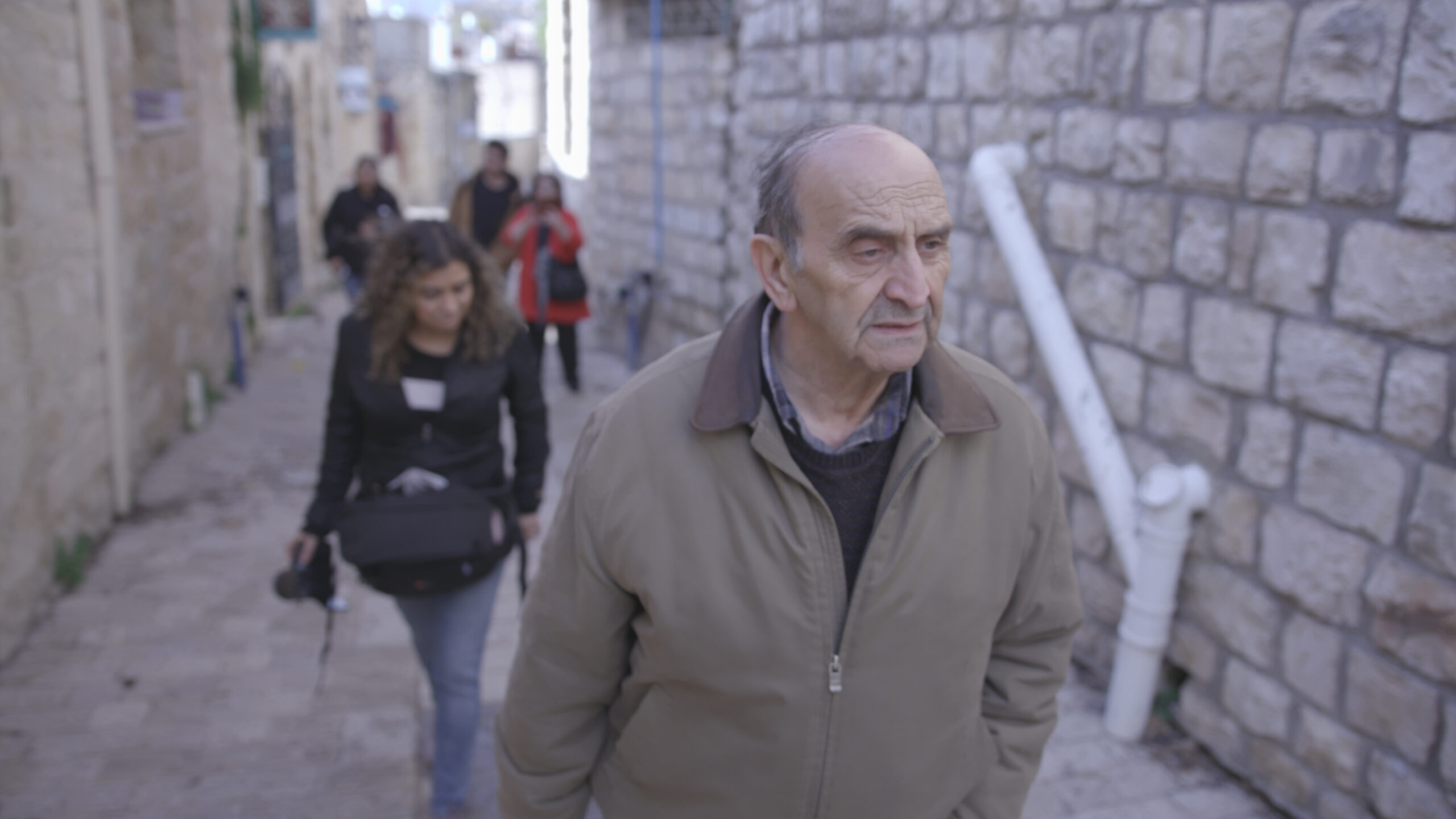
Traces of Home is a features the journey of Colette Ghunim and her parents, immigrants from Palestine and Mexico, to find the homes they fled as children.
Tell me about deciding to work together.
Colette: I remember watching Sara at the Chicago Palestine Film Festival in 2018 and I was so inspired. Her film was phenomenal and she was this boss woman. I was so amazed by her. It would be my dream to get to work with her someday. She was very busy but I decided I would wait for however long it would take. Now we’ve gone through so much together. It’s really a gift.
Sara: My first impression of Colette is that she’s immediately very open, and you can feel she has a big heart. She’s incredibly vibrant and warm-hearted. When we started talking about her film, she told me it would be a little political and very much about her family. As soon as one of her other advisors told her she should put herself in the film, I knew it was going to be great!
Colette: I started interviewing potential editors in 2020 through an accelerator program. Sara was always at the top of my list. We had our first conversation, and it was clear she was the most aligned with the themes of the project, with her heart, sensitivity and care for the family story. And she was willing to make it work with her super busy schedule.
Sara, you’ve been involved with a lot of films. What was unique about this project?
Sara: This was the first time I’d done such a deep dive into somebody’s own personal story. Most of the films I’ve worked on are social justice films. The director was not sitting in the room with me, trying to figure out her own feelings and relationships. It was intense. It was amazing. It was magical and hard. What we went through together was an incredibly unique experience for me.
Colette: I’m so grateful to work with someone who has such extensive experience in making feature-length documentaries. It’s a whole other beast to figure that jigsaw puzzle out.
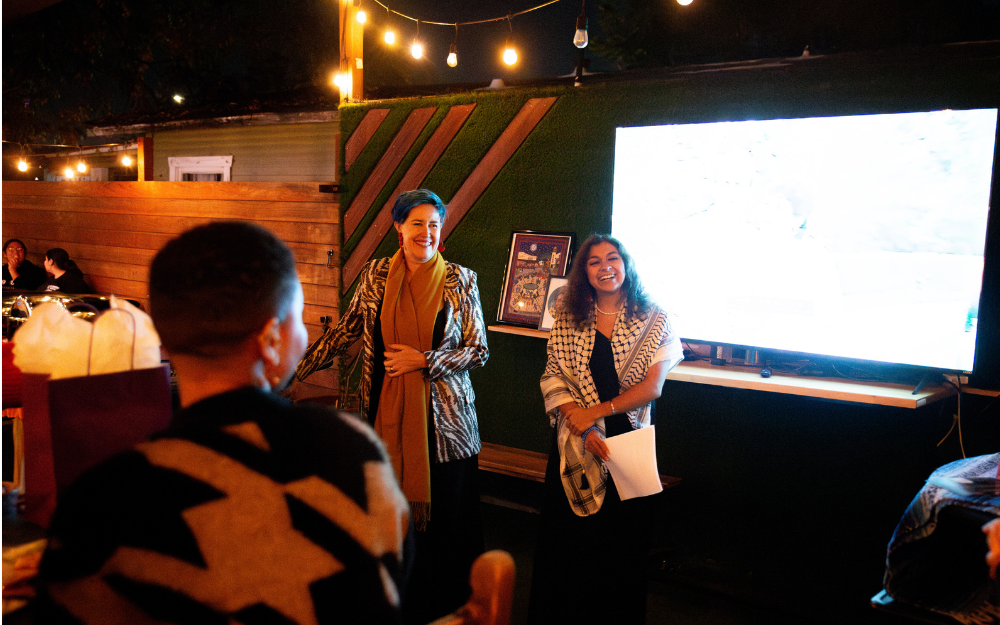
One of the most rewarding parts of this filmmaking process has been receiving feedback from audiences at screenings, producer Sara Maamouri (left) and director Colette Ghunim (right) agree.
What were the significant moments you experienced when making this film?
Colette: We made this film over nine years. It followed my own life trajectory, which went through some really intense ups and downs. Through the process of making this film, I figured out what home was for myself. It feels like the journey that all of us must take as humans, to figure out our sense of belonging, my own identity. Who am I? Why am I the way I am? This film did that work for me.
I learned how I can actually start to find a home within myself and stop trying to find it externally, in these countries and these people, to be able to come back home to self. It was a deep healing journey and I learned my own self-worth. I’m so grateful for it.
Sara: It’s impossible to work on a film like this and not reflect on yourself and your own family. Editing is a long process. Colette and I were in my studio for hours and hours on end, talking about everything nonstop.
Colette: When we started doing screenings and getting feedback, seeing how people connected with it, even in the early, messy stages, was eye-opening and unexpected. We did a screening with 500 high schoolers in San Diego, and they were the ones who reacted the most. They were full of reactions and emotions. We realized they were that age when you’re trying to figure out your own sense of fitting in. It confirmed that they are actually our target audience—the high schoolers, the children of immigrants.
Sara: The reaction at the high school screening was totally unexpected. We were aiming for university and college screenings. We had a screening in Baltimore last week, and a 13-year-old girl was sobbing. She didn’t have any connection to Palestine, but she said it really helped her understand the situation there for the first time.
It is meaningful to people regardless of their cultural background. It’s relatable to everyone about their own families and connections. It has been wonderful to see.
Colette: We’ve had seven screenings so far in the festival circuit. The reception we have received from it, like people coming out with their full emotional catharsis. It’s just unbelievable to see how deeply it has resonated across demographics and ages around the country.
It’s bringing up things I didn’t even know were inside me, around my own upbringing and my parents. I am realizing what has shaped me.
I’m in awe that this medicine that was for my family and me is now medicine for everyone else.