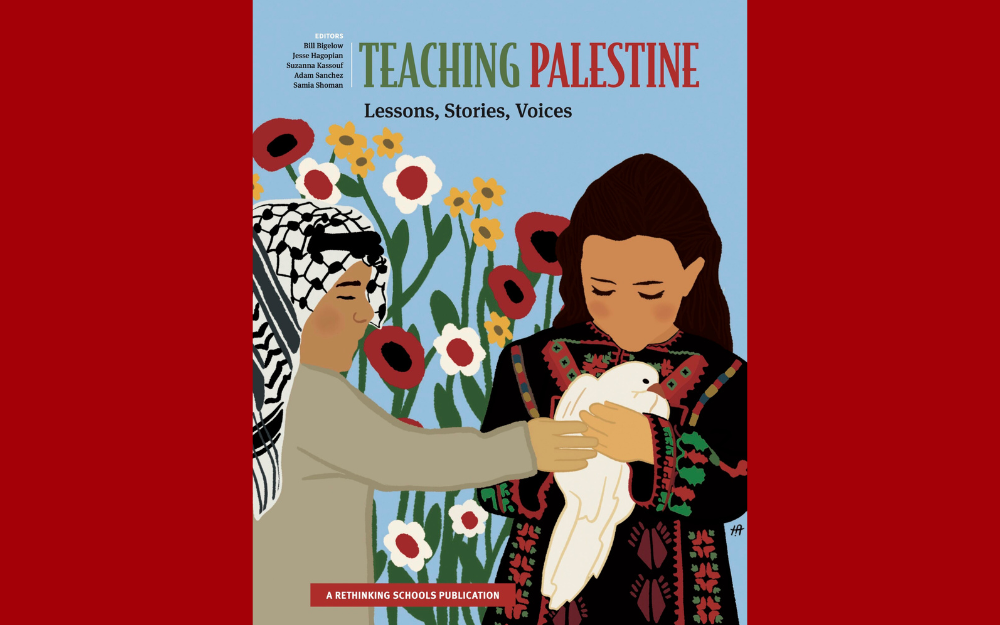
Teaching Palestine: Lessons, Stories, Voices, a nationally award-winning book from Milwaukee publisher Rethinking Schools, offers educators tools to uncover the history and current context of Palestine-Israel in their classrooms.
“The K-12 curriculum across the United States teaches children what is important, what knowledge matters—and crucially, whose lives matter. But silence is also a part of the curriculum. What is missing from school tells young people what not to consider, what not to question, and whose lives do not count. Palestine has long been one of the great silences in the official curriculum,” write the editors of the award-winning book Teaching Palestine: Lessons, Stories, Voices. (Teaching Palestine can be ordered here.)
The book’s editors insist in Chapter 1, Why Teach About Palestine, “that yes, Palestine matters; we need to teach Palestinians’ history, stories, struggles, and aspirations and this does not have to come at the expense of silencing or erasing others’ stories … But just as the Black Lives Matter movement draws attention to the devaluing of Black life, we emphasize the dignity and worth of Palestinians, whose humanity is so often disregarded in the mainstream narrative.”
Teaching Palestine, the latest book from publisher Rethinking Schools, won the 2026 Independent Book Publishers Gold Award in the education category, announced May 15 at IBPA’s annual conference and gala in Portland, Oregon. The IBPA Book Award program is the oldest and most recognized national honor in independent publishing.
Milwaukee-based Rethinking Schools celebrates its 40th anniversary next week with celebrations around the country. For four decades, the non-profit publisher and advocacy organization has been “dedicated to sustaining and strengthening public education through social justice teaching and education activism,” as its mission is stated in its magazine’s masthead. It publishes a quarterly magazine, books and other educational resources that promote equity and racial justice in the classroom.
Today, the organization has a small editorial and business staff around the country, from Milwaukee and Madison to Seattle, Portland, Philadelphia, New Jersey and Columbus, Ohio. They include practicing classroom teachers, retired teachers, teacher educators, teacher union activists, elected school board members and education policymakers.
In this article, the Wisconsin Muslim Journal features Rethinking Schools, America’s preeminent publisher of social justice education materials and publisher of Teaching Palestine, and interviews its co-founder, Bob Peterson of Milwaukee.
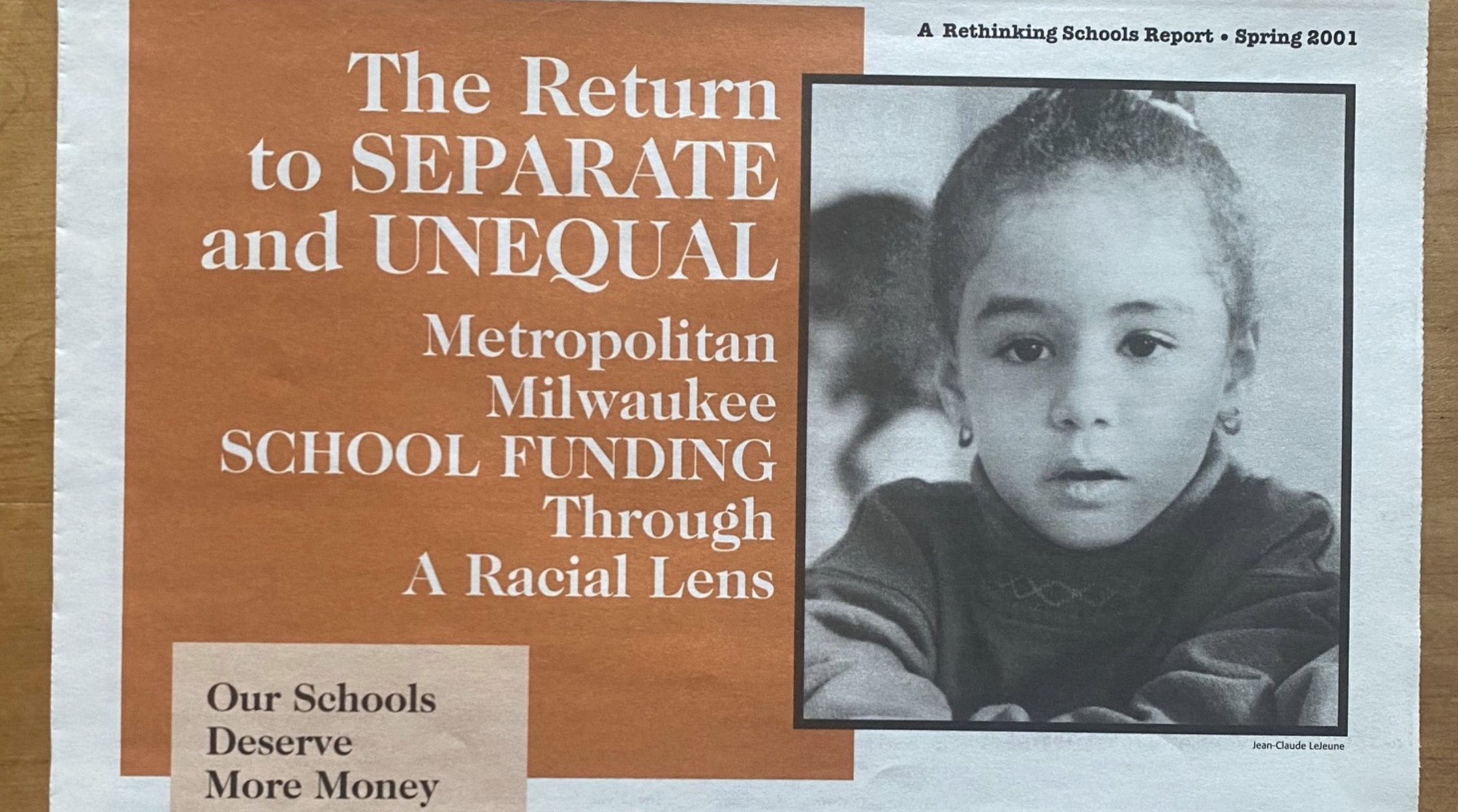
Photo credit Milwaukee Journal
Milwaukee publisher Rethinking Schools produces a quarterly magazine that has promoted social justice education since 1986.
Rethinking School’s notable history
“Who’d have thought that when we laid out the first issue on my kitchen table with rubber cement and an Apple IIe computer that we would still be around at the dawn of AI?” wrote Rethinking Schools co-founder Bob Peterson in an email to Janan Najeeb, Muslim Women’s Coalition’s executive director.
Najeeb remembers when Rethinking Schools operated out of “the old Peace Action Building,” she said. “Marking 40 years is a phenomenal achievement, as is the IBPA award for Teaching Palestine,” she told WMJ.
“We started as a book study group,” Peterson recalled. “It was a group of teachers, a couple of parents, a couple of university folks and community activists. I was teaching 5th grade at the New Fratney School in Riverwest at the time. (It was Wisconsin’s first two-way, bilingual school.)
“We were all about improving the public education system. We decided we were frustrated with what was coming out of the regular press, so we decided we’d start our own magazine,” Peterson said.

Bob Peterson of Milwaukee, teacher and co-founder of Rethinking Schools
Rethinking School’s website reports: “These founding Rethinking Schools editors saw a school curriculum that was conservative, dumbed-down, and dominated by corporate-produced textbooks. Inappropriate standardized testing was rampant. Racial bias infected every level of schooling.” They launched Rethinking Schools “to articulate alternatives.”
“Our first issue focused on how to teach reading,” Peterson said. “We had concerns about how, in Milwaukee Public Schools, teachers were not allowed to have students enjoy reading because we had to follow a scripted curriculum. We challenged that.
“We published 6,000 copies of the first issue. We got it laid out and printed. Then we wrapped and bundled them, and distributed them to schools, local libraries and community centers, free for the taking.
“How did we pay for it? Well, we started just out of our own pockets, and then we offered subscriptions. After a few issues, we reached out to some progressive organizations that ultimately helped us move to a much more sophisticated level.
“We were one of the first national publications that dealt with and encouraged social justice teaching,” Peterson said. “Nowadays there’s a variety of books published on teaching social justice. That wasn’t the case when we started.”
Rethinking Schools’ quarterly magazine has been published continuously since 1986. It now has subscribers in all 50 states, 10 Canadian provinces and in multiple countries around the world.
“It is unusual that a publication like ours can exist for 40 years,” Peterson reflected. “Many publications have folded—the Southern Poverty Law Center’s Teaching Tolerance Magazine, which was a good magazine, and several others. It’s really a challenge to sustain the work.”
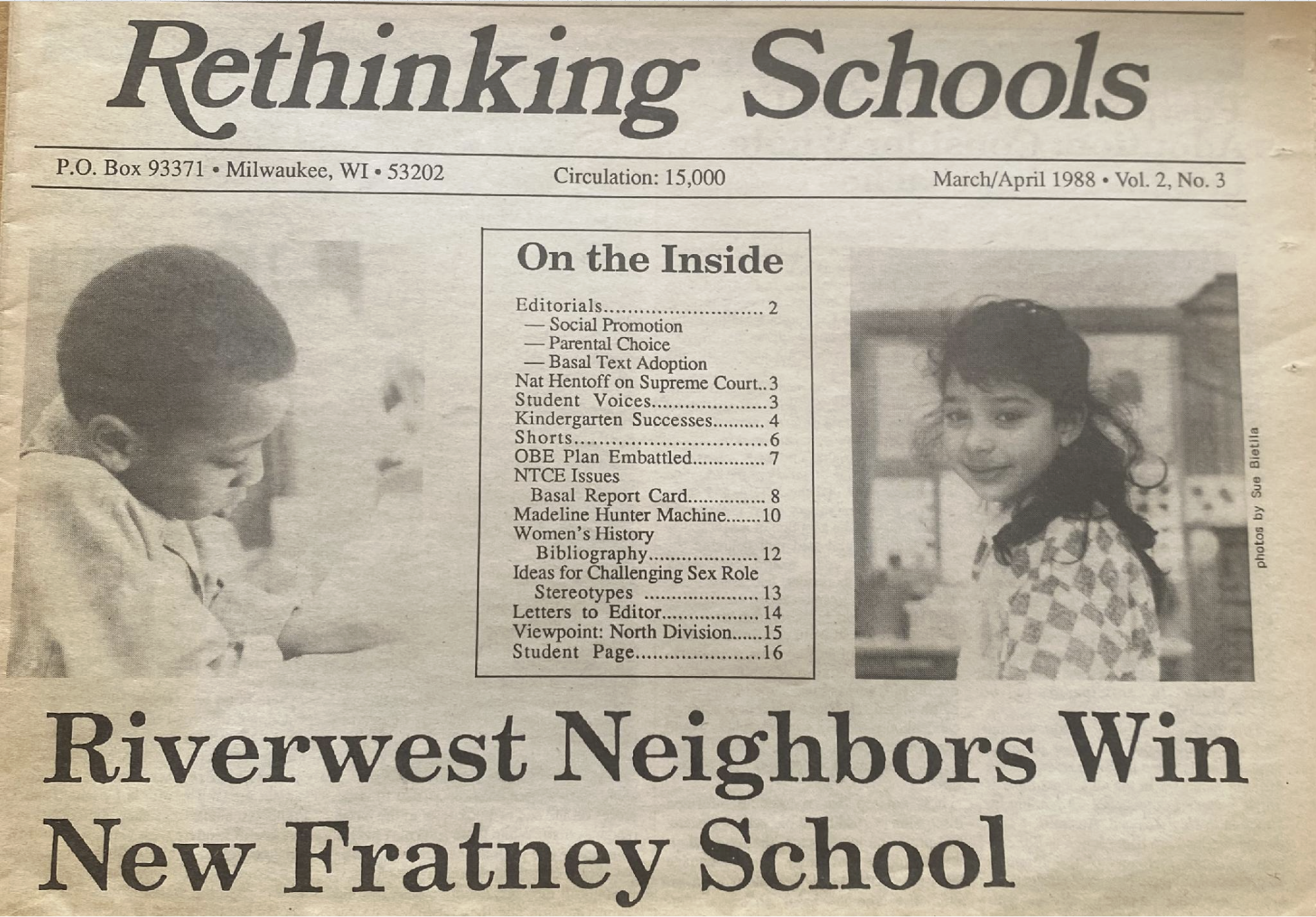
Photo credit: Milwaukee Journal
Rethinking Schools began as a free tabloid, distributed to Milwaukee schools, libraries and community centers.
Causing a stir
In 1991, on the eve of the Columbus Quincentenary, Rethinking Schools published a 96-page pamphlet, Rethinking Columbus, Peterson recalled. “We had a lot of input from the native communities in Wisconsin and around the country. It gave the native perspective, which of course challenged the traditional lessons.
“In the first print run, we published 30,000 copies. They went fast and we continued to publish 30,000 for the next eight months. It sold 1,000 copies a day for three solid months. It was unbelievable! That put us in the national limelight.”
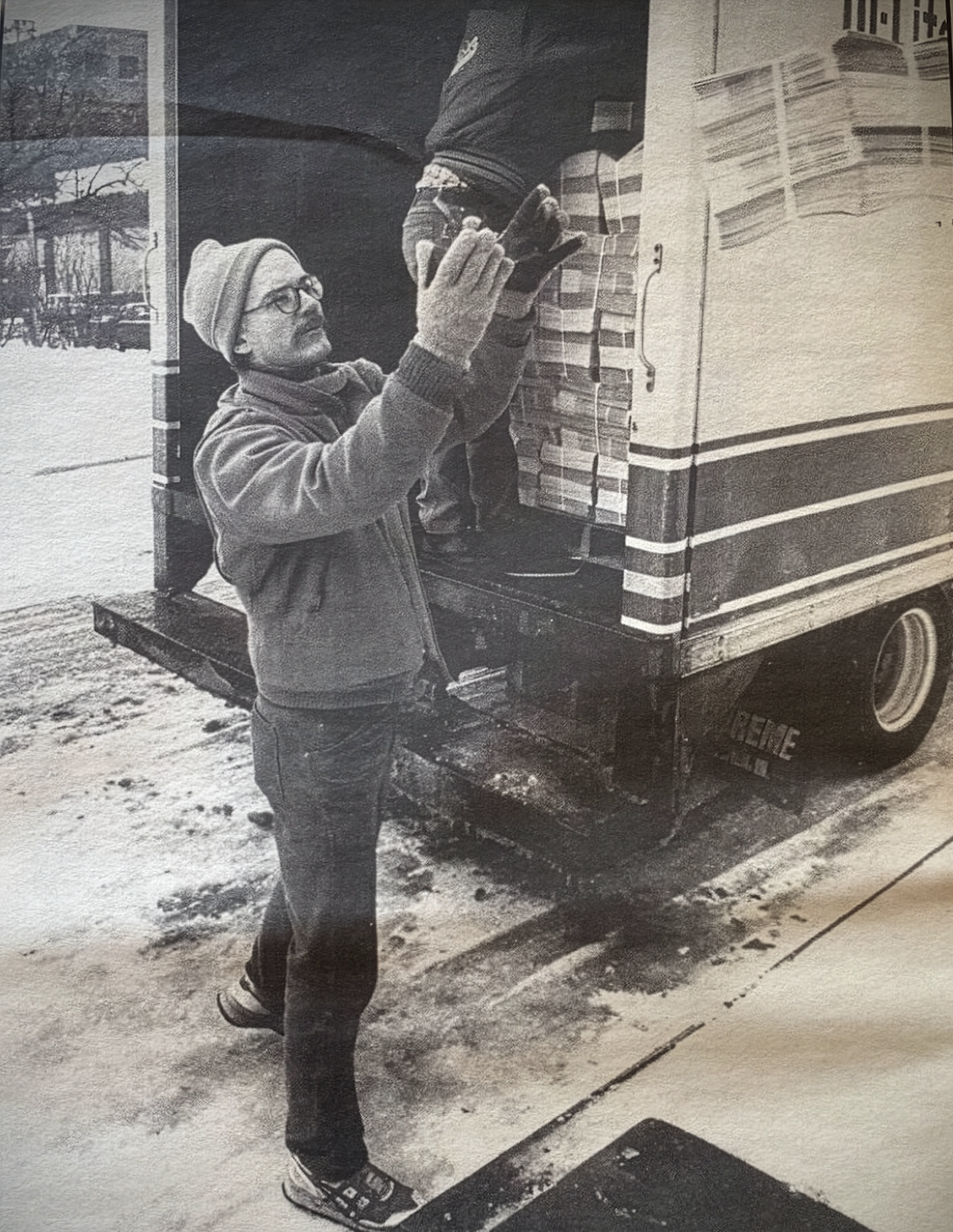
Photo credit: Dave Schlabowske
Bob Peterson delivered Rethinking Schools in 1992.
Rethinking Columbus became Rethinking Schools’ first book. “Through the years, Rethinking Columbus has sold about 300,000 copies, and articles in the book have been reprinted everywhere,” its website says. “Rethinking Columbus workshops have been sponsored by teacher unions, teacher education programs, Native American organizations, and school districts. As the historian Howard Zinn said, Rethinking Columbus ‘made educational history’ and changed the way Columbus is taught in schools throughout the United States.”
In 1994, Rethinking Our Classrooms: Teaching for Equity and Justice was published. It collected the best classroom teaching articles from Rethinking Schools magazine. It sold tens of thousands of copies and was followed in 2001 by Rethinking Our Classrooms, Volume 2. Both became key texts in teacher education programs.
Since then, Rethinking Schools has regularly published books across various disciplines and topics. “We publish two or three books a year,” Peterson said. Among its publications are books on race, culture, language, teacher unions, school reform, standardized testing, history, social studies, media, mathematics, climate and environmental justice.
Creating free resources for teachers
Its Zinn Education Project, named for “the people’s historian” Howard Zinn and coordinated in collaboration with Teaching for Change, has provided resources for teachers since 2008. It introduces students “to a more accurate, complex, and engaging understanding of history than is found in traditional textbooks and curricula,” the project’s website explains. More than 100,000 educators use its free, downloadable lessons and articles organized by theme, time period and grade level.
“The empowering potential of studying history is often lost in a textbook-driven trivial pursuit of names and dates. We believe that through taking a more engaging and more honest look at the past, we can help equip students – and all of us – with the analytical tools to make sense of and improve the world today.”
Teaching Palestine
“Teaching Palestine: Lessons, Stories, Voices provides educators with powerful tools to uncover the history and current context of Palestine-Israel in the classroom — poetry, personal narratives, interviews, role plays, critical reading and writing activities, and more,” says a press release from Rethinking Schools. “Teaching Palestine offers a defense of Palestinian humanity, centering Palestinian lives, uplifting and celebrating Palestinians’ struggle for justice, and critiquing racism and inequality.”
“… every educator on the planet needs this book,” wrote Robin D. G. Kelley, distinguished professor and Gary B. Nash Endowed Chair in U.S. History at UCLA. “This is a text that can correct lies, open minds, and possibly save lives. Any book that can do that is worth fighting for.”
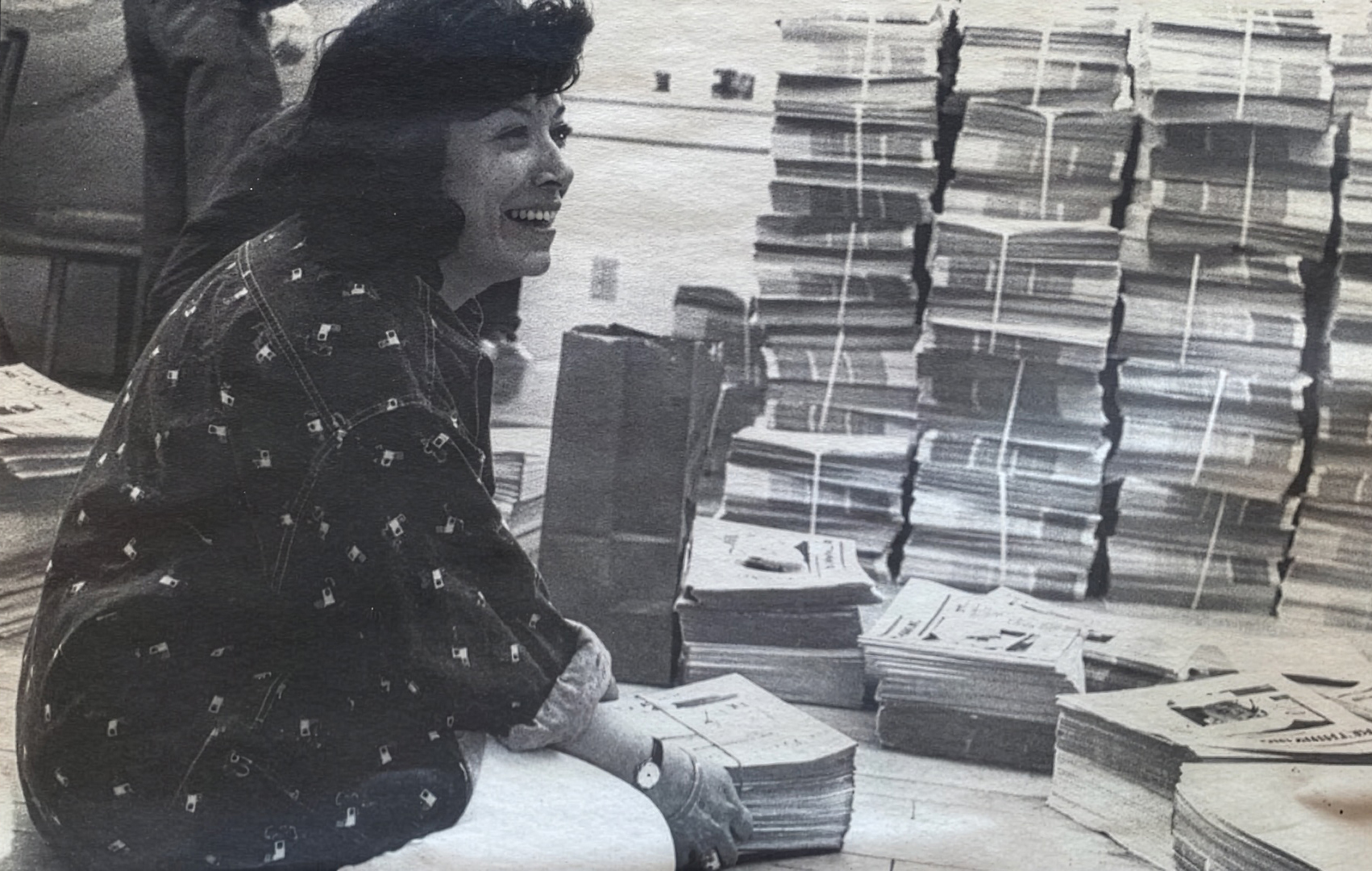
Photo credit: Milwaukee Journal
In its early days, Rethinking Schools was a volunteer operation, with co-founders and editors doing everything from laying out the tabloid to wrapping, bundling and delivering it.
It is one of several publications that have faced a backlash. “We’ve definitely received criticism from some people who really don’t like what we stand for,” Peterson said. For example, Rethinking Schools published a special edition after 9/11 that raised questions about why people around the world would be angry at the United States. “We received a grant that gave us money to send 40,000 copies of the magazine to public high school teachers around the country. It had articles against discrimination of Muslims and about how to teach the sensitive issues around (the historical context of ) 9/11.
Teaching Palestine “received criticism online by pro-Zionists,” Peterson said. “It’s hard to say what impact that has. Some people may say, ‘I don’t want to read that; I don’t want to hear that.’ On the other hand, there’s a whole growing group of people who are very eager to learn about the history of Palestine and to find ways to engage students in looking critically at what’s going on.”
As a high school student, Peterson lived in Egypt for two years when his father worked there as a soil scientist in the 1960s. They were sent home by the United States after the Six-Day War in 1967, he said.
“At 15, I decided to figure out what end was up. I studied what was going on in Palestine and read the Journal of Palestine Studies. It convinced me the Palestinians have the right to exist. I wrote letters to the minister of the church I attended in Madison, encouraging him to look at things from both perspectives.
“Growing up around the issue, I was really pleased that Rethinking Schools was able to publish this book,” he said. “We made sure that Palestinian voices dominate the book. A couple of the editors are Palestinian.
“I’m a strong believer that children from the upper grades in elementary school on can, and should, be following issues around the world. I’m hopeful that our efforts at Rethinking Schools can inspire enough teachers, both new and veteran teachers, to continue teaching the truth.”