Federal immigration enforcement in Minnesota unfolded in rapid, escalating stages, from a massive federal deployment, to civilian deaths, to children taken from school routes, and finally to statewide protests and political rupture, transforming what the Trump administration called a crime-focused operation into one of the most contested crackdowns in recent U.S. history.
The surge begins
In early December 2025, the Trump administration launched Operation Metro Surge, sending more than 3,000 federal agents across Minnesota in what the Department of Homeland Security described as its largest immigration enforcement operation ever. The stated goal was to target undocumented immigrants accused of violent crimes, as officials pointed to shootings and alleged fraud within immigrant communities.
President Donald Trump publicly framed Minnesota as a problem state, accusing some members of the Somali American community of fraud and using inflammatory language, describing Somali immigrants as “garbage” who should be thrown out of the country.
Federal officials argued the show of force was necessary because of what they called weak Democratic immigration policies. Local leaders countered that agents were conducting warrantless entries, racial profiling, and detaining U.S. citizens.
First killing ignites public anger
Tensions erupted on January 7, when ICE agent Jonathan Ross fatally shot Renee Good, a 37-year-old U.S. citizen and mother of three, during an enforcement-related confrontation in Minneapolis.
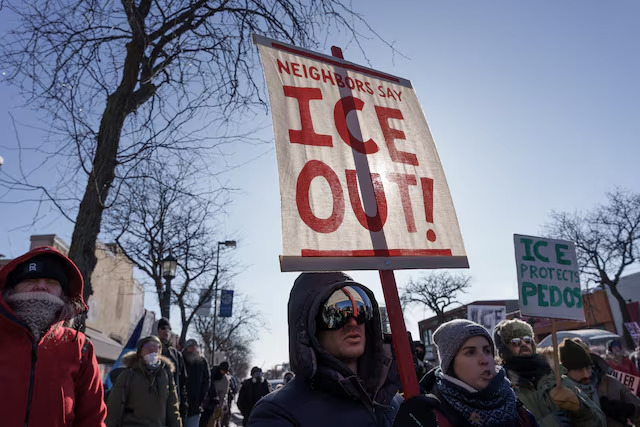
Her death immediately sparked daily protests across the Twin Cities. Community members began tracking ICE movements, blowing whistles to warn neighbors of raids, and confronting heavily armed federal officers in streets, churches, and neighborhoods.
Federal authorities showed no sign of retreat. Instead, arrests were announced even against protesters, including those who disrupted a church service in St. Paul. FBI Director Kash Patel said one organizer was charged under a federal law related to obstructing houses of worship.
Children drawn into enforcement
By mid-January, the crackdown reached schools. In Columbia Heights, school officials confirmed that ICE agents had detained at least four students, including five-year-old Liam Conejo Ramos.
Superintendent Zena Stenvik described armed, masked officers surrounding school spaces.
“ICE agents have been roaming our neighborhoods, circling our schools, following our buses, coming into our parking lots multiple times and taking our kids,” she said.
“The onslaught of ICE activity in our community is inducing trauma and is taking a toll on our children.”
“ICE agents have been roaming our neighborhoods, circling our schools, following our buses, coming into our parking lots multiple times and taking our kids,” she said.
“The onslaught of ICE activity in our community is inducing trauma and is taking a toll on our children.”

Liam was taken after returning from preschool with his father. Witnesses said agents seized the father in their driveway, then placed the frightened child into a black SUV — despite neighbors and school officials offering custody.
“I can’t imagine what was going through Liam’s mind,” said city council member Rachel James.
“He was frozen and paralyzed… he looked so scared.”
School board chair Mary Granlund said officers attempted to use the boy to draw his mother out of the house.
“When asked if the boy was being used as bait — correct,” she said.
“Children should be in school with their classmates.”
Other cases followed:
• a 17-year-old pulled from a car on the way to school by masked agents
• a 10-year-old detained with her mother while heading to class
• an 8-year-old taken from an apartment days later
Families reportedly had active asylum cases and no deportation orders. Children were transferred to detention facilities in Dilley, Texas.
DHS spokesperson Tricia McLaughlin insisted children were not targets.
“An officer remained with the child for his safety while others arrested the man,” she said, adding that parents are asked whether children should be placed with designated caregivers or removed with them.
Top ICE official Marcos Charles accused Liam’s father of abandonment. School officials and witnesses rejected that account.
Legal battles emerge
Attorneys began challenging the detentions. One family lawyer said he was considering habeas corpus to secure Liam’s release. A judge separately ordered the release of a 2-year-old girl from federal custody. Minnesota filed lawsuits arguing the operation used unconstitutional force, while the Department of Justice defended the crackdown as necessary enforcement.
By January 27, more than 3,000 arrests had been reported statewide, with patrols continuing.
The state also accused the federal government of retaliation after U.S. Attorney General Pam Bondi reportedly demanded access to voter and Medicaid data as a condition for pulling back agents — a demand Minnesota rejected as coercive.
Second death deepens crisis
Public outrage intensified further when federal agents shot and killed Alex Pretti, a 37-year-old U.S. citizen and intensive care nurse, during a protest confrontation.
Authorities claimed Pretti acted aggressively and the shooting was in self-defense. But bystander videos and witnesses contradicted that narrative.
Pretti’s parents the official version.
“The lies told about our son are sickening and reprehensible,” they said.
“He had a phone in one hand and his other hand raised above his head while trying to protect the woman ICE just pushed down.”
“Please get the truth out about our son. He was a good man.”
Former supervisor Dr. Aasma Shaukat described him as deeply compassionate.
“He really wanted to work in the health care field, with patients — and he thought veterans were particularly vulnerable,” she said.
“He was a team player and got along with everyone.”
Neighbors called him “gentle,” while a grieving family member recalled how Pretti comforted them during a veteran’s final moments at a VA facility.
Governor Tim Walz and other Democrats demanded accountability and investigations as ICE and Border Patrol tactics came under national scrutiny.
Statewide resistance grows
By late January, Minnesota had become a focal point of national protest.
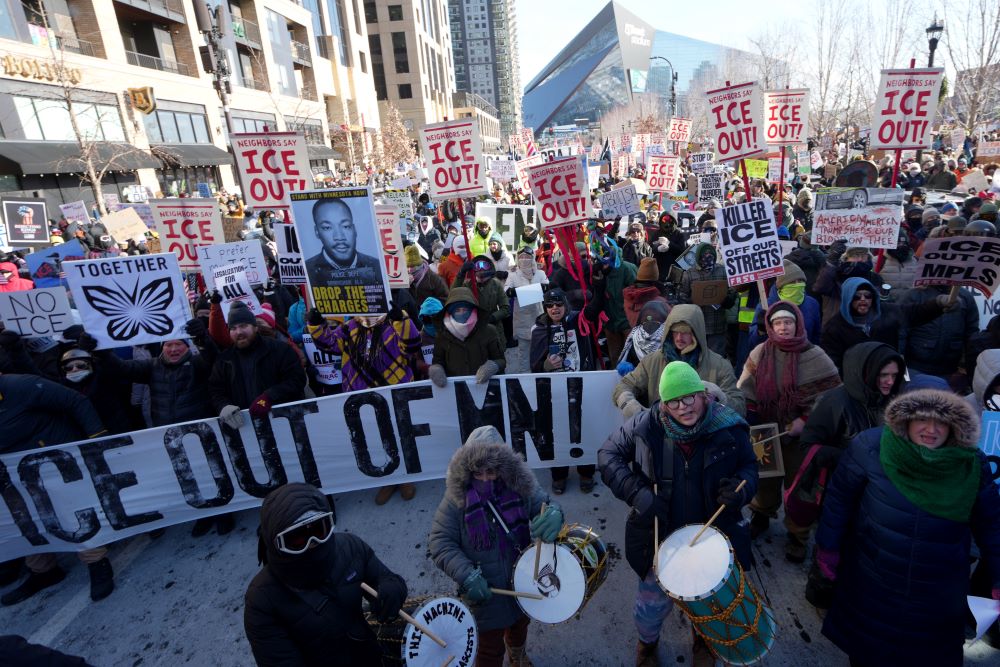
About 100 clergy members were arrested at Minneapolis–St. Paul International Airport while demonstrating against deportation flights. Thousands more marched downtown despite Arctic temperatures. More than 700 businesses closed statewide in solidarity.
“We cannot abide living under this federal occupation of Minnesota,” said Rev. Mariah Furness Tollgaard, who chose arrest in support of frightened migrants.
“What’s happening here is clearly immoral,” said Rev. Elizabeth Barish Browne.
“The kind of ice that’s dangerous to us is not the weather.”
Some protests turned tense, with reports of road blockades, ice chunks thrown at federal vehicles, and daily confrontations near schools and federal buildings.
Political fallout splits Republicans
The crisis soon fractured Trump’s own party.
Republican gubernatorial candidate Chris Madel abruptly ended his campaign,Operation Metro Surge had transformed into collective punishment.
“I cannot support the national Republicans’ stated retribution on the citizens of our state,” Madel said.
“United States citizens, particularly those of color, live in fear. Citizens are carrying papers to prove their citizenship. That’s wrong.”
“I have read about and spoken to countless United States citizens who have been detained in Minnesota due to the color of their skin.”
He condemned home raids conducted with civil warrants and said even minority law enforcement officers had been stopped by ICE.
Though he once supported removing “the worst of the worst,” Madel said the operation had expanded far beyond public safety — a sentiment now echoed by many local officials.
A state transformed
What began as a federal immigration enforcement campaign has reshaped daily life in Minnesota.
Children with asylum claims are in detention.
Two U.S. citizens are dead.
Schools operate under fear.
Churches have become protest grounds.
Lawsuits are piling up.
Political alliances are breaking.
Federal authorities continue to argue the crackdown is about safety and cooperation. Communities on the ground say it has produced trauma, racial targeting, and constitutional violations.
By Kanza Eemaan