Photos courtesy of the Milwaukee Islamic Dawah Center
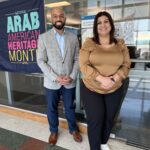
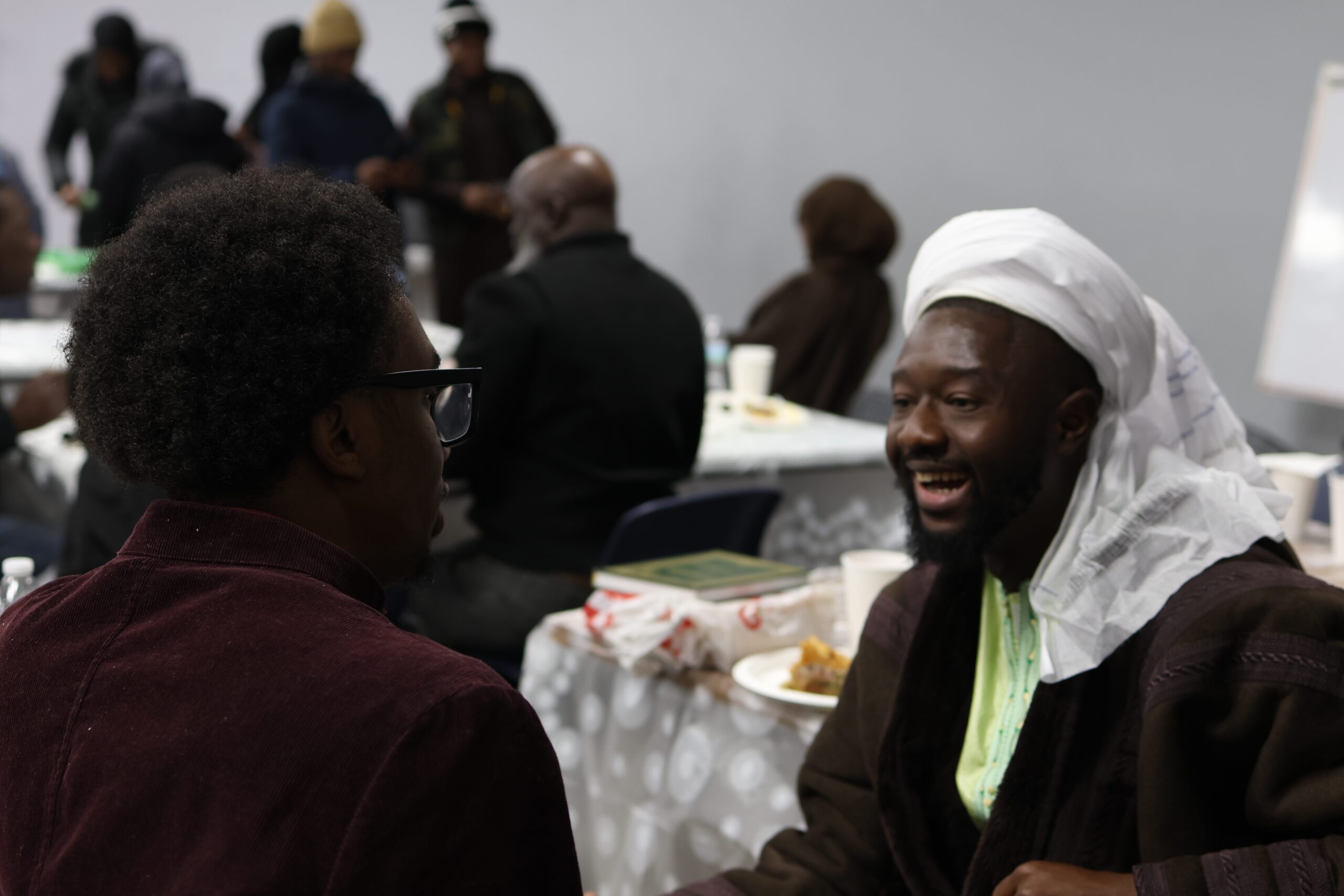
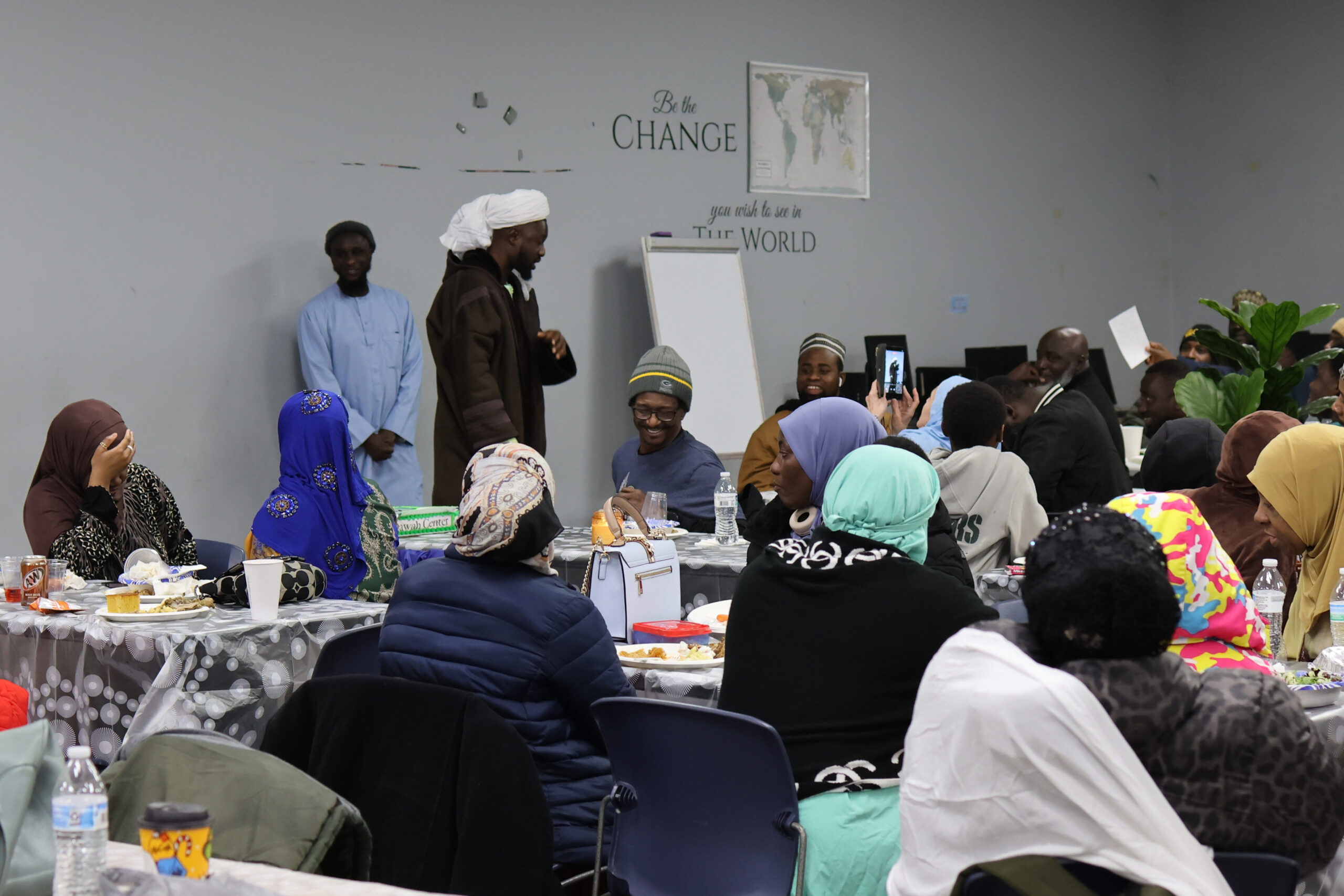
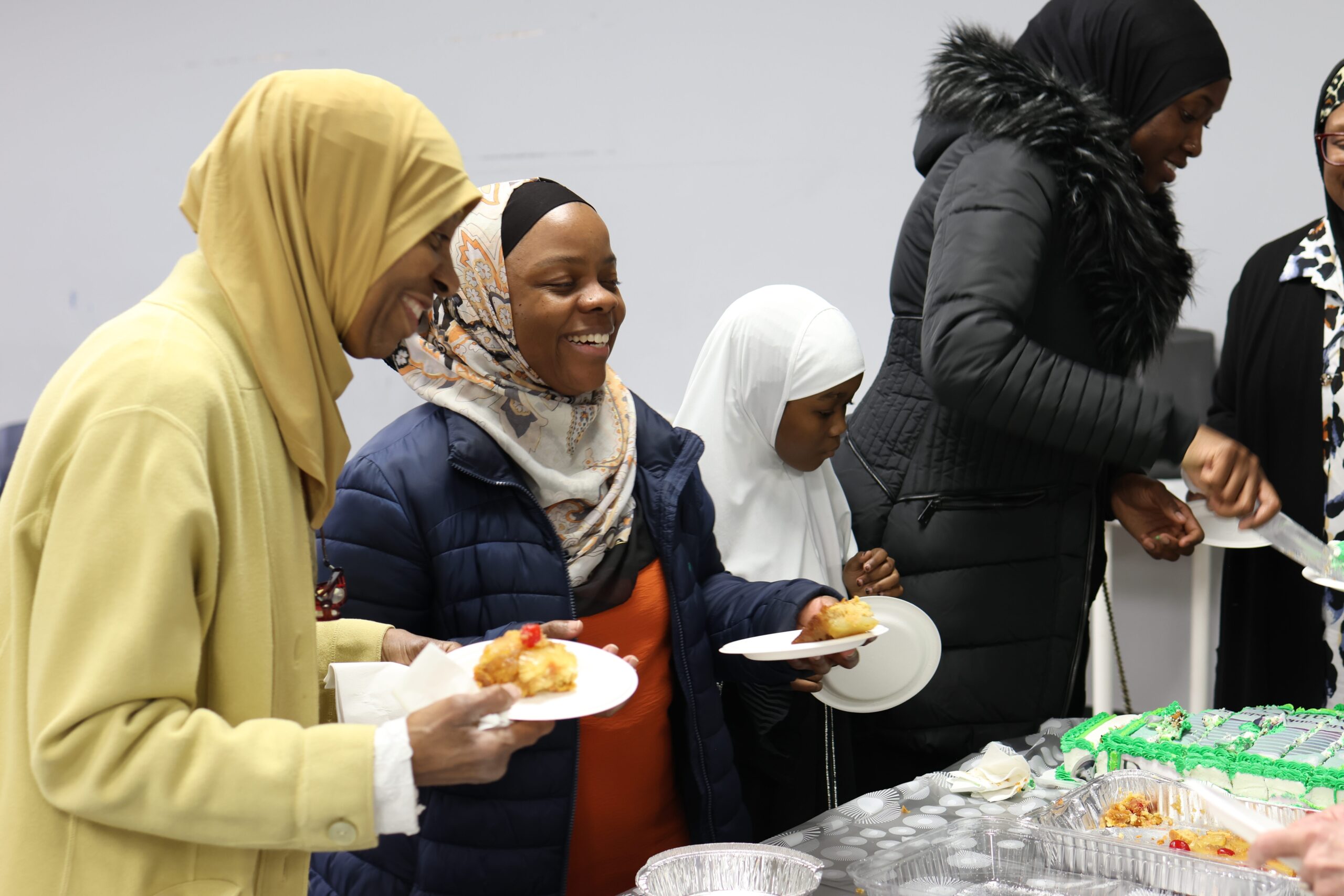
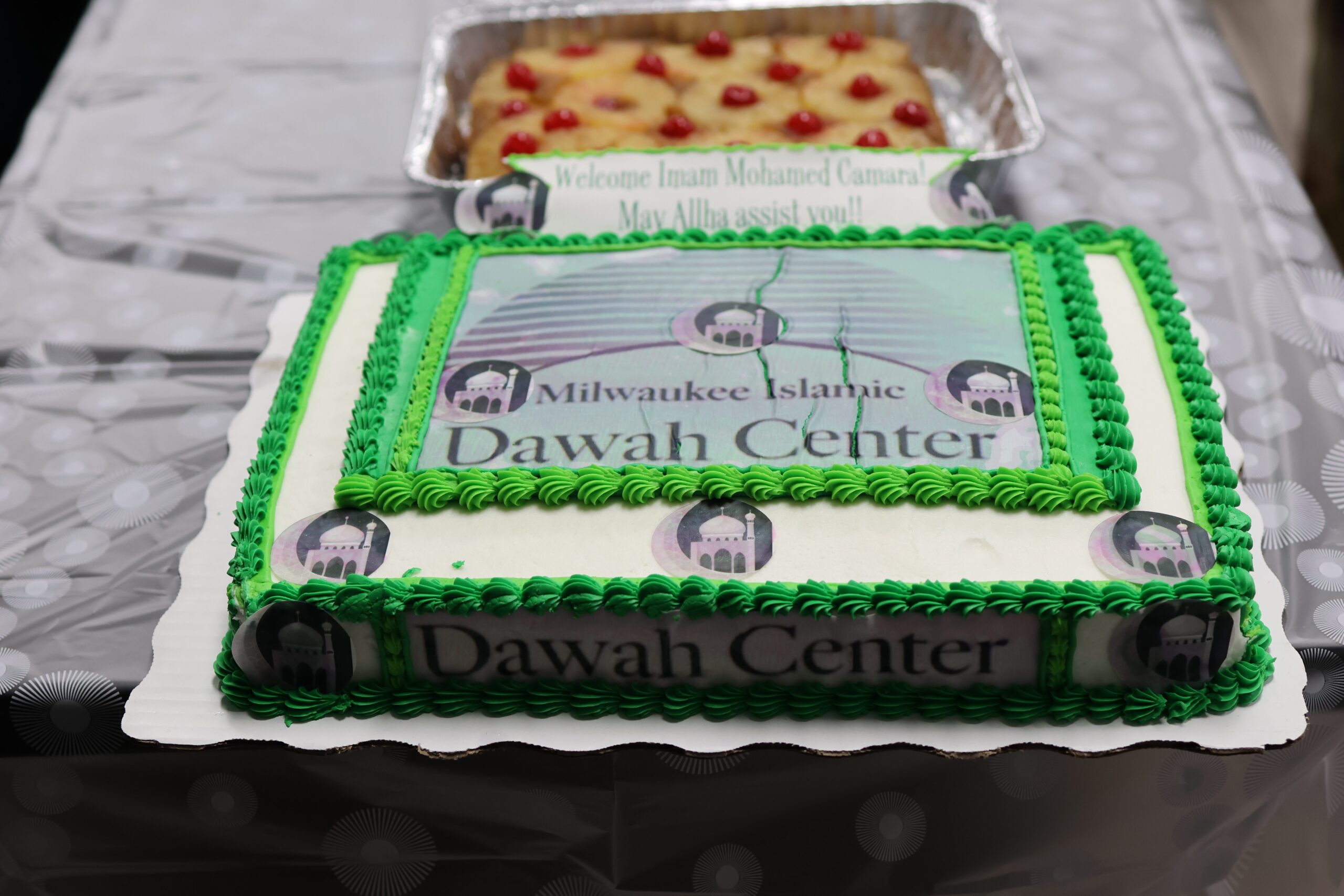
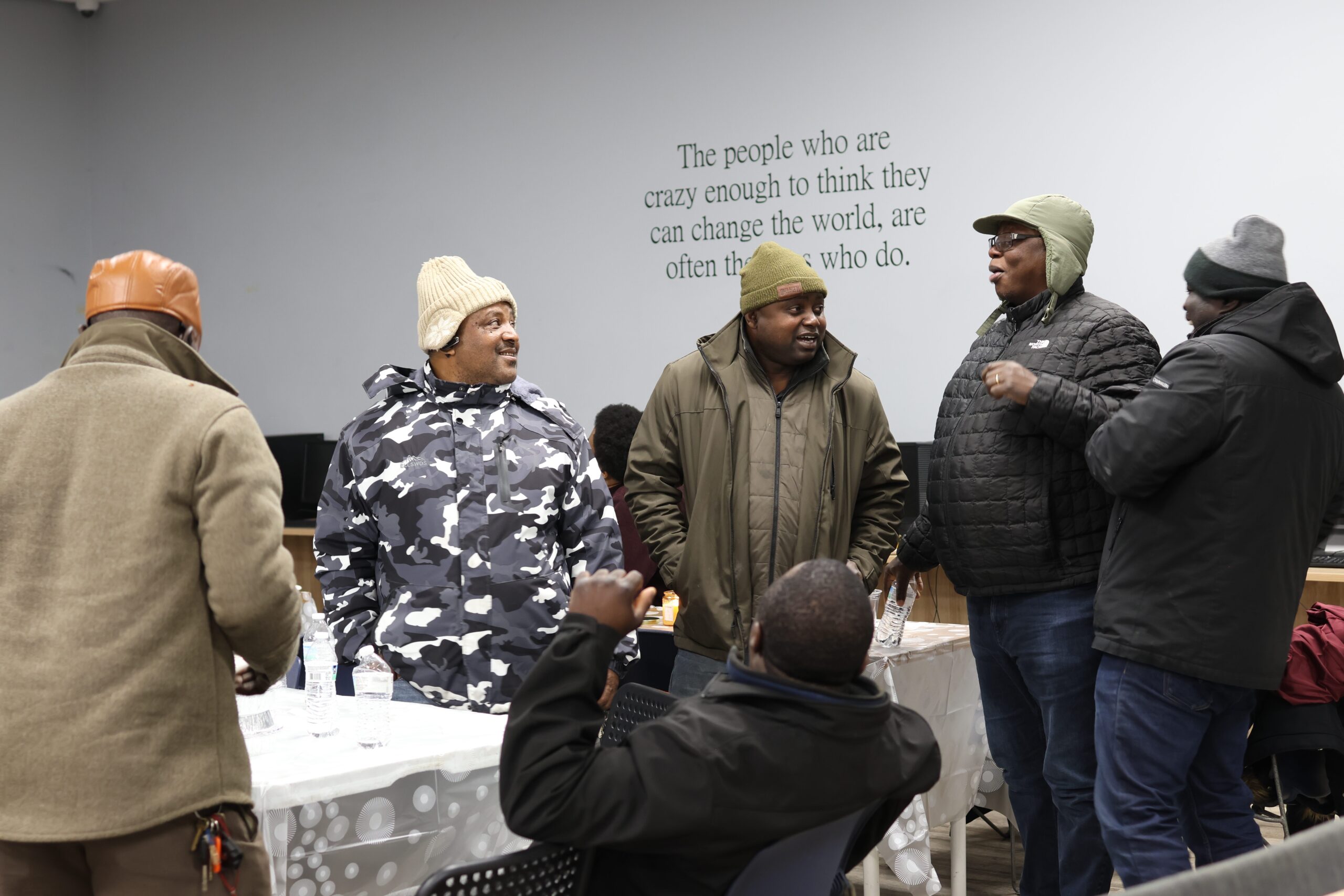
The Milwaukee Islamic Dawah Center celebrated the appointment of its new imam, Mohamed Camara (right), with a community dinner on Dec. 5.
Without an imam for four years, Milwaukee Islamic Dawah Center finally secured one from within its own community; thirty-two-year-old Mohamed Camara started Dec. 4.
Camara’s surprising journey from a typical American high school kid to religious scholar to the imam of an established religious community by the young age of 32 is a story worth hearing.
The search is on
Dawah Center Board President Burhan Clark said the board had been “passively looking” to fill the imam position since the winter of 2021, but the process had stalled.
And, for a while, they didn’t appear to be in a hurry to get it moving again. The community continued on rather smoothly during its first three years without an imam at the helm. Sheikh Nurideen Zakaria, who had served as the imam for a long stint that ended in 2010, showed up every day from dhuhr (noon) to isha (evening) prayers, offering spiritual guidance to community members. Three others, including Camara, led prayers and helped fill the leadership gap with their religious knowledge, Clark said.
Then Sheikh Zakaria’s son wanted his aging father to live near him on the West Coast; Sheikh Zakaria moved away in October 2024.
That meant a big change for the Dawah Center, Clark said. “While most mosques close their doors between prayers, the Dawah Center stays open from dhuhr to isha every day of the year.” People seeking help know they are welcomed—a woman facing domestic abuse who needs a place to stay, a teenager with questions or a father laid off and wondering how to feed his family. “Where would they go if the doors were locked?” Clark asked.
“That was when we decided to refocus and really push hard to fill the position,” Clark said. “We involved the entire shura (executive board) in thinking, ‘Hey, what do we want? What do we need? How do we get them here?’
“It’s a challenging position to fill, getting the right person who could mesh with the Dawah Center to come to Milwaukee,” he explained. “We really punch above our weight. In a larger city, an imam may have very little influence. Here, mayors and governors show up. We have the largest Muslim food pantry in the country and offer a lot of services that are outsized for our smaller footprint.”
Eyes on Camara
Camara had served on the shura for six years. “He was one of the primary people helping us find an imam,” Clark said.
The board considered Camara “for quite a while,” Clark said, “but there was an understanding he wanted to continue his education. He was doing different work, studying, busy with his children and family, doing some traveling, establishing himself, and also helping on the shura and in other capacities at the Dawah Center.
“I even asked him about a year ago and he said, ‘No,’” said Clark. “He felt the position needed a long-term commitment and he had other plans.” (Camara and his mother are establishing Islamic schools in their native country, Guinea, West Africa, and Camara intends to create an Islamic university there.)
Then, at a board meeting this fall, Vice President Sr. Aminat turned to Camara and said, “Why aren’t you doing this?” Clark recalled.
In an interview with the Wisconsin Muslim Journal, Camara recounted that moment. “Everyone looked at me and asked, ‘Why are you making us go through all of this when you could take the position?’
“I found it a difficult question to answer. I had been studying and perhaps had been qualified for the position for a long time. But the weight of the responsibility kept me away. It’s huge! Yet, with those responsibilities come rewards and opportunities to please Allah.”
Camara decided to go home and pray with his family about it. “(The prayers) left me with an easy feeling. I did not feel anxious about taking the position,” he remembered. “I took that as a sign.”
Camara accepted and began his post Dec. 4. The community honored him as the new imam with a dinner on Dec. 5.
“We are excited about it,” Clark said. “At the Dawah Center, a real balance is needed by someone who is understanding and accommodating of the community’s variation of belief and also able to keep that variation within the path of Islam.” Camara has the ability to do that, as well as the desire to continue learning and developing skills, Clark said.
“You can feel the enthusiasm in the community. It’s like having a New Year’s resolution and getting a treadmill,” he added with a laugh. “We’re all in. I’m glad. Now we want to maintain it because our success depends on the consistency of everyone’s engagement, not just the imam’s.”
Camara’s unique journey
Camara’s mother, Gnalen Konate, known in the Milwaukee Muslim community as Sister Hadjaa, honored her mother by naming her son Mohamed for her mother’s father. Camara had a special relationship with his grandmother, “like a mother and son,” Konate said.
Konate left Guinea, West Africa, in 2001 to seek asylum in the United States. “I came to save my life,” she said by way of explanation.
She left her only child, Camara, 8, with her mother, planning to bring them to the U.S. when she could. “I cried and prayed every day that I could bring my mom and Mohamed.” When her asylum was approved, she began the process to help them immigrate.
Meanwhile, she had moved from the East Coast to Milwaukee. “She was in the business of braiding hair,” Camara explained. She found the hair-braiding business in the cities she had heard of, New York and others, saturated. She learned Milwaukee had a large population of African Americans, her target market, so she moved here. “We came two years later, when I was 10,” he said.
Camara had a lot of responsibility from an early age, his mother told WMJ. “My mom was sick and he took care of her,” she said. “He wouldn’t go play with friends even if you paid him to. He’d wake at 4:30 and make her tea. He would make sure she had everything she needed before he’d leave at 6 a.m. to go to school.”
When Camara was 12, his grandmother died. His earliest memories of the Dawah Center community were of his grandmother’s funeral and burial. “Since that time, I have always been part of this community,” Camara said.
His mother remarried. “I had three babies back-to-back,” she said. “Long story short, my husband couldn’t stay and left us with the babies, so Mohamed became the father to my three boys. He helped cook and clean. He would help me with everything. He was my center.”
“I think I was a good kid,” Camara said. “Of course, raising boys isn’t the easiest thing, especially in the inner city. And my mom was a single mother for a lot of that time. That I became an imam is a surprise to all the family. I don’t really come from a scholarly background.”
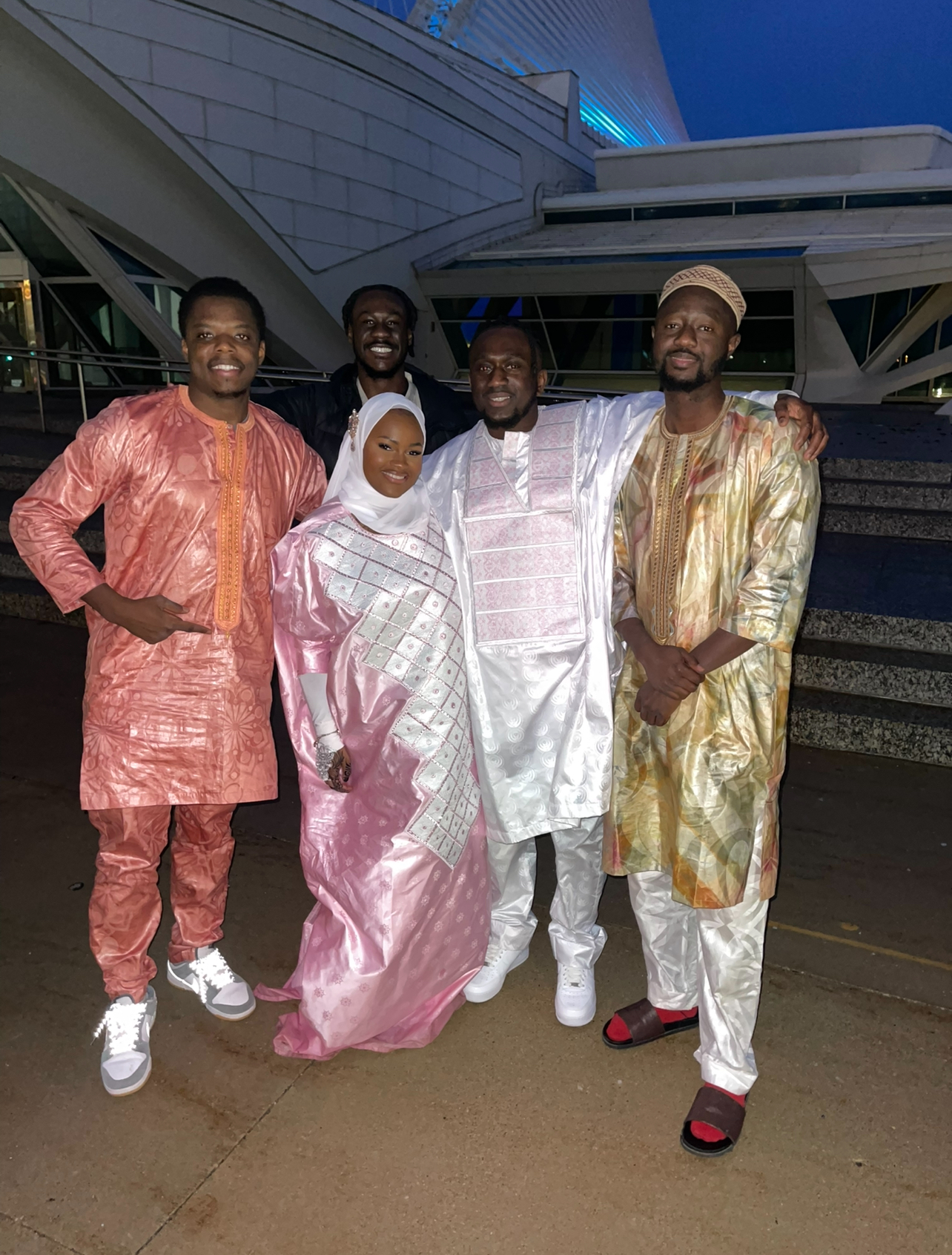
Photo courtesy of Mohamed Camara
Cousins, both named Mohamed Camara, who say they are as close as brothers, flank their friends following their 2024 nikkah.
Becoming a scholar
Camara’s life took a new direction during his junior year of high school. Prior to that, he was a kid going to school and doing his chores but with no particular plans. Maybe it was typical of adolescence, he reflected, but he started wondering about “the purpose of all this.”
At 17, he started frequenting the Brown Deer High School Library, searching for books on philosophy. He found plenty and read them. “The library was pretty decent,” he noted. “The answers to my questions found in philosophical literature brought me to the conclusion that these aren’t questions that can be answered through human faculties.”
That led him to seek books on spirituality. He read Buddhist literature, “but then, eventually, the realization came that beyond spirituality, you need something more universal that answers critical human questions about how we can live together and governance and all of these aspects of daily life.
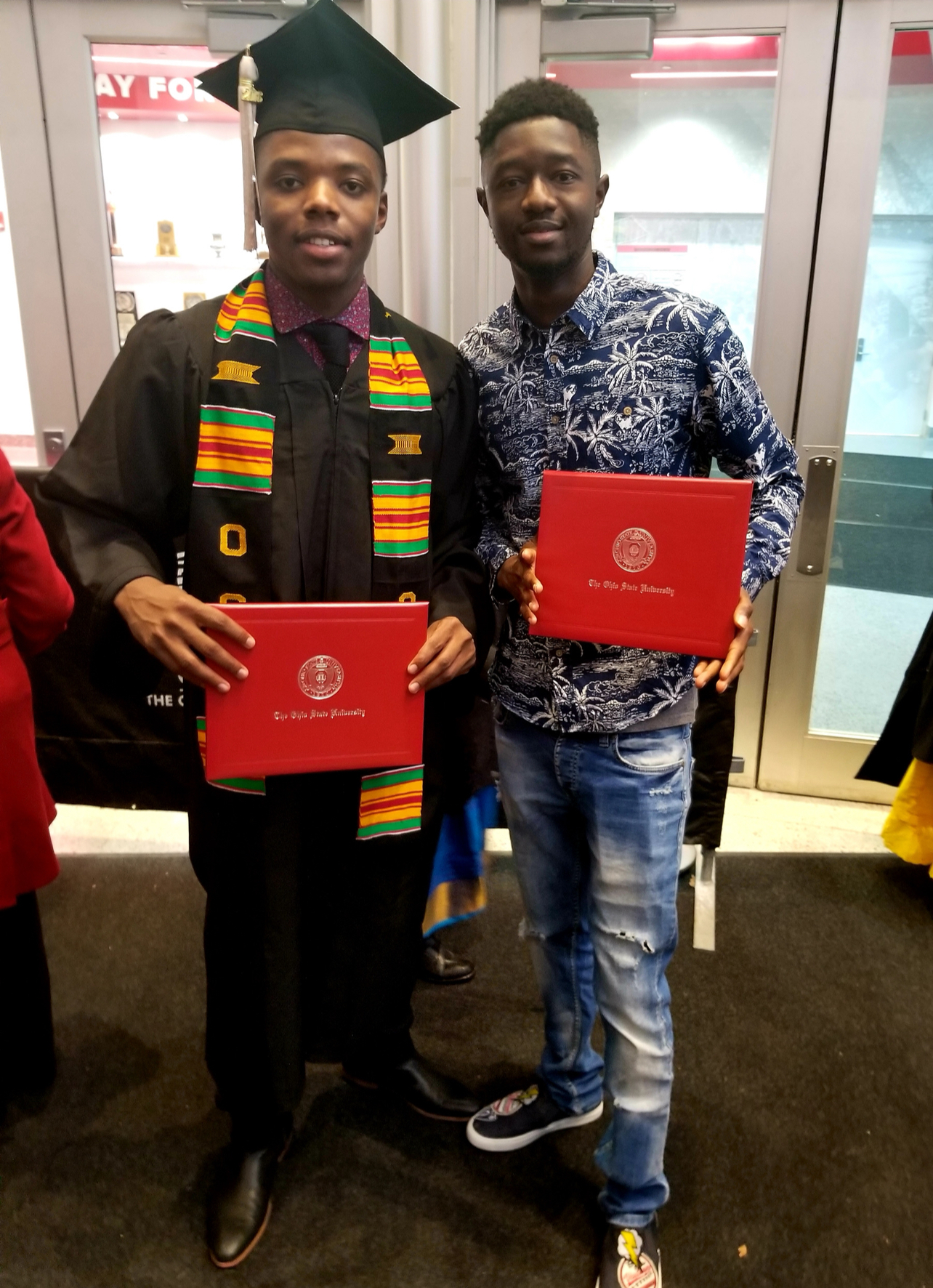
Photo courtesy of Mohamed Camara
Now Imam Mohamed Camara (right) attended his cousin’s graduation in Ohio in 2018. “He always shows up for family,” his cousin, also named Mohamed Camara, said.
“That took me to religion and I started looking into Christianity. I didn’t find anything objectionable. But then, of course, the whole thing about Jesus Christ and the Trinity, I had some issues with that.
“That’s when the light bulb went on in my mind, Islam also has issues with the concept of the Trinity. Why haven’t I looked into the religion I was brought up with?”
Camara had grown up “culturally Muslim,” he said. “We practiced the general belief of God being one and tried to be good. But my faith wasn’t based on inquiry. Now I had an opportunity to relearn the religion I was brought up with.”
His exploration into the meaning of life all took place that year. “I was pretty quick with schoolwork. After finishing my work, I would read. I would also check out some books to take home. I would say all time outside of school work and necessary daily activities was spent reading and researching. And it wasn’t just books; I also used the internet. That same year, he started learning to read the Quran.
“I’m not a quick reader, but I’m a very quick thinker,” he added. “I often don’t need to necessarily read all the small details to draw conclusions that I find confidence in.”
“The rediscovery of the beauty and truth of Islam captured me. The first fascinating thing was the nature of God. I rediscovered Islam on the platform of the nature of God—the 99 names of Allah, I found these very profound. It gave me purpose. I realized there’s so much more to learn about.”
Taking classes
Camara began studying the Quran with classes at the Dawah Center. “I learned some letters and guidelines about reading Arabic.”
When he had the opportunity to go to the Islamic Society of Milwaukee that same year and enroll in Brother Ameer Hamza’s class, he jumped at the chance. In that class, Camara learned to read and started memorizing Quran. He memorized a third of the Quran.
By the time Camara graduated from Brown Deer High School in 2012, he was deeply engaged in learning the Quran. Soon after graduation, he met his first mentor, a guest from Chicago who came to lead Taraweeh prayers at the Dawah Center that summer. “Because there was no one else in the community who knew how to read properly, I was the only person able to help him review before he started the week. We built a relationship through that.”
The guest told Camara about a program in Islamic sciences in Chicago. “I told him I wanted to finish memorizing the Quran. He advised me that since I was on my way to university, given the different kinds of trials and tribulations that might come my way, it would be more important right now for me to learn Arabic and to be able to understand the Quran than to memorize it.” Camara took his advice and enrolled in the DarusSalam Seminary for two consecutive years before he came back to Milwaukee and started his university studies. He continued the six-year seminary program online at Darul Uloom Online, finishing in 2024.
He had launched into his college studies simultaneously, beginning at Milwaukee Area Technical College. After two years, he transferred to the University of Wisconsin-Milwaukee, where he earned a Bachelor of Science degree in chemistry and cell and molecular biology.
“I’ve always been fascinated by science,” Camara declared. “It’s an expression of Allah, the result of His acts. It is so amazing. When you learn the structure of things at the atomic and molecular levels and the inner workings of those things, like physics, it nourishes the soul.”
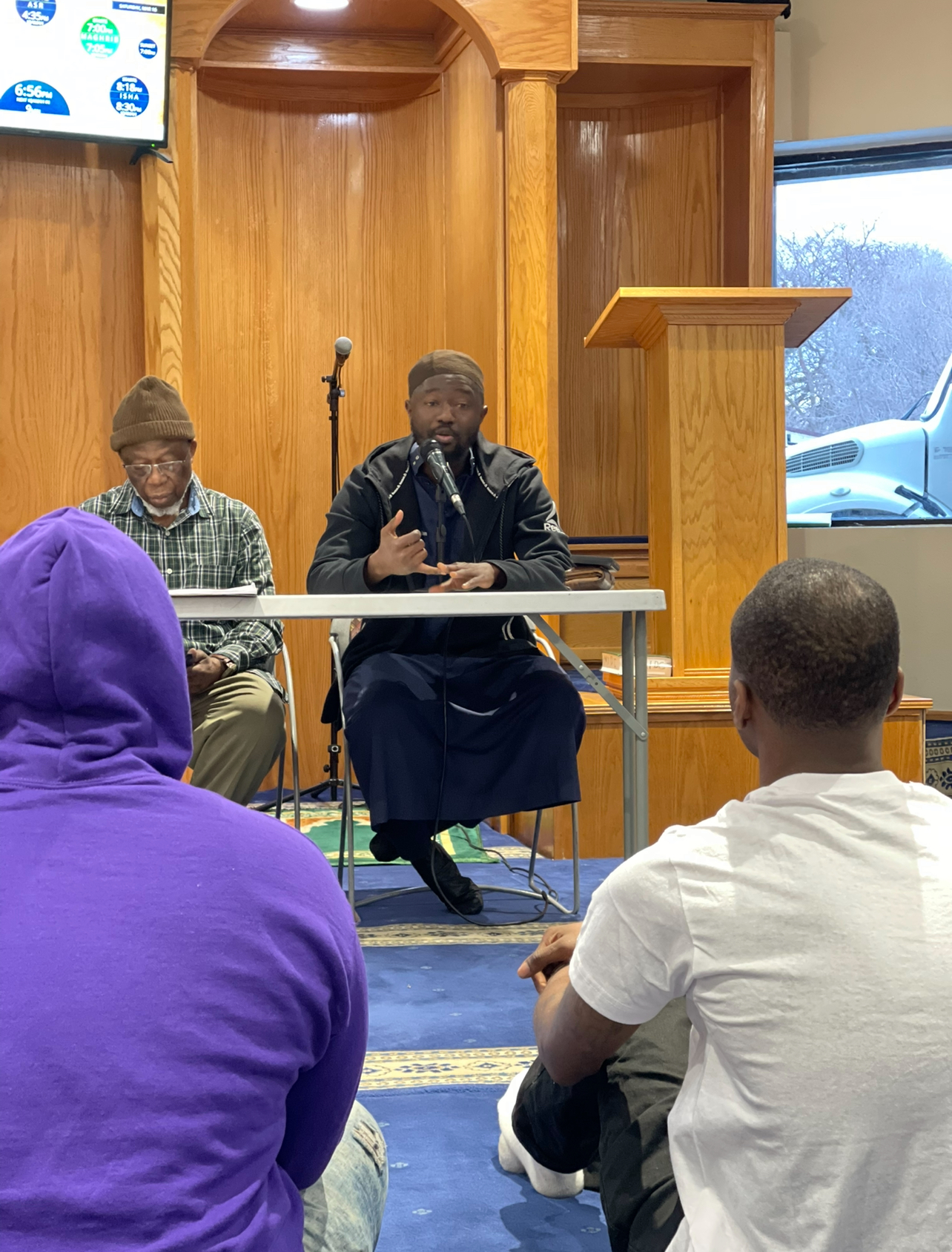
What’s the new imam like? Answers from those who know him best.
WMJ asked Camara, “Who knows you best?”
“My mother is definitely high on that list and also my cousin, who actually has the same exact name—Mohamed Camara. He’s my father’s older brother’s son. We’ve been very close throughout our teenage years into adulthood.”
Sister Hadjaa shared stories of her son’s commitment to Islam, his selflessness, caring and generosity. “When he was in high school, he stopped eating at home. He told me, ‘Mom, I don’t want to bother you. I can just eat plain white rice.’ He had started eating halal before the rest of the family did. We joined him later.
“At Brown Deer Middle School, he wanted to pray all his prayers on time. The principal gave him a room and every time it was prayer time, they would go get him. He finished high school in Brown Deer and they were always a big support.
“After he graduated, he would not take steps to go to college until he was able to read the Quran and understand it. He went to an institute in Chicago for two years. Then I couldn’t find a babysitter because the one I had always wanted to go to church and take the kids, but since they are Muslim, she didn’t want to confuse them. So, Mohamed stopped his Islamic studies to help me with the boys. He had to move back from Illinois. He continued going to school and work, paying his own tuition and expenses. He’s always managed on his own. He even went to India for four months (on a service trip) at his own expense.
“He’d give me money for my expenses every single month. I never even saw my light bill. He’d just take care of it. I don’t know how he does it. He named his first daughter Fatimah after my sister who died. He did that for me.”
His cousin Mohamed had similar stories of Camara’s faith, selflessness and devotion to family.
“I would describe him, first and foremost, as a man of faith,” Mohamed said. “As young as he is, he’s already viewed in very high regard in his community. He’s a man people trust a lot, and personally, I trust him a lot, too.
“He’s a very well-spoken person, very thoughtful, very caring and very dedicated. Once he takes something on, he dedicates his time, energy and everything he can to make sure it gets done. He doesn’t take promises lightly.”
Mohamed recalled a personal experience. “My father was diagnosed with cancer and we were in Ohio. My dad asked about him. I realized he was getting to a very urgent state so I called my cousin. He left everything he was doing, drove seven hours, and came to comfort my dad and give me a break. And he had to go back within 24 hours. I knew how expended he was.
“Not even a week later, my dad passed away. And he drove again, leaving everything. He didn’t think about how tired he was or the shift he had given up. He puts himself last and others first, starting with his own family.
“I also really admire how when he doesn’t know something, he will literally tell you he doesn’t know and that he is going to get guidance from those who know better,” Mohamed added. “That’s a sign of humility. He is not someone who thinks he knows it all. And he is willing to go find out.
“Finally, I’ll add, he is very committed to his way of life. He and I have talked about his vision of what he is trying to accomplish. Through all the conversations, it has never been about himself. It’s always been about the community.
“He spent his own personal money to travel to different places to do dawah. He spent four months in India, going to neighborhoods and villages that don’t have any sort of Islamic teaching—four months away from his family on his own dime. He used to take us to read to kids. Now those kids are in college and remember how he helped them.
“And he never complains. He just says, ‘I’m planning to do this. May Allah make it easy for me.’”
Imam Camara’s hopes
WMJ asked Imam Camara himself, “What is your main ambition, your biggest hope?”
His answer came quickly: “I want to be as much of a reflection of our Prophet Mohammad, sallallahou alayhe wasallam (peace be upon him) as I can possibly be.”
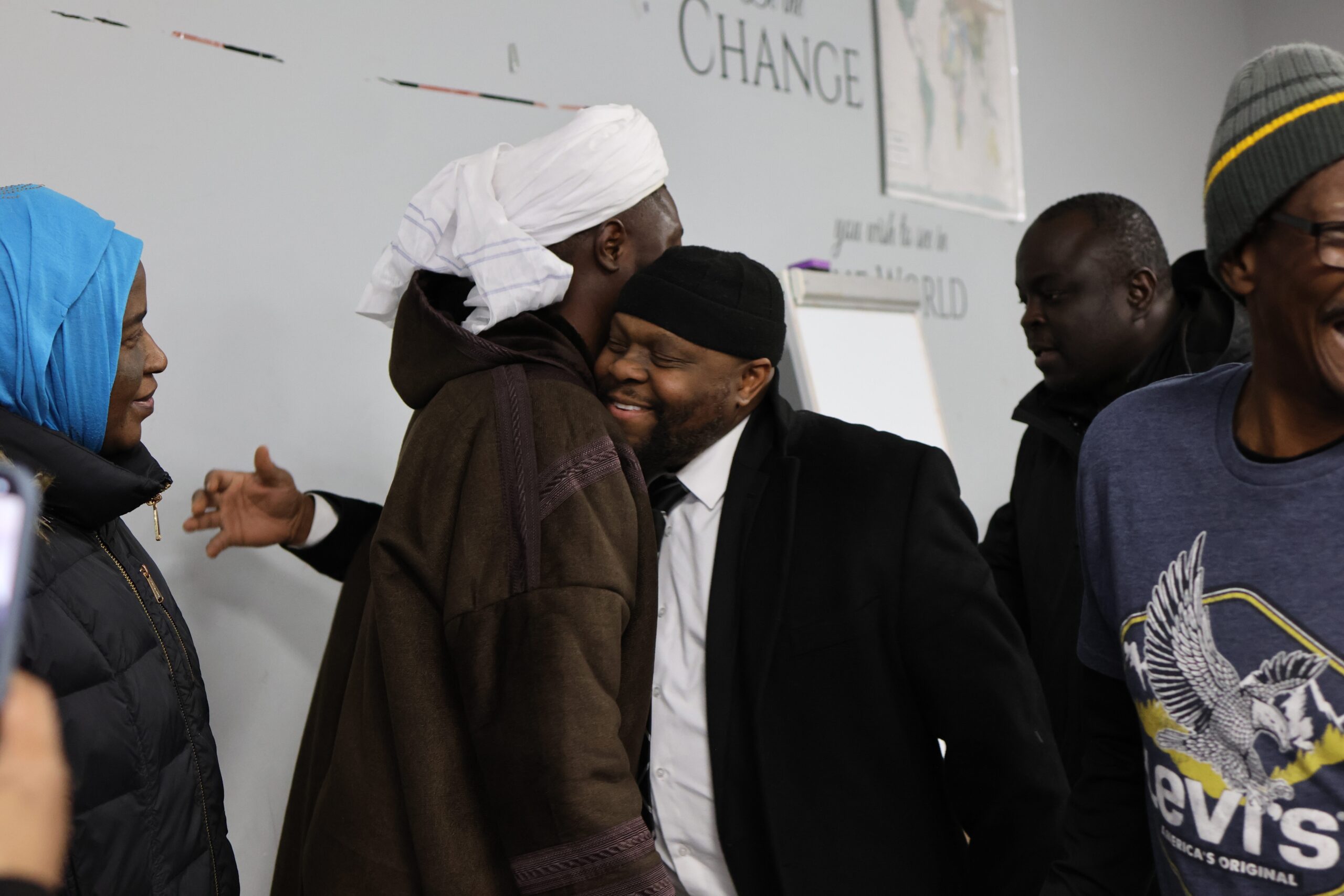
New Milwaukee Islamic Dawah Center Imam Mohamed Camara received warm hugs from a community he has known most of his life.