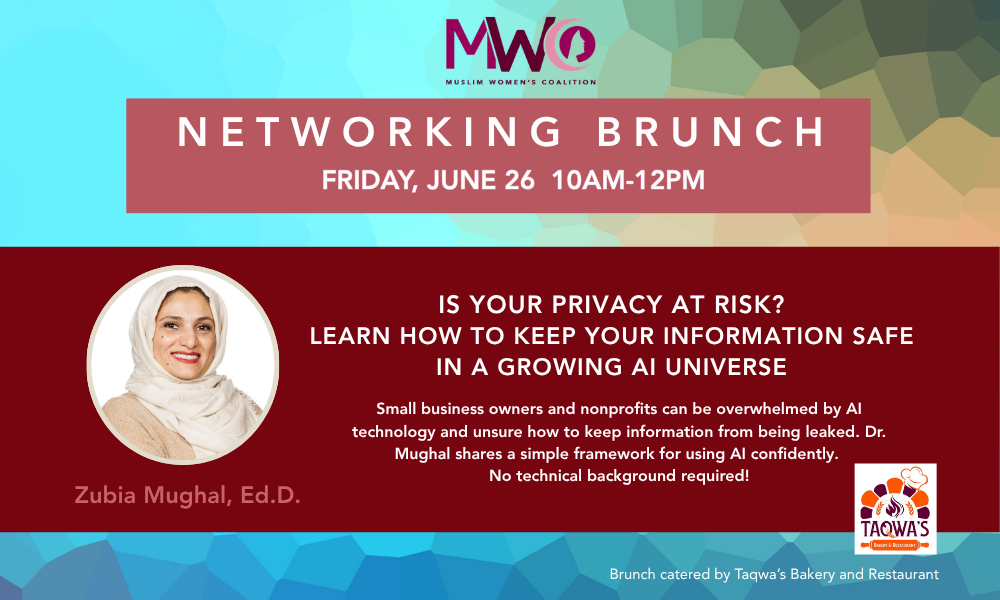
AI expert Zubia Mughal, Ed.D., will talk about how entrepreneurs, small businesses and nonprofits can use AI while keeping their private information and business secrets safe at the June 26 Muslim Women’s Coalition’s Networking Brunch.
“AI is everywhere right now, but most small business owners, entrepreneurs and nonprofits are overwhelmed by it and unsure how to keep their information from being leaked,” says Zubia Mughal, Ed.D., artificial intelligence expert and speaker at the Muslim Women’s Coalition’s June Networking Brunch.
Dr. Mughal, a Pewaukee resident, is the founder of Dr. Data Decision Intelligence, LLC, where she builds AI systems for clients and teaches business owners and organization leaders how to use AI without sacrificing privacy and control. Throughout her career, Dr. Mughal has worked at the intersection of data science, workforce development and enterprise systems architecture.
At MWC’s June Networking Brunch, she will share a simple framework for using AI confidently, providing real examples of how entrepreneurs and small businesses use AI to save time and grow revenue. Attendees need no technical background to benefit from this talk, she said.
The June MWC Networking Brunch will be held June 26, 10 a.m. – 12 p.m., at the Islamic Resource Center, 5233 S. 27th St., Greenfield. A Middle Eastern buffet from Taqwa Bakery & Restaurant will be served. Register here. A $15 payment will be taken at the door.
Bringing a discussion on AI to MWC’s Networking Brunch
MWC Networking Brunches are open to the public. The monthly event features expert speakers on a wide range of topics, attracting a diverse audience from all backgrounds.
When Dr. Mughal attended a brunch a few months ago, she asked MWC’s special projects manager and WMJ managing editor Cherrie Hanson if MWC would be interested in a presentation on AI. Hanson sent her a questionnaire that is sent to all potential speakers to evaluate their presentation for the Networking Brunch audience and found it to be a great fit, Hanson said.
“For a program manager, it’s a gift when the expert shows up to offer an exciting topic and has the potential to attract new people to the event,” she added.
“I’m a Muslim woman, a business founder and someone who builds AI systems for a living,” Dr. Mughal said. “I genuinely believe our community shouldn’t be on the sidelines of this shift.
“Speaking at an MWC event is meaningful to me personally, and I want to make sure the men, women and entrepreneurs in the room walk out feeling capable, not intimidated.”

Photos by Cherrie Hanson
The Islamic Resource Center’s event space frequently hosts speaker presentations and educational programs.
Talking AI with expert Zubia Mughal, Ed.D.
WMJ interviewed Dr. Mughal last week to preview her MWC Networking Brunch talk and learn more about her. Here are the highlights (paraphrased):
How will attendees at your talk benefit?
In my work, I create private AI solutions for small businesses. And one of the things I do is help educate people so they understand the dos and don’ts of AI. There are many quick, easy and lazy ways to do a lot of things through open AI tools such as ChatGPT, Claude and Gemini. For general uses, like finding out about a job, a company or travel destinations, these tools are fine. They give you an aggregation of things on the internet. They save time.
Trouble begins when you begin to share your expert judgment with them. For example, if you say things like, “I have a client who needs x,y,z and I’m thinking of doing this for them. What do you think about it?” or if you put entire meeting transcripts into ChatGPT or Claude. Two things will happen. First, if you have not masked personal, identifying information or any database identification number, private information is exposed and can be found. The second is that you begin brainstorming.
AI is a great brainstorming tool, but you lose more than you gain. You save time in exchange for all the brilliant ideas you provided that are now exposed.
All AI tools, even free ones, come at a price. You are paying with your expert judgment and intelligence that they use for training.
Please give us an example of how that impacts the user.
Say you work with an AI advisor or life coach or career coach, another life coach in another part of the country could benefit from your discussion. AI will summarize what you discussed. Where it took you two or three hours to come to your conclusion, when another person logs in to a life coach the next day, it’s going to go into its servers, find all the things you discussed and share what you learned. That’s how your brilliant idea becomes average, because soon everyone will find it.
How can we use AI while protecting ourselves from exposing private information?
One of the things that is possible is to have a large local language model. “Local” means you can download it on your machine and create a private AI system. That’s what I do. You can discuss your business, share your numbers – the sky’s the limit. You don’t need to hide anything. It’s like having a Word document on your own computer. That’s the safest way to share your expert judgment and do some brainstorming.
Is it expensive to have your own system?
It is definitely something a layperson can’t do on their own. But there are ways to do it. This is something I can address at the brunch.
What about the risk of AI giving bad advice?
To be honest, that issue is getting better with time. Accuracy is improving. Speed is improving. Still, we need to validate the information we are getting and verify its accuracy.
Like when you look at information on a website, we were taught how to evaluate the authenticity of the website by looking at the URL and other clues to determine whether it is even a genuine website.
Evaluating AI is no different. You should know ways to evaluate the information you are getting before you accept it. One thing you can do is to ask the same question in multiple ways and at different times. If you receive different answers, you know you can’t trust it. The key is knowing when to stop trusting it, when to draw the line.
In my experience, AI can be trusted for finding general information but not expert advice like healthcare or legal advice. You have to take those with a grain of salt.
How did you get interested in AI and decide to build your career around it?
My entire professional experience is in this field. One thing led to another.
I studied information systems technology at Northern Virginia Community College, where I got an Associate of Applied Science degree and started as an application developer, software developer and programmer. And at George Mason University, I earned a Bachelor of Science Degree in Information Technology Management. I used to teach programming classes at the community college level.
Then I decided I wanted to support instructors and professors, so I got into instructional design. I completed my Master’s Degree in Instructional Design & Curriculum Planning at Virginia Tech. As a post-grad, I earned an Education Specialist degree in E-Learning at Northcentral University, after which I started creating training interfaces. I built a lot of training programs for a lot of businesses, then got into career and technical education.

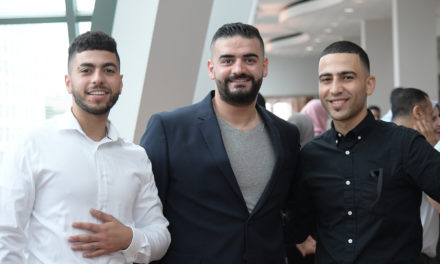
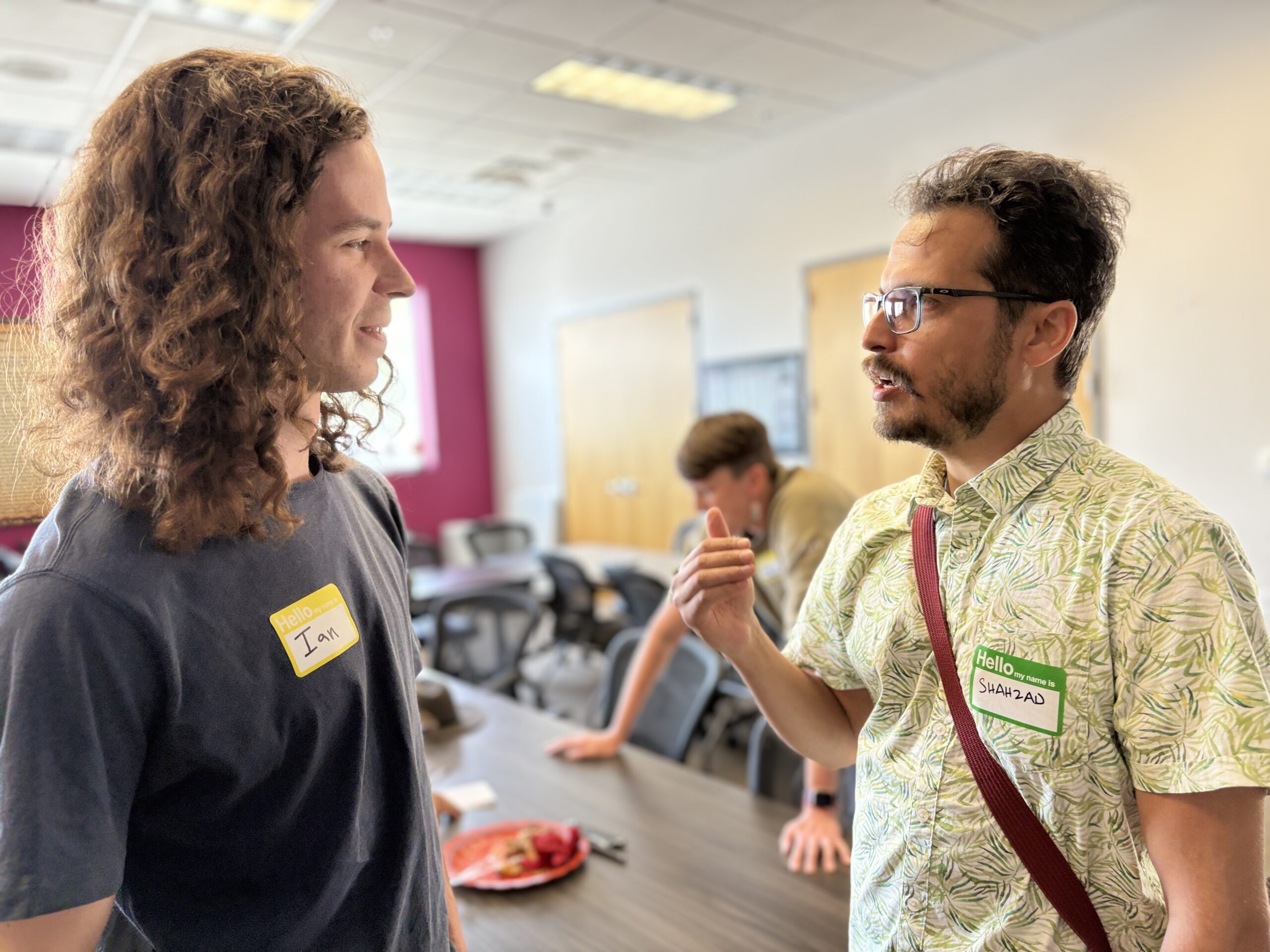
Attendees’ conversations begin before, during and after the brunch.
I got my Doctor of Education Degree in Workforce Development Leadership at the University of Wisconsin-Stout. While I was working on my doctorate, I worked with data and statistics, and I was very intrigued. It was 2020, and I taught myself how to build databases and how to relate data to multiple databases, how they’re connected, how data can be displayed, how data is hidden.
I love working with data. It is challenging. I taught myself machine learning algorithms and got a certificate from the Massachusetts Institute of Technology two years ago.
I became interested in bridging the gap between human beings and the data they need, how better interfaces present data in ways anybody should be able to understand, how to make data accessible so people can make better decisions—that’s my whole business now at a glance.
You launched your own business, Dr. Data Decision Intelligence LLC earlier this spring. Please tell us more about it and how you use AI for clients.
Sometimes I feel AI found me because it became a medium through which I can organize data to help clients make decisions. AI saves their decisions and data in databases, then it helps them walk through the data and decisions, and helps people talk to them. The gap between data and people is closed by large language models that can be used locally and privately. Building those systems where anybody can talk to their own data is what my business is all about.
I’m in my third month and on my fifth project. I’m getting lots of requests. AI is a new thing and people are still dabbling into it. But it is here to stay, that’s for sure.
What will you focus on at the MWC Networking Brunch?
I will talk about how to use publicly available free and subscription-based tools safely. We’ll look at what is safe, what is dangerous, what keeps them safe online and how to keep their expertise and business secrets safe.